How to Focus Better: 9 Techniques That Work (2026)
Focus is not a personality trait. It's a trainable skill, and the research is pretty clear about which inputs move it the most. If you want to know how to focus better, the short answer is: protect your attention, sleep enough, meditate briefly, and get your phone out of the room. The long answer — ranked by how much each technique actually helps — is below.
TL;DR — 9 techniques ranked by effect size
Here are the nine techniques in this guide, ranked by how much they move the needle on focus in published research:
- Sleep 7–9 hours — biggest single lever (Walker, 2017).
- Single-task (don't media-multitask) — heavy multitaskers do worse on attention tests (Ophir et al., 2009).
- 10 minutes of daily mindfulness — measurable focus gains in 2 weeks (Mrazek et al., 2013).
- Phone in another room — having a phone nearby reduces working memory (Ward et al., 2017).
- 90-minute work blocks — ultradian rhythm, not 4 hours straight.
- Nature breaks — Attention Restoration Theory (Kaplan, 1995; Berman et al., 2008).
- Implementation intentions for distractions — pre-decide what you'll do when X happens.
- Cognitive offloading — write down distractions instead of acting on them.
- Caffeine timing — 90–120 minutes after waking, not the moment you open your eyes.
Pick three, run them for two weeks, then add more.
What "focus" actually is
When people say "I can't focus," they usually mean three different things. Pulling them apart matters because the fix is different for each.
Directed attention is the effortful kind of focus you use to read a contract or debug code. It's tiring. Rachel and Stephen Kaplan, the environmental psychologists who coined Attention Restoration Theory in 1995, argued that this is the type of attention that fatigues throughout the day.
Concentration is sustained attention on one task without your mind wandering. This is what mindfulness training targets directly.
Flow is a different beast. Mihaly Csikszentmihalyi's Flow (1990) described it as full absorption in a task whose challenge matches your skill. Flow feels effortless, but it requires the same underlying attention machinery you've been training.
Most "how to focus better" advice mashes the three together. The techniques below specify which they help.
How to focus better: the 9 techniques, in order
1. Sleep 7–9 hours (the biggest lever)
Nothing on this list beats sleep. Matthew Walker, neuroscientist and author of Why We Sleep (2017), summarizes decades of research showing that even modest sleep loss degrades attention, working memory, and reaction time the next day. Cut sleep from 8 hours to 6 for ten nights, and your performance is comparable to a person who hasn't slept at all for 24 hours.
The most useful intervention is regularity, not just duration. Same bedtime, same wake time, including weekends. If you only do one thing on this list, fix sleep first. (Our sleep hygiene checklist walks through the 12 daily habits that move the needle.)
Helps: all three (directed attention, concentration, flow).
Effort: medium (it's behavioral, not effortful in the moment).
Time to results: one good night helps; lasting effects in 1–2 weeks.
2. Single-task — don't media-multitask
A widely cited Stanford study by Eyal Ophir and colleagues (PNAS, 2009; PubMed 19706386) found that people who heavily switch between media (TV, texts, browser tabs, music) performed worse on tests of attention control, task switching, and memory than light multitaskers. The kicker: the heavy multitaskers thought they were better at it.
In practice, "single-tasking" means: one screen, one tab, one task, until you stop or take a real break. Email is closed. Slack is closed. Phone notifications off.
Helps: directed attention, concentration.
Effort: low to medium (mostly tab discipline).
Time to results: noticeable in 1 day.
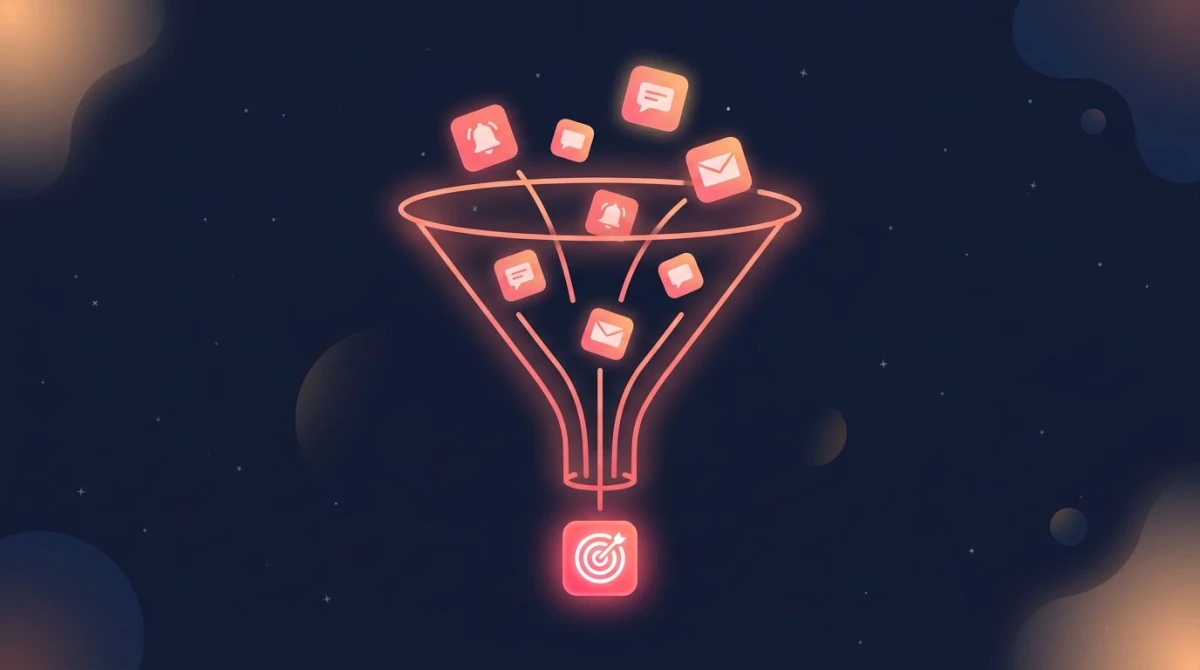
Focus is mostly subtraction: remove the inputs competing for attention and one clear target remains.
3. 10 minutes of daily mindfulness
A 2013 study by Michael Mrazek and colleagues at UC Santa Barbara (PubMed 23538911) trained 48 undergrads with a two-week mindfulness program (10–20 minutes a day). Working memory and GRE reading-comprehension scores improved measurably. Mind-wandering — the thing that breaks focus — dropped.
You don't need to chase enlightenment. Ten minutes a day of guided breath-awareness practice will do. The APA's overview of meditation research summarizes the broader case. If you've never done it before, our meditation practice guide lays out a no-pressure 14-day plan.
Helps: concentration, directed attention.
Effort: low (10 min/day).
Time to results: measurable in 2 weeks.
4. Put your phone in another room
A 2017 study by Adrian Ward and colleagues (University of Texas at Austin) — known popularly as the "brain drain" paper — found that the mere presence of a smartphone, even powered off and face-down, measurably reduced people's available cognitive capacity. Participants who left phones in another room outperformed those who had phones on the desk.
The fix is brutally simple. Phone goes in another room (or in a drawer, far away) for your focus block. You're not banning your phone forever — you're banning it during the two hours that matter. The screen-time tracker guide covers how to make this stick.
Helps: directed attention, concentration.
Effort: low.
Time to results: immediate.
For a deeper, neuroscience-grounded tour of these levers, Andrew Huberman's focus toolkit pulls many of them together in one place:
5. 90-minute work blocks (ultradian rhythm)
The body runs on roughly 90-minute cycles of alertness — a finding originally described by sleep researcher Nathaniel Kleitman in the 1960s and extended into wake behavior by Ernest Rossi. You can sustain high focus for about 90 minutes; after that, cognitive performance drops sharply unless you rest.
So: 90 minutes of focused work, then 15–20 minutes of real break (walk, stretch, eat — not scroll). Two to three of these blocks a day will out-produce a 6-hour grind.
Helps: concentration, flow.
Effort: medium (requires schedule control).
Time to results: same day.
6. Take nature breaks (attention restoration)
In a 2008 University of Michigan study by Marc Berman and colleagues (PubMed 19121124), people who walked in a park for an hour performed better on attention tests than people who walked the same distance through busy city streets. The mechanism, per Attention Restoration Theory: nature engages "soft fascination," which lets the directed-attention system recover.
You don't need a forest. A tree-lined block, a small park, a window with a view of greenery will do. The point is to stop demanding active attention and let it refill.
Helps: directed attention.
Effort: low.
Time to results: within one walk.
7. Use implementation intentions for distractions
An implementation intention is an "if X, then Y" plan you write before the moment of distraction arrives. Psychologist Peter Gollwitzer's research has shown they roughly double follow-through on intended behavior.
For focus, examples look like:
- If I feel the urge to check email, then I will write down the trigger and continue.
- If my phone buzzes, then I will turn it face-down without looking.
- If a new task pops into my head, then I will add it to a paper list, not Slack.
The trick is pre-committing the response so you don't have to decide in the moment. Decisions in the moment are where focus dies.
Helps: directed attention, concentration.
Effort: low.
Time to results: immediate.
8. Cognitive offloading — write down distractions
This is the focus-friendly cousin of David Allen's Getting Things Done (2001). When a thought interrupts — "I forgot to email Sarah," "what's for dinner," "I should book that appointment" — write it on a paper pad next to you. Then return to the task.
The trick is that the brain only nags you about open loops until it trusts they're captured. Once written down, the loop quiets. Research on "Zeigarnik effects" (Bluma Zeigarnik, 1927) supports this: unfinished tasks intrude on attention, and capturing them on paper releases the intrusion.
Helps: concentration.
Effort: low.
Time to results: same day.
9. Time your caffeine
Cortisol — your natural wake-up hormone — peaks 30–60 minutes after you open your eyes. Drinking coffee on top of that peak gives you less effect from the caffeine and a steeper crash later. A more useful pattern: wait 90–120 minutes after waking, then drink your first cup. Avoid caffeine after about 2 p.m. — half-life is around 5 hours and it will hit your sleep, which (see #1) is the biggest focus lever you have.
Helps: directed attention.
Effort: low.
Time to results: 1–2 days.
Comparison table
| # | Technique | Evidence base | Effort | Time to results |
|---|---|---|---|---|
| 1 | Sleep 7–9 hours | Strong (Walker, 2017) | Medium | 1–14 days |
| 2 | Single-task | Strong (Ophir, 2009) | Low | 1 day |
| 3 | 10-min daily mindfulness | Strong (Mrazek, 2013) | Low | 2 weeks |
| 4 | Phone in another room | Strong (Ward, 2017) | Low | Immediate |
| 5 | 90-minute work blocks | Moderate (ultradian theory) | Medium | Same day |
| 6 | Nature breaks | Moderate (Berman, 2008) | Low | One walk |
| 7 | Implementation intentions | Strong (Gollwitzer) | Low | Immediate |
| 8 | Cognitive offloading | Moderate (Zeigarnik) | Low | Same day |
| 9 | Caffeine timing | Moderate (cortisol research) | Low | 1–2 days |
The 4-habit focus stack
You don't need all nine techniques on day one. Pick four daily habits that compound focus, and track them. Most people see real change in two to four weeks.
| Habit | Daily action | Why it matters |
|---|---|---|
| Sleep window | In bed by [target time] | Biggest lever, slowest to feel |
| Morning meditation | 10 min after coffee | Trains the muscle directly |
| Phone-free block | One 90-min session, phone elsewhere | Removes the largest distraction |
| Daily nature break | 15-min walk outside | Refills directed attention |
This is a habit stack — small habits anchored to existing routines so you don't have to remember them. If you want to mark each one off daily and see your streak, HabitBox does exactly this on iOS and Android, with custom icons and a calendar heatmap. No account, no social feed, no AI coach — just the boxes you check.
What about Pomodoro?
The Pomodoro Technique (Francesco Cirillo, late 1980s) — 25 minutes of work, 5-minute break — works for some people and fails for others. Here's the honest take.
When Pomodoro works: for tasks you don't want to start. The 25-minute commitment is small enough to overcome inertia. Good for grading papers, doing taxes, churning through admin.
When Pomodoro fails: for deep work that needs warmup. Coding, writing, design work often hit a stride around minute 30. A 25-minute timer interrupts that just as it's starting. For these, 90-minute blocks (see #5) work better.
Pomodoro is a starter technique. Many people graduate out of it once they can sustain longer blocks. Both are fine. Use what fits the work.
How long does it take to improve focus?
Realistic timeline:
- Day 1: sleep more, phone out of room, single-task. You feel it.
- Week 1: add a 10-minute meditation habit. It won't feel like much yet.
- Week 2: Mrazek's mindfulness gains kick in. Less mind-wandering, easier returns to task.
- Week 4: sleep regularity compounds. You notice you can stay on a hard task longer.
- Month 3: focus feels like a default state, not an effort. This is where most people stop tracking and the habits become invisible (in a good way).
That's not a slick promise. It's roughly what the studies cited above show on average. Some people see effects faster; some need more time.
Why you can't focus right now
Common culprits, ranked by how often they're the real cause:
- You're under-slept. Almost always part of it.
- You're checking your phone every 4 minutes. Average US screen time is around 4–5 hours a day, mostly on social apps engineered for re-entry.
- You're trying to do five things at once. "Five tabs of work" is media multitasking.
- You're under-caffeinated or over-caffeinated. Both kill focus.
- You're hungry or dehydrated. Easy to fix.
- The task is wrong-sized. Too vague ("work on report") or too big ("finish report"). Break it down.
- You're stressed or anxious about something else. Cognitive offloading (#8) helps; sometimes you need to handle the thing first.
If after a week of basic fixes you still can't focus on simple work, and especially if this has been lifelong, it may be worth talking to a doctor — adult ADHD is widely under-diagnosed.
FAQ
How can I improve my focus quickly?
Why can't I focus?
What's the best focus technique for ADHD?
Does meditation actually improve focus?
Does Pomodoro really work?
Where to start
If you read this and remember only one thing: phone in another room, sleep eight hours, single-task. Three changes, no apps required. After two weeks, add 10 minutes of meditation. After a month, look at your work blocks.
Track those four daily so you can see whether you're actually doing them — most people overestimate how often they single-task. If you'd rather not build a tracker from scratch, habit tracker apps like HabitBox handle the streak math for you. The goal isn't more apps. The goal is fewer interruptions and clearer days.
Pick three from the list. Run them for two weeks. Adjust.

Mira Hartwell
Editor, HabitBoxEditor at HabitBox. Writes about habit science and productivity, grounding every post in named research (Lally, Wood, Walker, Huberman) instead of recycled advice. Read full bio →