Getting Things Done: The GTD Method Explained (2026)
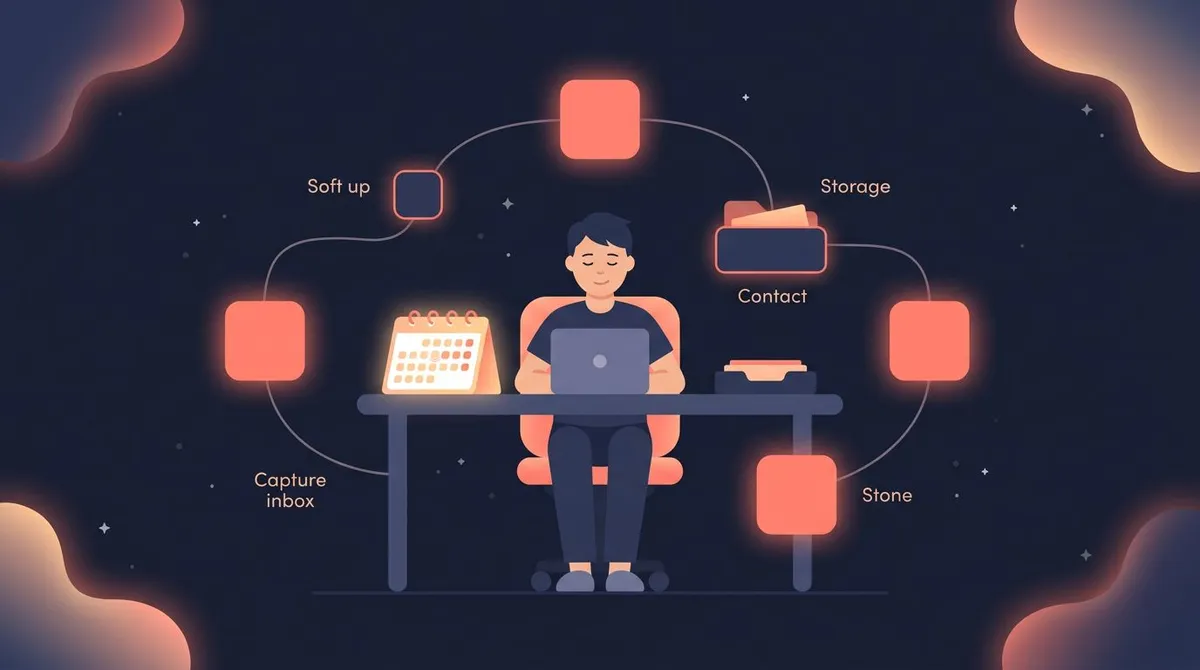
Getting Things Done (GTD) is David Allen's system for moving every task, idea and promise out of your head and into lists you trust. It runs on five steps: capture, clarify, organize, reflect and engage. You don't need a special app. You need a few lists, a clear rule for each item, and a weekly review that keeps it all current.
TL;DR: Capture everything that has your attention in one inbox. Clarify each item by asking "is it actionable?" and naming the next physical step. Organize the results onto a small set of lists: next actions, projects, waiting for, calendar, someday/maybe and reference. Reflect by reviewing those lists every week. Engage by picking a task based on where you are, your time and energy, and what matters most.
What is Getting Things Done?
Getting Things Done is a personal productivity method from consultant David Allen, first published as a book in 2001. A revised edition came out in 2015 to reflect a decade of new technology. The method is tool-neutral. It works on paper, in a notes app, or in a task manager.
Allen's core claim is simple: your brain is a poor filing cabinet. When you try to hold promises in your head, they become "open loops" that nag you at the wrong moments. You remember the batteries in the shower, not at the store. GTD closes those loops by moving each one into an outside system and deciding what it means.
Allen calls the ideal state "mind like water": calm, responsive, then settled again.
The 5 steps of GTD
The official GTD site lists five steps. Older summaries based on the 2001 edition use different names for some of them, such as "collect" and "process," but the flow is the same.
| Step | The question it answers | What you do |
|---|---|---|
| 1. Capture | What has my attention? | Write it down in an inbox |
| 2. Clarify | What is this, and can I act on it? | Name the next action, or bin it |
| 3. Organize | Where does it belong? | Put the reminder on the right list |
| 4. Reflect | Is my system still current? | Review lists often, and weekly in depth |
| 5. Engage | What should I do right now? | Pick a task and do it |
1. Capture: get it out of your head
Capture means writing down anything that has your attention, big or small. "Plan Q4 budget," "fix the squeaky door" and "gift idea for Dad" all go in the same place. Don't sort yet.
Use as few inboxes as you can live with. A good starting set is one capture list on your phone, one paper tray or notebook, and your email. Every extra inbox is one more place for things to rot.
Start with a mind sweep: list every open loop you can think of, at work and at home. Most people are surprised by how long the list gets. That's everything your brain was trying to track alone.
2. Clarify: decide what each item means
Clarify is where GTD earns its keep. Take one item at a time, from the top of the inbox, and ask: is it actionable?
If the answer is no, it goes to one of three places:
- Trash if you don't need it.
- Reference if it's useful information, like a manual or a receipt.
- Someday/maybe if it's an idea you might act on later.
If the answer is yes, name the next physical action. "Taxes" is not an action. "Find last year's tax return in the filing box" is. Then apply three quick rules:
- If the action takes less than two minutes, do it now. This is the famous 2-minute rule, and our free 2-minute rule timer keeps you honest about the clock.
- If someone else should do it, delegate it and note it on your waiting-for list.
- Otherwise, defer it. Put it on your calendar if it has a fixed date, or on a next-actions list if it doesn't.
If the outcome needs more than one action, it's also a project. Add it to your projects list so the bigger result stays visible.
3. Organize: put reminders where they belong
Organize means parking each clarified item on the right list. The lists are simple, but each one has a strict job.
The calendar gets special treatment. Only put things there that must happen on a specific day or at a specific time: appointments, deadlines and day-specific tasks. If your calendar fills with "would be nice today" items, you'll stop trusting it.
4. Reflect: review so you keep trusting the system
A list you don't review becomes a list you don't believe. Reflect means checking your calendar and next actions as often as you need to, plus a deeper weekly review.
The weekly review has three parts. Get clear by emptying every inbox. Get current by updating your projects, waiting-for list and calendar. Get creative by looking over someday/maybe for anything worth starting. Our weekly review guide has an 8-question script if you want a ready-made version.
Allen also describes six "horizons of focus" for zooming out, from current actions and projects up to long-term vision and life purpose. You don't need them on day one.
5. Engage: choose what to do next
Engage is the doing part. With a list you trust, Allen suggests choosing your next task with four filters, in this order:
- Context: where are you, and what tools do you have? You can't make calls on a train with no signal.
- Time available: a 15-minute gap before a meeting calls for a short task.
- Energy available: save hard thinking for sharp hours and do admin when you're tired.
- Priority: of what's left, what matters most?
The GTD lists you actually need
Here is the full set for a working system. Seven lists sounds like a lot, but most take seconds to check.
| List | What goes on it | Example |
|---|---|---|
| Inbox | Anything captured but not yet clarified | "Something about the lease?" |
| Next actions | Single visible steps, grouped by context | "@calls Book dentist cleaning" |
| Projects | Any outcome that needs more than one action | "Renew apartment lease" |
| Waiting for | Things you delegated or expect from others | "Sam: final slides (asked Mon)" |
| Calendar | Only time-specific or day-specific items | "Thu 3 pm: sign lease" |
| Someday/maybe | Ideas you haven't committed to | "Learn Spanish" |
| Reference | Useful information with no action | "Lease PDF, landlord's number" |
Paper fans often add a tickler file: 43 folders, 12 for the months and 31 for the days, that hold reminders until the day they matter. In an app, a start date or scheduled reminder does the same job.
Contexts: filter your next actions
A context is the place, tool or person a task needs. Allen's classic examples include calls, computer, errands, office, home and agendas for specific people, often written with an @ sign. When you're out running errands, you only see errands.
If you work almost entirely at a laptop, place-based contexts may not help much. A common tweak is to use energy or time tags instead, like "deep focus" or "15 min." Keep it to three to five contexts.
A worked example: clarifying six inbox items
Here's what clarify looks like on a normal Monday. Each item takes a few seconds once the questions become second nature.
| Inbox item | Actionable? | Decision | Where it goes |
|---|---|---|---|
| Meeting invite that needs a yes | Yes, under 2 minutes | Reply now | Done |
| Email from landlord about renewal | Yes, several steps | Project plus a next action | Projects: "Renew lease." Next actions: "@computer Ask landlord for new rate" |
| Need the final slides from Sam | Yes, but Sam does it | Send a one-line request now | Waiting for |
| Dentist appointment card | Yes, fixed date | Schedule it | Calendar |
| Idea: take a pottery class | Not yet | Park it | Someday/maybe |
| Laptop warranty receipt | No | Keep it | Reference |
The inbox is now empty, and nothing from it is sitting in your head.
A minimal GTD setup in any app
You can build a working setup in one sitting:
- Pick one digital inbox. Choose the capture tool you can open fastest on your phone. Speed matters more than features.
- Create five lists: next actions, projects, waiting for, someday/maybe and reference. With your inbox and calendar, that makes seven.
- Add three to five context tags. Start with something like @calls, @computer, @errands and @home.
- Do a mind sweep. Dump every open loop into the inbox. Set a timer so it doesn't sprawl.
- Clarify to zero. Work through the inbox from top to bottom with the questions above.
- Book a weekly review. Add a recurring 30-to-60-minute event to your calendar and treat it like a meeting.
Here's how those pieces map onto common tools:
| Tool | Lists | Contexts | Time-specific items |
|---|---|---|---|
| Paper notebook | One section per list | Separate next-action pages | Paper or wall calendar |
| Apple Reminders | One list per GTD list | Tags | Apple Calendar |
| Todoist | A project per list | Labels and filters | Due dates or a connected calendar |
| Notion | One database with a "list" property | A multi-select property | A calendar view |
Resist building more than this in week one. Simple systems get used.
Why GTD works (and what the research can't tell you)
The best evidence behind GTD comes from studies of its parts, not of the whole system.
Making a plan quiets unfinished goals. In a 2011 set of experiments, psychologists E.J. Masicampo and Roy Baumeister found that unfinished goals caused intrusive thoughts and hurt performance on unrelated tasks. Letting people make a specific plan for those goals removed those effects. That's the clarify step in a nutshell: you don't have to finish a task to stop it nagging you. You have to decide what happens next.
A specific to-do list can help you fall asleep. In a 2018 sleep-lab study led by Baylor University researchers, 57 young adults wrote for five minutes before bed. Those who wrote a to-do list for the next few days fell asleep faster than those who wrote about tasks they had already finished. The more specific the list, the faster they fell asleep.
Outside memory fits how the brain works. A 2008 paper by Francis Heylighen and Clément Vidal argued that cognitive science, including the limits of working memory, supports GTD's design. The authors also noted that no empirical studies had yet confirmed GTD's claims.
The honest summary: capturing tasks and making specific plans have decent support. GTD as a complete system rests mostly on theory and user reports. We couldn't find a controlled trial that tests the full method.
Why most people quit GTD (and how to avoid it)
GTD has a reputation for being adopted with excitement and dropped a few months later. The failures tend to follow the same patterns.
Building the system instead of using it. It's easy to spend weekends tweaking tags, templates and apps. Merlin Mann, whose 43 Folders blog helped make GTD famous, later worried that list-making had become an end in itself, as Cal Newport recounts in a 2020 New Yorker essay. The fix: freeze your setup for a month before changing anything.
Skipping the weekly review. This is the big one. Without a review, lists go stale, you stop trusting them, and your brain starts tracking everything again. The fix: book the review for the same time every week and track whether it happened. HabitBox won't hold your GTD lists, but it's built for this part: a one-tap check-in for the recurring habit that keeps those lists alive.
Vague next actions. "Mom's birthday" sits on a list for weeks because it doesn't say what to do. "Order flowers online for Mom" gets done. If an action doesn't start with a verb you can picture, rewrite it.
Too many inboxes and contexts. Five capture apps and twelve tags create more work than they save. Cut back until the system feels light.
Expecting GTD to set your priorities. GTD is great at making sure nothing slips. It says less about which task deserves your best hours. Pair it with a daily method like Eat the Frog or the Ivy Lee method to pick your top tasks.
Blaming yourself for an overloaded job. Newport's essay makes a fair point: personal systems help individuals cope, but they don't fix how work gets handed out across a team.
GTD vs other productivity methods
GTD is a capture-and-organize system. Most other popular methods decide what to do today, which is why they combine well.
| Method | Main job | Time horizon | How it pairs with GTD |
|---|---|---|---|
| Getting Things Done | Capture and organize every commitment | All horizons | The base layer |
| Time blocking | Assign tasks to calendar slots | One day | Gives next actions a set time |
| Timeboxing | Cap how long a task gets | One task | Stops project work from sprawling |
| Eat the Frog | Do the hardest task first | One day | Picks which next action goes first |
| Ivy Lee method | Rank six tasks for tomorrow | One day | Chooses six items from next actions |
A simple stack that works for many people: GTD to hold everything, a time-blocked calendar to protect focus, and a timebox for tasks that tend to sprawl. For a wider comparison of daily methods, see how to plan your day.
Make the weekly review a habit
GTD rarely fails on one bad day. It fails slowly, as the weekly review slips from "every Friday" to "when I get around to it." So treat the review as a habit with a fixed trigger.
Pick a slot, like Friday at 3 p.m., and keep a short checklist so starting is easy. Pair it with an end-of-day shutdown ritual so each workday closes with an empty inbox. Then track two things: did the review happen, and did you clear your inbox today?
Your lists hold the tasks. The habit keeps the lists honest. Download HabitBox on iOS and Android — one-tap check-ins for your weekly review and inbox zero, with a streak you won't want to break. Free to start, with an optional Plus upgrade, and no account needed.
FAQ
What are the 5 steps of GTD?
What is the two-minute rule in GTD?
Is GTD still relevant in 2026?
Is the 3-3-3 rule part of Getting Things Done?
What is the best app for Getting Things Done?

Mira Hartwell
Editor, HabitBoxEditor at HabitBox. Writes about habit science and productivity, grounding every post in named research (Lally, Wood, Walker, Huberman) instead of recycled advice. Read full bio →