Habit Stacking: A Science-Backed Guide (2026)
TL;DR. Habit stacking is a behavior-design tactic where you attach a new habit to one you already do. The formula is simple: "After CURRENT HABIT], I will [NEW HABIT]." The method was framed by BJ Fogg's Tiny Habits research at Stanford and named by James Clear in Atomic Habits (2018). It works because your brain already runs the cue for the old habit, so the new one borrows the trigger. Most stacks take 18 to 254 days to feel automatic, with a median of 66 days ([Lally et al., UCL).
If you've tried to start meditation, journaling, or stretching and it never stuck, the issue is rarely willpower. It's usually a missing cue. Habit stacking gives you one for free.
This guide covers what habit stacking is, why it works in the brain, the exact formula, fifteen real examples, a comparison with related techniques, the troubleshooting most articles skip, and ready-to-copy templates.
What habit stacking is
Habit stacking is the practice of pairing a new behavior with a current, automatic one — so the old habit acts as the cue for the new one. You don't add a new alarm or reminder. You let an existing routine do that work.
The technique has two parents in habit science:
- BJ Fogg, founder of the Stanford Behavior Design Lab, formalized "anchor habits" in his Tiny Habits method. His recipe is "After I ANCHOR], I will [NEW BEHAVIOR]," followed by a brief celebration. Fogg has been teaching the model since 2011 and published the book [Tiny Habits in 2019.
- James Clear named the move "habit stacking" in his 2018 book Atomic Habits. He framed it as a special case of implementation intentions, with a stronger anchor — the previous habit — instead of a time or place.
So Fogg gave us the mechanic; Clear gave us the label most readers know today. Both authors stress the same point: the anchor must be specific and reliable. "After lunch" is not specific. "After I put my plate in the sink" is.
Why habit stacking works: the neuroscience
Three layers of brain science explain why an old habit makes a strong cue.
1. Synaptic pruning has already done the wiring. Your brain treats neural pathways like trails in a forest. Trails you walk often get wider; trails you ignore get pruned. By adulthood, your daily routines (brewing coffee, brushing teeth, locking the door) live on the widest trails. When you attach a new behavior to one of these, it rides the same well-worn path instead of trying to cut a new one through underbrush.
2. The cue–routine–reward loop is already firing. Charles Duhigg's The Power of Habit (2012) describes habits as a three-part loop: a cue triggers a routine, which delivers a reward. The brain already runs this loop for your existing habit. By inserting a tiny new behavior right after the cue fires, you piggyback on a loop your brain already wants to complete.
3. Context-dependent memory makes recall automatic. Wendy Wood's research at USC shows that about 43% of daily behavior is repeated in the same context. When you reuse a stable context (the kitchen counter, the bathroom mirror, the desk chair), recall happens without conscious thought. The current habit is your reliable context.

The takeaway: habit stacking is not a trick. It's a way to use brain hardware that's already built for it.
The habit stacking formula
The formula has three parts and one rule.
Formula: After [CURRENT HABIT], I will [NEW HABIT].
Rule: the current habit must be specific, daily, and reliable.
A vague anchor breaks the stack. "After I get to work" can mean five different actions. "After I sit down at my desk and open my laptop" is one moment, every day. The new habit needs the same precision: "move more at work" is a wish, while taking the stairs when you arrive at work is an action you either did or didn't.
Here are three worked examples:
| Anchor (current habit) | New habit (the stack) | Why it works |
|---|---|---|
| After I pour my morning coffee | I will write three lines in my journal | Coffee cue is daily, fixed, takes the same 90 seconds every time |
| After I take off my work shoes | I will change into workout clothes | The action is bodily and unmistakable; sets up exercise without negotiation |
| After I plug my phone in to charge at night | I will read one page of a book | The phone-on-charger cue is already nightly; reading replaces the doomscroll |
The new habit should take less than two minutes when you start. Once it's automatic, you can extend it. James Clear calls this the "two-minute rule" — the smaller the entry, the lower the activation cost.
15+ habit stacking examples by anchor type
Most articles give five examples and stop. Here are sixteen, organized by when you'd use them — so you can scan to your slot in the day.
Morning anchors
- After I turn off my alarm, I will drink the glass of water on my nightstand.
- After I pour my coffee, I will list the three things I want to finish today.
- After I brush my teeth, I will do ten squats.
- After I sit down with breakfast, I will write one sentence in a gratitude journal.
Work anchors
- After I open my laptop, I will close all tabs from yesterday.
- After I send my first email of the day, I will fill my water bottle.
- After I finish a meeting, I will stand up and stretch for one minute.
- After I come back from lunch, I will plan the top task for the afternoon.
Evening anchors
- After I put my work laptop in its bag, I will change out of work clothes.
- After I wash the dinner dishes, I will go for a five-minute walk.
- After I sit on the couch, I will spend two minutes tidying the surface in front of me.
- After I plug in my phone for the night, I will read one page of a book.
Weekend anchors
- After I make Saturday breakfast, I will check my budget for the week.
- After I finish my weekly grocery run, I will prep one batch of food for Monday.
- After I get back from a Sunday walk, I will write the one thing I want to remember from the week.
- After I pour Sunday-evening tea, I will look at the calendar for the week ahead.
Pro tip: don't try all sixteen. Pick one anchor, one new habit, and run it for two weeks. Add the next stack only after the first feels automatic.
Habit stacking vs implementation intentions vs temptation bundling vs environment design
These four techniques get blurred together online. They share a goal — making the right behavior easier — but the mechanic differs.
| Technique | What it pairs | Best for | Watch out for |
|---|---|---|---|
| Habit stacking | A new habit + an existing habit | Building a daily routine on top of stable cues | Anchor habit must already be reliable |
| Implementation intentions | A new habit + a specific time and place | One-off goals or weekly behaviors (e.g., gym on Monday at 6 pm) | Time-based cues drift when schedules shift |
| Temptation bundling | A wanted-but-hard habit + a fun behavior you already love | Motivation-poor habits (treadmill while watching a show) | The reward can swallow the habit if the bundle is too pleasurable |
| Environment design | A behavior + a physical context shift | Cutting friction (running shoes by the door) or adding it (phone in another room) | One-time setup, not a recurring cue |
You can stack these techniques, too. Putting your meditation cushion next to the coffee maker (environment design) makes "After I pour my coffee, I will sit on the cushion for two minutes" (habit stacking) far more likely to fire.
How long until a stack becomes automatic
The most-cited number in habit research comes from a 2010 study at University College London. Phillippa Lally and colleagues followed 96 adults trying to form simple daily habits like drinking water with lunch or walking after dinner. The team published their findings in the European Journal of Social Psychology, and they're freely indexed at PubMed.
What they found:
- Median time to automaticity: 66 days.
- Range: 18 to 254 days, depending on the habit and the person.
- Missing one day did not measurably hurt the habit.
- Missing several in a row did slow progress.
This range matters more than the average. A daily glass of water might feel automatic in three weeks. A daily 20-minute run might still feel hard at four months. Both are normal.
Cleveland Clinic psychologist Dr. Lauren Alexander puts the same range in a different frame: "It can take anywhere from 18 to 200 days for a new habit to set in." She also pushes back on the popular framing of habit stacking as effortless. It isn't. It's just less effortful than building a cue from scratch.
A practical guideline: give a new stack at least eight weeks before you decide it isn't working. That covers the 66-day median with room to spare.
5 common habit stacking mistakes
Most failures trace back to one of these five issues. The fix is usually a small change to the anchor or the new habit, not a complete restart.
1. The anchor is too vague
"After breakfast" is not an anchor. Breakfast is a window, not a moment. Pick a single observable action inside that window — "After I rinse my breakfast plate" — and the cue lands every time.
2. The new habit is too big
If your stack is "After I pour my coffee, I will work out for 30 minutes," the friction is too high for the morning brain. Start with two minutes. "After I pour my coffee, I will do five push-ups." Once the chain holds for two weeks, expand the back end.
3. Wrong time of day
Some habits don't fit some hours. Reading dense nonfiction at 11 pm fails because your brain is winding down. Move the new habit to its natural time, then find an anchor that fires there.
4. No reward inside the loop
Duhigg's loop needs a reward, even a small one. If your stack feels like pure obligation, add a 10-second celebration: tick a box, say "nice," sip the coffee. BJ Fogg calls this celebration a deliberate dopamine hit, and his Tiny Habits research finds it speeds up automaticity.
5. You stacked onto an unstable habit
If your "anchor" is a habit you only do four days a week, your new habit will fire four days a week too. Audit the anchor first. Replace it with something you genuinely do every day, even on weekends and travel days.
How to track your habit stack
Tracking each link of a stack as a separate habit is the fastest way to see which step is failing. If "pour coffee" fires every day but "two-minute journal" only fires three days a week, the journal is the weak link — not the stack as a whole.
A simple way to do this in any habit-tracking app, including HabitBox, is to create one habit per step in the chain and group them under the same category (for example, "Morning stack"). The calendar heatmap then shows the chain visually: solid green for steps that always fire, patchy for steps that don't.
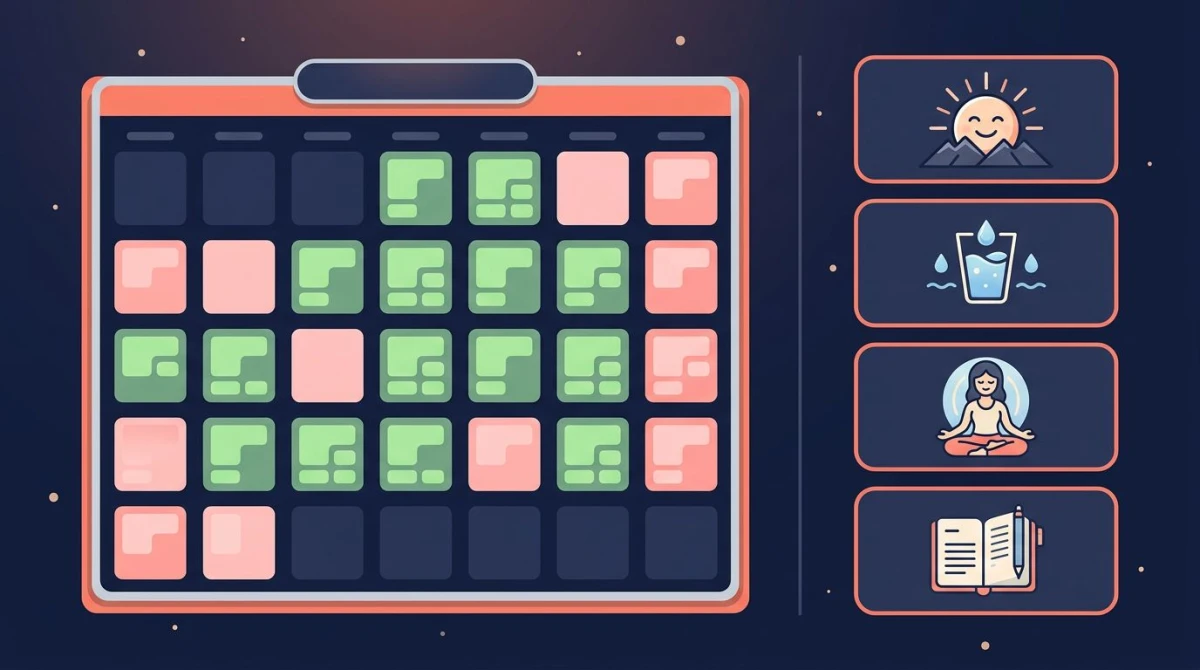
If you're tracking with paper or a spreadsheet, the same principle applies: log each link, not just the outcome. (For more on picking a tracker that fits a stack, see our guide to daily habit tracker apps. For deeper context on why these chains map to your sense of self, see identity-based habits.)
5 ready-to-copy habit stacking templates
Use these as starting points. Swap the anchors for ones you actually do every day.
Fitness stack (morning)
- After I turn off my alarm, I will drink a full glass of water.
- After I drink the water, I will do five push-ups on the bedroom floor.
- After my push-ups, I will lay out my workout clothes for the gym.
Reading stack (evening)
- After I plug my phone in to charge for the night, I will pick up the book on my nightstand.
- After I open the book, I will read one page.
- After the page, I will write one sentence about it on a sticky note.
Mindfulness stack (mid-morning)
- After I finish my first meeting of the day, I will close my laptop.
- After I close my laptop, I will sit still for two minutes with my eyes closed.
- After two minutes, I will write one word that names how I feel.
Hydration stack (workday)
- After I send my first email, I will fill my water bottle.
- After I refill, I will mark the level on the side of the bottle as my noon target.
- After lunch, I will refill the bottle to the next mark.
If you'd rather log cups digitally than mark a bottle, a water tracker app makes each refill a one-tap entry.
Journaling stack (evening)
- After I finish dinner, I will pour a cup of tea.
- After I sit down with the tea, I will write three lines about today.
- After three lines, I will close the journal and put it on top of tomorrow's planner.
Frequently asked questions
Does habit stacking actually work?
How many habits can I stack at once?
What if I miss a day?
Habit stacking vs habit chaining — same thing?
Best app to track a habit stack?
The bottom line
Habit stacking works because it stops asking your brain to do something new with no cue. It hands the new behavior a cue your brain already obeys.
The formula is short: After [CURRENT HABIT], I will [NEW HABIT]. The hard parts are picking an anchor that's truly daily, keeping the new habit small at first, and giving the chain at least eight weeks to settle.
If you want to see exactly which link in your stack is breaking, a tracker that lets you log each step separately makes the chain visible. HabitBox is free to try on iOS and Android, with Plus for more, and it's built for this kind of layered routine — small daily check-ins, streak visualization, and a calendar heatmap that shows the pattern at a glance.
Pick one anchor today. Pick one new habit. Run it for two weeks. Then add the next link.

Mira Hartwell
Editor, HabitBoxEditor at HabitBox. Writes about habit science and productivity, grounding every post in named research (Lally, Wood, Walker, Huberman) instead of recycled advice. Read full bio →