7 Best Reading Tracker Apps for a Reading Habit (2026)
There are two kinds of reading tracker apps, and most "best of" lists mix them up. Book-cataloging apps like Goodreads and StoryGraph log titles you've finished. Habit-based trackers like HabitBox and Streaks build a daily routine. Pick the wrong category and you'll quit within a month — not because the app is bad, but because it solves a problem you don't have. This guide splits the seven best into those two camps.
Last updated: 21 September 2026.
How this list is put together. Every price, free-tier limit, platform and rating below was read on 21 September 2026 from the app's own App Store listing, its Google Play listing or the vendor's own page — not copied from other roundups. Where a vendor doesn't publish a number, we say so instead of guessing. Store prices move, so check yours before you pay.
The two kinds of reading tracker apps
Book-cataloging apps answer "what have I read?" They log titles, ratings, reviews and reading lists, and the unit of progress is a finished book: Goodreads, StoryGraph, Hardcover and Fable.
Habit-based reading trackers answer "did I read today?" They log a check, a page count or a number of minutes, and the unit of progress is a session: HabitBox, Streaks and Loop Habit Tracker.
One thing changed in 2026: the cataloging camp started bolting streaks on. StoryGraph lists "Streaks" in its App Store features, and Fable's listing promotes daily reading streaks with a home-screen widget. That narrows the gap — but the streak still lives inside a book-shaped app, where you open a title and log progress against it. If you already read daily and want nicer charts, that's enough. If the problem is getting to the book at all, the one-tap tracker wins.
| Question you have | What you actually need |
|---|---|
| What have I read this year? | Book-cataloging app |
| Why can't I read consistently? | Habit-based tracker |
| What should I read next? | Cataloging app (recommendations) |
| How do I hit 30 minutes a day? | Habit-based tracker |
| Did I finish more books this year? | Both, together |
If you've tried Goodreads and quit because "tracking books didn't help me read more," that's why: a finished book is a lagging indicator, and the reading habit is the leading one. (More on that in our guide to tracking habits effectively.)
Why most readers quit their tracker
A University College London study by Phillippa Lally found new behaviors take a median of 66 days to feel automatic — not the famous 21-day myth. During those 66 days, the brain needs frequent, low-friction repetitions, not occasional big wins.
Do the arithmetic. A finished book gives you one moment of feedback every two to four weeks; a daily check-in gives you one every 24 hours — roughly 30 a month against one or two. That gap is the argument for pairing a habit tracker with whatever catalog you use. The barrier is rarely time. It's consistency, and that's what a daily tracker fixes.
The 7 best reading tracker apps in 2026
Four book-cataloging apps and three habit-based trackers. Prices are US App Store and Google Play figures on 21 September 2026.
| App | Category | Platforms | Free tier | Paid | Daily streak | Tracks pages | Best for |
|---|---|---|---|---|---|---|---|
| Goodreads | Cataloging | iOS, Android, Web | Free, ad-supported | None | No | Manual | Social readers, recommendations |
| StoryGraph | Cataloging | iOS, Android, Web | Yes | $4.99/mo or $49.99/yr | Yes | Manual | Mood-based stats, charts |
| Hardcover | Cataloging | iOS, Android, Web | Yes | $4.99/mo or $49.99/yr | No | Yes | Indie alternative, no Amazon |
| Fable | Cataloging | iOS, Android | Yes | $5.99/mo or $49.99/yr | Yes | Yes | Book clubs, social discovery |
| HabitBox | Habit-based | iOS, Android | Free to start (Plus for more) | Optional Plus | Yes | Count-based | Daily page or minute streaks |
| Streaks | Habit-based | Apple only | None (paid up front) | $5.99 one-time | Yes | Count-based | iOS minimalists |
| Loop Habit Tracker | Habit-based | Android only | Yes, everything | None | Yes | Count-based | Android, open-source fans |
1. Goodreads — best for social readers
The default. Goodreads launched in January 2007, owns the largest reader community by a distance — 10M+ Google Play installs, 753,000+ US App Store ratings — and costs nothing.
It is not ad-free. Goodreads sells placements to publishers and authors ("integrated advertising and promotional programs," in its own words), and its Play listing carries a Contains ads badge, with no paid tier to remove them.
The interface has barely changed since Amazon bought Goodreads in 2013. There's no daily streak and no check-in — the "reading challenge" is a yearly book count, and that's the only goal mechanic here. Ratings are healthy either way (4.8 on iOS, 4.6 from 217,000 Play reviews), so the complaints are about design, not stability.
Rating: (3.5/5)
Use Goodreads for the social layer — friends, reviews, lists — and the annual goal. Don't expect it to help you read on a Tuesday night.
2. StoryGraph — best for stats nerds
StoryGraph is the rising challenger. Its mood-based recommendations ("dark, fast-paced, character-driven") are sharper than Goodreads', and the stats dashboards are genuinely good.
The free tier is the generous one here: streaks, buddy reads, custom tags, reading challenges, content warnings and the machine-learning recommendations are all in the base app, none of them paywalled. StoryGraph Plus costs $4.99/month or $49.99/year and adds custom charts on your own dashboard, more stats filters, and comparisons between any two periods. No ads badge on its Play listing.
Worth knowing: the iOS app rates 4.5 from about 3,600 ratings, below the 4.6 from 6,800 Play reviews, and last updated in March 2026. The web app is fuller.
Rating: (4.5/5)
Pick StoryGraph for richer analytics than Goodreads, if you don't mind a smaller community.
3. Hardcover — best Amazon-free option
Hardcover is the indie favorite: clean modern design, a community-driven book database, and reading-progress updates that most cataloging apps still do badly. Its Play listing offers import "from Goodreads & StoryGraph."
It's also genuinely small: 63 iOS ratings, 226 Play reviews and 10,000+ installs, with its last Play update on 18 December 2025. There's no daily streak. The optional Supporter tier runs $4.99/month or $49.99/year on the App Store; everything core stays free.
Rating: (3.5/5)
Pick Hardcover if Amazon ownership bothers you and a small app on a slow release cadence is fine.
4. Fable — best for book clubs
Fable leans into community. The headline feature is curated book clubs — pick one, get the reading schedule, discuss as you go — and it now tracks TV shows too. The interface is more Instagram than spreadsheet.
Two things changed since most roundups last looked. Ownership: Fable was acquired by Scribd in 2025, its Play listing now names Scribd, Inc. as the developer, and a combined Everand–Fable subscription launched in 2026. And it is no longer streak-free — its App Store listing promotes daily reading streaks, per-page or per-percentage progress, streak reminders and a home-screen widget.
Fable Plus is $5.99/month or $49.99/year. Fable also sells individual ebooks and audiobooks as in-app purchases (roughly $3.99–$14.99 a title), so it's part tracker, part bookstore. It rates 4.8 on iOS from 80,000+ ratings and 4.7 from 28,500 Play reviews.
Rating: (4/5)
Pick Fable if you want guided social reading and would rather have one app for clubs and a streak.
5. HabitBox — best for daily reading streaks
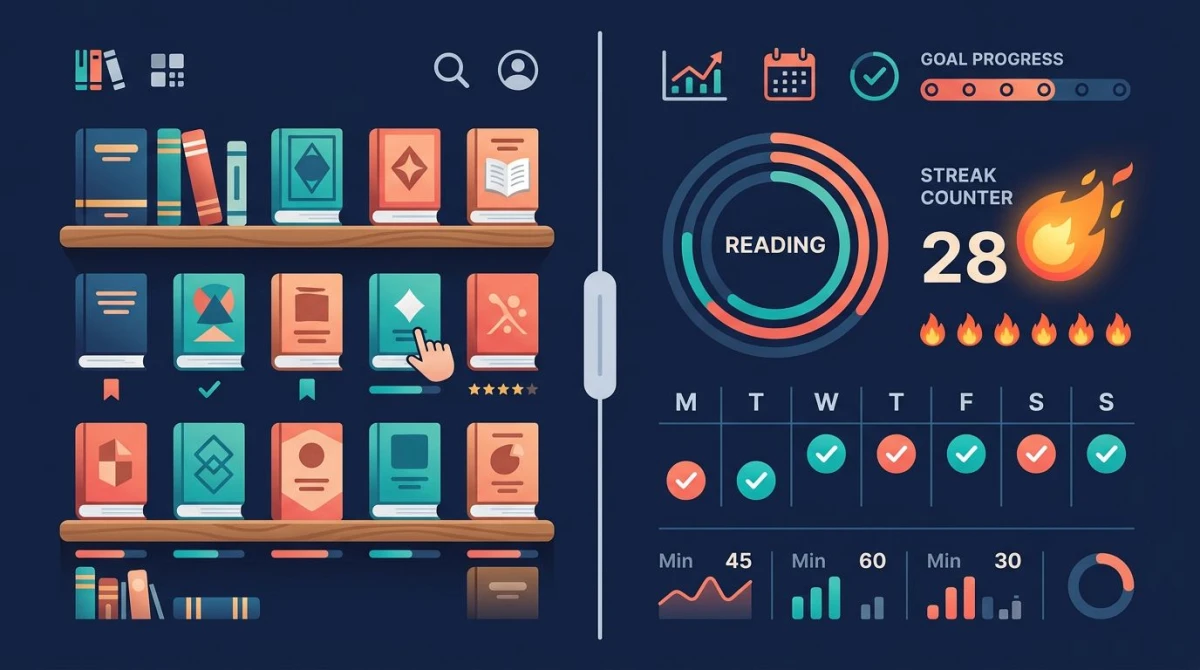
HabitBox is a habit tracker, not a book-cataloging app. It lands on this list for count-based habits: set up "Read 20 pages" or "Read 15 minutes," log it with one tap, and watch the streak build on a calendar heatmap.
It runs on iPhone and Android, free to start with an optional Plus upgrade. There's no HabitBox account and no sign-up — habits live on your device, with optional sync to your own iCloud on iPhone; on Android they stay on the phone and move across with the Plus export/import backup file. No book database, no reviews, no friends — it removes everything that isn't the daily check-in.
Rating: (4.5/5)
Pick HabitBox if you've finished books before but can't string daily sessions together. Pair it with Goodreads or StoryGraph for the finished-books log.
6. Streaks — best for iOS minimalists
Streaks is an Apple Design Award winner, $5.99 once, with no in-app purchases and no subscription. The interface is famously clean, and it tracks up to 24 tasks a day — not the six-habit limit older roundups still quote. There's no free tier and no trial: you pay up front, and nothing is held back afterwards.
For reading, Streaks supports timed tasks, so "Read for 20 minutes" runs as a timer rather than a number you type. Tasks sync across your Apple devices through iCloud, and Health-linked tasks auto-complete — handy for water or steps, irrelevant here. It rates 4.8 from over 27,000 US App Store ratings. No Android version.
Rating: (4/5)
Pick Streaks if you're locked into Apple hardware and want the simplest possible tracker.
7. Loop Habit Tracker — best free Android option
Loop Habit Tracker is open-source (GPLv3), Android-only and free — its Play listing carries no ads badge and no in-app purchases badge, so there is nothing to buy. The streak score algorithm is the interesting part: it weighs recent consistency more heavily than ancient streaks, which keeps the score honest after a slip.
The interface is utilitarian, development is slow (last Play update: 14 September 2025), and there's no cloud sync. For reading, create a "Read daily" yes/no habit or a numerical "Pages read" one.
Rating: (4/5)
Pick Loop if you're on Android, value privacy and open source, and don't need polish.
How to use both kinds of trackers together
The strongest setup is one app from each camp. Cataloging app for the year-end "books I read" list, habit tracker for the daily reinforcement that drives the count up.
- Set the daily habit in your habit tracker. Start with a tiny target — "read 10 pages" or "read 10 minutes." BJ Fogg's Tiny Habits method is built on small wins compounding faster than ambitious ones that get skipped. The same principle drives habit stacking — pairing reading with something you already do, like morning coffee.
- Log finished books in your cataloging app. Skip in-progress updates unless you want the stats. Add the book when you finish it.
- Review weekly, not daily. Daily checking spawns anxiety; a weekly look at the heatmap surfaces the trend.
- Treat the streak as the leading indicator. A 30-day streak doesn't guarantee anything, but it's the input you control — the way weekly gym attendance is the input and fitness is the output.
For HabitBox, the count-based habit type is the one readers want: set "Read pages" with a daily target of 10 and log each session. Our words-per-minute reading test turns your reading speed into a realistic pages-per-day number.
Decision matrix: pick by goal, not features
| Your primary goal | Use this |
|---|---|
| Build a daily reading habit | Habit tracker (HabitBox, Streaks, or Loop) |
| Beat last year's book count | Cataloging app (Goodreads, StoryGraph) |
| Track pages or minutes per day | Habit tracker with count-based habits (HabitBox) |
| Find your next book | Cataloging app with recommendations (StoryGraph, Goodreads) |
| Read with friends or a club | Fable, then Goodreads |
| Ditch Amazon | Hardcover or StoryGraph |
| Track without creating an account | HabitBox or Loop Habit Tracker |
| One app for clubs and a streak | Fable |
Stuck between two apps in the same category? Default to the cross-platform one — switching phones and losing years of data is the most common reason readers quit. If a general daily tracker matters more than reading features, our best habit tracker app comparison goes deeper.

Common reading habit mistakes (and how a tracker helps)
Setting a yearly book count without a daily habit
A 50-book goal with no daily routine is a New Year's resolution. By March the math gets bleak — a book a week from here — and most readers quit. Set a daily minute count first; the book count takes care of itself.
Choosing a session-timer app when you need a check-in
Bookly and Bookmory are the two big session-timer trackers, and they're better than their reputation: Bookmory rates 4.7 from 78,700 Play reviews, Bookly 4.6 from 61,400 App Store ratings. Both run a timer while you read, log pages and keep a streak, and both are free with a paid tier — Bookmory's Premium is $3.49/month or $30.99/year on the App Store, and its Play listing carries a Contains ads badge.
The catch is what they ask of you: start a session, pick the book, stop the timer. Three decisions before you read a sentence. If you're trying to start a habit, pick the app with the fewest taps between "open" and "logged."
Logging in-progress books obsessively
Some apps make it tempting to update progress page-by-page. That shifts attention from reading to logging. Update once per session at most — for cataloging only the finished count matters, and for habit tracking only the daily check does.
FAQ
What's the best reading tracker app overall?
What is replacing Goodreads?
StoryGraph vs Goodreads — which is better?
How do I track pages read every day?
Is there a free reading tracker app?
What's the best reading tracker app for kids?
Can I track reading and other habits in the same app?
The bottom line
Goodreads, StoryGraph, Hardcover and Fable catalog the books you finish — and StoryGraph and Fable now add a streak on top. HabitBox, Streaks and Loop Habit Tracker track the daily sessions that get you to the finish line. Most readers who quit one camp quietly needed the other.
If you've struggled to read consistently, start with the habit tracker. Pick a tiny daily target — 10 pages or 10 minutes — log it for two weeks, and let the streak do the work motivation can't. Then layer on a cataloging app for the record. More on that in how to read more books.
Want the daily half of the setup? Download HabitBox on iOS and Android — set a page or minute target, log it with one tap, and watch the streak build on the calendar heatmap. Free to start, no account, and Plus when you want more.

Mira Hartwell
Editor, HabitBoxEditor at HabitBox. Writes about habit science and productivity, grounding every post in named research (Lally, Wood, Walker, Huberman) instead of recycled advice. Read full bio →