Tracking Habits: A Practical Guide That Works (2026)
Tracking habits doubles your follow-through. A 2008 weight-loss trial by Hollis and colleagues found people who kept a daily log lost twice as much as those who didn't (study summary on PubMed). The catch: tracking only works if the system is light enough to keep up — and forgiving enough to survive a missed day.
This guide covers the five methods most people use, how often to log, how many habits to track at once, what type of data to capture, and how to recover when you slip. It's tactical, not philosophical. Pick a method by the end of section two and start tonight.
Why tracking habits actually works
Three things happen the moment you mark a habit complete. Each one is a small psychological lever, and together they explain why a checkbox can move behavior more than willpower.
It closes the feedback loop. Most habits have delayed payoffs. Five push-ups today don't show up in the mirror for months. A check mark gives you something now — visible evidence that the work happened. Behavioral scientists call this "immediate reinforcement," and it's why slot machines and Duolingo streaks are so sticky.
It triggers a small reward. Marking the box releases a tiny hit of satisfaction. James Clear, author of Atomic Habits, calls the habit tracker "an obvious cue, an attractive form of motivation, an easy task to complete, and immediately satisfying" — all four laws of behavior change in one act. Read more on his habit tracker page.
It surfaces the truth. Memory lies. Most people overestimate how often they exercised last week and underestimate how often they doomscrolled. Logging shows you what actually happened. The 2008 weight-loss study mentioned above tracked 1,685 adults; food-diary keepers lost roughly twice as much as non-loggers, and the more days they logged, the more they lost (Kaiser Permanente study summary).
There's a fourth, quieter benefit: tracking forces a daily decision. You either mark the box or you don't. That binary creates accountability with yourself, even when nobody else is watching.
What the research actually says
The numbers behind habit tracking are stronger than people expect. The Hollis 2008 trial isn't a one-off — it's part of a body of behavioral research showing that self-monitoring is one of the most reliable predictors of follow-through across health, productivity, and skill domains.
Phillippa Lally's well-known 2009 study at University College London is often cited for the "median of 66 days" finding, but the more useful detail is buried in the data: participants who logged their target habit consistently moved up the automaticity curve faster than those who logged sporadically. Tracking didn't just measure the habit — it accelerated it.
Wendy Wood, professor of psychology at USC and author of Good Habits, Bad Habits (2019), describes habits as a context-cue-response loop. Tracking gives you visibility into the cues. You'll spot, for instance, that you skip the gym every Monday or always reach for your phone during dinner — patterns invisible without a log. Once a pattern is named, you can change it.
Charles Duhigg's The Power of Habit makes the same point from a journalistic angle: most habit change starts with awareness. People who can't articulate what they did this week have no leverage point to change next week.
The shorthand: tracking habits is part feedback, part awareness, part commitment device. You don't need all three to benefit, but the more of them your system delivers, the more durable the habit becomes.
The 24-hour rule
Tracking only works if you do it within 24 hours. Two days out, you're guessing. A week out, you're reconstructing a story. The shorter the gap between action and log, the more accurate the data — and the stronger the psychological reward. James Clear's preferred move is to log immediately after the habit, using a "habit stack": after I [habit], I will mark it.
If you're brand new to this, start with our primer on how habit formation actually works before picking a method.
The 5 main methods for tracking habits compared
There's no single best way to track habits. There's the way you'll keep up with for 60+ days. The five methods below cover almost every working system. Pick the one with the least friction for your life — not the one that looks coolest on Pinterest.

| Method | Setup time | Friction | Portable | Streak view | Best for |
|---|---|---|---|---|---|
| Paper journal | 2 min | Low | Medium | Weak | People who hate phones |
| Bullet journal grid | 20-40 min/month | Medium | Medium | Medium | Visual planners who already journal |
| Spreadsheet | 10-30 min | Medium | High | Strong (with formulas) | Data nerds, complex tracking |
| Dedicated app | 2 min | Very low | Very high | Very strong | Most people, multi-habit setups |
| Calendar X-method | 1 min | Very low | Low | Strong | Solo-habit focus, Seinfeld fans |
1. Paper journal
A spiral notebook and a pen. Each morning or evening, write the date and the habits you completed. Done.
Pros: Zero distraction. No notifications. Permanent record you can flip through years later. Studies in journaling and writing-by-hand link physical writing to better memory consolidation.
Cons: No automatic streaks. No reminders. Easy to skip days, then "catch up" inaccurately. Hard to query — you can't filter or graph last quarter's runs.
Best for: People building one or two habits who want a calm, screen-free ritual.
2. Bullet journal habit spread
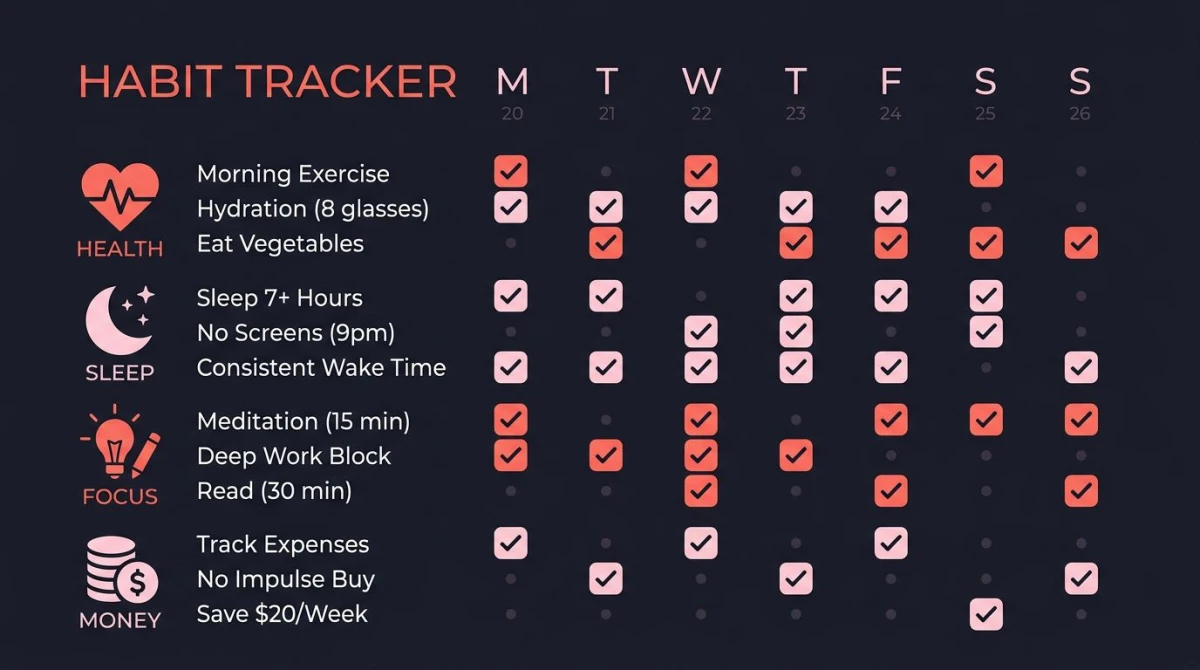
A monthly grid: habits down the left column, days across the top. Fill in each cell with a dot, X, or color. Aesthetic, satisfying, and surprisingly powerful when you flip back.
Pros: Visual at a glance. Doubles as a planner. Makes patterns obvious — you can see Tuesdays are weak, weekends are strong.
Cons: Setup tax every month. If you forget a few days, the page looks defeated and people abandon it. Not portable; you need the journal in front of you.
Best for: People who already keep a bullet journal and enjoy the ritual. If setting up a tracker spread feels like homework, skip this method.
3. Spreadsheet
Google Sheets, Excel, Apple Numbers. Habits in rows, dates in columns, 1s and 0s in cells. Add a few formulas and you get streak counts, completion percentages, and weekly graphs.
Pros: Total customization. Track anything — duration, count, mood, notes. Powerful querying. Free. Syncs across devices.
Cons: Highest cognitive friction. You have to open a spreadsheet, scroll to today, type. Most people abandon it within 3 weeks because the friction is real, even if it feels small.
Best for: Data-oriented people tracking complex habits (calories, training volume, deep-work hours) who already live in spreadsheets.
4. Dedicated habit-tracking app
A purpose-built mobile app: tap to check off, automatic streak counting, calendar heatmap, reminders that show up at the right time. The full list is in our roundup of the best habit tracker apps.
Pros: Lowest friction (one tap). Always in your pocket. Reminders solve the "I forgot to log" problem. Visual streaks tap into loss aversion — you don't want to break the chain. Most apps offer calendar views, weekly stats, and quick add for new habits.
Cons: Phone in hand means a lot of other apps in hand too. Some apps are bloated with features you don't need. Quality varies; pick a focused one.
Best for: Most people, especially anyone tracking 3 or more habits at once. If you're comparing options, our reading tracker app guide and daily habit tracker apps roundup walk through what to look for.
5. The calendar X-method (the "Seinfeld" method)
A wall calendar and a thick marker. Each day you do the habit, you draw a big red X on that date. Your only goal is "don't break the chain." The method is famously associated with Jerry Seinfeld's joke-writing routine.
Pros: Visceral. The longer the chain of Xs, the harder it gets to skip a day. Zero technology. The wall is the reminder.
Cons: Works for one habit, not five. Not portable. If you travel, the chain feels broken even if you kept the habit.
Best for: A single, high-priority habit you want to lock in. Pair with another method if you're tracking more.
Choosing between paper and app
The honest answer: pick the one you'll actually open tomorrow morning. Paper feels meaningful but requires more discipline. Apps remove friction but can feel less ceremonial. There's no productivity bonus for picking the harder system. One distinction worth making: habit trackers measure repetition, while goal setting and tracking apps measure progress toward a finish line — if your target has a deadline, you may want the latter.
If you're tracking more than two habits, an app's automatic streaks and reminders save you real cognitive load. If you're tracking one anchor habit (write 500 words a day, walk 30 minutes), paper or the calendar X-method can be enough.
A 30-second test before you commit
Before you adopt any of the five methods, run this thought experiment: imagine yourself on a Tuesday at 10:47 PM, exhausted, lying in bed. Will you reach for this system? If the honest answer is "no, that's too much effort right now," the system is too heavy. The best tracker is the one with the smallest activation energy at your worst moment, not your best.
Common mismatches we see:
- Spreadsheet fans who think they're "data people" but never open the sheet on weekends.
- Bullet journal converts who skip three days, then start a fresh page each month — losing the long view.
- App skeptics who set up a paper notebook, leave it on a shelf, and forget it exists by week two.
There's no virtue in choosing a "harder" method. Pick the one that wins on Tuesday at 10:47 PM, not the one that wins on Sunday afternoon when you're feeling motivated.
How often should you log a habit?
Three options: real-time, end-of-day, or weekly review. The right cadence depends on how forgetful you are and how detailed your tracking is.
Real-time (right after the habit). This is the gold standard. Walk for 30 minutes, log it the moment you walk in the door. Accuracy is highest, the dopamine hit is freshest, and you don't have to remember at midnight whether you flossed.
End-of-day (a single review window). Pick a 2-minute slot — say, right before bed or while the kettle boils. Run through your habit list and mark what you did. This works if you have a stable evening routine. Risk: if you skip the window two nights in a row, you start guessing.
Weekly review. Once on Sunday, you fill in the whole week. This isn't really tracking — it's reconstruction. Useful for low-stakes habits or as a backup when you've been traveling, but don't make it your primary method. Memory at 5 days out is unreliable, and the daily reinforcement is gone.
Most people get the best results by combining real-time logging for fitness and study habits (where the moment is obvious) with end-of-day for everything else. A quick weekly review on Sunday catches misses and surfaces patterns.
Pro tip: Build the log into the habit itself. "I haven't done my push-ups until I've checked the box" turns the log from chore into part of the move.
Sample logging schedules
Three working examples of how real people structure their tracking day. Steal whichever fits your life.
The morning person. All habits live before 10 AM — workout, meditation, journaling, language practice. They log in real time as they finish each one. The kitchen counter holds either a paper tracker or a phone, and the act of marking is part of the morning routine. By the time work starts, the day's tracking is done.
The evening reviewer. Habits are scattered through the day — water, walking, focused work, reading at night. They log everything in a single 2-minute session while brushing their teeth. Habit-stacking the log to an existing nightly routine ("after I brush, I open my tracker") removes the "did I remember to log?" question.
The hybrid. Real-time logging for the high-effort habits (gym, deep work, meditation) where the moment is unmistakable. End-of-day for the low-effort ones (vitamins, water, gratitude note). Sunday evening, a 5-minute review of the past week to spot trends and adjust the next 7 days. This is the most resilient pattern for most people.
Whichever schedule you pick, tie it to an existing strong habit — coffee, brushing teeth, a commute. Habit stacking turns an isolated chore into an automatic step.
How many habits should you track at once?
Three to five. That's the range where most people succeed. Fewer than three and you're under-using the system. More than five and the daily logging burden tips you into abandonment.
BJ Fogg, Stanford behavior scientist and author of Tiny Habits, recommends starting with one or two new habits at a time and only adding more once they feel automatic — see his work on tinyhabits.com. Wendy Wood's research at USC reaches a similar conclusion: habit automaticity takes time, and stacking too many novel behaviors competes for the same self-regulatory budget.
Here's a working breakdown:
- 1-2 habits: Pure focus mode. Use this when you have one big behavior change to make (quit drinking, start exercising). Don't dilute it.
- 3-5 habits: The sweet spot. A few keystone habits (sleep, movement, deep work) plus one or two life-quality habits (reading, meditation).
- 6-10 habits: Power-user territory. Works only if most are already automatic; you're really just maintaining a few core ones plus tracking smaller add-ons.
- 10+ habits: Almost always too many. The tracker becomes the chore.
A useful test: imagine your worst day this month — sick, exhausted, behind on work. Could you still log every habit on your list in under 2 minutes? If not, trim it.
For more on which habits give the highest leverage, see our companion article on what habits to track first.
What to track: binary, count, or duration?
Not every habit fits a checkbox. Pick the smallest data type that captures what you actually care about. Bigger data costs more friction.

Binary (yes/no)
Did you do the habit today? One tap.
Use when: The habit has a clear "done" line. Took medication. Made the bed. Meditated. No stretching the truth.
Strengths: Fastest to log. Easiest to maintain. Streaks read clearly.
Weakness: Ignores intensity. "Read today" covers both 5 minutes and 90 minutes equally.
Count (how many)
A number — glasses of water, pages read, push-ups, journal entries.
Use when: Volume matters and you have a daily target. 8 glasses of water. 20 push-ups. 5 pages of a book.
Strengths: Captures dose-response. Makes "almost there" visible (5 of 8 glasses) without breaking the streak entirely.
Weakness: More friction. You have to count and enter a number. Apps with quick-increment buttons help here — for hydration specifically, dedicated water tracking apps make each cup a single tap.
Duration (how long)
Minutes spent on the habit — meditation, deep work, language learning, walking.
Use when: Time-on-task is the real metric. 10 minutes of meditation. 25 minutes of focused study. 30 minutes of cardio.
Strengths: Honest about effort. A 5-minute meditation isn't the same as 30 minutes, and duration tracking shows that.
Weakness: Easy to fudge. People round up. Use a timer to keep yourself honest, or pair with a binary "did I hit my target" check.
A practical rule: start binary. Upgrade to count or duration only after the binary version is automatic. Most people who start with duration on day one are dropping the habit by week three because the friction is too high.
Mixing data types in one tracker
Most working trackers have a mix. A real example for a typical 5-habit setup:
- Sleep before midnight — binary. You either did or didn't.
- Read — count (pages). The number matters; "read today" hides whether it was 2 pages or 25.
- Workout — duration (minutes). Captures whether you did 10 minutes of stretching or a full 45-minute session.
- Meditation — binary on weeks 1-4, then upgrade to duration once consistency is locked in.
- No social media before noon — binary. A simple yes/no anchor for a focus rule.
Notice that the same person uses all three data types in the same day. The data type follows the habit, not your personality.
One more pattern worth knowing: the "binary-with-target" hybrid. You define a daily target (e.g., 20 push-ups) and the box gets checked when you hit it. The streak is binary, but the underlying volume is real. Most habit-tracking apps support this mode out of the box, and it strikes a good balance between speed and meaningful data.
What to do when you miss a day
You will miss a day. Everyone does. The question is what happens on day two.

James Clear's rule is the cleanest in the field: never miss twice. One miss is an accident. Two misses is the start of a new habit — the habit of skipping. So the priority on day two is showing up at any size, even if it's a 2-minute version.
Phillippa Lally's 2009 habit-formation research at University College London reached a similar conclusion: missing a single day did not significantly reduce habit automaticity, but missing repeatedly did. The chain is more resilient than people think — once.
Here's the recovery playbook:
- Don't try to "make up" yesterday. Doing two workouts today doesn't unmiss yesterday. It often leads to soreness or burnout, which makes day three harder.
- Show up smaller. If your habit is a 30-minute run, do a 5-minute walk. If it's writing 500 words, write 50. The point is to break the skip-skip pattern, not to hit your normal target.
- Log it honestly. Don't backfill yesterday's missed box. The miss is data. Seeing one X in a sea of green is motivating, not shameful.
- Notice the pattern. Three weekday misses in a row probably means your trigger is wrong, not that you're lazy. Move the habit to a different time.
- Skip the guilt spiral. The literature is unambiguous: self-criticism after a miss makes the next miss more likely. Treat yourself like a friend who slipped — encouraging, not lecturing.
A streak counter that resets to zero after one miss is a system bug, not a feature. The better trackers let you see both your current streak and your overall completion rate, so a single miss doesn't erase six weeks of work.
A 4-week recovery plan
If you've already fallen off — say, you stopped logging two weeks ago and want to come back — don't try to "restart" the way you started. The way back is gentler.
Week 1: Pick one habit. The most important one. Set the bar absurdly low (5 minutes, 1 page, 10 push-ups). Log it daily, real time.
Week 2: Stay at one habit, raise the bar slightly if it feels easy. Add a Sunday review.
Week 3: Add a second habit, again at minimum dose. Log both in the same window each day.
Week 4: If both habits feel automatic, add a third. If not, hold steady another week.
This is slower than people want, and it's the version that actually works. The instinct after a relapse is to over-correct ("I'll do 10 habits this time, perfectly!"). That's the same trap that caused the first abandonment.
Common habit-tracking failures and how to avoid them
The reasons people quit tracking are predictable. Recognizing them in advance is half the fix.
Tracking too many habits at once
Symptom: You miss a few days, see a wall of red, and abandon the whole tracker.
Fix: Cut your list to 3-5 habits. The ones that don't make the cut aren't gone forever — park them for next month.
Ambitious targets on day one
Symptom: You set "meditate 30 minutes daily" or "write 1,000 words" and burn out in a week.
Fix: Start at a "ridiculously small" version (Fogg's term). Two minutes of meditation. 50 words. Build the habit of starting first; expand later.
Tracking what doesn't matter to you
Symptom: You're logging "drink water" because someone on Instagram does it, but you don't actually care.
Fix: Ask each habit, "Do I want this to be a part of my identity?" If no, drop it. James Clear's framework on identity-based habits is useful here.
All-or-nothing perfectionism
Symptom: You miss one day and "ruin" the month, so you give up entirely.
Fix: Track completion percentage, not just streaks. 28 of 30 days is a 93% rate — not a failure. The streak is one signal, not the only one.
Logging long after the fact
Symptom: You're guessing at midnight whether you actually walked yesterday.
Fix: Log within 24 hours, ideally right after the habit. If you keep forgetting, the cue is wrong — try a stronger trigger.
Setting it and forgetting it
Symptom: You set up the perfect tracker, use it for two weeks, then never open it again.
Fix: Build a weekly review. 5 minutes on Sunday. Look at last week, plan the next. The review is what turns data into change.
Tracking instead of doing
Symptom: You spend more time decorating your bullet journal spread than actually doing the habits.
Fix: If your tracking system takes more than 2-3 minutes a day to maintain, it's too elaborate. Strip it down.
How HabitBox handles tracking
A few of the patterns above influenced how we built HabitBox. Streaks and overall completion show up side by side, so a single miss doesn't visually erase your progress. The habit list defaults to a calendar heatmap view — patterns by day-of-week pop out in a glance. And because tracking has to be fast or you won't do it, check-in is one tap, with quick-increment buttons for count habits and a built-in timer for duration ones.
If you're tracking 3-5 habits and want a low-friction way to see streaks and completion across all of them, that's what HabitBox is built for — and it's free on both iOS and Android.
Frequently asked questions
How do you track habits effectively?
How often should I log a habit?
Is missing one day bad?
How many habits should I track at once?
Paper or app — which is better for tracking habits?
Do streak counters actually motivate behavior change?
What's the best habit-tracking app?
Start tracking tonight
The best tracking system is the one you'll open tomorrow. If you're not sure where to begin, here's a 5-minute starting kit:
- Pick 3 habits — one keystone (sleep, movement), one for skill-building (reading, language), one for fun (a walk after dinner).
- Choose binary tracking for all three. No counts, no durations on day one.
- Pick a method — paper, app, or calendar — based on which one you'll have in front of you tomorrow morning.
- Decide when you'll log: ideally right after each habit, or at one fixed evening slot.
- Set a 5-minute Sunday review on your calendar. That's the habit that powers all the others.
If you want streaks, reminders, and a calendar heatmap without the friction of building a system, HabitBox is free to try on iOS and Android. Either way: start tonight, miss small, and don't miss twice.

Mira Hartwell
Editor, HabitBoxEditor at HabitBox. Writes about habit science and productivity, grounding every post in named research (Lally, Wood, Walker, Huberman) instead of recycled advice. Read full bio →