7 Habits of Highly Effective People Summary (2026)
This 7 habits of highly effective people summary covers all 7 habits Stephen Covey laid out in his 1989 classic. It also shows how to turn each one into a routine you can track. Most summaries stop at the definitions. This one ends with a table. That table maps every habit to a single daily or weekly action. A principle you never practice is just a quote.
TL;DR
The 7 habits of highly effective people summary in one paragraph: Stephen Covey's The 7 Habits of Highly Effective People (1989) builds lasting success around 7 habits. The habits move you along a path from dependence to independence to interdependence. The first three build private character — be proactive, begin with the end in mind, put first things first. The next three build public relationships — think win-win, seek first to understand, and synergize. The seventh, sharpen the saw, renews you so the other six keep working. The book has sold more than 20 million copies (per Wikipedia, as of 2012).
Quick answer: Covey's 7 habits are (1) Be Proactive, (2) Begin With the End in Mind, (3) Put First Things First, (4) Think Win-Win, (5) Seek First to Understand Then to Be Understood, (6) Synergize, and (7) Sharpen the Saw. Habits 1-3 are the "private victory" (independence), habits 4-6 are the "public victory" (interdependence), and habit 7 renews all of them. The core idea: effectiveness flows from character and principles, not personality tricks.
What the 7 habits of highly effective people summary is really about
Covey argues that most self-help focuses on the "personality ethic." That means surface tactics for likability and quick wins. He pushes instead for the "character ethic." This is success that grows out of principles like honesty, fairness, and patience.
The whole framework sits on one idea Covey borrows from Aristotle. We are what we repeatedly do. Change your habits and you change your character. Change your character and outcomes follow.
He sorts the seven habits along a maturity continuum with three stages. You start dependent, which means you need others. You grow into independence, where you can stand on your own. Then you reach interdependence, where you can build with others. That last stage is the highest one, not a step backward.
Covey also leans on a concept he calls a paradigm — the mental map you use to read the world. Two people can look at the same facts and see different things. His argument is that real change starts inside that map, not with new behavior tacked on top. He calls this an "inside-out" approach. You work on who you are first, and the outer results follow. That's why the book spends so long on character before it ever gets practical.
The maturity continuum and the two victories
Covey groups the habits into a "private victory" and a "public victory." You have to win the private one first. As he puts it, you can't have a healthy bond with others until you can keep promises to yourself.
| Stage | Habits | What it builds |
|---|---|---|
| Dependence → Independence (Private Victory) | 1, 2, 3 | Self-mastery: responsibility, vision, prioritization |
| Independence → Interdependence (Public Victory) | 4, 5, 6 | Relationships: trust, empathy, collaboration |
| Continuous renewal | 7 | Sustains all six over time |
This order matters. People often try to be a great team player (habit 6) while still blaming everyone around them (skipping habit 1). Covey's claim is simple. The public victory is built on the private one, in order.
Habits 1-3: the private victory
These three habits are about you. They take you from being pushed around to acting on purpose. This is also where the famous time-management matrix lives.
Habit 1: Be Proactive
Proactive people focus on their circle of influence. That is the set of things they can actually change. They spend less energy on their circle of concern — the wider set of things they worry about but can't control. There is a gap between what happens to you and how you respond. That gap is where your freedom to choose lives.
In practice, this means owning your words. "I have to" becomes "I choose to." Reactive people let their mood and their surroundings run the day. Proactive people pause in that gap and pick a response on purpose. A trackable version: each day, note one moment where you chose your response instead of reacting on autopilot. Over a few weeks you start to spot the pattern, and the pause gets easier.
Habit 2: Begin With the End in Mind
Covey's exercise here is striking. He asks you to imagine your own funeral and ask what you'd want people to say. The point is to define success before you chase it. He suggests writing a personal mission statement to act as your internal rulebook.
A full mission statement can feel heavy. So start smaller. Define what a good week looks like, then a good day. A tool like our SMART goals generator can help you turn a fuzzy end-state into something specific enough to act on. For a deeper process, see our guide on how to set goals.
Habit 3: Put First Things First
This is habit 2 in action. It is the daily and weekly discipline that protects what matters. Covey's tool is a time-management matrix. It sorts tasks by urgency and importance into four quadrants.
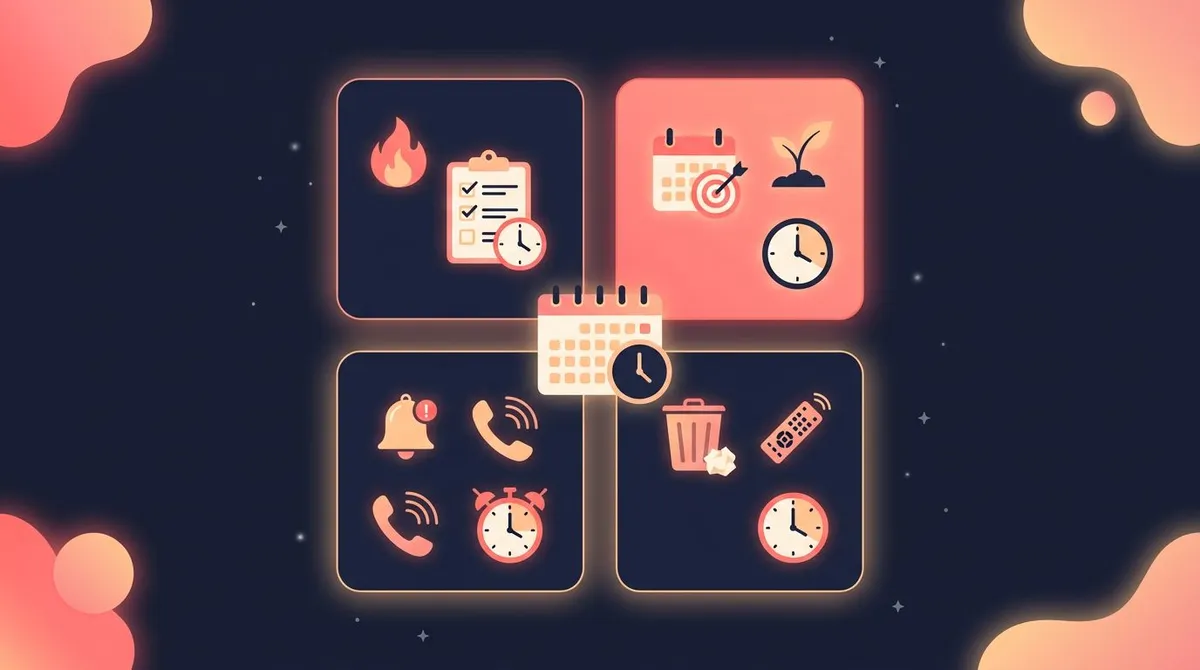
| Quadrant | Description | What to do |
|---|---|---|
| I | Urgent + Important | Do it now (crises, deadlines) |
| II | Not Urgent + Important | Schedule it (planning, relationships, renewal) |
| III | Urgent + Not Important | Minimize or delegate (interruptions) |
| IV | Not Urgent + Not Important | Eliminate (busywork, distractions) |
The whole secret is living in Quadrant II. Effective people handle important work before it turns into a fire. They plan, build relationships, and renew themselves while there is still time. Covey's matrix is closely related to the Eisenhower method. If you want worked examples, read our Eisenhower matrix examples guide.
Habits 4-6: the public victory
Once you can lead yourself, you can lead with others. These three habits move you from independence to interdependence. That is the place where teams and relationships create more than any one person could alone.
Habit 4: Think Win-Win
Covey describes six ways people can interact, from win-lose to lose-lose. The best one is win-win. You seek a result where both sides gain. You also keep a "win-win or no deal" option, which means you can walk away when a fair outcome isn't possible. The habit rests on an "abundance mentality" — the belief that there's enough success to go around.
Habit 5: Seek First to Understand, Then to Be Understood
Most of us listen so we can reply, not so we can understand. Covey's fix is empathic listening. You reflect back the other person's meaning and feeling before you make your own case. He calls it the single most important rule in human relations.
A trackable version: in your next disagreement, restate the other person's view to their satisfaction before you respond. It feels slow at first. But people relax once they feel heard, and the conversation usually moves faster after that.
Habit 6: Synergize
Synergy is the payoff of habits 4 and 5. When people truly value their differences, the result is creative teamwork. Together they reach a "third alternative" that beats either side's first idea. Covey's shorthand: the whole is greater than the sum of its parts.
Habit 7: Sharpen the Saw
Habit 7 is the one that keeps the other six alive. Covey tells a short story about a man sawing a tree for hours with a dull blade. He has "no time" to stop and sharpen it. Renewal across four areas is what keeps your saw sharp:
- Physical: exercise, nutrition, sleep, rest
- Mental: reading, writing, learning, planning
- Social/emotional: service, empathy, meaningful connection
- Spiritual: values, reflection, meditation, time in nature
This is the strongest tracking tie-in of all seven. Renewal habits repeat by nature. A daily walk, ten minutes of reading, a weekly check-in with a friend — these are perfect candidates for a streak you can actually see. Covey's point is that you are the most valuable tool you own. If you never maintain it, everything else slowly wears down.
All 7 habits at a glance
Here's the whole framework with one concrete action you can track for each. Pick a couple to start; you don't need all seven at once.
| Habit | Core idea | One tracked action |
|---|---|---|
| 1. Be Proactive | Own your response | Log one chosen response per day |
| 2. Begin With the End in Mind | Define success first | Review your mission/goals weekly |
| 3. Put First Things First | Prioritize Quadrant II | Schedule one important-not-urgent block daily |
| 4. Think Win-Win | Seek mutual benefit | Reframe one negotiation as win-win |
| 5. Seek First to Understand | Listen empathically | Restate someone's view before replying |
| 6. Synergize | Value differences | Ask for one opposing view weekly |
| 7. Sharpen the Saw | Renew yourself | Track one renewal habit daily (move, read, connect, reflect) |
How to apply the 7 habits
Reading the summary is the easy part. Living the habits is where it gets real. Here's a practical way in that won't overwhelm you.
Start with two or three habits, not all seven. Trying to build seven new behaviors at once is how good intentions die. Pick the two that fix your biggest gap right now. For many people that is habit 3 (prioritization) and habit 7 (renewal).
Turn each one into a clear, repeatable action. "Be more proactive" isn't trackable. "Each evening, write one moment where I chose my response" is. Use the at-a-glance table above as a starting menu. The narrower the action, the easier it is to keep.
Track it so you can see the streak. This is where a habit tracker like HabitBox earns its place. A renewal habit like "read 10 minutes" or a daily Quadrant II block is exactly the kind of recurring action a calendar heatmap makes visible. Watching the chain build is what keeps habit 7 from sliding into "I'll renew myself next week."
Review weekly. Covey was a strong believer in weekly planning. It's how habit 2 connects to habit 3. A short weekly review lets you check which habits held and which slipped. Then you reset for the next week.
One more nudge. The 7 habits are really about identity, not tactics. That overlaps neatly with the modern idea of identity-based habits. You're not just doing proactive things. You're becoming a proactive person. The actions reinforce the self-image, and the self-image makes the actions easier.
Who should read it
This book is for you if you want a values-first framework rather than a list of quick hacks. It suits people in leadership or relationship-heavy roles. It also helps anyone rebuilding habits after a rough patch. And it rewards readers who like a principled, slightly formal style.
It's less ideal if you want a fast tactical read. Covey is thorough and at times preachy, and some of the language feels of its era. But the core model has held up for more than three decades for a reason. It's about character, and character doesn't go out of date.
FAQ
What are the 7 habits of highly effective people?
What does "begin with the end in mind" mean?
What is the difference between the private victory and the public victory?
What is "sharpen the saw"?
How do I apply the 7 habits daily?

Mira Hartwell
Editor, HabitBoxEditor at HabitBox. Writes about habit science and productivity, grounding every post in named research (Lally, Wood, Walker, Huberman) instead of recycled advice. Read full bio →