How to Get Back on Track After a Slip-Up (2026)
TL;DR: Restart with a small action and a specific next opportunity. James Clear’s “never miss twice” saying is a reminder, not a scientific threshold or a rule that makes a second lapse irrecoverable. The seven steps below help you adjust the plan without treating past effort as lost.
You had a streak going. Then a bad week, a trip, a cold, or one skipped morning turned into three. Now the whole thing feels ruined, and starting again feels harder than it did the first time.
Here is the good news: you have not lost your progress. The habit you built is still partly wired in, and getting back on track is a much smaller job than starting from scratch. The trick is doing it before one slip becomes a pattern.
Why falling off track is normal (and not the end)
Missing days is the rule, not the exception. In the most-cited study on how habits form, Phillippa Lally and colleagues at University College London tracked 96 people building a new daily behavior over 12 weeks. Habits took a median of 66 days to become automatic — but the researchers also found that missing a single day "had no meaningful effect on the habit formation process."
That last point matters more than the famous 66-day number. Skipping one day does not reset a counter or undo the wiring you have built. The people in the study who missed a day and then kept going built the same automatic habits as the people who never missed. If you want the full picture on timelines, see our breakdown of how many days it takes to make a habit.
So the danger is not the missed day itself. The danger is what your brain does with the missed day — the story that says "I blew it, so the whole thing is off." That story is what actually ends habits, and it has a name.
The 7-step get-back-on-track plan
Here is a restart protocol built for habits and streaks, not vague motivation. Work through it in order. The whole thing can take ten minutes, and step two is the one that keeps you from needing this list again next week.
1. Drop the guilt and name the all-or-nothing spiral
The most common reason a one-day slip becomes a two-week collapse is a thinking trap: because you were not perfect, you treat the effort as worthless. Ate one cookie, so the diet is ruined. Missed one run, so the week is a write-off.
That is all-or-nothing thinking, and it is the enemy of consistency. The reframe: a habit is a batting average, not a light switch. Missing a rep drops your average by a point or two — it does not zero it out. Notice the guilt, name it as the spiral, and refuse to let one gap define the whole streak.
2. Never miss twice
James Clear’s “never miss twice” rule encourages a prompt return after a lapse. It is part of his Atomic Habits framework, not a demonstrated law that a second miss forms a new habit.
You do not have to be perfect. You have to avoid two zeros in a row. Meditated yesterday but not today? The only thing that matters is that tomorrow is not also a zero. This single rule turns an open-ended relapse into a hard, non-negotiable line, and it is far easier to keep than "never miss."

3. Shrink the habit to a two-minute version
When you are getting back on track, do not try to resume at full size. BJ Fogg, the Stanford researcher behind the Tiny Habits method, found that behavior happens when it is easy enough to survive low motivation. So make the restart rep almost embarrassingly small.
Restarting a running habit? The rep is putting on your shoes and walking to the end of the street. Reading? One page. Journaling? One sentence. The goal today is not progress — it is re-establishing the identity of someone who does the thing. Our guide to how long a habit takes to form covers why tiny reps compound, and you can time a two-minute restart with our two-minute rule timer.
4. Reset your cue and your environment
Habits do not run on willpower; they run on cues. Falling off track usually means a cue broke — you stopped seeing your running shoes, the gym bag moved, the new schedule buried your reminder.
Rebuild the trigger before you rebuild the streak. Put the visual cue back where you will trip over it. Lay the yoga mat out the night before. Reducing friction for the good behavior is more reliable than trying to want it harder, which is the core idea behind being consistent when motivation is low.
5. Schedule the exact next rep
Vague intentions ("I'll get back to it soon") fail. Specific ones work. Psychologist Peter Gollwitzer's research on implementation intentions shows that plans in the form "When situation X happens, I will do Y" reliably double or triple follow-through in studies across dozens of behaviors.
So do not just decide to restart — schedule it. "After I pour my coffee tomorrow at 7am, I will do ten pushups." Attach the restart rep to something you already do without thinking. The cue does the remembering for you.
6. Review what actually caused the slip
Once the next rep is locked in, spend two minutes on the autopsy — not to feel bad, but to find the failure point. Was it travel? A cue that disappeared? A habit stacked at the wrong time of day? Trying to do too much at once?
Most slips trace back to a fixable design flaw, not a character flaw. If evening workouts keep dying because you are wiped by 8pm, the answer is not more discipline — it is moving the workout to morning. Fix the design and the next slip gets less likely.
7. Track it so the restart is visible
Restarts stall when they feel invisible. You do one rep, nothing changes on the surface, and the momentum dies. The fix is to make the comeback visible immediately.
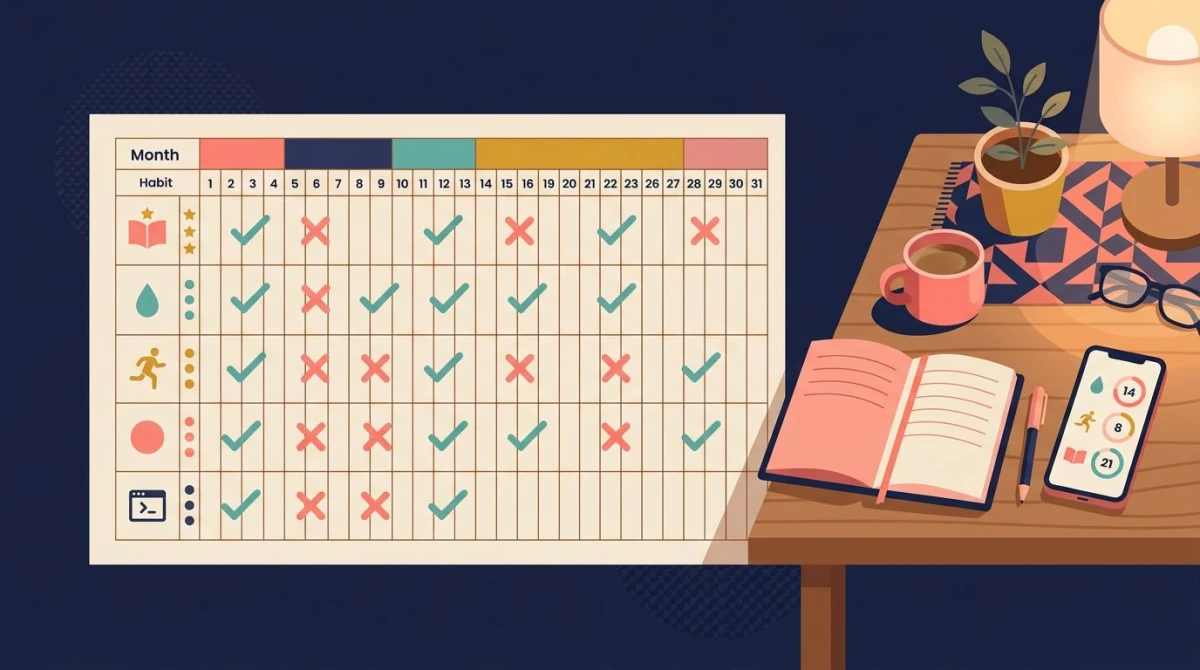
This is where a tracker earns its place. When you log the first rep back and watch the calendar heatmap start filling in again, you get instant proof you are moving. A tool like HabitBox is built for exactly this moment — a broken streak does not lock you out or shame you; it shows your overall consistency, so one gap in an otherwise strong month reads as what it is: a blip, not a failure.
How to prevent the next slip
Getting back on track once is a win. Not needing to do it every other week is the real goal. A few structural changes make future slips shorter and rarer.
Plan a small version of the habit for disrupted days and a realistic return after longer breaks. Travel, illness, and busy periods may require a pause. Review consistency across weeks instead of letting one streak number determine whether the plan is working.
The useful reframe is that a lapse calls for a next step, not a verdict on your ability. You can return after one missed day, two, or a longer break.
Slip scenario → fastest restart move
Different slips call for different first moves. Here is the quickest way back for the most common ones.
| Slip scenario | What went wrong | Fastest restart move |
|---|---|---|
| Missed one day | A gap in the record | Choose the next realistic opportunity to resume |
| Missed a full week | Momentum and cue both faded | Shrink to a 2-minute version and do it now |
| Fell off during travel | Environment and routine disrupted | Rebuild the cue at home before adding volume |
| Streak broke, feel like quitting | All-or-nothing spiral kicked in | Reframe as a batting average, log one rep |
| Keep restarting and re-quitting | The habit is designed wrong | Run the step-6 autopsy and move the cue/time |
FAQ
How do I get back on track with my habits?
Does missing a day ruin a habit?
What is the never-miss-twice rule?
How do I restart a broken streak?
Why do I keep falling off my routine?
Ready to make your comeback visible? HabitBox tracks your streaks and shows your overall consistency, so one missed day reads as a blip — not a reason to quit. Download it free and log your first rep back today.

Mira Hartwell
Editor, HabitBoxEditor at HabitBox. Writes about habit science and productivity, grounding every post in named research (Lally, Wood, Walker, Huberman) instead of recycled advice. Read full bio →