Implementation Intentions: The If-Then Formula (2026)
Implementation intentions are simple if-then plans that turn a goal into a concrete action. You pick a cue and a response, then write it as "When X happens, I will do Y" (also written as "If [situation], then [action]"). Decades of research show this small move gives a reliable boost to follow-through, because you decide in advance exactly when and where you will act. Instead of hoping you remember, you hand the decision to a specific moment.
What implementation intentions are
The term comes from psychologist Peter Gollwitzer, who made the case for it in a landmark 1999 paper in the journal American Psychologist. An implementation intention is a pre-commitment that links a specific situational cue to a specific goal-directed response. You write it in the form "If situation S occurs, then I will perform response R."
That structure does something clever. Most goals live in your head as vague wishes, like "I want to exercise more" or "I should read before bed." A wish has no trigger. An implementation intention attaches the action to a moment you can actually notice, so the cue does the remembering for you.
Gollwitzer described this as creating a strong mental link between a situation and a behavior. Once the link is set, the cue can prompt the action almost automatically, without you having to talk yourself into it each time. You front-load the decision so the moment of action is no longer a debate.
The reason this works is that you hand control of the behavior over to the situation. Gollwitzer called this strategic automaticity. You deliberately choose, in advance, to let a cue run the action instead of relying on willpower in the moment.
That matters because willpower and memory are unreliable when you are tired or busy. By pre-deciding when and where you will act, you no longer need to want it in the moment. The cue carries the weight, and the response follows because you already decided it would.
This is why if-then planning sits at the heart of so much modern advice on habit formation. You are not relying on motivation in the moment. You are relying on a plan you already made.
The science behind them
The evidence here is unusually solid. In Gollwitzer and Brandstätter's 1997 studies, people who formed a specific if-then plan for when and where to act were far more likely to follow through than people who only set a goal. Across these studies the plan-formers completed their intended tasks at roughly double the rate, or more, compared with the goal-only groups. Setting the goal was not enough. Specifying the moment was what moved the needle.
Why such a large gap? When you only hold a goal, you still have to decide, in some future moment, that now is the time to act. That decision often never comes, because you are busy, distracted, or simply forget. The if-then plan removes that step. The situation itself becomes the trigger.
The mechanism has two parts. First, writing the plan makes the cue mentally accessible. You have primed your mind to notice that exact moment, so it stands out instead of slipping past. Second, the action is pre-decided, so there is no deliberation left in the moment. The link between cue and response is already in place, and the behavior can start before doubt or distraction gets a vote.
The strongest single number comes from a later review. Gollwitzer and Sheeran's 2006 meta-analysis pooled 94 independent tests of implementation intentions and found a medium-to-large effect on goal attainment, d = 0.65. In plain terms, across a wide range of goals and people, forming an if-then plan reliably improved the odds of actually reaching the goal.
That effect held across many domains, from health behaviors to academic tasks to everyday chores. It is one of the better-replicated findings in behavior-change research, which is why it shows up in nearly every serious discussion of how change actually sticks.
This short explainer walks through the same idea and how to apply it:
The 3-part formula
Every implementation intention has three working parts. Get all three right and the plan tends to fire on its own. Leave one vague and it tends to stall.
| Part | What it is | Example |
|---|---|---|
| Cue / trigger | The specific situation that sets the plan in motion | "When my alarm goes off at 7 a.m." |
| Action / response | The exact behavior you will perform | "I will do 10 push-ups" |
| Context | The where and how that anchors it in real life | "Next to my bed, before I check my phone" |
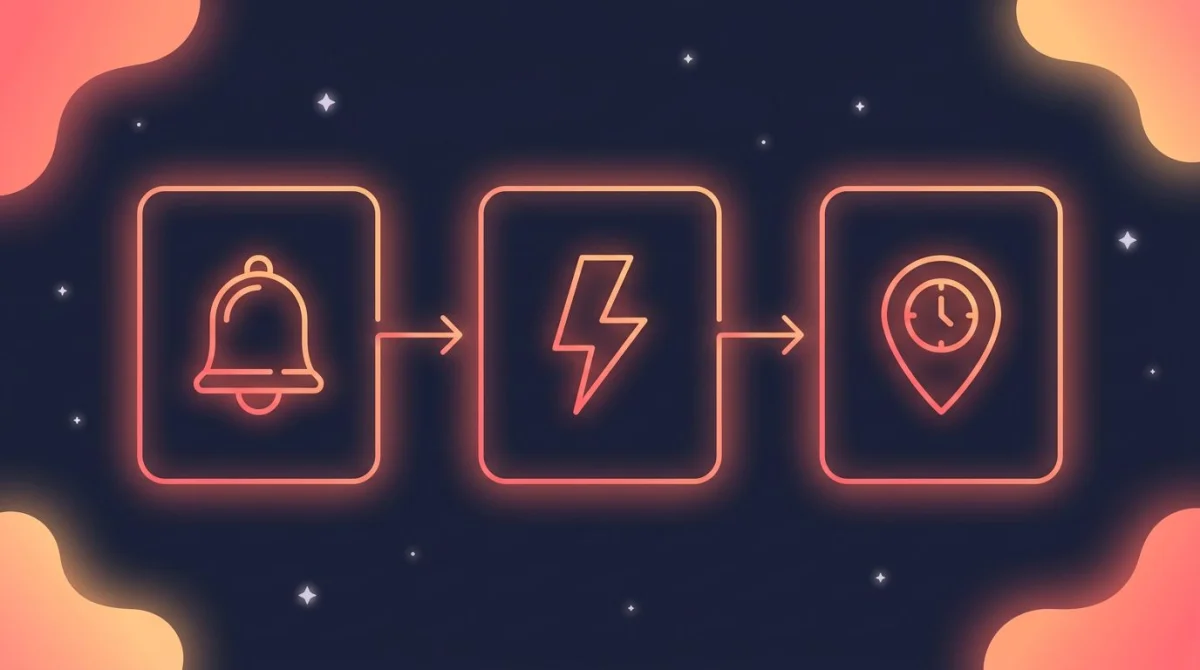
Read the three parts together and you get a full plan: "When my alarm goes off at 7 a.m., I will do 10 push-ups next to my bed, before I check my phone." Notice there is no wiggle room. The cue is a moment you cannot miss, the action is one clear behavior, and the context tells you the place.
The magic is in the specificity. "I will exercise more" has none of these parts. "When my alarm goes off, I will do 10 push-ups by my bed" has all three, and that is the difference between a hope and a plan.
10 implementation intention examples
The fastest way to learn the format is to see it across real situations. Here are ten plans spanning common goals. Notice how each cue is something you will clearly notice, and each action is one concrete step.
As you read, watch the pattern repeat. Every cue is a moment that already happens on its own, and every action is small enough to start without psyching yourself up.
| Domain | If (cue) | Then (action) |
|---|---|---|
| Exercise | If it is 6 p.m. on a weekday | Then I will put on my running shoes and walk for 20 minutes |
| Study | If I sit down at my desk after lunch | Then I will review flashcards for 15 minutes before anything else |
| Eating | If I open the fridge feeling hungry | Then I will eat a piece of fruit before anything else |
| Money / saving | If my paycheck lands on the 1st | Then I will move $50 into savings the same morning |
| Screen time | If I pick up my phone in bed | Then I will set a 10-minute timer and stop when it rings |
| Sleep | If the clock hits 10:30 p.m. | Then I will put my phone on the charger across the room |
| Hydration | If I refill my coffee | Then I will drink a full glass of water first |
| Work / focus | If I open my laptop in the morning | Then I will write my single most important task at the top of a note |
| Reading | If I get into bed | Then I will read two pages of my book before lights out |
| Mood / journaling | If I finish brushing my teeth at night | Then I will write one line about how my day went |
Copy any of these and swap in your own numbers. The structure is what carries the weight, not the exact wording. If a row almost fits, keep its cue and change the action to match your goal.
How they differ from goals
A goal and an implementation intention are not the same thing, and confusing them is where a lot of people get stuck. A goal is the what. It names the outcome you want: lose weight, save money, read more, sleep better. It points at a destination.
An implementation intention is the when, where, and how. It does not name the outcome. It names the moment you will take a step toward it. "Save more money" is a goal. "If my paycheck lands, then I move $50 to savings" is the plan that gets you there.
Picture the difference. Someone sets the goal "I want to read more this year" in January. By March they have read nothing, because no moment ever announced itself as reading time. The goal was real, but it never attached to a situation.
Give the same person an if-then plan: "If I get into bed, then I will read two pages before lights out." The goal has not changed, but now a cue arrives every night, and the reading happens because a moment triggers it.

A goal alone often fades; the same goal with an if-then plan gives the action a cue, so follow-through holds all the way to the target.
Goals are useful because they give you direction. But a goal on its own often stalls, because it never specifies the moment of action. You can want something badly and still never do it, simply because no particular situation ever cues you to start.
The fix is to pair them. Keep your goal as the headline, then write one or two if-then plans underneath it. The goal tells you where you are headed. The implementation intention tells you what to do at 6 p.m. tonight. If you want a deeper look at building that kind of follow-through, see how to be more disciplined.
How they relate to habit stacking
If if-then planning feels familiar, you may have met it under another name. James Clear's habit stacking, popularized in Atomic Habits, is a specific kind of implementation intention. The twist is the cue. Instead of using a time or a place as the trigger, you use an existing habit.
The habit stacking formula is "After I [current habit], I will [new habit]." Lined up against the if-then format, it reads as "If I have just finished [current habit], then I will do [new habit]." Same machinery, different choice of cue. The existing habit becomes the situation that fires the plan.
It helps to see the two side by side. A general implementation intention can hang on a clock time, a place, or an event. Habit stacking narrows that down to one cue type: a behavior you already do without thinking. So every habit stack is an implementation intention, but not every implementation intention is a habit stack.
This is a smart move because your established habits are some of the most reliable cues you have. You already brush your teeth, pour your coffee, and close your laptop every day, so anchoring a new behavior to one of those gives you a trigger that rarely fails. A clock time can be missed if your schedule shifts, but an existing habit happens in roughly the same way each day. You can read the full method in our guide to habit stacking, and you will find the same idea threaded through our Atomic Habits summary.
The takeaway is that habit stacking is not a competing technique. It is implementation intentions with a built-in cue, which is exactly why it works so well.
Common mistakes
Most failed if-then plans break for the same handful of reasons. Watch for these before you write yours.
- Vague cue. "When I have time" is not a cue, because that moment never reliably arrives. Trade the vague window for a concrete time, place, or event you cannot miss.
- Vague action. "Then I will be healthier" gives you nothing to do at the moment of the cue, because an outcome is not an action. Name one concrete behavior you could film yourself doing, like "do 10 push-ups."
- No clear context. Without a where, the plan floats and your brain has no place to attach it. The fix is to bolt it to a real location, like "at my desk" or "next to my bed."
- Stacking too many at once. Bolting five new actions onto one cue overloads it, and the whole chain collapses the first time you skip a link. Start with one and let it run reliably before adding another.
- Choosing an unreliable cue. If the trigger only happens some days, the plan only runs some days. Pick a cue that shows up every single day, ideally an existing habit or a fixed daily moment.
Fix the cue and the action, and most of these problems disappear on their own. Precision is the whole game.
5 fill-in-the-blank templates
Use these as starting points. Copy one, fill in the brackets, and you have a working plan in under a minute.
Before you fill in a template, choose a reliable cue. The best cue is something that already happens at the same time every day, like a meal, an alarm, or an existing habit. If you have to wonder whether it will show up, pick a different one.
- When it is [time] and I am [place], I will [action].
- After I [existing habit], I will [new action].
- If I notice [trigger or feeling], then I will [helpful action] instead.
- When [event] happens, I will [action] before I do anything else.
- If it is [day of week], then I will [action] at [time].
Once a plan works on paper, the next step is making sure the cue actually reaches you. Each if-then plan can be tracked as a daily habit in HabitBox, with the reminder time set to the cue, so the moment you planned for shows up on your phone instead of slipping past unnoticed.
Implementation Intentions FAQ
What is an implementation intention?
It is a specific if-then plan that links a situational cue to an action, in the form "If situation S occurs, then I will perform response R." The term comes from psychologist Peter Gollwitzer's research in the 1990s. Its purpose is to decide in advance exactly when and where you will act, so the moment itself prompts the behavior. By pre-deciding the action, you hand control of it to the cue and stop relying on willpower or memory in the moment.
How is it different from a goal?
A goal names the outcome you want, like "save more money." An implementation intention names the moment and the action that move you toward it, like "If my paycheck lands, then I move $50 to savings." Goals give direction, but they often stall without an if-then plan attached. The simplest approach is to pair them: keep the goal as your headline, then write one if-then plan underneath that tells you what to do and when.
How is it different from habit stacking?
Habit stacking is a type of implementation intention where the cue is an existing habit, written as "After I [current habit], I will [new habit]." A general implementation intention can use any cue, including a time, place, or event. So habit stacking is the same tool with one specific kind of trigger built in. It tends to be especially reliable because established habits happen at roughly the same time every day, which makes them dependable cues.
Do implementation intentions work for breaking bad habits?
Yes, and they tend to work best when the "then" replaces the unwanted behavior with a better one. A plan like "If I reach for my phone in bed, then I will put it on the charger across the room" gives you something specific to do at the trigger point. Naming the cue for the bad habit and pairing it with a clear replacement action is more effective than simply telling yourself to stop.
How many implementation intentions should I set at once?
Start with one, and add more only once it runs reliably on its own. Setting several at the same time splits your attention and makes each cue easier to ignore. A single well-chosen if-then plan that fires every day beats five plans you forget by Thursday. Once the first feels automatic, layer in a second, and the early win makes the next one easier to stick.

Mira Hartwell
Editor, HabitBoxEditor at HabitBox. Writes about habit science and productivity, grounding every post in named research (Lally, Wood, Walker, Huberman) instead of recycled advice. Read full bio →