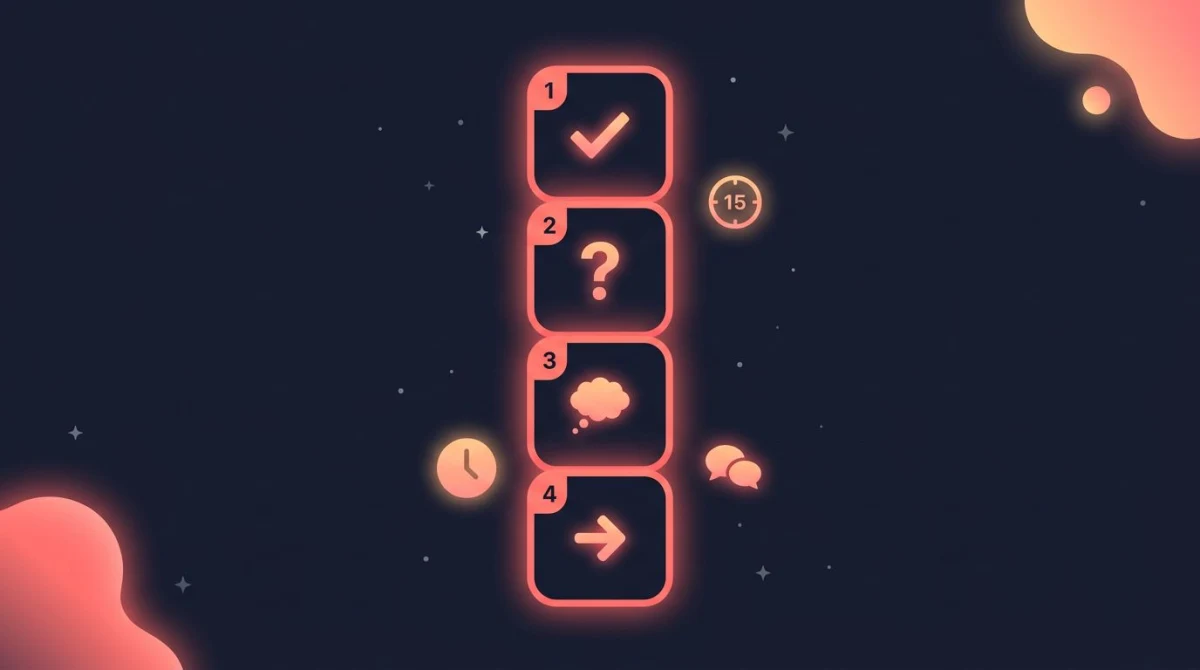
How to Be More Disciplined: 7 Daily Habits
People who look disciplined are rarely fighting harder than you. They have built a smaller, quieter system that does the fighting for them. Most of what looks like iron will is just a string of low-friction defaults: a fixed wake time, an outfit laid out, a phone in the other room. This guide pulls together what the behavior research says, the seven daily habits that compound into discipline, and the environment design that lets the habits work when motivation does not show up.
TL;DR
Self-discipline is not a fixed personality trait. It is the residue of seven daily habits running on top of an environment designed to make good choices easy and bad ones hard. The old "willpower as a muscle" framing (Baumeister 2011) has not held up well to replication — Hagger and colleagues' 2016 meta-analysis (PubMed) of ego depletion studies found the effect close to zero. Real driver: habit + context. Plan on about 60 days to install the foundation; expect it to keep compounding from there.
The willpower myth
For a decade, the dominant story was that willpower is a limited resource. Use it on hard email in the morning, and there is less for the gym after work. Roy Baumeister's ego depletion experiments framed self-discipline as a kind of muscle that fatigues and recovers.
The replication picture is rougher. Hagger et al.'s 2016 multi-lab study ran the ego-depletion protocol across 23 labs and found an effect size near zero. Later meta-analyses have produced mixed results. Even Baumeister has acknowledged in interviews that the original effect is smaller than first thought and depends heavily on a person's beliefs about willpower.
The takeaway is not "willpower is fake." The takeaway is: depending on willpower as your main tool is fragile. The disciplined people you know are mostly using something else.
That something else has two parts. Habit — behaviors so automatic they do not need a decision. Wendy Wood's Good Habits, Bad Habits (2019) makes the case that around 43% of daily behavior is habitual, not chosen. Environment — the cues, friction, and defaults that shape what is easy. James Clear's Atomic Habits (overview, 2018) is the cleanest popular treatment.
The seven habits below install both layers.
How to be more disciplined: the 7 daily habits
| # | Habit | Effort | Compounding speed |
|---|---|---|---|
| 1 | Fixed wake time | Medium | Fast |
| 2 | Decide tomorrow's top 3 tonight | Low | Fast |
| 3 | One small hard thing daily | Medium | Slow but durable |
| 4 | Track one keystone habit | Low | Fast |
| 5 | 10-minute end-of-day review | Low | Slow |
| 6 | One weekly refusal | Low | Slow |
| 7 | Protected sleep window | High | Very fast |
1. Fixed wake time
Pick the same wake time every day, including weekends, within 30 minutes. The aim is not to be a 5 a.m. zealot. The aim is to remove the daily negotiation about when the day starts.
Why it works. A fixed wake time anchors the rest of the day. It stabilizes sleep timing, which the APA's primer on willpower notes is one of the strongest predictors of next-day self-regulation. People who wake at random times use up the morning re-deciding the rest of the schedule.
How to apply it. Pick a wake time you can hold seven days a week. Set the alarm across the room so getting out of bed is mechanical, not optional. Give it three weeks. The morning negotiation will go quiet.
2. Decide tomorrow's top 3 tonight
The single most expensive moment in a day is the first one. If you wake up and decide what matters that morning, you have already burned half your starting reserves.
What to do. The night before, write down three things — only three. The first is the single most important task. The other two are next-most-important. Write them on paper or in a note app. Read them once before bed and once at the start of the next day.
Why it works. Pre-deciding shifts the decision out of the moment of weakness (groggy, tempted, distracted) into a calmer moment (planning at night). It also forces a triage that vague to-do lists do not.
3. One small hard thing daily
Pick a single small action that is uncomfortable on purpose. Cold shower for 60 seconds. 25 pushups. A no-phone hour. A 10-minute walk in the cold. The point is not the specific thing; the point is the daily contact with mild discomfort.
Why it works. Zen Habits author Leo Babauta calls this discomfort training — voluntarily pushing into discomfort builds tolerance for the bigger discomforts you will face by accident. The neuroscience reading is similar: predictable, low-stakes exposure to discomfort builds the prefrontal-cortex pathways that handle larger stressors.
The trap. Make the hard thing too big and you will skip it on a tired day. 60 seconds of cold water is repeatable. A 90-minute workout in the rain is not.
4. Track one keystone habit
You cannot improve what you do not see. Pick one habit that, when done, makes other behaviors easier — what Charles Duhigg called a keystone habit. Common keystones: a morning workout, daily reading, a journaling session, a fixed dinnertime.
Why it works. A visible streak creates loss aversion. Day 4 is easy to skip; day 48 is not. The visual streak is doing the same job a willpower-driven person tries to do with grit. Apps like HabitBox keep a daily streak and a calendar heatmap on iOS and Android, which makes the chain hard to ignore. The tracking-habits guide covers why streaks beat hour-counts for behavior change.
5. 10-minute end-of-day review
A short review at the close of the day does three things: it surfaces what worked, it logs what failed and why, and it sets up tomorrow's top 3.
Format. Ten minutes. Three lines. What got done. What got skipped, and why. What is the single most important thing for tomorrow. That is the entire ritual.
Why it works. Without a review, today's lessons evaporate. With one, you start spotting your own patterns — which time of day you fade, which days the gym slips, which environments wreck your focus. The review is the feedback loop that lets the system improve itself.
6. One weekly refusal
This one is subtler. Once a week, decline something you would normally say yes to — an invitation, a meeting, an extra commitment, a project — for the explicit reason that it does not fit your priorities.
Why it works. Discipline is partly the muscle of saying no. People who never refuse anything are not free; they are over-committed. A weekly refusal keeps the muscle active. It also clarifies what you actually value, because each refusal is a small statement of priorities.
The note. The refusal should be polite, brief, and honest. "I can't take this on right now" without elaborate justifications. Justifications invite negotiation.
7. Protected sleep window
Sleep is the foundation everything else stands on. Sleep-deprived people score worse on every measure of self-control, attention, and emotional regulation. The discipline you appear to have at 7 hours of sleep is mostly absent at 5.
How to apply it. Pick a sleep window (e.g., 11 p.m. to 7 a.m.). Treat it like a meeting on your calendar. Defend it with the same firmness you would defend a flight time. The sleep-hygiene checklist covers the supporting setup.
Why it works. Walker's Why We Sleep (2017) summarizes the research bluntly: every metric of self-regulation, mood, decision quality, and physical capacity worsens with shortened sleep, and improves with restored sleep. No discipline practice survives chronic sleep debt.
Environment design: the secret weapon
Habits are the first layer. Environment is the second, and it is what lets the habits run on tired days. James Clear sums up the rule in Atomic Habits: make good behaviors easier; make bad ones harder. Wendy Wood's research on habit cues shows the same pattern: the visible environment cues most of what we do.
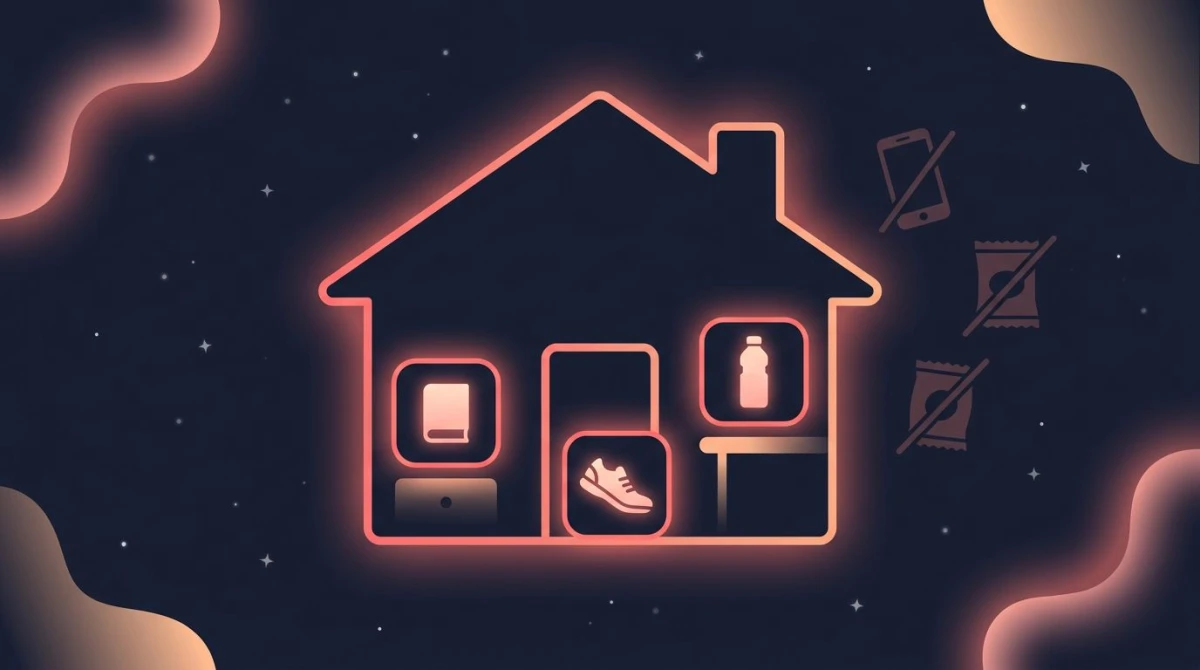
5 friction tweaks that change behavior
- Phone in another room. The single highest-leverage move. Out of sight removes 80% of the temptation. Charge it in the kitchen, not on the nightstand.
- Workout clothes laid out the night before. Reduces the morning decision to "put on the shirt." Doubles or triples adherence in most informal trials.
- Junk food off the counter, fruit on the counter. Wood's research confirms: counter-top visibility is destiny. Put what you want to eat where your hand goes first.
- One website blocker installed before week one. Choose Freedom, Cold Turkey, or your OS's built-in screen-time controls. Block the two sites that eat the most of your day.
- Default tab to a tool, not a feed. Set the new-tab page to a notes app or a calendar. The unconscious instinct to open social media gets redirected by the page that loads.
The pattern. None of these require willpower. They lower the cost of the good behavior or raise the cost of the bad one until the easy default flips.
The 60-day discipline build
You do not install seven habits at once. The realistic build is roughly two months.
Month 1 — install the foundation
- Week 1: Fixed wake time. Sleep window. Phone out of the bedroom. That is it.
- Week 2: Add the nightly top-3 list. Begin tracking one keystone habit.
- Week 3: Add the small daily hard thing (start tiny — 60 seconds of cold water, 10 pushups).
- Week 4: Add the 10-minute end-of-day review. Adjust the keystone habit if it has not stuck.
Month 2 — layer harder behaviors
- Week 5: Begin the weekly refusal.
- Week 6: Add a second friction tweak (junk food off counter, website blocker).
- Week 7: Increase the difficulty of the small hard thing (60 → 90 seconds, 10 → 20 pushups).
- Week 8: Audit the system. Drop one habit if it is dragging the rest down. Strengthen the survivors.
The system does not look impressive at the end of 60 days. It looks ordinary. That is the point. Ordinary repeats. Heroic does not.
This timeline pairs well with habit stacking (anchor each new habit to an existing one) and the identity-based habits framing (every completed habit is a vote for who you want to become).
When NOT to push discipline
Discipline is not self-punishment. Three states make the routine erode rather than build.
Sleep deprivation. Under 6 hours for several nights impairs the prefrontal cortex. Recover sleep first; resume discipline second.
Acute illness or injury. Insisting on a 5 a.m. workout with the flu is not discipline. Drop to the smallest version until recovered.
Grief or major loss. During grief, the routine is survival — eat, sleep, drink water. Heroic discipline can wait.
The rule: discipline protects your time during normal life. It should not override your body's signals when life is not normal.
A note on motivation
Motivation is not what disciplined people have more of. It is what they have managed to stop needing. Motivation is a feeling. Feelings are unreliable. The right question is not "how do I get more motivated?" It is "how do I make the behavior small enough, the cue clear enough, and the environment frictionless enough that I do not need motivation to act?" Every habit above is built around that question.
Common pitfalls
Going too big, too fast. Trying to install all seven habits in week one is the most reliable way to abandon them by week three. Pick the wake time and the sleep window first. Build from there.
Treating slips as failure, with no accountability. A missed day is a data point, not a verdict — Lally 2009 (habit-formation guide) found occasional misses do not reset the automatization curve. The system survives misses; it does not survive quitting. If solo follow-through is the bottleneck, an accountability partner and a weekly 15-minute check-in close the loop — pair the tracking habits practice with a short Friday sync to a friend.
Pairing with self-criticism. Discipline built on shame is brittle. It collapses under the first stressor. Build it on identity ("I am someone who reads daily") rather than self-judgment.
FAQ
How long does it take to build self-discipline?
Is self-discipline genetic?
Discipline vs motivation: what is the difference?
Discipline vs willpower: which one matters more?
What is the best book on self-discipline?
The takeaway
Discipline is not a personality. It is a quiet system of habits running on top of an environment designed to make the right things easy. Start with the wake time and the sleep window. Add a tracked keystone habit. Pre-decide tomorrow tonight. Run the system for 60 days, then layer the harder behaviors. When in doubt, lower the friction rather than raise the willpower.
The disciplined people you admire are not stronger than you. They are running a smaller, quieter system. You can build the same one.

Mira Hartwell
Editor, HabitBoxEditor at HabitBox. Writes about habit science and productivity, grounding every post in named research (Lally, Wood, Walker, Huberman) instead of recycled advice. Read full bio →