Sleep Hygiene Checklist: 12 Daily Habits (2026)
TL;DR. A sleep hygiene checklist works when 4 to 6 of its 12 items become daily habits — not when you try to do all twelve at once. Pick a fixed wake time, dim the lights 60 minutes before bed, and cap caffeine by 2 p.m. Most people notice better sleep within two weeks of consistent tracking (Walker, Why We Sleep, 2017; CDC).
If you keep reading sleep tips and still wake up tired, the issue is rarely the list. It's the habit part. Most checklists hand you twenty rules with no plan for making them stick.
This guide gives you a 12-item checklist split AM/PM, the science behind each item, and a 7-day starter plan you can track. We pull from CDC guidelines, the Harvard Medical School Division of Sleep Medicine, and Matthew Walker's Why We Sleep.
Sleep hygiene supports rest, but it isn't medical care. If poor sleep lasts more than a few weeks, talk to a clinician.
What a sleep hygiene checklist is
A sleep hygiene checklist is a short, repeatable set of behaviors that protect your sleep — the environmental and lifestyle choices that make falling and staying asleep easier, like a consistent schedule, light exposure, and a wind-down routine.
It's a baseline, not a treatment — small daily inputs that compound. The American Academy of Sleep Medicine and the CDC both publish guidance, and the items overlap by about 80%. The same dozen behaviors keep showing up.
The science: why these habits work
Three mechanisms explain why a sleep hygiene checklist changes how you feel.
1. Light is the master clock. Your circadian rhythm is set primarily by light hitting your eyes. Bright morning light pulls bedtime earlier; evening light, especially blue wavelengths from screens, pushes it later. A 2014 PNAS study found that reading on a light-emitting device before bed delayed melatonin onset by about 1.5 hours and reduced morning alertness, even after 8 hours in bed.
2. Adenosine builds up while you're awake. Adenosine is the chemical that creates "sleep pressure" — the heaviness you feel by 10 p.m. Caffeine blocks adenosine receptors and has a half-life of roughly 5 to 6 hours, so an espresso at 4 p.m. is still doing meaningful work at 10 p.m. (NHLBI).
3. Conditioning ties context to sleep. When the bed only ever means sleep (not work, not scrolling), lying down becomes its own cue to wind down. This is the principle behind cognitive-behavioral therapy for insomnia (CBT-I), which has decades of clinical evidence behind stimulus control as a core technique.
Sleep hygiene works on the same systems clinicians use in evidence-based treatment — just at a lifestyle scale.
For a clinician-led overview of the same mechanisms — light, adenosine, conditioning — and what to actually change first, this short walkthrough is the cleanest 5-minute primer:
The 12-item sleep hygiene checklist
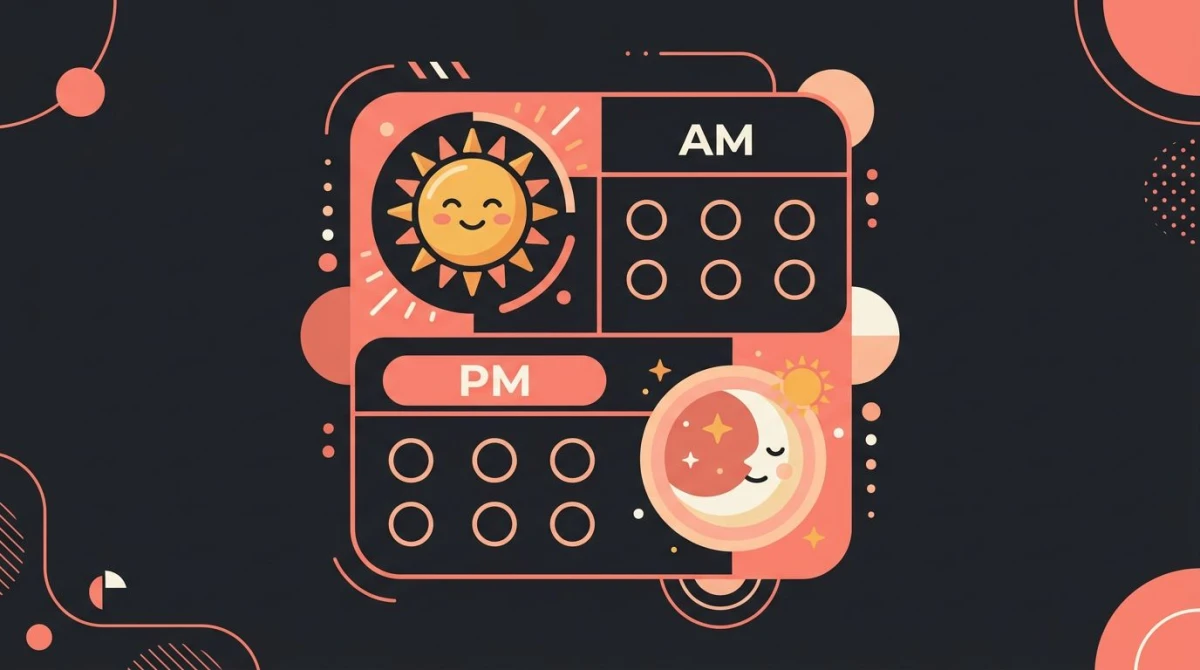
Six morning items, six evening items. Each row tells you what, when, and how hard it is to start.
| # | Habit | When | Difficulty |
|---|---|---|---|
| 1 | Wake at the same time, weekends included | Within 30 min of alarm | Hard |
| 2 | Get 5–10 minutes of outdoor light | First hour awake | Easy |
| 3 | Move your body, even briefly | Morning or early afternoon | Medium |
| 4 | Cap caffeine | By 2 p.m. (12 p.m. if you're sensitive) | Medium |
| 5 | Eat your last large meal 3 hours before bed | Late afternoon / early evening | Medium |
| 6 | Keep naps short and early | Before 3 p.m., under 30 min | Easy |
| 7 | Dim household lights 60 min before bed | Wind-down zone | Easy |
| 8 | Put screens down 30 min before bed | Wind-down zone | Hard |
| 9 | Set the bedroom cool, dark, quiet | Before bed | One-time setup |
| 10 | Run a short wind-down ritual | 15–20 min before bed | Medium |
| 11 | Skip alcohol within 3 hours of bed | Evening | Medium |
| 12 | Use the bed only for sleep | Always | Easy once set |
A note on item 11: alcohol can knock you out, but it fragments REM sleep and causes wake-ups later in the night (Sleep Foundation). Even a single evening drink can show up as a worse night.
How to actually build the habit
You won't run all twelve from day one. That's the trap. Pick three. Anchor each to something you already do every day — a method James Clear calls habit stacking and BJ Fogg calls anchoring in his Tiny Habits work.
Step 1: Pick the keystone — a fixed wake time. Set the same alarm for seven days, weekends included. Everything else gets easier when your wake time is steady, because your circadian rhythm finally has a stable reference point. Walker calls a regular schedule the single most powerful sleep lever you have.
Step 2: Add a morning light cue. After your alarm goes off, step outside or near a window for 5 to 10 minutes. If you have coffee, drink it there. The pairing turns light exposure into an automatic habit.
Step 3: Add an evening anchor 60 minutes before bed. Pick one trigger — finishing dishes, brushing your teeth, putting on pajamas — and let it start your wind-down. Dim lights, no screens, low-stim activity.
Step 4: Add one habit a week. People who add slowly keep five or six items long-term. People who try all twelve in week one keep zero. This matches Phillippa Lally's UCL habit-formation study, where new habits took a median of 66 days to become automatic — but only when the daily input was small enough to repeat.
Step 5: Track it. A checklist that lives in your head doesn't survive a busy week. Print it, write it on a sticky note, or use a habit tracker. The act of checking off the box matters more than the medium.
A 7-day starter plan you can track
This is the ramp. Don't add new items mid-week — let each one settle.
| Day | What to do | What to track |
|---|---|---|
| 1 | Set fixed wake time. Set alarm. | Did I wake within 30 min of alarm? Y/N |
| 2 | Same wake time. Add 5 min outdoor light after alarm. | Wake on time? Y/N. Light? Y/N |
| 3 | Same two items. Move your body 10 min. | Three habits, three checkboxes |
| 4 | Add caffeine cutoff at 2 p.m. | Four checkboxes |
| 5 | Add 60-min wind-down anchor. Dim lights. | Five checkboxes |
| 6 | Add no screens 30 min before bed. | Six checkboxes |
| 7 | Review the week. Note which habits stuck. Drop one if needed. | Weekly review |
After day 7, you have a working baseline. Add items 7 through 12 one per week from there. By week six you're running the full checklist — and the items feel like routine, not effort.
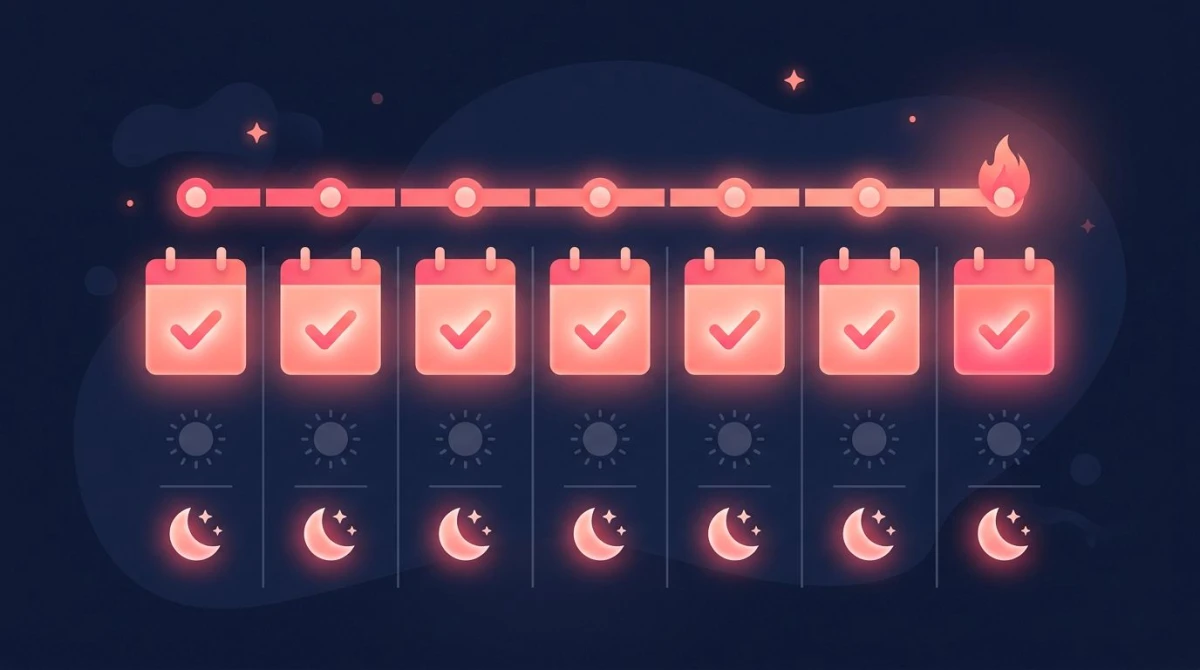
If you'd rather not redraw a tracker every week, a habit app lets you set the twelve checklist items as separate daily check-ins and watch them on a calendar heatmap. The streak view is the part that matters — you can see at a glance which two or three habits you're skipping, which is usually where the sleep problem actually lives.
When it doesn't work: missed days and recovery
You will miss days. Travel, illness, a hard week, a kid waking up at 3 a.m. — the checklist will break. What you do next is the part that matters.
The "never miss twice" rule. From James Clear's Atomic Habits: missing once is an accident, missing twice is the start of a new habit. If yesterday went sideways, don't make it up. Do today.
Don't try to catch up on sleep all at once. Sleeping ten hours on Saturday after a short week fragments the next night. Better: shift your wake time forward by no more than 30 minutes and protect tonight's bedtime.
Drop the weakest habit first. If the checklist feels heavy, audit what you're tracking. Six items you actually do beats twelve you write down and ignore.
Watch for sleep that doesn't recover. This checklist is a habit tool, not a diagnostic. If you keep the routine for three to four weeks and still feel exhausted, wake repeatedly during the night, or struggle to function during the day, that's a signal to talk to a clinician. The NHS sleep guide and the APA's sleep page both note that ongoing sleep problems often need professional input — and that's a normal step, not a failure of habits.
Habit trackers vs sleep trackers
A habit tracker and a sleep tracker answer different questions. A sleep tracker (a wearable, a sleep-staging app) measures the outcome — hours, stages, awakenings. If you're not sure what those numbers should be, our free sleep need calculator shows how many hours you need by age plus deep and REM stage targets to aim for. A habit tracker measures the inputs — did you cap caffeine, dim lights, hold your wake time. Most people benefit from tracking the inputs first, because outcomes are noisy and inputs are controllable. Use the calendar heatmap view in any tracker to spot the weeks where things slipped.
Frequently asked questions
How long does sleep hygiene take to work?
What's the single most important sleep hygiene habit?
Does sleep hygiene work for shift workers?
What if my partner has a different schedule?
How is sleep hygiene different from CBT-I?
Putting it together
A sleep hygiene checklist is only as useful as the habits it builds. Start with three items. Anchor each to something you already do. Track them daily for a week before adding anything new.
If you want a simple way to run the checklist without paper, HabitBox lets you set up the twelve habits as daily check-ins with reminders and a streak view — free to start on iOS and Android, with Plus for the full list. Pair it with a morning routine that includes light exposure and you've covered the two highest-leverage items on the list.
The good news: the checklist doesn't have to be perfect. It just has to be running.

Mira Hartwell
Editor, HabitBoxEditor at HabitBox. Writes about habit science and productivity, grounding every post in named research (Lally, Wood, Walker, Huberman) instead of recycled advice. Read full bio →