Anxiety Journal: How to Start a Daily Practice (2026)
TL;DR. An anxiety journal is a short daily writing practice — five minutes is enough — where you name what you are worried about and what is true about it. Four formats work: free-write, thought record (CBT-style), worry postponement, and gratitude shift. The research traces to James Pennebaker's 1997 expressive writing studies and decades of APA-cited reviews. A journal is a habit, not a treatment — if anxiety is interfering with sleep, work, or relationships, please loop in a clinician.
Most people who try an anxiety journal stop within two weeks. That is rarely about willpower — it is a design problem. The journal is too long, the prompt too vague, the cue missing. This guide fixes that with four formats, a seven-day starter plan, and a missed-day rule that keeps the chain alive.
What is an anxiety journal?
An anxiety journal is a short writing practice where you put anxious thoughts on the page so they stop running on a loop in your head. Formats range from open ("write whatever is loud") to structured ("situation, thought, evidence, reframe"). The shared mechanism is externalization — moving a thought out of working memory and onto something you can look at.
The strongest evidence comes from James Pennebaker's expressive writing research. People who wrote about emotional topics for 15 to 20 minutes a day, three to four days in a row, showed measurable reductions in stress markers and improvements in mood weeks later. A modern anxiety journal trades intensity for cadence — five minutes every day, not 30 once a week.
The science: why writing about worry helps
Expressive writing. Pennebaker's 1997 paper and decades of replication suggest putting feelings into words helps the brain process them. The APA's coverage put it simply: "the act of writing is more powerful than people realize."
Cognitive reappraisal. A thought record is essentially a paper version of CBT's reappraisal step. The APA's overview of anxiety lists CBT among the best-studied approaches. One row a day is not therapy, but it is a skill you build by repetition.
Tiny habits. BJ Fogg's Tiny Habits shows new behaviors stick when effort stays below motivation on a bad day. A five-minute floor clears that bar. James Clear's Atomic Habits makes the same point: make it obvious, easy, satisfying.
Combined, these three threads explain why a single index card and 5 minutes a day can rival a more elaborate intervention. The format below is what closes the gap between intent and action.
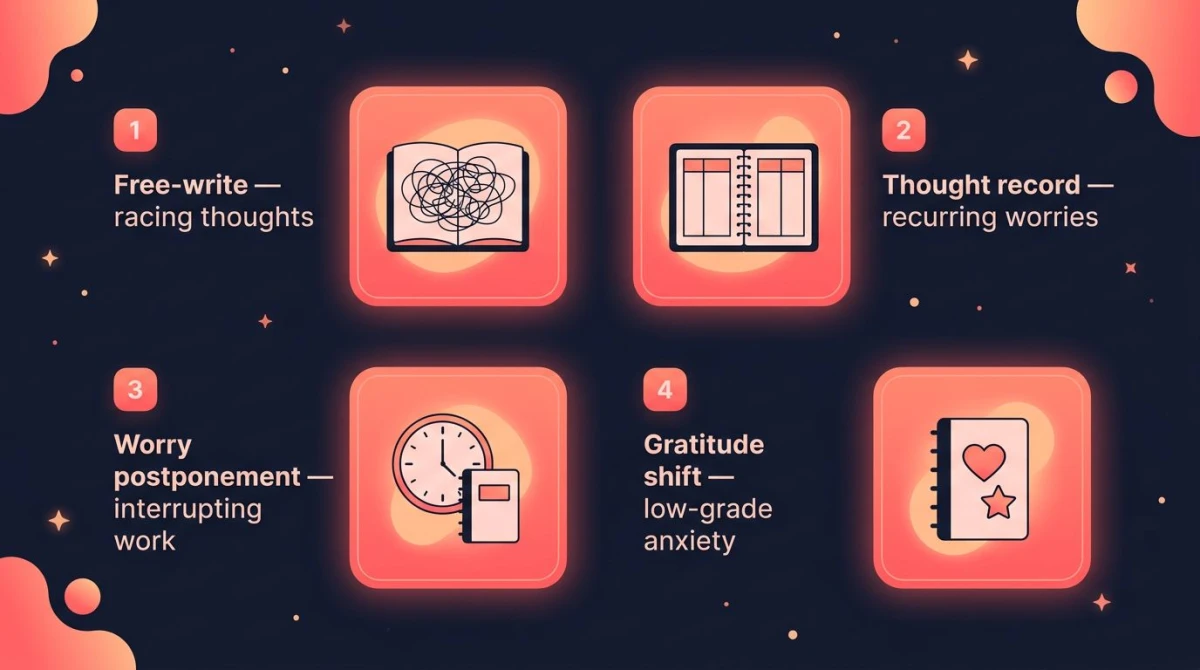
Four anxiety journal formats compared
Pick one. Starting with one means you only decide what to fill in, not what to write.
| Format | Best for | Time / day | Sample prompt |
|---|---|---|---|
| Free-write | Racing thoughts, unclear what is wrong | 5 min | "What is loudest in my head right now?" |
| Thought record | Recurring specific worries | 5–7 min | "Situation / thought / evidence for / against / kinder version" |
| Worry postponement | Worry that interrupts work or sleep | 5 min | "Three things to worry about later, and when I'll come back" |
| Gratitude shift | Low-grade anxiety, rumination | 3–5 min | "One thing that went okay, one thing I'm bracing for" |
Free-write has the lowest friction for beginners. The thought record gives the most structure when worry circles one topic. Worry postponement — "scheduled worry" — appears in the NHS self-help guide for generalized anxiety. For the gratitude shift, a gratitude journal app with daily prompts removes the blank-page problem entirely.
How to actually build the habit
You need a cue, a small first action, and a way to see your consistency.
For a practical, clinician-style reality check on whether journaling actually moves the needle before you commit to a 5-minute daily slot, this short walkthrough is a clean primer:
- Pick one anchor moment. Tie the journal to something you already do — coffee, brushing teeth, charging your phone. "After I pour my morning coffee, I will write for five minutes."
- Set a five-minute floor, not a goal. The floor is the smallest version that counts — one prompt, even one sentence on a hard day.
- Pre-decide your prompt for the week. Use one format daily for seven days. Decision fatigue kills new habits.
- Track the check-in, not the word count. Marking the day "done" is the visible feedback that keeps the chain going.
- Keep the journal where the cue happens. Friction is the silent killer of habits.
- Re-read once a week, not every day. Daily re-reading tends to feed rumination.
For more on anchor cues, see habit stacking.
A 7-day starter plan
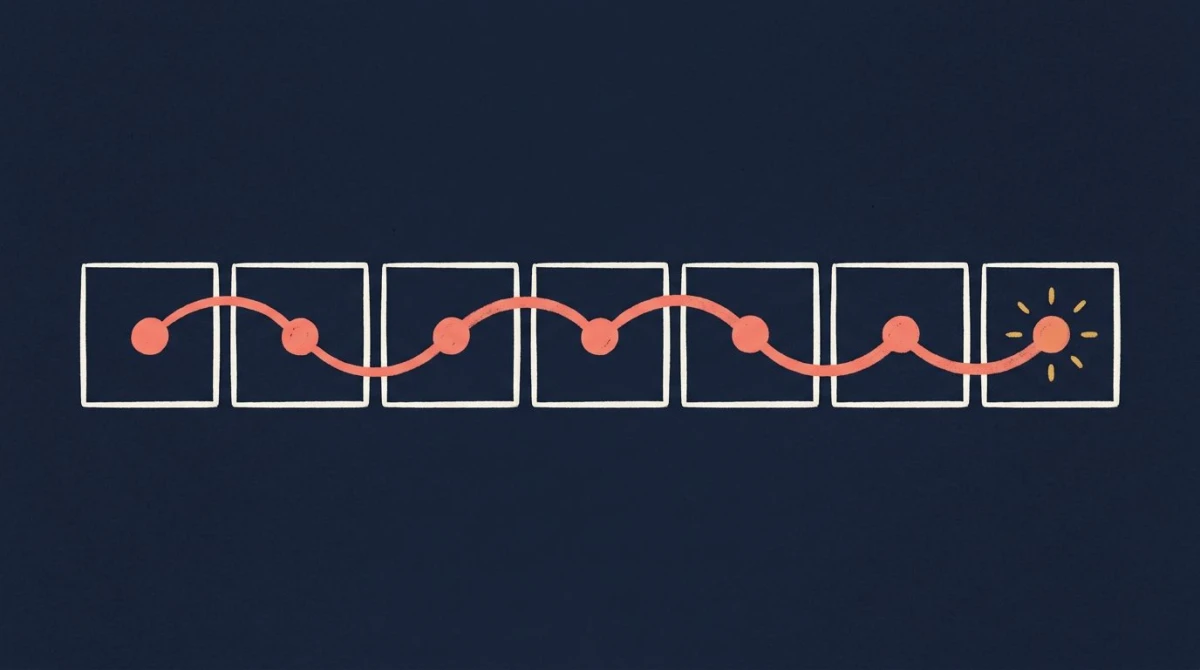
Free-write format, one question per day, five minutes.
- Day 1. "What is loudest in my head this morning?"
- Day 2. "What am I bracing for, and what is the most likely outcome?"
- Day 3. "What did I worry about yesterday that did not actually happen?"
- Day 4. "What does my body feel like right now? Where is the tension?"
- Day 5. "If a friend told me what I am about to write, what would I say to them?"
- Day 6. "What is one small thing within my control today?"
- Day 7. "Looking back at this week — what kept coming up?"
Day 7 is the review. Most people find one or two themes repeat three or four times. That becomes the prompt for week two.
When the habit slips: the missed-day rule
You will miss a day. What decides whether the habit survives is what you do the day after.
The rule, from James Clear: never miss twice. One missed day is a data point. Two in a row is the start of a new habit — the habit of skipping. If you miss Tuesday, the goal for Wednesday is one sentence. Mark it done and break the pattern.
From BJ Fogg: shrink, do not skip. On a hard day, write one line. The brain distinguishes between "showed up" and "didn't" — not between five minutes and one.
Paper or app — does it matter?
Less than you think. Paper is slower, tactile, private. Apps are faster and searchable, but live on the same device as your notifications.
A useful middle path: keep the journal on paper, track the check-in in a habit app. Writing stays analog; the streak goes digital. If you also want to log how you feel each day alongside the writing, a dedicated mood tracker app is the other common pairing. A tracker like HabitBox handles the streak side — add "anxiety journal" as one habit, tap it after writing, watch the streak grow. If you have not started journaling at all yet, our how to start journaling guide is the gentler on-ramp.
Speaking instead of writing. Pennebaker's finding is about putting feelings into words — not into typing specifically. When thoughts are racing, talking is usually easier than composing sentences, and dictation gets them out at speaking speed. macOS Dictation (press Fn twice) and Windows (Win + H) both do this for free; VoiceSnap Pro is an early-access alternative that turns a held shortcut into punctuated text in whatever window is already open. Two caveats worth knowing: you need somewhere private enough to say the words out loud, and most dictation tools — VoiceSnap included — send that audio off your device to transcribe it before discarding it. For the entries you would not want leaving the room, paper is still the safest format.
When to talk to a clinician
An anxiety journal is a self-regulation habit, not a substitute for therapy. It pairs well with treatment — many therapists assign thought records as homework — but on its own it is a coping tool. If anxiety is making it hard to sleep most nights, do your job, or shows up as panic attacks, talk to a clinician. The NIMH's overview of anxiety disorders is a starting point.
Frequently asked questions
What exactly is an anxiety journal?
How long should I journal each day?
When is the best time to journal for anxiety?
Is paper or an app better?
What are good prompts to start with?
Can journaling make anxiety worse?
Build the habit, not the perfect journal
The honest version: the writing matters, but the showing up matters more. Five minutes a day, same anchor, same format for at least a week. Chase the streak, not a beautiful entry.
Once the cadence is in place, the words take care of themselves. Patterns surface, the same worry shows up four days in a row, and a piece of the loop loosens. That is consistency working the way the habit-formation research says it should. If you want a quiet way to track the check-in, HabitBox keeps it simple — one tap after you write, data stays on your device.

Mira Hartwell
Editor, HabitBoxEditor at HabitBox. Writes about habit science and productivity, grounding every post in named research (Lally, Wood, Walker, Huberman) instead of recycled advice. Read full bio →