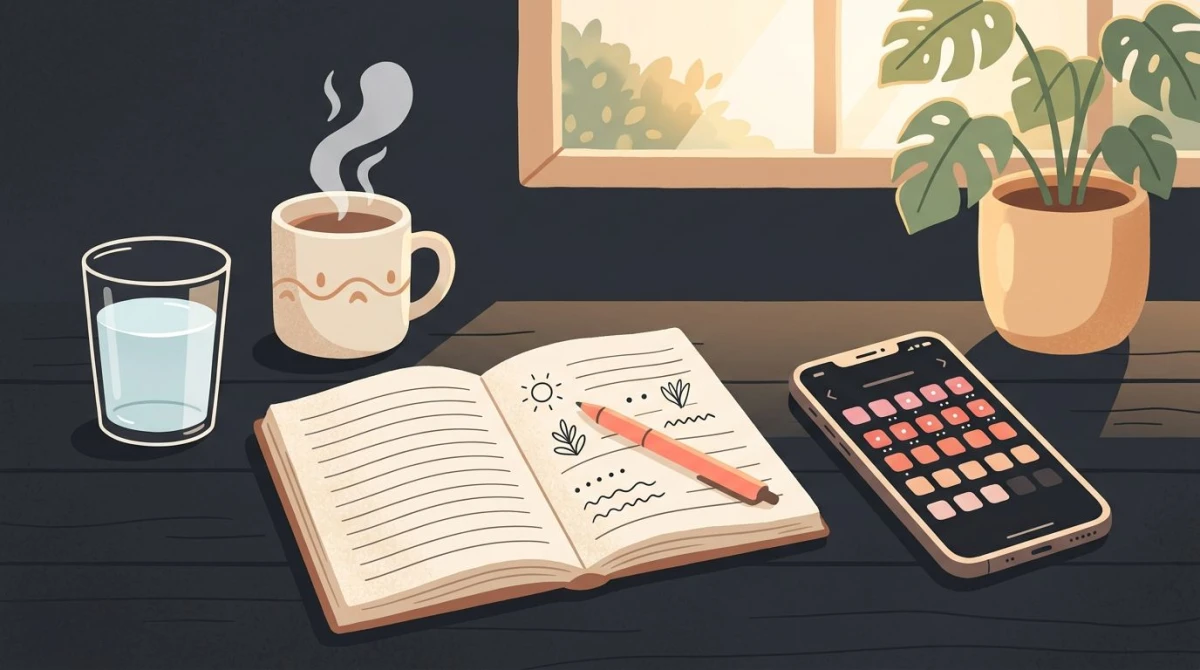
Anxiety Morning Routine: 15-Min Habit Stack (2026)
TL;DR. A 15-minute anxiety morning routine works best as a habit stack: 5 minutes of morning light, a glass of water, 2 minutes of box breathing, a 3-minute body scan, and one written line of intent. The full sequence takes about a quarter hour and pairs onto your wake-up cue. Most people feel a small shift in 5 to 7 days of consistent practice, with bigger gains over a few weeks (Hofmann et al., 2010 meta-analysis; Harvard Health on breath control). This is lifestyle support, not a treatment for an anxiety disorder.
This guide is lifestyle support. It is not a substitute for treatment of an anxiety disorder. If your symptoms are severe, persistent, or getting worse — talk to a clinician. In the US, 988 Suicide & Crisis Lifeline is free and confidential. The NHS self-help page for generalised anxiety is a reasonable starting point in the UK.
If you wake up with a knot in your chest before your feet hit the floor, you are not alone. Morning anxiety is its own pattern — driven by a cortisol spike that peaks in the first 30 to 45 minutes after waking, mixed with anticipation of the day ahead. The good news is that a short, structured routine can work with that biology instead of against it.
This guide gives you the full 15-minute stack, the science behind why each step works, a 7-day starter plan you can track on your phone, and a recovery rule for when you miss a morning. Nothing fancy. Nothing magical. Just five anchors that fit between alarm and shower.
Quick triage — which anxiety pattern is this?
The five-step stack works as written for most readers, but the dial moves depending on which morning anxiety pattern you experience. The short version, before you read further:
- Anticipatory anxiety (worry about the day ahead, restless mind, "I haven't even started and I'm already behind") → spend more time on breath + intent, less on body scan. Skip ahead to adapting the stack for the tuned version.
- Generalised morning dread (heavy, low, hard to start, body feels weighted) → front-load morning light. Outdoor light is the highest-leverage step for this pattern.
- Panic-leaning anxiety (chest tightness, racing heart, dizziness on waking) → skip the body scan for the first two weeks and replace it with sensory grounding (5-4-3-2-1). Body scan and other interoceptive exercises can amplify physical sensations during a high-arousal state — only add them once your baseline arousal drops. If panic attacks are severe or frequent, talk to a clinician; CBT for panic disorder is well-evidenced and works fast.
If you are not sure which pattern fits, run the stack as written for one week. The pattern usually becomes obvious by day three.
What an anxiety morning routine actually is
An anxiety morning routine is a short, repeatable sequence of calming behaviors you do in the same order, at the same time, every morning. The point is not to eliminate anxiety. The point is to give your nervous system a familiar runway in the most volatile 30 minutes of your day.
Most published advice frames this as a list of healthy ideas — drink water, breathe, journal, walk. That is not wrong, but it is not a routine. A routine is an ordered sequence with anchor cues that runs even when your willpower is low. Done right, the routine becomes nearly automatic in two to three weeks, and that automaticity is the whole point.
A useful anxiety morning routine has three properties:
- It is short enough to do on your worst morning (under 20 minutes).
- It is anchored to a cue you already do (waking up, putting feet on the floor).
- It has a single track-it metric so you know whether you did it.
The 15-minute stack below is built around those three properties.
The science: why a morning habit stack helps anxiety
Three mechanisms do most of the work.
1. Mindfulness and breathwork reduce anxiety symptoms — modestly but reliably. A widely-cited meta-analysis by Hofmann and colleagues (2010) reviewed 39 studies of mindfulness-based therapy and found moderate effect sizes for anxiety. Later reviews, including a 2014 meta-analysis on meditation programs commissioned by the US Agency for Healthcare Research and Quality, replicated the finding for everyday anxiety symptoms. The effects are not dramatic, but they show up across studies.
2. Slow, paced breathing flips the parasympathetic switch. Box breathing and other slow-breath practices increase vagal tone, lower heart rate, and dampen the stress response. Harvard Health summarizes the mechanism: controlled breathing at six breaths per minute or slower triggers a relaxation response within minutes. A 2018 review in Frontiers in Human Neuroscience tied slow breathing to lower self-reported anxiety and improved emotional control.
3. Habit stacking compresses willpower demand. This is the behavioral mechanism James Clear describes in Atomic Habits and BJ Fogg unpacks in Tiny Habits. Stacking new behaviors onto an existing cue removes the decision point, which is where most anxious mornings derail. You do not have to choose to breathe — you breathe because you just drank your water, every time.
A fourth, smaller effect: morning sunlight anchors your circadian rhythm, which in turn supports sleep, which lowers next-day anxiety reactivity. Recent reviews link morning bright-light exposure to improved sleep and mood outcomes (2022 review on circadian rhythm and mental health).
None of these effects are huge on their own. Stacked together, daily, they add up.
For a 5-minute version you can follow along to on a bad-anxiety morning, this guided walkthrough is a clean drop-in for the steps below:
The 5-step anxiety morning routine habit stack
Here is the full stack. Each step links to the one before it — that is the stacking. Total time: about 15 minutes.

| Step | What you do | Time | Why it works |
|---|---|---|---|
| 1 | Get morning light | 5 min | Anchors circadian rhythm; supports sleep–mood loop (review) |
| 2 | Drink one full glass of water | 1 min | Pairs the next behaviors to a single cue; counters overnight dehydration |
| 3 | Box breathing (4-4-4-4) | 2 min | Activates parasympathetic response (Harvard Health) |
| 4 | Body scan | 3 min | Reduces anxious rumination (Hofmann et al. 2010) |
| 5 | Write one line of intent | 1 min | Shifts attention from threat to action; closes the routine |
The two minutes that are not in the table are buffer — opening blinds, sitting down, putting the phone down. Real life takes time. Plan for it.
Step 1 — Get 5 minutes of morning light
Open the blinds, step outside, or sit by a wide window. Aim for the first 30 minutes after waking. You do not need direct sun; even a cloudy sky outside is brighter than your indoor lights.
Cue: feet on the floor → blinds open or door open. The cue chains directly to step 2.
Step 2 — Drink one full glass of water
Have it pre-poured the night before, on your nightstand or by the kettle. The pre-pour matters. On an anxious morning, you will not "remember" — but the glass that is already there does the remembering for you.
Cue: light → water within reach.
Step 3 — Box breathing for 2 minutes
Sit. Breathe in for 4 counts. Hold for 4. Out for 4. Hold for 4. That is one box. Do six to eight boxes. You can find a box breathing walkthrough on Cleveland Clinic's health site if you want a visual.
A few common notes. Your hands may tingle. That is normal. If 4 counts feels long, start with 3 — the Harvard Health guidance on breath control is that any slow, paced breath at six per minute or below works.
Cue: empty glass → sit and breathe.
Step 4 — Body scan for 3 minutes
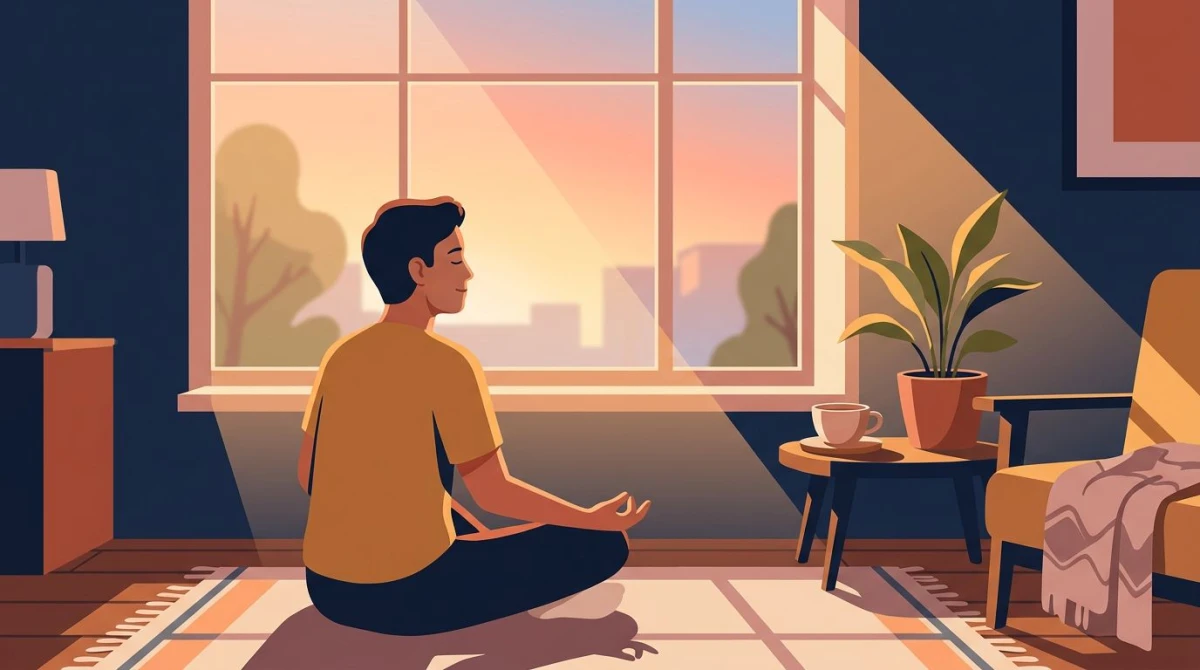
This is the step that makes the routine anxiety-specific rather than generic self-care. A body scan is a brief, gentle form of interoceptive exposure — the practice of noticing bodily sensations without trying to suppress or "fix" them. It is one of the better-evidenced CBT techniques for anxiety, used in panic-disorder protocols (where it is trained more aggressively) and in MBSR for generalised anxiety. The mechanism: anxious nervous systems treat normal body signals as threats; repeated, gentle exposure to those signals — chest tightness, fluttery stomach, warm cheeks — trains the brain to register them as data, not danger.
Stay seated. Move your attention slowly from the top of your head to your feet. Notice — do not fix — any tightness, warmth, or numbness. If your mind jumps to the day ahead, name it ("planning") and come back to your shoulders.
Three minutes is short on purpose. Anxious minds tolerate three minutes; they do not tolerate twenty. As the practice gets easier, you can extend. If you have panic-leaning anxiety, skip this step for the first two weeks and use sensory grounding (5-4-3-2-1) instead — see the quick triage above.
Cue: last breath cycle → body scan.
Step 5 — Write one line of intent
On paper or a notes app, write a single sentence. Not a to-do list. A direction.
Examples that work:
- "Today I am moving through email at 9 a.m. and not before."
- "Today the priority is the meeting at 2."
- "Today I am being kinder to my own pace."
The intent line shifts your attention from anticipated threats to a chosen action. That is the close of the stack — five minutes of light, one of water, two of breath, three of scan, one of intent. Walk to the shower.
How to actually build the routine — the habit-formation layer
Most morning routine articles end with the list. The list is the easy part. Sticking with it is the rest.
Use these four habit-formation rules, drawn from James Clear, BJ Fogg, and Phillippa Lally's UCL habit-formation research, summarized here by James Clear, which found new habits take a median of 66 days to feel automatic, with a wide range of 18 to 254.
- Pin one anchor cue and never move it. Your cue is "feet on the floor." Not "after I check my phone." Not "after coffee." The same cue, every morning. Anchor cues that drift become routines that drift.
- Cut friction the night before. Pre-pour the water. Set the blinds in the right open-able position. Put the breathing app on your home screen. Tomorrow's you should not have to think.
- Track one binary, not five. Daily question: "Did I run the stack?" Yes or no. Do not track each step separately for the first month — that turns the habit into a chore. A simple habit tracker like HabitBox makes it easy to keep the daily check-in to one tap and watch the streak grow.
- Lower the bar on bad days. On your worst morning, the routine is allowed to shrink to: light + one breath cycle + one written line. Two minutes total. The rule is "did the stack happen, in some form?" — not "was it perfect?"
The habit literature is clear that consistency beats intensity. Twenty days of two-minute mornings will build more habit strength than three days of perfect routines followed by eleven skipped ones.
The 7-day starter plan
Before you commit to the full 15 minutes daily, run a one-week ramp. The point of the ramp is to find the friction points in your morning, not to be impressive.
| Day | What you do | Time | Track |
|---|---|---|---|
| 1 | Light + water | 6 min | Did I do it? Y/N |
| 2 | Light + water + 1 min breath | 7 min | Did I do it? Y/N |
| 3 | Light + water + 2 min breath | 8 min | Did I do it? Y/N |
| 4 | Add 2 min body scan | 10 min | Did I do it? Y/N |
| 5 | Add 3 min body scan | 11 min | Did I do it? Y/N |
| 6 | Add intent line | 12 min | Did I do it? Y/N |
| 7 | Full stack — light, water, breath, scan, intent | 15 min | Did I do it? Y/N |
After day 7, repeat the full 15-minute stack daily. Most people feel a noticeable shift in baseline morning anxiety by the end of week two. If you do not, that is information — see the troubleshooting section below.
For a deeper look at how anchor-cue stacking works across other habits, our guide on habit stacking walks through the same mechanism applied to evening, exercise, and reading routines.
What if you wake up at different times?
Shift workers, parents on broken sleep, and anyone with an irregular schedule often ask whether the routine still works. It does — with one adjustment.
Anchor the cue to "first time my feet hit the floor today," not to a specific clock time. The cortisol awakening response that drives morning anxiety happens after waking, not at 7 a.m., so the routine wraps your wake-up regardless of when that is. Run the same five steps at 5 a.m. on a long shift or 11 a.m. after a hard night. The biology follows the alarm clock, not the wall.
The one caveat: morning light works best within the first 30 minutes of waking. If you wake at 4 a.m., the sun is not up — but bright indoor light or a 10,000-lux therapy lamp (cleared by a clinician) can substitute on the days you need it. The Cleveland Clinic guide on light therapy is one starting point for understanding daily light needs more broadly, though for actual lamp use, talk to your doctor.
What to track in your habit app
Open question for a lot of readers: do I track each step, or just the whole routine?
For the first 30 days, track the whole routine as one habit. A single yes/no every morning. The reasons:
- It keeps the tracking time under five seconds.
- It treats the stack as one behavior, which is what you are training.
- It avoids the perfectionism trap where "I missed the body scan, so it is a failure."
After 30 days, if you want more granularity, you can break it into two habits: "morning light" and "breath + scan + intent." That is the most useful split — light is environmental, the rest is internal practice. If you also want to log how anxious you feel before the day starts, a mood tracker app adds a one-tap morning check-in that shows the trend over weeks.
In practice, the habit tracking part works best when you build the cue into your phone. Most people find that putting the tracker icon on their home screen and the breathing tool in the same place removes the last friction point. Apps like HabitBox let you customize the icon and color so the tap takes one second and the streak gives you a small visible win.
Common mistakes — and how to recover
A few patterns show up over and over when people start morning routines for anxiety.
Mistake 1: Starting too long. A 60-minute morning sequence sounds great in theory. In practice, you will skip it on day three. Start at 6 to 10 minutes for the first week.
Mistake 2: Anchoring to the phone. "After I check my phone" is the single most fragile cue you can pick. Phones pull you into news, email, and social — all anxiety multipliers. Anchor to a physical cue: feet on floor, glass in hand, blinds open.
Mistake 3: Over-tracking. Five separate checkboxes turn a calm routine into a morning quiz. One binary is enough.
Mistake 4: Skipping the missed-day rule. This is the big one. A missed morning is not a broken habit — it is one missed morning. The Phillippa Lally UCL study (summarized in James Clear's piece on how long habits take) found a single skipped day did not meaningfully slow habit formation. Skipping two in a row, on the other hand, predicted dropout. So the rule is simple.
The missed-day rule. Never skip twice in a row. If you missed yesterday, the only goal today is the two-minute version: light + one breath cycle + one written line. Do not "make up" the missed day. Just run the minimum and move on.
Mistake 5: Treating the routine as the cure. It is not. If your anxiety is severe, persistent, or accompanied by panic, intrusive thoughts, or thoughts of self-harm, this routine is one piece of a bigger plan. Talk to a clinician. The APA's overview on anxiety and the NIMH page on anxiety disorders both list when self-help is appropriate and when it is not.
When the routine is not working
Two-week check-in. If you have run the full stack for 10 to 14 days and your morning anxiety is unchanged, three things to look at.
- Sleep. A 15-minute morning routine cannot fix a six-hour night. The single biggest leverage on morning anxiety is regular, sufficient sleep. The CDC's sleep page walks through baseline guidance, and a recent review on sleep regularity and mood shows that consistent wake times often outperform total sleep duration as a predictor of next-day mood.
- Caffeine timing. Coffee right after the breath work is fine. Coffee within the first 90 minutes of waking, on a poor sleep, on top of a cortisol spike, is a reliable way to make morning anxiety worse. Try delaying your first caffeine by an hour for one week.
- Underlying conditions. Generalized anxiety disorder, panic disorder, and PTSD all respond best to evidence-based treatment — typically therapy and sometimes medication. Lifestyle habits help, but they are not a substitute. If you have not seen a clinician in the past year and your anxiety affects work, sleep, or relationships, that is the next step.
A morning routine for anxiety is one tool. It is a useful one for many people. It is not the only one.
Adapting the stack to different anxiety patterns
Not every morning anxiety looks the same. Three common patterns show up — and small tweaks make the stack land better for each. (Short version up top in the quick triage; detailed adjustments below.)
Anticipatory anxiety (worry about the day ahead). The body scan tends to amplify the worry loop for this pattern. Spend the saved time on a longer breath block (4 minutes instead of 2) and a more action-oriented intent line — not "today I am being kinder," but "today my first task is X, between 9 and 9:30." The structured action target gives the worry something to land on.
Generalized morning dread (heavy, low, hard to start). Front-load the light. Instead of 5 minutes inside by a window, aim for 10 minutes outdoors if the weather allows. The cortisol awakening response and morning mood both respond well to bright outdoor light, and many readers find this is the single highest-leverage adjustment they can make. Drop the body scan to 2 minutes if needed.
Panic-leaning anxiety (chest tightness, racing heart). Skip the body scan entirely for the first two weeks — it can amplify physical sensations during a high-arousal state. Replace it with a grounding practice: name five things you can see, four you can hear, three you can touch. Slower breath blocks (5-5-5-5 instead of 4-4-4-4) tend to help here too. The APA's anxiety page has additional grounding techniques worth knowing.
The common thread across all three: the stack scaffolds the morning, but the specific contents flex to your nervous system. After two weeks you will know which steps land for you. Keep those. Trim the rest.
How this fits with other morning habits
If you already have a morning workout or meditation practice, this stack does not replace them — it slots in front of them.
- The 15-minute anxiety stack runs first, on waking. It is the calm-down layer.
- A morning workout routine can come after, once your nervous system has settled.
- A longer meditation practice can replace the body-scan step once you are at 10+ minutes of regular practice.
If you only have one morning slot to spend, the order of priority for anxiety is: sleep regularity, light + breath stack, exercise, longer meditation. That is the rough evidence-strength ranking from the reviews cited above.
Frequently asked questions
Why am I so anxious in the morning?
How do I start a morning routine when I am too anxious to start anything?
How long until a morning routine helps anxiety?
Is a morning routine a substitute for anxiety medication or therapy?
What is a realistic anxiety morning routine for working parents?
Should I do the routine if I wake up panicked?
A 30-day starting point
If a 7-day plan is too short to feel a difference, that is a fair concern. Here is the longer arc.
- Days 1–7. Run the ramp above. Single binary tracking: "Did I run the stack today?"
- Days 8–21. Hold the full 15-minute stack daily. Same tracking. The goal is automaticity, not optimization.
- Days 22–30. Add a single end-of-week reflection (60 seconds, written): "Did mornings feel different this week?" Most people start to see a pattern by week three.
- Day 30. If the routine is helping, keep going for the full 66-day window the UCL research suggests. If it is not, see the troubleshooting section above.
Putting it into practice
The shortest version of this guide: open the blinds, drink water, breathe for two minutes, scan your body for three, write one line, walk to the shower. Do that tomorrow. Then again the day after. Track it as one yes/no.
If you want a place to keep the streak visible — and the visible streak is part of why this works — a simple habit tracker like HabitBox lets you log the routine in a single tap and see the chain build. The point of the streak is not pressure. It is feedback: a morning you ran the routine looks different on the calendar from a morning you did not, and that small loop reinforces the habit faster than memory does.
This routine will not erase morning anxiety. It is one structured 15 minutes that, repeated, makes mornings a little softer and a little more yours. That is enough to build on.

Mira Hartwell
Editor, HabitBoxEditor at HabitBox. Writes about habit science and productivity, grounding every post in named research (Lally, Wood, Walker, Huberman) instead of recycled advice. Read full bio →