Self-Care Morning Routine: 5, 20, or 45-Minute Habit Stack
TL;DR. The same five-step self-care habit stack — hydrate, breathe, move, set intent, log mood — runs at three time settings: 5 minutes on a chaotic morning, 20 minutes as the default, 45 minutes on a weekend. Same order, same anchor cues, different durations on the steps that flex (breath and movement). That flexibility is the whole point — most morning routines collapse because they're written for one ideal morning that almost never happens. Picking a length on the fly keeps the streak alive on the days willpower is gone. Most people feel a small shift in 5 to 7 days and reach near-automatic flow by week 3 (Lally et al., 2010, UCL habit formation study; Clear, 2018, on habit stacking). This is general self-care lifestyle support — if mornings are driven specifically by anxiety, see our anxiety morning routine instead.
This guide is lifestyle support. It is not medical or mental health advice. If you are struggling with persistent anxiety, depression, burnout, or any condition that interferes with daily life, please reach out to a clinician. The APA stress management page and the NHS Every Mind Matters stress guide are useful starting points.
If you have ever opened your phone before your eyes fully adjust to the light and felt your day get worse before it began, you already know the problem. The first 30 minutes after waking set the tone for the next 16 hours. Most people leave that window to whatever notification screams loudest. A self-care morning routine reclaims it without asking you to wake up at 5 a.m. or buy a meditation cushion.
This guide gives you a structured 5-step stack with anchor cues for every step, the science behind why each one works, a comparison table, three time variants, a 7-day starter plan you can track on your phone, and a missed-day rule for when life gets in the way.
What a self-care morning routine actually is
A self-care morning routine is a short, repeatable sequence of small caring rituals you do in a fixed order every morning. The point is not to optimize your day. The point is to give your nervous system a familiar, low-friction runway from sleep into life.
Most articles on this topic frame self-care as a list of nice-sounding ideas — drink water, journal, stretch, breathe. That framing is the reason most morning routines collapse by week two. A list asks you to choose. A routine, built as a habit stack, removes the choice. You do step two because you finished step one — every time — until the whole sequence runs without willpower.
A useful self-care morning routine has four properties:
- It is short enough to survive a bad night of sleep.
- It is anchored to a cue you already perform every morning.
- Each step chains to the next, with no decision in the middle.
- It has one tiny track-it metric so you know if you did it.
The 20-minute stack below is built around those four properties. Five steps, fixed order, fixed cues.
The science: why a morning habit stack works for self-care
Three behavioral mechanisms do most of the heavy lifting here.
1. Habits form faster when stacked onto an existing cue. A landmark UCL study by Phillippa Lally and colleagues (2010) tracked 96 people building new daily habits and found a median of 66 days to reach automaticity, but with a key caveat: behaviors anchored to consistent context cues stuck faster and held up better. James Clear builds on this in Atomic Habits, summarizing habit stacking as "after I current habit], I will [new habit]." BJ Fogg's [Tiny Habits research frames the same idea as anchor moments — small behaviors attached to existing daily cues are the ones that survive.
2. Slow, paced breathing calms your stress response — fast. Two minutes of slow breathing increases vagal tone, lowers heart rate, and activates the parasympathetic nervous system. Harvard Health summarizes six relaxation techniques including breath focus and notes that a relaxation response can begin within minutes. A 2018 review in Frontiers in Human Neuroscience linked slow breathing to reduced self-reported stress and better emotional regulation. The NHS breathing exercises for stress page walks through a simple version you can do in bed.
3. Movement, mindfulness, and brief expressive writing each move the needle a small amount — and they stack. A short morning walk or stretch supports mood and attention; the APA's overview of exercise and mental health summarizes how even brief activity reduces anxiety symptoms. A few minutes of mindful attention has been associated with measurable changes in stress and emotional reactivity (APA on meditation; Harvard Gazette on mindfulness research). Short expressive writing — even one or two lines — has been linked to lower stress and improved coping in research summarized by Harvard Health's Healthbeat.
None of these effects are huge on their own. Stacked together, every morning, they compound. That is the wedge: not bigger habits, but small habits chained until they run themselves.
For a quick reality check on what a sustainable morning actually looks like (without an hour-long Instagram aesthetic), this short walkthrough is a clean primer:
The 5-step self-care morning routine, with anchor cues
Here is the full 20-minute stack. Each step has a cue, a body, and a hand-off to the next step. That hand-off is the stacking.
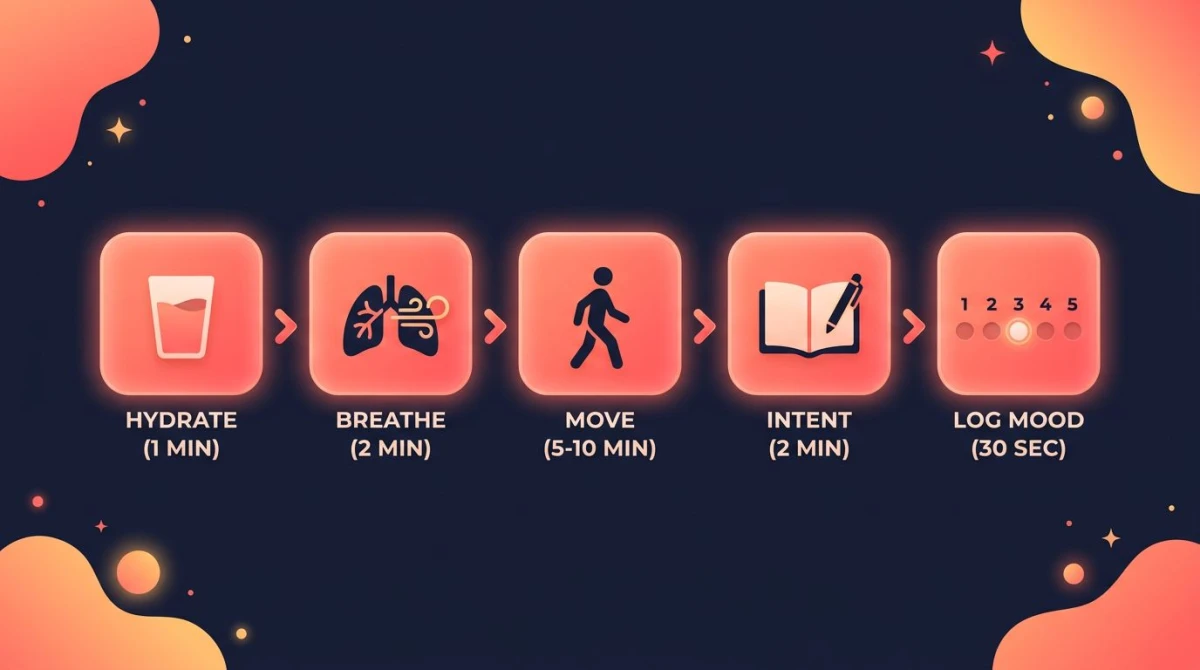
| Step | Habit | Anchor cue | Time | Why it works |
|---|---|---|---|---|
| 1 | Hydrate — one full glass of water | After feet hit the floor | 1 min | Counters overnight dehydration; first easy win (Harvard Health on hydration) |
| 2 | Breathe — 6 slow breaths or 2 min box breathing | After the last sip of water | 2 min | Activates parasympathetic response (Harvard Health) |
| 3 | Move — 5–10 min walk, stretch, or yoga | After the last breath | 5–10 min | Supports mood and energy (APA on exercise; Harvard Health) |
| 4 | Set intent — write one sentence | After moving, before opening apps | 2 min | Brief expressive writing supports coping (Harvard Healthbeat) |
| 5 | Log mood — tap a number 1–5 | After writing your intent | 30 sec | One-tap track-it closes the loop and feeds the streak |
The remaining few minutes are buffer — putting the kettle on, opening blinds, sitting down. Real life takes time. Plan for it instead of pretending it does not exist.
Step 1 — Hydrate (1 minute)
Pre-pour a glass of water on your nightstand or by the kettle the night before. The pre-pour matters. On a tired morning, you will not "decide" to hydrate. The glass that is already there does the deciding. Drink the whole thing before you open your phone. If you want hydration nudges to continue past the morning, a water reminder app handles the rest of the day.
Cue: feet on the floor → glass within reach.
Step 2 — Breathe (2 minutes)
Sit. Close your eyes. Box breathing is the simplest version: in for 4 counts, hold for 4, out for 4, hold for 4. Six rounds. If counting is too much on a foggy morning, just lengthen your exhale: 4 counts in, 6 counts out, six times.
Cue: last sip of water → six slow breaths.
Step 3 — Move (5 to 10 minutes)
This is the step that separates a self-care routine from a stress-relief routine: gentle morning movement. Five to ten minutes of light activity within the first hour of waking does three measurable things in the research — it raises core body temperature (which reinforces the circadian wake signal), produces a small spike in BDNF and other neurotrophic factors associated with mood, and acts as a low-stakes "win" that compounds across the day. The 2016 walking meta-analysis found small-to-moderate antidepressant effects from short, regular walks; you do not need to break a sweat for the benefit to be real.
This is the step that flexes most across the three time variants:
- 5-minute mode: 5 sun-salutation cycles or a single lap of stretches.
- 20-minute mode: a 10-minute walk to the end of the block, or a short yoga flow.
- 45-minute mode: 20–30 minutes — a real walk, an at-home strength circuit, or a yoga class.
Pick one form and stick with it for a week before swapping. The form matters less than the consistency, and switching forms before the routine is automatic is the #1 reason morning movement habits die. If you are layering a more structured workout, our morning workout routine guide covers a 20-minute plan you can swap in.
Cue: last breath → standing up.
Step 4 — Set intent (2 minutes)
Write one sentence in a notebook or notes app. The format that works best for most people is two prompts:
- One thing I want to feel today.
- One thing I will do to support that feeling.
Examples: "Calm. I'll take a 10-minute walk after lunch." "Focused. I'll write the proposal first thing." Two lines, total. Do not optimize the wording. The act of writing it is the work.
If you want a more structured version, our how to start journaling guide walks through prompts that take 5 minutes or less.
Cue: standing up after move → notebook or app open.
Step 5 — Log mood (30 seconds)
Tap a number from 1 to 5 in your habit tracker. That is it. The point is not deep introspection — it is a single data point that closes the loop. Over a few weeks, the trend tells you which mornings landed and which did not. If you want richer trends than a habit tracker offers, we compared the best mood tracking apps for 2026 for exactly this kind of daily check-in.
Cue: closed notebook → mood tap.
Comparison: the three time variants
You will not always have 20 minutes. Build all three variants now so you have a fallback when life gets loud.
| Version | Time | Steps included | Use when |
|---|---|---|---|
| Lean | 5 min | Hydrate + 6 slow breaths + 1-line intent + mood tap | Travel, sick days, bad sleep, kids up early |
| Default | 20 min | Full 5-step stack | Most weekdays |
| Slow | 45 min | Default + longer movement + tea + 5-min journaling | Weekends or recovery mornings |
The lean version is not "failure." It is the same habit, scaled. The same five-step pattern shows up — that is what trains the routine. Skipping a step is fine. Skipping the structure is what breaks the streak.
How to actually build the habit (numbered steps)
Most morning routines fail because people start at the default and crash by Wednesday. Use this sequence instead.
- Pick your wake-up anchor. This is the cue that triggers step 1. For most people it is feet on the floor. For others it is the kettle starting or the coffee maker beeping. Pick one and write it down.
- Pre-stage everything the night before. Glass of water beside the bed. Notebook on the kitchen counter. Walking shoes by the door. Pre-staging cuts morning friction more than any motivation tactic.
- Start with the lean version. 5 minutes for the first 7 days. No exceptions, no upgrades. Build the cue first.
- Add one step every 2 to 3 days. Once the lean version runs on autopilot, add the next step. Move from 5 minutes to 10 to 15 to 20 over two to three weeks.
- Track one metric — completion only. Yes/no. Did the routine happen? You can complicate it later. Right now you need a streak, not a spreadsheet. We cover this more in our guide on tracking habits without burning out.
- Pair it with habit stacking on existing routines. If you already make coffee, stack hydrate after the first sip of coffee instead of before. Use what is already there. Our habit stacking guide walks through how to chain new habits onto cues that already work.
- Do not move the time. A self-care morning routine that runs at 6:00 some days and 8:30 others is a different routine. Pick a window — say 6:30 to 7:00 — and protect it.
A note on willpower: you do not need much. You need cues. If you find yourself "trying to remember" your routine more than once, the cue is wrong. Move it.
A 7-day self-care morning routine starter plan
This is a track-it format you can paste into any habit tracker. Each day has one yes/no completion, plus a number to log.
| Day | Plan | Track-it |
|---|---|---|
| Mon | Lean: water + 6 breaths + 1-line intent + mood tap | Done? Y/N · Mood 1–5 |
| Tue | Lean again | Done? Y/N · Mood 1–5 |
| Wed | Lean + 5-min walk or stretch | Done? Y/N · Mood 1–5 |
| Thu | Lean + 5-min walk or stretch | Done? Y/N · Mood 1–5 |
| Fri | Lean + 5-min walk + 2-line intent | Done? Y/N · Mood 1–5 |
| Sat | Slow version, 30–45 min, no clock | Done? Y/N · Mood 1–5 |
| Sun | Default 20-min full stack | Done? Y/N · Mood 1–5 |
Do not grade yourself on the mood number — that is just data. Grade yourself on completion. After 7 days, look at your streak. If it is 5 of 7 or better, hold the lean version another week before adding the move step. If it is 3 of 7 or fewer, the cue is the problem, not your discipline. Move the cue earlier or pre-stage more aggressively.
If you are tracking multiple wellness habits at once, a dedicated tracker like HabitBox makes it easy to see all five steps as one chain plus a daily mood log on the same screen — that single-screen visibility is what keeps the routine from feeling fragmented.
When it doesn't work — the missed-day rule
Everyone misses mornings. The question is what happens next. Researchers studying habit formation have found that one missed day does not break a habit; what breaks it is the second consecutive miss (Lally et al., 2010). So the rule is simple.
Never miss twice. Miss Monday, do the lean version Tuesday — even at noon, even in five sloppy minutes. The streak you are protecting is not perfection; it is the cue chain.
Three common failure modes and the fix for each:
- You wake up later than planned. Run the lean version. Five minutes still counts. Skip nothing — shrink everything.
- You feel anxious or low. Drop the move step, keep hydrate, breath, and one-line intent. On hard mornings, the breath is the most important step. Make the writing kinder ("Today is hard. I will be gentle.") rather than productive.
- You hit week 2 and the novelty is gone. Good. That is the boring middle, where the habit is still building. Stay on the lean version another 5 days. Do not add steps, do not change order, do not redesign the routine. Boring is the work.
If your low moods persist for more than two weeks, become severe, or interfere with daily life, that is past the scope of any morning routine. Talk to a clinician. The APA stress management page and the NHS Every Mind Matters guide are reasonable first steps for finding support.
A note on what self-care is not
Self-care is not a face mask, a $40 candle, or a Sunday spa day. Those are nice. They are not the routine. A self-care morning routine is the boring, repeatable, daily version of caring for yourself — the one that runs on Tuesdays in February when nothing is special. The expensive stuff is decoration. The five steps above are the foundation.
It is also not a productivity hack in disguise. The point is not to win the morning so you can dominate the day. The point is to start the day from a steadier place. Some days that means a more focused workday; other days it just means you cried less in the car. Both count.
FAQ
What is a self-care morning routine?
A self-care morning routine is a short, repeated sequence of small caring habits you do every morning in a fixed order. The five-step version in this guide — hydrate, breathe, move, set intent, log mood — takes 20 minutes. Each step is anchored to the previous one so the routine runs without willpower once it is built. Research on habit formation suggests this kind of cue-chained sequence becomes near-automatic in roughly 2 to 3 weeks of consistent practice (Lally et al., 2010).
How long should self-care take in the morning?
The default is 20 minutes. The lean version is 5 minutes for chaotic mornings (water, six slow breaths, one-line intent, mood tap). The slow version is 30 to 45 minutes for weekends. The exact length matters less than running the same five-step pattern every day. Five consistent minutes beats 30 minutes done twice a week.
What's a good self-care morning routine for busy moms?
Start with the lean 5-minute version and pre-stage everything the night before — glass of water by the bed, notebook on the kitchen counter, shoes by the door. Anchor your routine to a cue that exists no matter what your kids do, like the moment the kettle starts. Do the routine before they wake up if possible, or in the kitchen while they eat breakfast if not. Five minutes done daily beats 20 minutes attempted three times a week. Skip the move step on days you are sleep-deprived; keep hydrate, breath, and a one-line intent.
Can I do a self-care morning routine on a budget?
Yes — the entire 20-minute stack costs nothing. A glass of water, two minutes of breathing, a walk or stretch, a notebook you already own, and a free habit tracker on your phone. Self-care marketing has convinced people that wellness requires products. The research-backed steps in this guide do not. If you want to add one paid item later, a comfortable journal is the most-used and least-required.
Self-care morning routine vs evening routine: which matters more?
Both matter and they support each other, but a morning routine has one structural advantage: it runs before the day's stress and decision fatigue have happened. An evening routine runs after, when willpower is depleted and unexpected things have already pulled at you. Most people find a morning routine sticks faster because the cue (waking up) is more reliable than the cue for evening (which depends on whatever your day did to you). A reasonable approach is to build a 5-minute morning routine first, get it stable for two to three weeks, then add a 5-minute evening shutdown.
How long until a self-care morning routine feels automatic?
The widely-cited number is a median of 66 days from Lally et al.'s UCL study, but the range was 18 to 254 days across participants. Most people report the routine starting to feel "normal" rather than effortful at 2 to 3 weeks. Full automaticity — running on cue without thinking — usually arrives between weeks 6 and 10 for simple routines, longer for complex ones. The lean 5-minute version reaches automatic state faster than the full 20-minute version, which is part of why we recommend starting lean.
Build the routine, watch the streak
The hardest part of a self-care morning routine is not the breathing or the journaling. It is showing up at the same time tomorrow, and the day after that. The five-step stack above is designed to keep working when motivation does not.
If you want a clean way to track the chain, HabitBox lets you set up the five steps as one daily check-in plus a mood log, so you can see your streak and your trend in one view — without the complexity of a general productivity app. Build the routine first, track it second, and let the streak do the work motivation cannot.

Mira Hartwell
Editor, HabitBoxEditor at HabitBox. Writes about habit science and productivity, grounding every post in named research (Lally, Wood, Walker, Huberman) instead of recycled advice. Read full bio →