How to Make Exercise a Habit: 5 Tactics That Stick (2026)
TL;DR. Motivation is the wrong system for making exercise a habit. The five tactics that actually work are a tiny floor (BJ Fogg), a fixed cue (James Clear's habit stacking), an identity reframe ("I'm a runner," not "I'm trying to run"), a minimum-viable session (10 minutes beats zero), and streak tracking (loss aversion + Lally's UCL formation study). Stack the five and 90-day retention rises sharply, because each tactic removes a different friction point that motivation alone can't.
If you've started and stopped a workout plan three times this year, the issue is not your discipline. It's your system. Most exercise advice tells you to "find your why" or "stay motivated," which sounds wise and works for about two weeks. After that, motivation does what motivation always does — it dips.
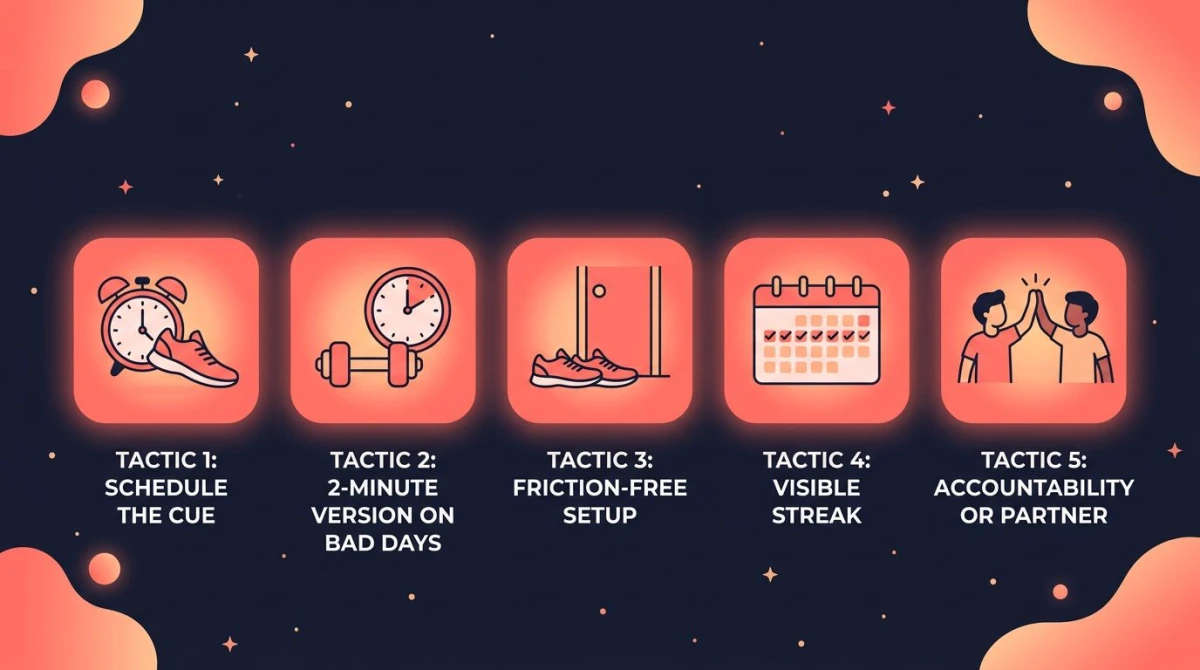
The five tactics below come from behavior science, not gym culture. Each names a specific researcher and a specific mechanism. Use one and you'll get further than willpower took you. Use all five together and exercise stops feeling like a decision.
Why motivation is the wrong system
USC behavior scientist Wendy Wood spent more than thirty years studying how habits actually form. Her central finding: roughly 43% of daily behavior is repeated in the same context, with little conscious thought. The behaviors that survive aren't the ones we feel most motivated about — they're the ones tied to a stable cue.
Motivation, by contrast, is a feeling. It rises and falls with sleep, stress, weather, and a hundred other variables you don't control. Building a routine on a feeling is like building a house on a tide. The wave goes out and the structure goes with it.
Wood's reframe in Good Habits, Bad Habits (2019): stop trying to want it more, and start arranging the context so the behavior happens with less thought. That is what each of the five tactics below is doing.
There's a second reason motivation fails for exercise specifically. The reward (fitness, energy, weight change) is delayed by weeks, and your brain weights immediate costs against delayed rewards. A habit system fixes this by making the act itself the reward — through streaks, identity, and friction reduction.
The five tactics below are how that system gets built. Each one targets a different point where motivation usually fails.
How to make exercise a habit: the 5 tactics
1. Set a tiny floor (BJ Fogg)
Stanford behavior scientist BJ Fogg built his Tiny Habits method on one principle: shrink the behavior until it's stupidly easy. Not "easy" — stupidly easy. Two pushups. One squat. Walk to the end of the driveway.
The point is that two pushups happen on the days you'd otherwise skip. A skipped day breaks a habit. Two pushups is a kept day, and kept days compound.
Fogg's recipe: "After [ANCHOR], I will [TINY BEHAVIOR]." Your tiny floor should be something you can do in under a minute, fully clothed, in any mood. The ceiling — what you actually do most days — will rise on its own once the floor stops being negotiable.
A tiny floor also gives you a clean answer to the worst day. When 30 minutes is impossible, two pushups is still possible. The streak survives. Tomorrow's session is easier because today's didn't snap the chain. If you want a pre-built version of this idea, a 30 day plank challenge with built-in rest days starts at 20 seconds a day — a fixed, tiny commitment that ramps on its own.
For more on shrinking the entry cost of any habit, see our guide to habit formation.
2. Lock in a fixed cue (James Clear)
A cue is what tells your brain it's time. Without one, exercise lives in the same mental drawer as "I should call my mom" — a vague intention that never fires.
James Clear's Atomic Habits popularized habit stacking: the formula "After [CURRENT HABIT], I will [NEW HABIT]." It works because the existing habit is already on a wide neural pathway, so the new behavior rides along instead of cutting its own.
For exercise, good anchors are sticky and specific:
- After I pour my morning coffee, I will put on my workout clothes.
- After I drop the kids at school, I will drive straight to the gym.
- After I close my laptop at 5:30 p.m., I will do a 10-minute walk.
Bad anchors are vague: "in the morning," "after work," "when I have time." Vague anchors are how you end up at 9:47 p.m. on the couch wondering where the day went.
Wendy Wood's context research tells us why specificity matters: the cue and the context have to be stable for the brain to automate the response. "After lunch" is not stable. "After I put my plate in the dishwasher" is. We've covered the full method in our guide to habit stacking.
3. Reframe your identity (James Clear)
Identity is the lever almost every fitness article misses. Clear's argument in Atomic Habits is that lasting change happens at the level of identity, not outcomes.
There's a difference between these three statements:
- "I want to lose 10 pounds." (outcome)
- "I'm trying to exercise more." (process — but tentative)
- "I'm a runner." (identity)
The first two leave a back door open. The third closes it. A runner runs on rainy Tuesdays. A runner runs on the morning after a bad night's sleep. Not because they feel like it, but because that's who they are, and people behave consistently with their identity.
The shift is small but powerful. When a friend invites you to brunch at the time you usually train, "I can't, I'm trying to work out more" sounds negotiable. "I can't, I run on Tuesday mornings" doesn't. The second sentence is harder to argue with — including for the part of your brain that wants to skip.
Pick a one-word identity that fits the activity: runner, lifter, swimmer, walker, climber, yogi. Use it out loud. Each completed session is a vote for that identity, and votes accumulate. For a deeper dive, read our piece on identity-based habits.
4. Define a minimum-viable session
The minimum-viable session is the shortest workout that still counts. Not the workout you wish you'd done. The shortest one your future self can't argue with.
For most people, this is 10 minutes. Ten minutes of walking, jogging, bodyweight circuits, or yoga. The American Heart Association's movement guidance emphasizes that any movement counts — short bouts add up across the day, and consistency beats duration for habit formation.
Why 10 minutes works:
- It's short enough that "I don't have time" stops being true.
- It's long enough that your body warms up and you usually keep going.
- It produces the same identity vote as a 60-minute session — a kept day is a kept day.
The trap most people fall into is the all-or-nothing default: "If I can't do my full workout, I'll do nothing." That's how a missed Monday becomes a missed week. The minimum-viable session breaks that pattern. On a hard day, you do 10 minutes. On a normal day, you do 30. On a great day, an hour. The streak continues either way.
Decide your minimum-viable session before the week starts, not in the moment when you're tired. The version of you at 6 a.m. is not the version at 8 p.m. negotiating with the couch.
5. Track the streak (loss aversion + Lally)
The fifth tactic is the one most people skip, and it's the one that holds the other four together.
Tracking does three jobs at once:
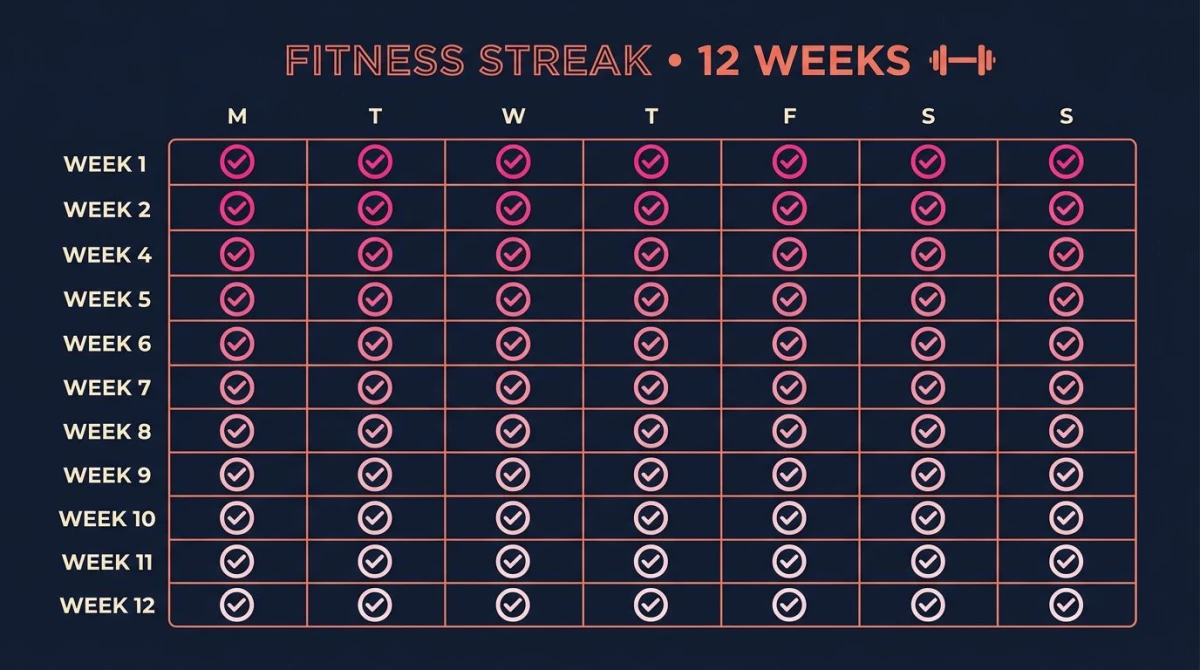
- Visible progress. A row of green check marks across a calendar is more motivating than a vague sense of "I've been doing okay."
- Loss aversion. Once you've got a 14-day streak, missing day 15 feels like losing something, not just not gaining something. Behavioral economists since Kahneman have shown losses feel roughly twice as strong as equivalent gains.
- A self-honest record. Memory is generous. Your tracker is not. If you skipped four days last week, the tracker shows four blanks — and that's information you can use, not a vibe.
A landmark study by Phillippa Lally and colleagues at University College London found that automaticity — the feeling that a behavior happens without thinking — took a median of 66 days to develop, with a range from 18 to 254 days depending on the person and the habit (Lally et al., 2009). Two practical takeaways from that study:
- It's not 21 days. That number is folklore, not science.
- Missing one day didn't destroy the curve. The participants who missed an occasional day still built automaticity. Consistency matters more than perfection.
That second finding is liberating. You don't need a perfect streak. You need a long streak with occasional gaps that you don't let snowball. A tracker shows you the difference between an honest miss and the start of a slide.
This is where a dedicated app earns its place. If you're juggling exercise alongside a few other habits, a tracker like HabitBox keeps the streak visible without you having to think about it — calendar heatmap, current streak, longest streak, all in one tap per day. The friction is low enough that on a tired evening you'll still log it, and that single tap is what protects the chain.
For more on the mechanics of tracking, see tracking habits and our guide to fitness consistency.
Motivation-based plan vs system-based plan
| Motivation-based plan | System-based plan | |
|---|---|---|
| Trigger to start | "When I feel ready" | Fixed cue (after coffee, after school drop-off) |
| Workout length | What you "should" do | Minimum-viable session (10 min floor, more if able) |
| Bad day response | Skip — try again tomorrow | Tiny floor (2 pushups, short walk) |
| Self-talk | "I'm trying to exercise more" | "I'm a runner / lifter / walker" |
| Progress signal | Bathroom scale, weekly weigh-in | Daily streak in a tracker |
Each row replaces a feeling with a structure. That's what "habit" means in behavior science: the structure has gotten strong enough that the feeling stops being the deciding vote.
A 14-day starter plan
For a practical, trainer-led version of the same five-tactic logic — stop relying on motivation and build the system underneath — this short walkthrough is a clean companion to the plan below:
If you want to put the five tactics into practice this week, here's the simplest version:
- Day 1. Pick your one-word identity (runner, lifter, walker, etc.). Pick your fixed cue (e.g., "after I pour my morning coffee"). Decide your minimum-viable session (10 minutes).
- Day 1. Pick your tiny floor — the version you can do on the worst day (2 pushups, walk to the corner).
- Days 1–14. Every day, after your cue, complete at least your minimum-viable session. On hard days, drop to the tiny floor. Do not skip.
- Days 1–14. Log every session in a tracker. Watch the streak grow.
- Day 14. Review. If you hit 12+ of 14 days, lengthen the session. If you hit fewer, shrink the cue or the floor — don't push through with willpower.
Notice what's missing: a goal weight, a target distance, a "transformation." Those come later, downstream of the habit. First you build the habit. Then the habit builds the result.
The pattern is well-established for sport-specific routines too — see our piece on building a running streak for how this same five-tactic stack applies to running specifically.
FAQ
How long does it take for exercise to become a habit?
Should I exercise at the same time every day?
What if I miss a session?
Is morning or evening better for building an exercise habit?
Do I really need to track, or can I just exercise?
The takeaway
Exercise becomes a habit when you stop relying on the feeling and start engineering the structure. Pick a one-word identity. Anchor a fixed cue. Set a tiny floor and a minimum-viable session. Track the streak. Then keep showing up on the days you don't feel like it — because by that point, the system, not your mood, is doing the work.
If you want a clean place to keep the streak visible, HabitBox is a free habit tracker for iOS and Android with calendar heatmaps and streak counts — no account required, your data stays on your device.

Mira Hartwell
Editor, HabitBoxEditor at HabitBox. Writes about habit science and productivity, grounding every post in named research (Lally, Wood, Walker, Huberman) instead of recycled advice. Read full bio →