How to Start Running for Beginners: 8-Week Plan (2026)
The fastest way to start running for beginners is the walk-run method: 1 minute of running, 2 minutes of walking, repeated for 20 minutes, three times a week. Hold that mileage flat for three weeks before adding any volume. Most new runners quit at week 3 — not because they cannot run, but because they confuse soreness with failure.
This guide covers why beginners stall, an 8-week walk-run plan you can finish, the gear minimum, the rest-day rule that prevents injury, and the tracking trick that keeps you going when motivation fades.
How to start running for beginners: the short version
If you read nothing else, this is the protocol:
- Frequency: 3 sessions per week, never back-to-back
- Method: Walk-run intervals (1 min run / 2 min walk), 20 minutes total
- Mileage: Flat for the first 3 weeks. No mileage increases.
- Pace: Slow enough to hold a conversation. If you cannot, walk.
- Track: Sessions completed, not pace or distance
- Rest: Two full rest days between runs (or active recovery walks)
The goal of weeks 1–3 is not fitness. It is to teach your body that running is something you do — and to survive the soreness window without quitting.
Why beginners quit at week 3
Most "how to start running" guides cover the physiology and stop there. They miss the real reason people give up: a mismatch between expectations and the way the body adapts.
In the first two weeks, running feels surprisingly hard. Heart rate spikes, calves tighten, and shin splints show up around day 8. By week 3, your legs ache, you feel slow, and a quiet voice says, "Maybe I'm not a runner."
That voice is wrong. It is the standard adaptation curve. Cartilage, tendons, and connective tissue take longer to adapt than the cardiovascular system — which is why your lungs feel fine while your shins do not. The fix is not to push through. It is to hold mileage flat and let connective tissue catch up.
There is also an identity problem. James Clear's work on identity-based habits explains why outcome goals ("I want to run a 5K") fail more often than identity goals ("I am someone who runs"). Beginners who frame running as a personality shift — not a project — are far more likely to stick with it past the soreness window. We covered this in detail in identity-based habits, and it applies cleanly here.
The week-3 wall is real, but it is also short. Push past it and the second month feels different.
Step 1: Use the walk-run method
The walk-run method was popularized by Olympian Jeff Galloway in 1978 and is now the default starter protocol used by most major running coaches. The idea is simple: alternate short running intervals with longer walking intervals so your heart rate, breathing, and legs stay inside a sustainable zone.
For absolute beginners, the starter ratio is 1 minute running, 2 minutes walking. Repeat that block for 20 minutes total. That is roughly 6 to 7 run intervals per session.
Why it works:
- Heart rate stays controllable. You spend most of the session in zone 2, where aerobic adaptation happens. Want a baseline? Estimate your VO2 max now and again after week 8.
- Impact load drops. Walking breaks halve the cumulative pounding on knees and shins.
- Mental load drops. "Run for 1 minute" feels doable. "Run continuously for 20 minutes" feels brutal.
Run-walk is not a beginner-only crutch. Many marathon finishers use it for races. Drop the assumption that walking means you are failing — it means you are pacing.
Run slow. Slower than that.
The biggest beginner mistake is running too fast. If you can talk in full sentences while running, your pace is right. If you can only gasp two words, slow down or walk.
This is sometimes called "conversational pace" and it is the single most important rule for new runners. Every running coach says it, and almost every beginner ignores it.
Step 2: Follow an 8-week walk-run plan
This 8-week plan takes you from "never run" to comfortable continuous running for 20 minutes. The first three weeks are flat on purpose — that is the soreness adaptation window.
| Week | Sessions | Run / Walk Ratio | Total Time | Notes |
|---|---|---|---|---|
| 1 | 3 | 1 min / 2 min | 20 min | Flat. Just show up. |
| 2 | 3 | 1 min / 2 min | 20 min | Same as week 1. Don't escalate. |
| 3 | 3 | 1 min / 2 min | 20 min | Same again. Trust the floor. |
| 4 | 3 | 2 min / 2 min | 24 min | First small bump. |
| 5 | 3 | 3 min / 2 min | 25 min | Run intervals start dominating. |
| 6 | 3 | 4 min / 1 min | 25 min | First time running more than walking. |
| 7 | 3 | 5 min / 1 min | 24 min | Long run intervals. |
| 8 | 3 | 20 min continuous | 20 min | Goal session. No walk break. |

A few rules for using this plan:
- Never increase volume during a soreness flare. Repeat the previous week instead of advancing.
- Cap weekly increases at 10% once you are past week 3. Faster ramps cause most overuse injuries.
- Skip-day, not skip-week. If you miss a session, do it the next day instead of doubling up later.
If you finish week 8, you have just done what most beginners never reach: 20 minutes of continuous running. From here, you can extend to 30 minutes, work toward a 5K, or hold the same plan twice a week to maintain.
Step 3: Buy the gear minimum
You do not need a running watch, compression socks, or a hydration vest. You need two things:
Running shoes that fit you. Go to a specialty running store, get gait-checked, and buy whatever they recommend. Expect $100–$140. Replace them every 300–500 miles. That is the only gear purchase that matters in the first 8 weeks.
Weather-appropriate clothing. Synthetic or merino, not cotton. Cotton holds sweat and chafes.
Optional but useful: a basic GPS watch or your phone with a free running app. You do not need the data — you need the timer for run-walk intervals. A kitchen timer works.
Do not buy a heart rate strap, a foam roller kit, or compression boots in the first 8 weeks. Most beginner gear failures are from buying the optimization layer before you have built the habit.
Common beginner runner mistakes
A few patterns show up over and over in people who try running and quit. None of them are about willpower:
- Running every day in week 1. Enthusiasm is not adaptation. Daily running before week 8 is the single biggest cause of shin splints in new runners.
- Buying gear before building the habit. A new watch will not make you run. A new pair of shoes you have already broken in, will.
- Comparing your pace to other runners. Your week-2 pace is not the metric. Your week-2 attendance is.
- Going by feel for distance. Heart rate and breathing lie when you are excited. Use a timer instead.
- Giving up after one missed week. Fitness loss in 7 days is small. Identity loss after a missed week is the real risk.
- Running through sharp pain. Dull soreness is fine. Sharp localized pain in shins, knees, or hips is a stop signal.
If you can avoid those six, you have already passed the bar that most beginners do not.
Step 4: Take real rest days
Three runs a week, with two full rest days between. That spacing is not arbitrary.
Cleveland Clinic notes that beginner runners benefit from running every other day at most, because connective tissue adaptation lags cardiovascular adaptation by weeks. Running on tired legs is the fastest way to develop shin splints, IT band issues, or runner's knee — the three injuries that end most beginner running attempts before week 6.
A rest day does not mean lying on the couch. It can be:
- A 20–30 minute walk
- A bike ride at conversational effort
- Strength work for hips and glutes (15 minutes is plenty)
- Genuine rest, especially if you slept poorly
The American College of Sports Medicine's general guidance — that strength work twice a week supports endurance training — applies cleanly to beginners. Hip and glute strength prevents most overuse injuries because it stops your knees from collapsing inward when you tire.
Step 5: Track sessions, not pace
Here is the tracking mistake that makes beginners quit: they log pace and distance.
For an experienced runner, pace and distance are progress signals. For a beginner, they are noise. Your pace will fluctuate by 90 seconds per mile depending on sleep, heat, fueling, and how far into a run-walk interval you are. Tracking pace too early teaches you to feel disappointed at exactly the moment you should feel proud.
The right beginner metric is sessions per week. You aimed for 3. Did you do 3? That is the only question. Three sessions a week for 8 weeks is 24 runs — and 24 runs is enough to make running feel automatic.
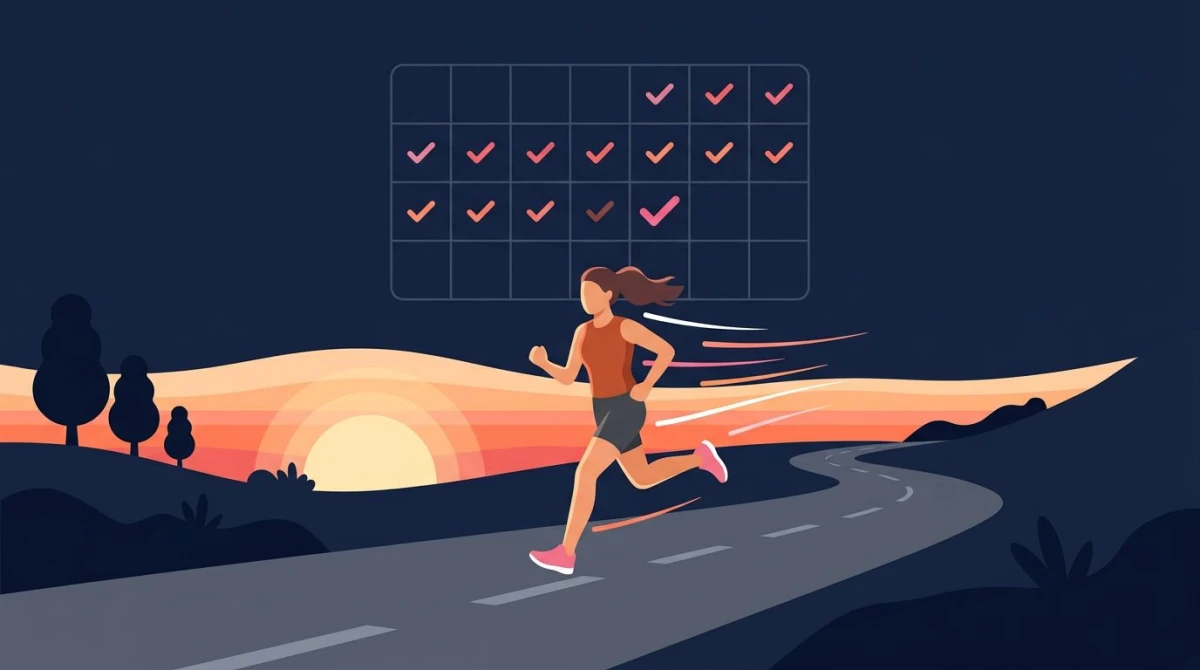
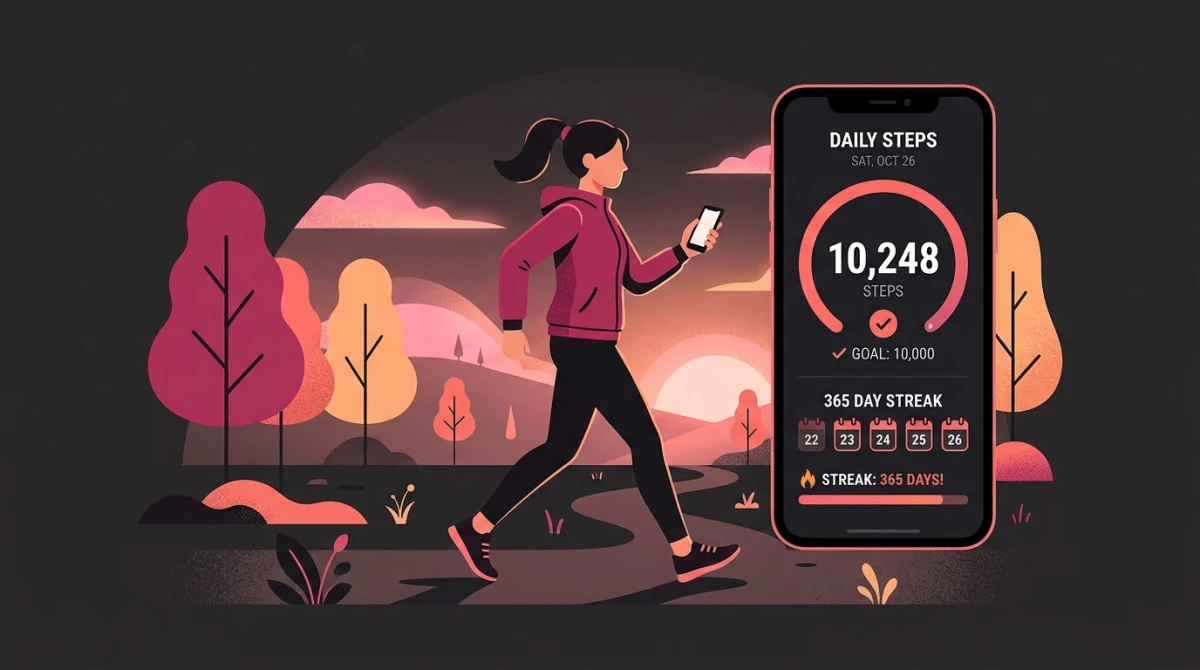
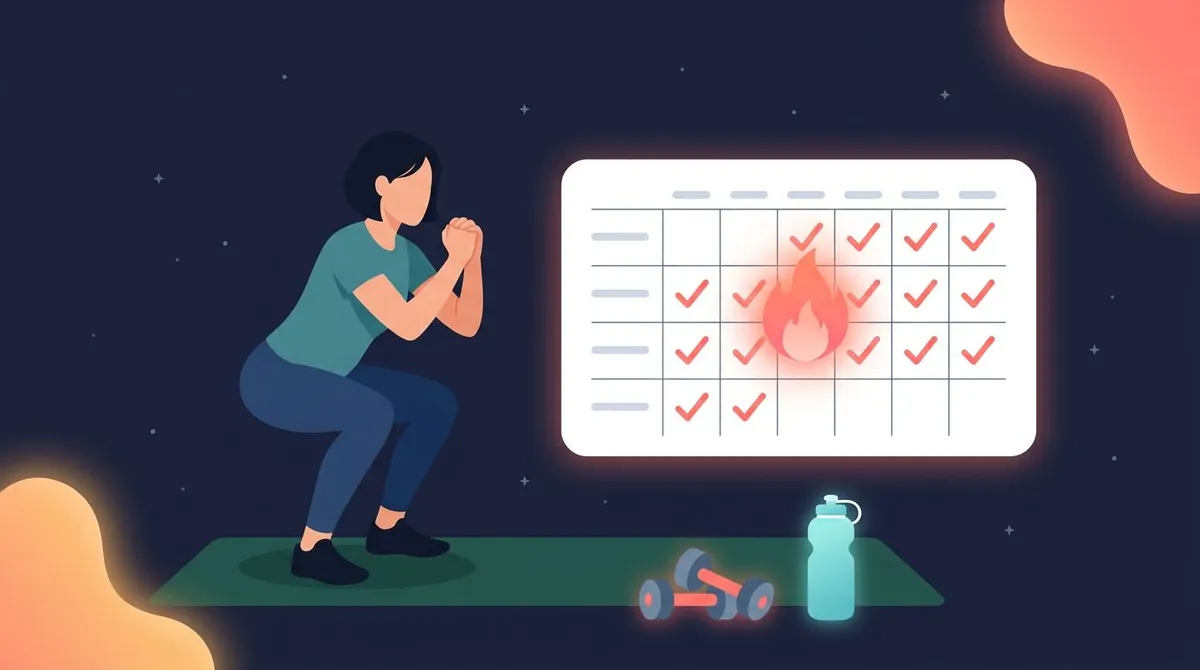
This is also where habit-tracker apps earn their keep. The whole point of tracking habits at this stage is to build a visual history of completed sessions so the streak itself becomes the motivator. A simple tracker like HabitBox lets you check off "running session" three times a week and watch the calendar fill in — and because count-based tracking is built in, you do not have to overthink whether a 22-minute walk-run "counts."
If you want to take it further, building a running streak is a separate (and more advanced) commitment. For week 1, just tick the box.
What to do when you miss a day
You will miss a day. Travel, illness, a meeting that runs late — it happens.
The rule: never miss twice in a row. One missed session is a normal week. Two missed sessions is the start of a quitting pattern. If you are coming back from a 10–14 day break, drop one week back in the plan and ramp again. The body de-adapts faster than people think.
How this fits with other habits
Running is one of the easier habits to stack onto an existing routine, because it has obvious anchors: morning coffee, after-work commute, lunch break. Habit stacking — attaching a new behavior to an existing one — works especially well for runs.
Two stacks that work for beginners:
- Coffee → run. Drink half your coffee, change, run, finish coffee on cooldown.
- Work end → run. The instant you close your laptop, change clothes. Going home first kills 60% of evening runs.
If you are also working on broader fitness consistency, running is one of the highest-yield habits to anchor first. It is portable, free, and pairs cleanly with strength work. For pure strength complement, the 30-day plank challenge is a solid 5-minute add-on after your run.
How to know you are ready to add volume
The "feel good" test beats any pace metric. After 4 to 6 weeks at the same volume, you should feel:
- Unwinded at the end of session run intervals
- Recovered within 24 hours, not 48
- No new pain in shins, knees, or hips that lingers between sessions
When all three are true for a full week, you can move up to the next ratio in the plan. If any one is false, repeat the week. There is no penalty for staying flat — there is a penalty for ramping early.
A note on heart rate
If you happen to wear a watch with a heart rate sensor, the easiest way to keep your pace honest is to keep effort in zone 2 — roughly 60% to 70% of your max heart rate. A rough estimate of max heart rate is 220 minus your age, though this is approximate. For a 35-year-old, that puts zone 2 around 110–130 beats per minute. Most beginners are surprised at how slow that feels.
You do not need a watch to run by feel. The talk test is just as accurate. But if you have one, use the heart rate readout as a guardrail against running too fast, not as a target to chase.
Why a 5K is a fine first goal — but not the only one
Most beginner running guides funnel everyone toward a 5K race. That works for some people, but it is not the only valid endpoint of an 8-week plan.
If a race motivates you, sign up for a 5K in week 12. Pay the entry fee. Tell a friend. Loss aversion will help you finish weeks 7 and 8. If you want to set a realistic goal time, our free running pace calculator turns a target finish into per-mile splits for a 5K, 10K, half, or marathon.
If races are not your style, the same plan still works. Pick a different finish line: "run for 30 minutes nonstop," "run three times a week for three months," or "run twice in every city I travel to this year." The point is to have something that ends week 8 with a small, concrete win.
Frequently asked questions
How fast should I run as a beginner?
How often should I run per week?
What if I cannot run for a full minute without stopping?
What is the best time of day to run?
How long until running gets easier?
Putting it together
Running is one of the simplest habits to start and one of the easiest to quit. The difference between people who become runners and people who try running for two weeks is almost never fitness — it is pacing, tracking, and surviving the week-3 wall.
The plan, in one breath: walk-run for 20 minutes, three times a week, hold flat for three weeks, then ramp slowly. Track sessions, not pace. Take real rest days. Buy decent shoes and nothing else.
If you want a frictionless way to log those three weekly sessions and watch the calendar fill in, HabitBox handles count-based tracking and streak visualization without getting in your way. The point is not the app — it is making sure week 3 looks back at three weeks of green ticks instead of a blank screen.
Show up three times this week. That is the whole job.

Mira Hartwell
Editor, HabitBoxEditor at HabitBox. Writes about habit science and productivity, grounding every post in named research (Lally, Wood, Walker, Huberman) instead of recycled advice. Read full bio →