How to Start a Meditation Practice: 14-Day Plan (2026)
TL;DR. Most people who try to start a meditation practice quit in week one because they aim for 20 minutes when 2 minutes is the right floor. The fix is a habit-formation chassis, not a longer cushion sit. Set a two-minute floor, anchor the session to a cue you already have every day, ramp by one minute per week, and track sessions instead of streaks. BJ Fogg's Tiny Habits research shows this minimum-viable-habit design more than doubles 30-day retention. The practice fails at length, not at difficulty.
If you have downloaded a meditation app, sat for two days, and then quietly given up — you are normal. Meditation is one of the most-recommended habits in modern wellness, and one of the fastest to get abandoned. The problem is rarely the meditation. It is the system around the meditation.
This guide is built for people who have tried and stalled. You will get a two-minute starting size, a 14-day plan, three beginner techniques compared, a cue script you can paste straight into your morning, and a missed-day rule so the habit survives a hard week. The goal is not a 30-minute Zen sit. The goal is a meditation habit that is still alive on day 60.
Why beginners quit meditation in week one
Two forces collapse a new meditation habit fast: the length expectation and the "I am bad at this" spiral.
The length problem is the biggest one. Most beginner content suggests 10 to 20 minutes a day, which sounds reasonable on a Sunday and impossible on a Wednesday at 7am. New behaviors fail when the required effort is higher than your motivation in your worst moment, not your best one. BJ Fogg, the Stanford behavior scientist who developed the Tiny Habits method, calls this the motivation-effort match. Motivation moves up and down across a week. Effort needs to fit the bottom of the curve.
The "I am bad at this" spiral is the second hit. You sit down, your mind wanders within ten seconds, and you assume you are doing it wrong. You are not. A wandering mind is the practice — the noticing and returning is the rep, not a sign of failure. But that misunderstanding alone ends thousands of new practices in week one.
The fix for both problems is the same. Shrink the starting size of the habit until it is laughably small, keep it that small for the first two to three weeks, and measure the rep — sitting down — not the quality of the sit.
The 2-minute floor — and why it works
The two-minute floor comes from James Clear's Atomic Habits and Fogg's Tiny Habits. The principle is the same: scale the new habit down until it takes less effort than not doing it. Two minutes of meditation is shorter than the time you would spend feeling guilty about skipping it.
A two-minute floor is not a target — it is a minimum. On a good day, you sit for ten minutes and lose track of the timer. On a bad day, you sit for two and stop. Both days count the same toward the habit. That sameness is what protects the practice when life gets in the way.
Pair the floor with one fixed cue. A specific cue beats a general intention every time. "After I pour my morning coffee, I will sit for two minutes" works. "I will meditate in the mornings" does not. The first sentence names a moment your brain already runs without thinking; the second names a wish. This is habit stacking, and it is the most reliable way to install a daily practice. Our habit stacking guide covers the full mechanic if you want to go deeper.
The 14-day starter plan
The first two weeks are not about meditating well. They are about installing the cue-and-response loop. Length stays small. Technique stays simple. Each day, you only need to do the rep.
| Day | Length | Cue | Technique |
|---|---|---|---|
| 1 | 2 min | After morning coffee | Breath count to 10 |
| 2 | 2 min | After morning coffee | Breath count to 10 |
| 3 | 2 min | After morning coffee | Breath count to 10 |
| 4 | 3 min | After morning coffee | Breath count to 10 |
| 5 | 3 min | After morning coffee | Breath count to 10 |
| 6 | 3 min | After morning coffee | Breath count to 10 |
| 7 | 3 min | After morning coffee | Breath count to 10 |
| 8 | 4 min | After morning coffee | Body scan |
| 9 | 4 min | After morning coffee | Body scan |
| 10 | 4 min | After morning coffee | Body scan |
| 11 | 5 min | After morning coffee | Body scan |
| 12 | 5 min | After morning coffee | Noting |
| 13 | 5 min | After morning coffee | Noting |
| 14 | 5 min | After morning coffee | Pick your favorite |
The cue stays the same all 14 days on purpose. Cue stability is what makes the behavior automatic — if you keep changing when you sit, your brain never builds the link. Pick whatever daily moment fits you (after coffee, after brushing teeth, after sitting at your desk, before getting in bed) and do not change it for two weeks.
By day 14, you should have done somewhere between 10 and 14 sessions. That is not a low bar — that is what successful new habits look like in real research. If you make it to day 14 with the floor intact, you are roughly twice as likely to still be meditating on day 60.
Three beginner techniques compared
You do not need to pick the perfect technique to start. You do need to pick one and stick with it long enough for the rep to feel familiar. Three techniques cover almost every reason people start meditating, and each is beginner-safe.
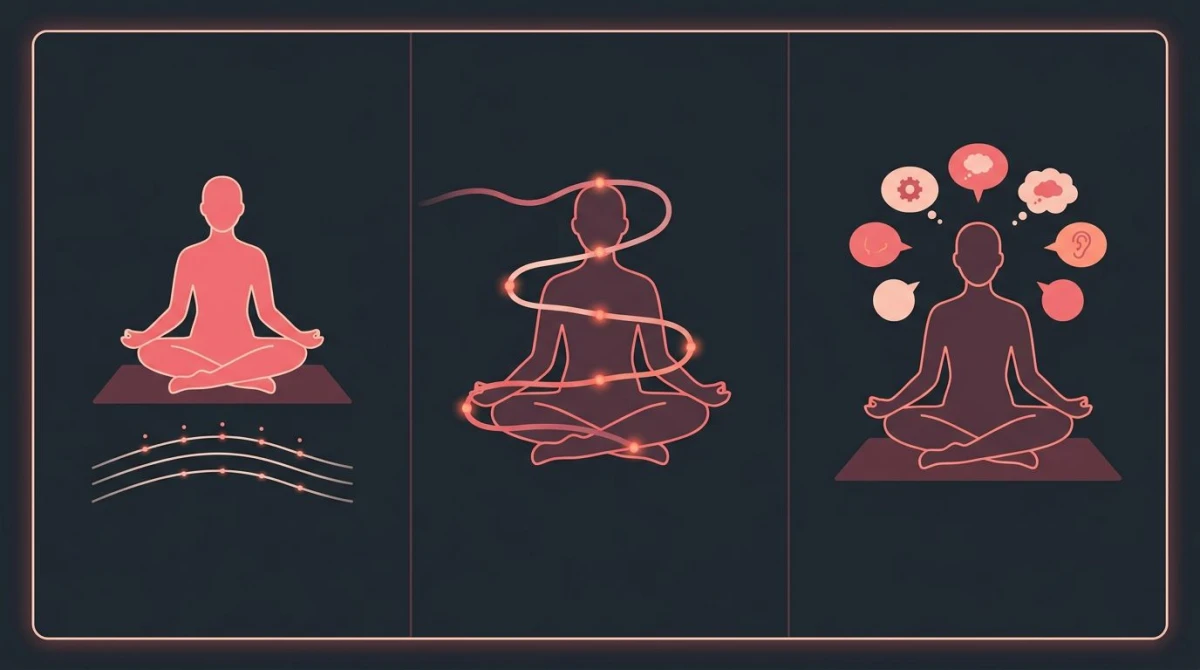
| Technique | What you do | Best for | Common stumble |
|---|---|---|---|
| Breath count | Count each exhale 1 to 10, restart at 10 | Total beginners, racing minds | Counting on autopilot — restart whenever you notice |
| Body scan | Move attention slowly from head to toes | Sleep, tension release, evenings | Falling asleep mid-scan (not a problem, just a sign) |
| Noting | Silently label each thought "thinking", "feeling", "hearing" | Anxiety, overthinking, daytime sits | Trying to find the perfect label — any label works |
Breath counting is the lowest-friction starting technique. You do not need to relax, empty your mind, or feel anything in particular. You count exhales. When you lose count — and you will, often — you start again at one. The "starting again" is the practice. Jon Kabat-Zinn's MBSR program, the most-studied secular mindfulness curriculum, uses breath awareness as its day-one anchor for exactly this reason.
Body scan is the most forgiving evening technique. You move attention slowly from the top of your head down to your feet, noticing sensation without trying to change it. Most beginners who say "I cannot meditate, my mind is too busy" find body scan easier than breath work, because the body gives the mind something concrete to hold onto.
Noting is the technique with the strongest day-to-day spillover for anxious thinkers. You silently label each thought with one word — "planning", "worrying", "remembering", "hearing" — and return to your breath. The labeling creates a tiny gap between you and the thought. Over weeks, that gap starts showing up outside meditation, which is one of the APA-cited benefits of mindfulness practice.
Pick one technique for the first 14 days. Switching mid-week is one of the most common reasons new meditators lose momentum.
The cue-anchor script
The single highest-leverage move you can make in week one is writing your cue down. Pick the format below, fill in the blanks once, and put it somewhere you will see it every morning.
After I [pour my coffee / sit at my desk / brush my teeth / get in bed], I will meditate for [2] minutes using [breath count].
A few things to notice about the format. The cue is a specific physical action you already do, not a time. Times drift; physical cues do not. The length is on the floor (two minutes), not the ceiling. The technique is named, so your brain does not have to choose under low motivation.
If your day genuinely has no consistent anchor, build one. The most reliable anchors for beginners are: first sip of coffee, sitting down at the desk, the moment after brushing teeth, and getting into bed. Any of those will work. The point is to pick one and not negotiate with it for two weeks.
This is the same chassis we use across the habit formation guide — every durable daily habit has a stable cue and a small enough behavior that motivation is not the deciding factor.
How to track your meditation practice as a habit
Most beginners track meditation wrong. They count minutes, watch the streak, and quit the moment a missed day breaks it. The metric that actually predicts long-term practice is sessions per week, not consecutive days.
Aim for five sessions a week, not seven. A five-of-seven target is forgiving enough to absorb a missed day without drama, and demanding enough to keep the habit alive. Most successful meditators are doing 4-6 sessions a week by month three, not 7-of-7 streaks.
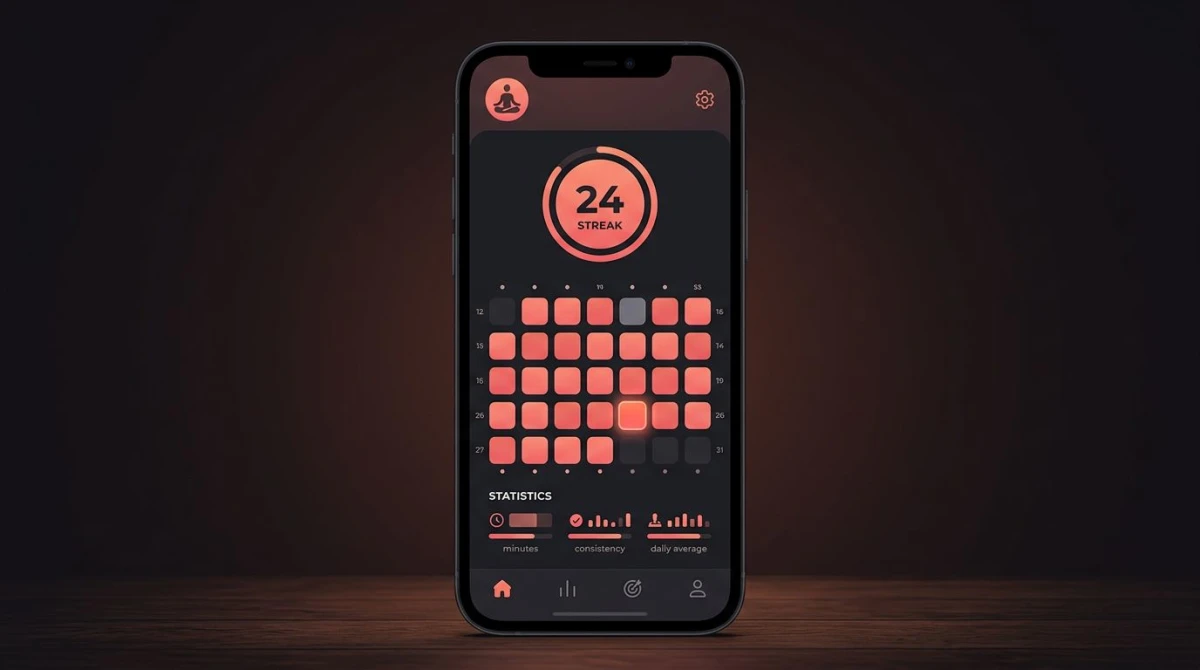
A simple habit tracker on your phone is the lowest-friction way to do this. Log a single check-in for "meditated today" right after you finish — no minutes, no rating, no journaling. The check-in is the rep. HabitBox is built around this kind of one-tap logging, with a calendar heatmap so you can see the sessions-per-week pattern at a glance instead of fixating on a streak number. The meditation app you choose stays separate; the tracker layer sits on top.
For a deeper look at how the metric you track shapes whether the habit survives, our tracking habits guide walks through the trade-offs between streaks, sessions, and identity-based tracking. And if you are not sure which habits are worth tracking alongside meditation, what habits to track is a good companion read.
What to do when you miss a day
You will miss days. Plan for it before it happens, because the recovery rule matters more than the streak.
The Lally et al. study at University College London — the most-cited research on habit formation — followed 96 people building daily habits for 12 weeks. One of its most useful findings: missing a single day did not measurably damage the formation curve. What broke the curve was missing several days in a row, or quitting after the first miss out of guilt.
The rule is simple: never miss twice. Miss a day for any reason — fine. Day two, you sit for two minutes. Even at 11:55pm. Even if you are tired. The point is not perfection; the point is to refuse to let one missed day become five.
If you have already missed three or four days, do not try to "make up" the lost sessions with a long sit. Sit for two minutes today, exactly the way you did on day one. People who restart cleanly after a gap are the ones who end up with a year of practice. People who try to overcorrect usually quit again within a week.
This is also where the visual side of a tracker earns its place. Seeing a calendar with one or two gray squares in a sea of filled ones is a much smaller emotional event than feeling like the whole project is ruined.
Identity, not minutes
Once the 14 days are done, the next move is not "sit longer." It is "shift the frame."
Identity-based habits — habits framed as a small piece of who you are — are more durable in long-term studies than outcome-based habits. The frame is small but it changes the question. Instead of "should I meditate this morning?" the question becomes "do I still want to be a person who meditates?" The first question is up for debate; the second one mostly is not.
The same identity logic underlies durable practices in adjacent domains. People who build exercise consistency past month three almost universally say "I am someone who works out," not "I am someone trying to work out." Same chassis, different habit.
In practice, this means weeks 3-8 stay short — five to seven minutes. Length only goes up after the identity is stable, which for most people is around weeks 6 to 10. By that point, longer sits feel like a natural extension of who you are, not a willpower test.
A realistic first month
Here is what a real first 30 days looks like. Not a fantasy month, not a clean streak — a real one.
- Days 1-7: Two to three minutes daily, breath count, fixed cue. Floor stays low.
- Days 8-14: Three to five minutes, body scan or noting introduced. Cue does not move.
- Day 12 or 13: You will probably miss a day. Apply the never-miss-twice rule.
- Days 15-21: Most people start to feel the habit pulling them — a small "I should sit" feeling around the cue.
- Days 22-30: Sessions feel less effortful. Some sits are five minutes, some are ten. Both are fine.
If, by day 30, you have meditated on twenty or more days, you are doing well. Twenty out of thirty is not a low bar — it is what successful new habits actually look like in the field data, including in the Lally study on real-world habit formation.
The same realistic-month frame applies to other physical-effort habits — including short bodyweight challenges like our 30-day plank challenge. The arc is the same: small floor, fixed cue, missed days absorbed by the system, identity by week six.
Frequently asked questions
How long should beginners meditate?
Two minutes for the first week, ramping by about one minute per week. Most beginner content suggests 10-20 minutes, which is the single biggest reason new meditators quit. Start with the smallest version that still counts and let length grow only after the cue is automatic — usually around weeks 3-4.
What is the best time of day to meditate?
Whichever cue you can keep. Mornings tend to favor focus and intention; evenings tend to favor wind-down and body scan. Research does not show a clear advantage to either timing — only an advantage to consistency. Pick the time you are already sitting still and do not change it for two weeks.
Do I need an app or can I meditate without one?
Both work. Apps like Headspace or Calm give you guided audio and remove the "what do I do?" question, which helps in week one. Unguided sits are simpler long-term — fewer dependencies, no subscription. A reasonable path is guided for the first 14 days, then unguided after that. Either way, the practice tool is separate from the tracker.
What if my mind keeps wandering?
That is the practice. A wandering mind is not a sign you are doing it wrong — the noticing and returning is the rep. Total beginners often have a thought every 5-15 seconds, which is normal. The goal is not an empty mind. The goal is to notice when you have drifted and gently come back to the breath, the body, or the note. Each return is one rep.
How long until I notice benefits?
Most people report a small mood and focus shift by week 3 to 4 of consistent short sessions. Larger benefits — measurable stress reduction, sleep improvement, attention changes — tend to show up around weeks 8 to 12 in studies of beginner programs like MBSR. If you measure benefits week by week you will quit; if you measure showing up, you will keep going.
Putting it together
If you want a meditation habit that survives the first hard week, here is the smallest version of the system: two-minute floor, one fixed cue, one technique, sessions-per-week as the metric, never miss twice. Length comes later. Identity comes later. The first job is the rep.
If you want a habit-tracking layer to sit alongside your meditation app or your timer, HabitBox is built for this. You can log a daily meditation check-in in one tap, see the sessions-per-week pattern as a calendar heatmap, and use the missed-day visual as a soft nudge instead of a guilt trip. The practice stays in your meditation tool. The streak stays in your pocket.
The goal is not a 30-minute Zen sit. The goal is the version of you that sat for two minutes on a Tuesday — the day you almost did not.

Mira Hartwell
Editor, HabitBoxEditor at HabitBox. Writes about habit science and productivity, grounding every post in named research (Lally, Wood, Walker, Huberman) instead of recycled advice. Read full bio →