30 Day Plank Challenge: Free Day-by-Day Schedule (2026)
TL;DR. A 30 day plank challenge works only if the daily jumps are small and rest days are built in. Start at 20 seconds on day 1, climb to a 5-minute hold by day 27, and rest every fourth day. Most challenges fail at the day-8 cliff, where the schedule goes from 30s to 90s overnight — your core isn't ready, and one bad rep ends the streak. The fix: never raise your hold by more than 20% week-over-week, and use a missed-day repeat rule instead of restarting from day one.
If you've started a 30 day plank challenge before and dropped off around day 10, you didn't fail at planking. You failed at pacing. The schedules from most fitness magazines are written for someone who can already hold a 90-second plank — they bury the real beginner curve under "just push through it" advice.
This guide gives you the day-by-day numbers, the form fundamentals from clinical sources, the missed-day recovery rule that keeps the streak alive, and three difficulty variants. By the end you'll have a plan you can actually finish.
The full 30 day plank challenge schedule
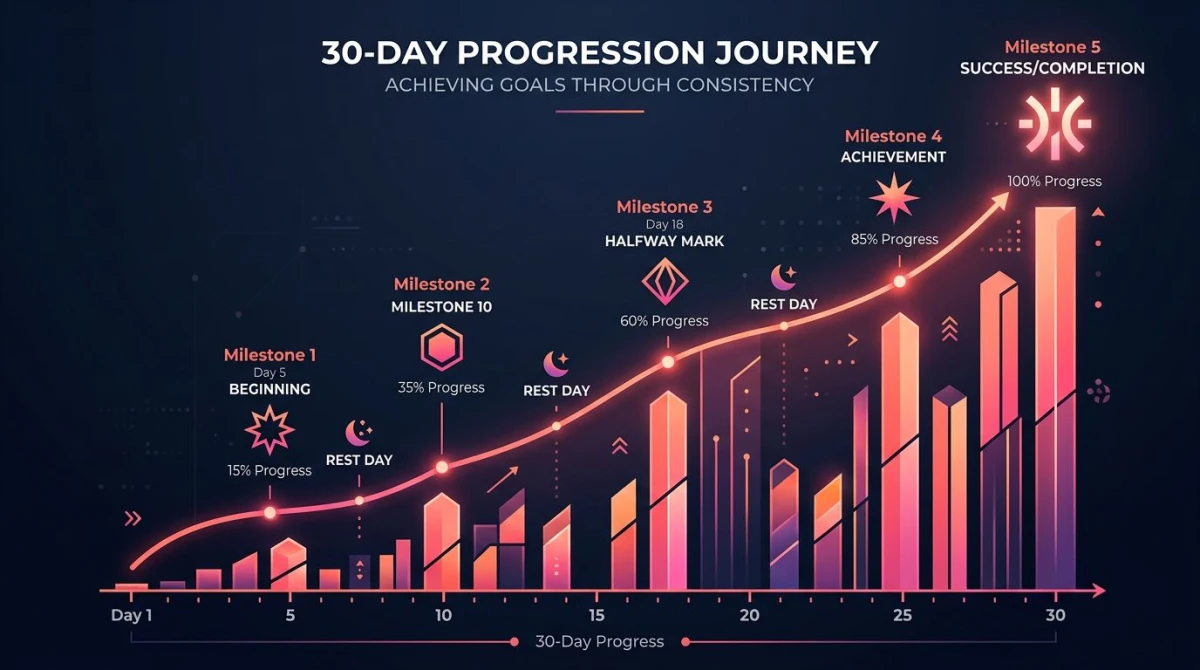
Here's the schedule — free to print or screenshot, no PDF gate, no signup. Punch it into a habit tracker if you prefer, but use it as written, not as a suggestion. To time each hold without fiddling with a stopwatch, our free plank timer counts the hold and beeps when you're done.
| Day | Plank time | Rest day |
|---|---|---|
| 1 | 20s | No |
| 2 | 25s | No |
| 3 | 35s | No |
| 4 | Rest day | Yes |
| 5 | 40s | No |
| 6 | 50s | No |
| 7 | 1:00 (60s) | No |
| 8 | Rest day | Yes |
| 9 | 1:15 (75s) | No |
| 10 | 1:30 (90s) | No |
| 11 | 1:45 (105s) | No |
| 12 | Rest day | Yes |
| 13 | 2:00 (120s) | No |
| 14 | 2:15 (135s) | No |
| 15 | 2:30 (150s) | No |
| 16 | Rest day | Yes |
| 17 | 2:45 (165s) | No |
| 18 | 3:00 (180s) | No |
| 19 | 3:20 (200s) | No |
| 20 | Rest day | Yes |
| 21 | 3:40 (220s) | No |
| 22 | 4:00 (240s) | No |
| 23 | 4:15 (255s) | No |
| 24 | Rest day | Yes |
| 25 | 4:30 (270s) | No |
| 26 | 4:45 (285s) | No |
| 27 | 5:00 (300s) | No |
| 28 | Rest day | Yes |
| 29 | 5:00 (300s) | No |
| 30 | 5:00 (300s) | No |
Each working day is one continuous forearm plank. Rest days are real rest — no sneaky "active recovery" planks. Your core needs the recovery to handle the next jump.
Why most 30 day plank challenges fail
Look at the schedules ranking on Google for this keyword — as of mid-2026, most of them still jump from 30 seconds on day 1 to 60 seconds by day 4 to 90 seconds by day 7. That's a 200% increase in your first week. Almost no beginner can hold form through that, and once form breaks, the lower back takes the load.
The drop-off curve has a name in fitness coaching: the day-8 cliff. The first week is exciting and short enough to power through. By day 8 the holds are long enough to hurt, the novelty has worn off, and the schedule is asking for a number you can't hit. So you skip a day. Then two. Then the streak is gone and the whole thing feels pointless.
There are three structural reasons these challenges break:
- Linear duration scaling ignores your nervous system. A 30-second plank and a 90-second plank are not the same exercise. The second one is a different demand on your transverse abdominis and shoulder stabilizers, and you need recovery days to adapt.
- No rest days means cumulative fatigue. Cleveland Clinic recommends planking two to four times a week, not seven. Daily planks without rest are a one-way ticket to lower-back strain.
- No missed-day plan. Most schedules treat day 1 as sacred. Miss day 12 and you "have to start over." Almost nobody starts over. They quit.
This guide solves all three: the daily jumps cap at 20% week-over-week, you rest every fourth day, and there's a recovery rule for the day you inevitably miss.
The streak-recovery rule (read this before day 1)
Here's the rule that saves the challenge: if you miss a day, repeat the previous day's hold instead of skipping ahead or restarting.
So if you nail day 11 (1:45) and then life happens on day 12 — late meeting, sick kid, travel — you don't restart from day 1. You don't pretend day 12 was rest and jump to day 13. You repeat day 11 (1:45) the next time you train. The day count adjusts but the streak of completed sessions stays alive.
This is borrowed from research on habit formation. A University College London study by Phillippa Lally and colleagues tracked 96 people forming new habits and found that missing a single day had no measurable effect on the long-term automaticity curve. What broke habits was missing two consecutive days. The repeat rule keeps you from compounding misses into a quit.
James Clear calls this the "never miss twice" principle in Atomic Habits. The first miss is data. The second miss is the start of a new pattern.
In practice:
- Miss one day: repeat the previous day's hold. The challenge becomes 31 days. That's fine.
- Miss two days: drop back two days and rebuild from there. Don't try to skip back to your original target — your core has already lost a small amount of capacity.
- Miss a week or more: restart from a comfortable mid-point (day 7 or day 13), not from day 1. You won't lose all your progress; you'll just need a week to rebuild.
Form fundamentals: how to plank correctly
Bad form turns the plank from a core exercise into a lower-back exercise. Here's what to lock in before day 1.
Position checklist
- Forearms parallel, elbows directly under shoulders. Not in front, not splayed wide. A 90-degree angle at the elbow.
- Body in a straight line from heels to crown of head. Imagine a broomstick resting on your back — it should touch your tailbone, mid-back, and skull at the same time.
- Glutes engaged, slight forward pelvic tilt. Cleveland Clinic puts it well: "If someone poked your abdomen, it should be firm." Soft belly means you're hanging on the spine.
- Neck neutral, eyes on a spot 12 inches in front of your hands. Don't crane your neck up; don't tuck your chin to your chest.
- Breathing slow and rhythmic. Holding your breath spikes blood pressure and shortens the hold. In through the nose for three counts, out through the mouth for four.
Common mistakes to fix
- Sagging hips. The most common error past 60 seconds. Cue: "lift the belt buckle toward the ceiling."
- Piked hips (butt in the air). This shifts load to the shoulders and shortens the lever — you're cheating the core. Cue: "lower the hips until the body is one line."
- Locked elbows or shrugged shoulders. Push the floor away with your forearms. Shoulders should sit down and back, not jammed up by your ears.
- Held breath. If you're red-faced, you're not breathing. Drop the time and rebuild form before adding seconds.
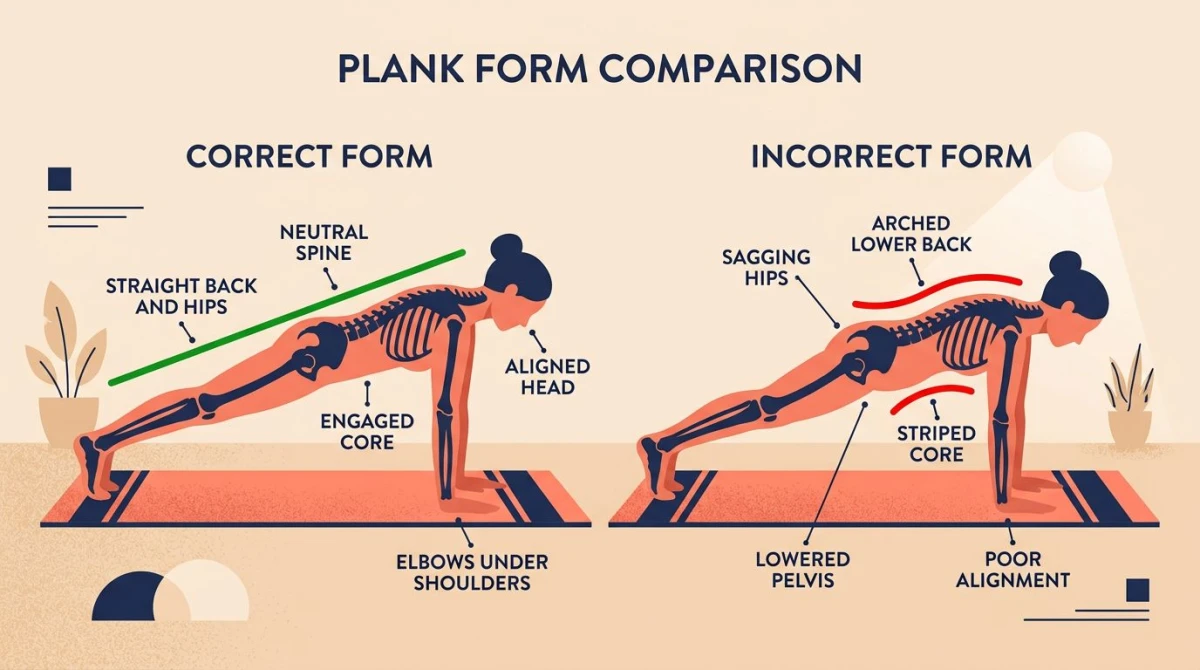
If your back hurts during or after a hold, stop. Form has broken. Drop to your knees for a modified plank and rebuild from there. A 30-second clean plank beats a 90-second sloppy one every time.
Three difficulty variants: pick your starting line
Not everyone walks into day 1 with the same baseline. Here are three versions of the challenge — pick the row that matches where you actually are, not where you wish you were.
| Variant | Day 1 hold | Day 30 target | Best for |
|---|---|---|---|
| Beginner | 15s on knees, then 5s on toes | 2:30 on toes | First time training core, returning after injury, or post-pregnancy |
| Standard | 20s on toes | 5:00 on toes | Casual exerciser who can hold 30s with clean form today |
| Advanced | 45s on toes | 5:00 weighted (10–25 lb plate on back) | Lifter or athlete with a strong base who wants a real adaptation |
The beginner variant uses the same rest cadence and missed-day rule but caps lower. If you finish the beginner version and want more, that's day 1 of the standard track — not day 31 of "I should be doing five minutes by now."
The advanced variant adds load instead of time after day 18, because research on plank duration suggests minimal extra benefit beyond two minutes of continuous holding. Past that point, variation and load beat duration.
Why tracking the streak changes the outcome
Here's the part most fitness articles skip. Whether you finish a 30-day challenge has less to do with your core strength on day 1 than with whether you can see the streak.
Wendy Wood, the USC researcher who has spent two decades studying habit psychology, has shown that about 43% of daily behavior is repeated in the same context. Habits live in cues, not willpower. The visible streak — checkmarks on a calendar, a counter on a phone, a row of green squares — becomes the cue that triggers the next session.
Streaks also tap loss aversion, which behavior economists have measured at roughly 2-to-1 against gain seeking. Once you've built a 12-day chain, breaking it feels worse than the work of doing today's plank. That asymmetry is why streak-based apps work where motivation alone doesn't.
If you're tracking the challenge on paper, that's fine — a wall calendar with X marks works. If you'd rather have it on your phone, HabitBox is a habit tracker built around exactly this mechanic: one-tap check-ins, a streak counter that survives a single missed day with the same repeat rule, and a calendar heatmap so you can see all 30 days at once. The point isn't the app, though — it's making the streak visible enough that you don't want to break it.
For more on this idea, see our deeper guides on habit stacking and habit formation, which cover the science of streak-based behavior change.
How a 30-day challenge fits into a real fitness habit
Thirty days is a useful container, not a finish line. Lally's UCL research found that habits take a median of 66 days to feel automatic, with a wide spread from 18 to 254 days depending on the person and the behavior. So the day-30 plank isn't where the work ends — it's where the work starts being routine.
Three ways to land the challenge into a longer habit:
- Stack it with an existing daily anchor. Plank right after you brush your teeth, or right before your morning coffee. The anchor cue does the remembering for you. (See our habit stacking guide for the full method, or build your own stack with the free habit stacking builder.)
- Drop the duration, keep the frequency. After day 30, switch to a 90-second plank three or four times a week. That's the maintenance dose Cleveland Clinic recommends, and it sustains the gains without burning you out.
- Pair it with another short streak. A 30-day plank challenge layers well with a running streak, a pushup challenge, or any other simple daily-or-near-daily routine. The streak mindset transfers between exercises. People who finish one tend to start another within a month — see our piece on fitness consistency for why.
If finishing a 30-day plank teaches you anything, it's that consistency, not intensity, is the variable that moves outcomes. Most people overestimate what they can do in a week and underestimate what they can do in 90 days. The plank is the small unit you use to learn that.
FAQ
How long should I plank on day 1?
Will I see results in 30 days?
What if I miss a day?
Should I plank every day or take rest days?
Can I combine the plank challenge with other workouts?
Putting it into practice
A 30 day plank challenge is mostly a test of whether you can show up for two minutes a day, not whether you have a strong core. The schedule above gives you the right ramp, the rest days, and the missed-day rule. The streak gives you the cue.
If you'd like a clean way to track day-by-day progress and keep the streak alive after this challenge ends, HabitBox handles the daily check-in and the calendar view in one tap. Whatever you use to track it, start with day 1 and twenty seconds today — it's the only day that's hard to start.

Mira Hartwell
Editor, HabitBoxEditor at HabitBox. Writes about habit science and productivity, grounding every post in named research (Lally, Wood, Walker, Huberman) instead of recycled advice. Read full bio →