Running Streak: How to Build One Safely (2026)
A running streak is the practice of running at least one mile every single day, with no rest days. It works for habit consistency because it removes the daily decision of whether to run. It breaks runners who ramp mileage too fast. The fix is not to skip days — it is to set a minimum-mile floor, cap your weekly increase at 10%, and treat slow shuffles as wins.
This guide covers the official rules, the science behind why streaks stick, a safe-streak protocol you can follow without ending up injured, and an honest comparison of streak running versus 4-days-a-week consistency.
What counts as a running streak
The United States Running Streak Association (USRSA) is the body that tracks official streaks, and its definition is the one most runners use:
A running streak is running at least one continuous mile (1.61 km) within each calendar day, on a road, track, treadmill, or trail. Walking, biking, or swimming does not count.
Three rules that surprise people:
- One mile is the minimum, not a target. A 12-minute slow jog satisfies it.
- The day is the calendar day, not 24 hours. You could run at 11:30 PM Monday and 6:00 AM Tuesday and still keep your streak.
- Illness, injury, and travel all count as streak days — you still have to run a mile, even if it is slow.
The shortest USRSA-recognized streak is one year. The longest active streaks run past 50 years.
"Streak" in habit-tracker apps means something different
Most habit-tracking apps use "streak" loosely — it usually means consecutive days you logged the habit, whatever the dose. For a running streak, the dose matters: one mile minimum. Set your tracker so that anything under a mile does not count as a complete day.
Why streaks work (the psychology)
Streaks are one of the most studied habit mechanics in behavior science. Three forces make them stick:
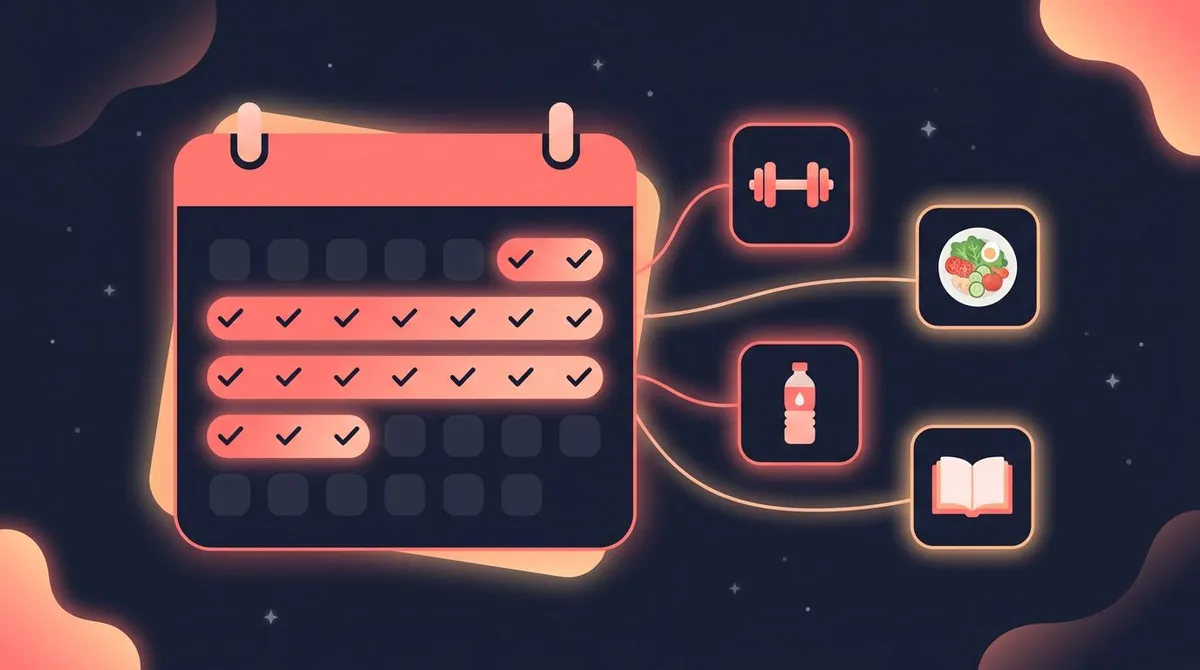
1. Don't Break the Chain. Productivity writer James Clear popularized the technique after Jerry Seinfeld used a wall calendar with a red X for every day he wrote jokes. The X is a visual streak. Once the chain is long enough, breaking it feels worse than running.
2. Habit formation timeline. A University College London study by Phillippa Lally and colleagues found that automatic behaviors form in a median of 66 days — not the popular 21-day myth. A streak gives you a clean 66-day on-ramp where the habit stops being a decision.
3. Loss aversion. People feel losses about twice as strongly as equivalent gains. After 30 days, you are not running because you want to run — you are running because you do not want to lose 30 days of work. That is leverage your motivation cannot match.
The catch: all three forces also work against you on a bad day. Pushing through a hot calf or fever to protect a streak is exactly how short streaks turn into long injuries.
The safe-streak protocol
Most "run every day" guides either celebrate streaks or warn against them. Here is the middle path: a written protocol that lets you keep the chain without wrecking your body.
1. Set a minimum-mile floor, not a maximum-mile ceiling
Decide your floor up front: one mile, easy pace, no exceptions. On good days, run more. On bad days, run the floor and stop. The mistake is treating every day as a full training day. The streak only requires the minimum.
2. Cap weekly mileage growth at 10%
The American College of Sports Medicine's well-known 10% rule is the most cited guideline for avoiding overuse injuries: do not increase weekly running volume by more than 10% from the previous week. If you ran 20 miles last week, this week's ceiling is 22 miles. The rule is conservative for a reason — running injuries are a volume problem, not an effort problem.
3. Build a "bad day" plan before you need one
Write down your three categories before you start the streak:
- Green day: normal training run.
- Yellow day (tired, sore, busy): minimum mile only, easy pace, treadmill if needed.
- Red day (fever, sharp pain, food poisoning): skip the streak. Health beats the chain.
Pre-deciding the categories takes the negotiation out of bad days. You are not deciding at 10:00 PM whether to "push through." You are checking which color today is.
4. Make the minimum embarrassingly easy
BJ Fogg's Tiny Habits research shows new behaviors stick best when the entry point is much smaller than your motivation on a bad day. A one-mile floor at any pace meets that test. If a mile feels hard on Day 5, your minimum is not too small — your training load is too big.
5. Treat the streak as a 90-day experiment, not a life sentence
USRSA streaks are measured in years, but the people who go that long started by treating it as a finite trial. Commit to 90 days. Reassess. If your sleep, mood, and weekly mileage are all in good shape, extend. If anything is breaking down, end the streak deliberately and move to a 4-5 day schedule.
Streak vs consistency: which wins
A daily streak is one path to consistency. It is not the only one. For many runners — especially anyone over 35, returning from injury, or training for a long-distance race — running 4 days a week is healthier and produces equal or better fitness gains. If you are training for a specific race, our free running pace calculator turns a goal finish time into per-mile splits for anything from a 5K to a marathon.
Here is the honest tradeoff:
| Factor | Daily streak (7x/week) | Consistency (4x/week) |
|---|---|---|
| Habit stickiness | Very high — no decision needed | High, but each day is a decision |
| Injury risk | Higher, especially in the first 3 months | Lower |
| Recovery quality | Limited — every day adds load | Built-in rest days |
| Weekly mileage ceiling | Lower (more days, lower per-day) | Higher (longer runs possible) |
| Mental load | Low after Day 30 | Moderate forever |
| Best for | New runners building the habit | Trained runners optimizing performance |
The honest answer: a streak is a habit-formation tool, not a training plan. Use it for the first 60-90 days to wire in the behavior. Then either keep it (with the safe-streak protocol) or transition to a 4-5 day rotation with structured rest. Both are real consistency. Neither is failure.
If you are completely new to the sport, our how to start running for beginners guide covers the conditioning side first.
How to track a running streak
Tracking is not optional with streaks. The chain is the point — if you cannot see it, you lose 90% of the psychological benefit. You have three tracking choices:
Paper calendar. A wall calendar with a marker is the original Seinfeld method. Cheap, visible, satisfying. The downside is no data — you see the chain but not your mileage trends.
Running app (Strava, Garmin, Nike Run Club). Records distance and pace automatically. Most do not show streaks well. You will see "weekly summary" but the daily chain is buried.
Habit tracker app. Records the streak as a habit, not a workout. You log the run as completed (yes/no), and the app shows a daily heatmap, current streak, and longest streak. This is what most run-streakers actually want — the chain, not the splits.
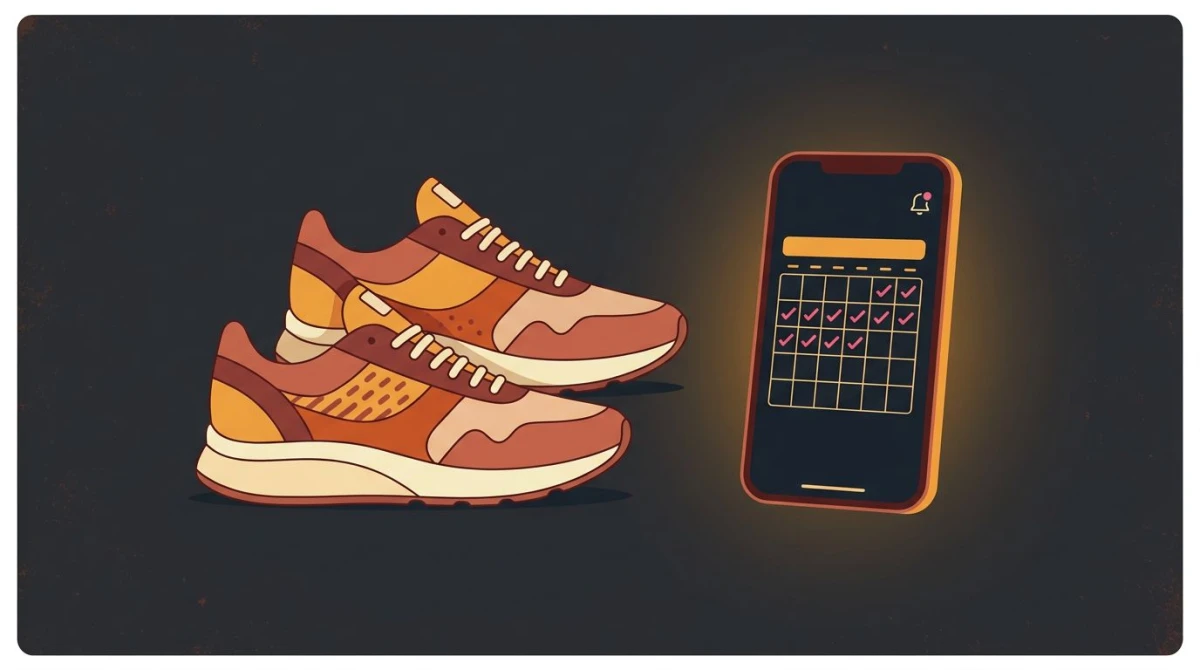
Most runners end up using two: a running app for the workout data and a habit tracker for the chain. Apps like HabitBox were built for the second job — daily check-in, streak counter, calendar heatmap, and a notification that nudges you before midnight if you have not logged today.

Set up your tracker for a running streak
Whichever app you choose, configure it the same way:
- Habit name: "Run 1 mile" — not "Run." The dose has to be in the name.
- Frequency: every day.
- Reminder time: mid-afternoon. By evening, your willpower is spent.
- Streak counter visible on the home screen. The visible chain is the engine.
- Skip rules: do not allow auto-skip on rest days. A streak does not have rest days by definition.
For more on the mechanics of building any new habit, see our guide on habit formation.
Common running streak mistakes
After reading about streakers who go decades, most people make the same five mistakes in the first 30 days:
- Running their normal pace on the minimum day. A 1-mile easy jog is recovery; a 1-mile race-pace effort is training. They are not the same.
- Stacking the streak on top of an existing training plan. If you already run 4 days a week with hard workouts, adding 3 daily 1-mile junk-mile days will break you. Reduce hard days first.
- Treating soreness as illness. Soreness is normal, especially early. The minimum mile actually helps recovery on sore days. Save the "skip" decision for sharp pain or fever.
- Skipping warmup on the minimum day. A mile at a cold start is when calves and Achilles tendons get hurt. Two minutes of walking before the mile prevents most of it.
- Hiding the streak. People who track privately drop out 2-3x faster than people who tell one person. You do not need a public Instagram — one accountability friend is enough.
If running consistency is the goal but a daily streak feels too rigid, fitness consistency covers the 4-days-a-week alternative in detail. And if you like the streak format but want to try it on something lower-impact first, the 30-day pushup challenge uses the same chain mechanic with less injury risk.
Pair your streak with a stack
The runners who keep streaks longest do not rely on willpower. They build a tiny pre-run routine that triggers the run automatically: shoes by the door, key on the shoes, watch on the key. Pick up the watch, you pick up the shoes.
This is the habit stacking principle — anchor the new habit to an existing one, and the trigger does the work. A run streak that lives inside a morning coffee or post-work-shutdown routine survives bad weeks. A run streak that lives in standalone motivation does not. Once the run is automatic, a 30 day plank challenge layers core strength onto the same daily slot — two minutes post-run, same streak logic.
FAQ
Is a running streak healthy?
What is the minimum to count as a run streak day?
What if I get sick during a running streak?
How long should my first running streak be?
What is the best app to track a run streak?
A note on commitment
The thing nobody tells you about a running streak is that the first 14 days are easy and the next 30 are not. Day 17 is when you realize you are tired, your legs are tight, and the weather is bad. That is the day the streak is actually being built.
You do not need to run far on Day 17. You just need to run one mile. That is the entire trick — the minimum-mile floor that lets you keep the chain on the days you do not feel like keeping it.
For tracking the chain across any habit you are building, HabitBox is a free habit tracker for iOS and Android with a streak counter, calendar heatmap, and reminders that nudge you before midnight if you have not checked in. It is built to do one thing — keep your chain visible — and stay out of the way for everything else.
Run the minimum. Mark the day. See you tomorrow.

Mira Hartwell
Editor, HabitBoxEditor at HabitBox. Writes about habit science and productivity, grounding every post in named research (Lally, Wood, Walker, Huberman) instead of recycled advice. Read full bio →