Fitness Consistency: How to Stop Quitting at Week 3 (2026)
TL;DR. Fitness consistency breaks because most people scale plans for their motivated self, not their tired self. The collapses happen at three predictable points: week 3 (novelty fades), week 7 (the plateau), and week 12 (a life event). The fix is a minimum-viable workout your tired self will still do, an identity reframe so missing a session doesn't end the run, and a recovery rule for missed days. Floor your weekly minimum at two sessions and treat showing up as the win.
You've done this before. The first two weeks feel great. By week three, the alarm sounds different. By week seven, the scale stops moving. By week twelve, a work trip or a flu wipes the routine and the next Monday never comes.
That cycle isn't a willpower problem — it's a design problem. The plan you wrote on a Sunday for your motivated self does not survive your tired Tuesday self. Fitness consistency is built by closing that gap.
What "fitness consistency" actually means
Fitness consistency is the habit of training on a schedule your real life can support, week after week, with a floor low enough that bad weeks still count. It is not perfect attendance. It is the absence of long unplanned breaks.
Harvard Health's review of activity patterns found that people who exercise on a steady schedule see better cardiorespiratory fitness than people who exercise the same total minutes but irregularly (Harvard Health). Two reliable sessions a week beats five great ones followed by a three-week gap.
Consistency is a frequency game first, an intensity game second. You earn the right to push intensity by stringing weeks of basic attendance together.
Why fitness consistency breaks: the three inflection points
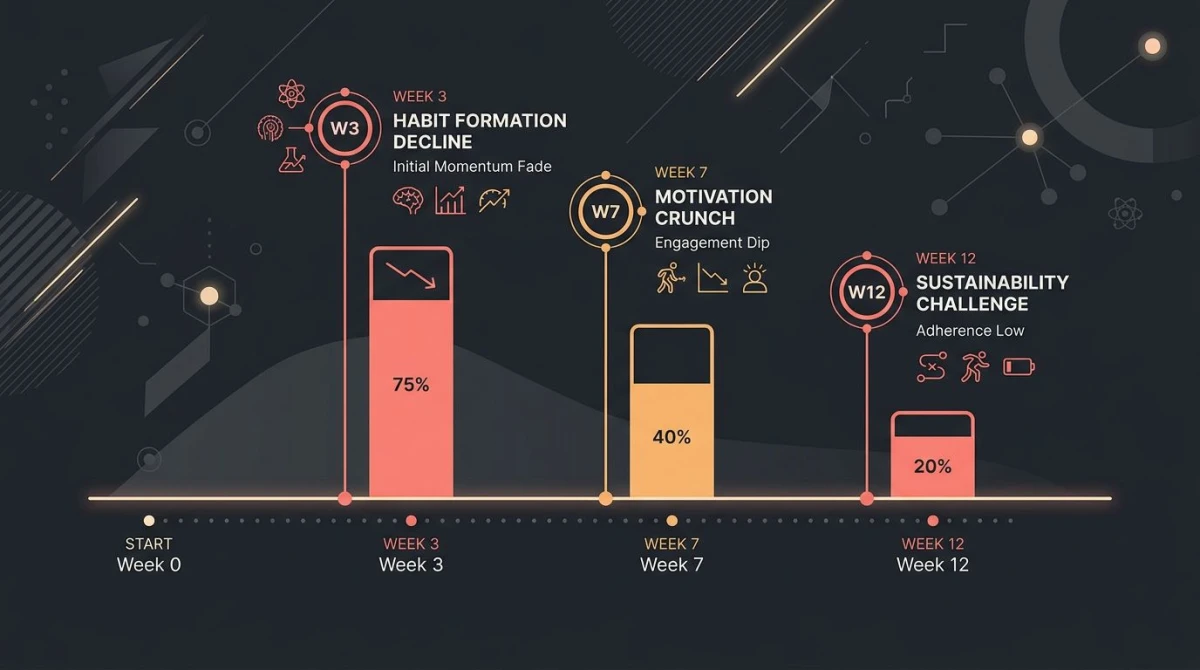
New routines die at three predictable moments. Naming them before they hit roughly doubles your survival rate, because you stop reading a normal dip as personal failure.
Week 3: the novelty fade
The first two weeks run on novelty dopamine. The gym is new, the program is new, the gear is new — your brain treats it as exploration and pays you in feel-good signal. Around day fifteen, novelty stops paying out and the habit loop isn't built yet, so nothing pulls you out the door.
This is the most common quit point. It feels like lost motivation, but the underlying mechanism is that the temporary reward is gone and the permanent one (skill, fitness, identity) hasn't compounded enough to replace it.
Week 7: the plateau
Around week six or seven, beginner gains slow. Your first three pounds came off fast; the next three won't. Your bench moved 20 pounds in a month and now hasn't moved in two weeks. The plateau is normal physiological adaptation — your body has caught up with easy linear progress and now requires more recovery, variation, or time.
Most people read it as "the program stopped working" and switch programs. The new program restarts the novelty clock and sets up another week-3 quit. Expect the plateau and don't move the goalposts during it.
Week 12: the life event
Somewhere around month three, life will hand you a reason to skip — a flu, a work trip, a family event, a deadline week. If you've built consistency around perfect attendance, one missed week ends the chain mentally. The plan you go back to is the optimal version, which is the version you can't sustain in a recovery week, so you skip again.
This is where identity-based habits matter most. We'll cover the recovery rule below.
The minimum-viable workout: what to do when you don't want to
The most useful idea in fitness consistency comes from BJ Fogg's Tiny Habits research at Stanford: a behavior must be small enough that motivation isn't required to do it. Fogg calls this the minimum-viable behavior. For training, that's the workout you would do on your worst day of the month.
It is not a "good" workout. It is the workout that keeps the streak alive when everything else is on fire.
| Tier | Description | When to use |
|---|---|---|
| Aspirational | 60-min lift + 30-min cardio, full program adherence | Best weeks. Maybe 1 in 4. |
| Optimal | 45-min focused lift or full cardio session, hits the program | Normal good week. About half your weeks. |
| Minimum-viable | 10–20 min: bodyweight circuit at home, walk around the block, one compound lift x 3 sets | Bad weeks. The non-negotiable floor. |
The trap most people fall into: they design only the aspirational and optimal workouts. When the bad week arrives, the only options are "real workout" or "skip." Skip wins, and the chain breaks. Adding a written, pre-decided minimum-viable workout means the bad-week choice is between two versions of yes.
Floor your weekly minimum at two minimum-viable sessions. Two is the smallest number that still maintains the rhythm Harvard's data shows matters. One feels too easy to skip. Three becomes optional during a hard week.
Identity-based reframe: who you are vs what you do
James Clear's Atomic Habits makes a distinction worth borrowing. Outcome-based habits ask "what do I want to achieve?" Identity-based habits ask "who do I want to become?" The second framing survives bad weeks; the first does not.
The reason is simple. If your goal is "lose 15 pounds," every missed workout is a setback against the goal, and a string of setbacks tells a story of failure. If your identity is "I am a person who trains twice a week," a missed Tuesday isn't evidence against the identity — it's a single data point. You make it up Thursday and the identity holds.
In practice, the reframe sounds like this:
- Outcome: "I'm trying to get in shape." Identity: "I'm a person who works out."
- Outcome: "I want to run a 5K." Identity: "I'm a runner."
- Outcome: "I want to bench 225." Identity: "I'm someone who lifts."
The phrasing seems small. The downstream behavior isn't. People who hold the identity skip less often, return faster after misses, and resist the program-hopping that breaks consistency. Our identity-based habits guide goes deeper on the votes-not-vows mechanic Clear describes.
This is also why one missed session doesn't end a run. Skipping a single workout doesn't change who you are. Skipping fourteen in a row does. Treat the identity as the asset you're protecting and the workouts as the deposits.
Anchor your sessions: habit stacking for workouts
Consistency lives or dies on cues. Wendy Wood's research at USC shows that roughly 43% of daily behavior is repeated in the same context. Workouts that ride a stable cue stick; workouts that float on intention drift.
The fix is to attach your training to something you already do every day. The formula, from Clear's habit stacking method, is: After [CURRENT HABIT], I will [NEW HABIT].
- Morning lift: "After I pour my first cup of coffee, I will put on my training clothes."
- Lunchtime walk: "After I close my laptop for lunch, I will walk for fifteen minutes."
- Evening run: "After I drop my bag inside the door, I will change into running shoes."
The anchor must be specific and reliable. "After work" is not specific; "after I park the car in the driveway" is. Our habit stacking guide has a full template library.
Motivation is variable, but routines are stable. The session you anchor to a daily cue runs on existing wiring; the session you schedule by good intentions runs on a budget that empties by Thursday.
The recovery rule: never miss twice
When you do miss — and you will — the move that protects consistency is the one James Clear has popularized as "never miss twice." A single missed workout is a single missed workout. Two in a row is the start of a new pattern. The rule is to treat the second session after a miss as the most important workout of your week.
The mechanism behind this is loss aversion. Phillippa Lally's habit formation research at University College London found that a single missed day did not measurably impair habit formation; it's the compounding of misses that erodes automaticity (Lally et al., 2010). One miss is a data point. Two is a trend. Five is a new habit of skipping.
Practical rules that operationalize this:
- If you miss a planned session, schedule the make-up within 48 hours, even if it's the minimum-viable version.
- If you miss a full week (vacation, illness, work crush), restart at your minimum-viable floor — not your optimal volume. The point is to re-anchor the cue, not to make up lost work.
- Do not double the next session to "catch up." This breaks recovery and stacks the soreness that justifies the next skip.
Track the streak: why visibility matters
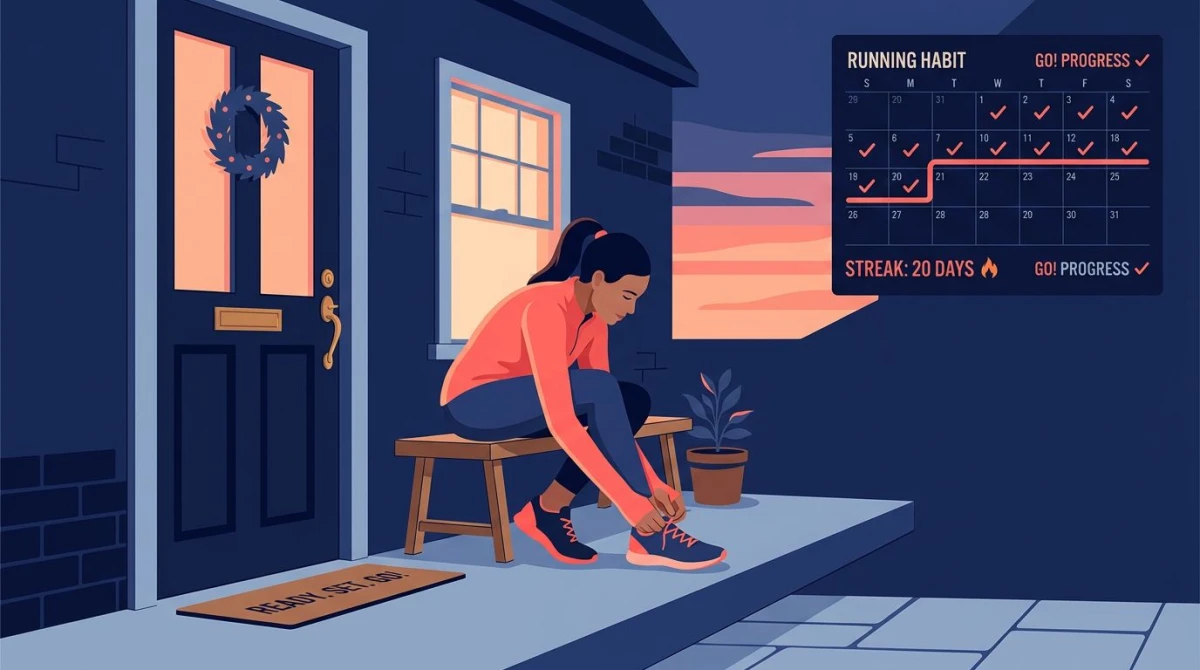
Consistency is built on small reliable choices, and small reliable choices need feedback. A visible streak gives the brain a tangible thing to protect, which converts an abstract goal ("get in shape") into a concrete daily input ("don't break the chain").
The mechanism is loss aversion, the same lever the recovery rule uses. People work harder to avoid losing a 23-day streak than to gain a 24th day. A wall calendar works; a habit tracker app works better, because it shows the pattern over months and surfaces which days of the week you skip.
If you're tracking workouts alongside other habits, a dedicated tracker like HabitBox makes the rhythm visible at a glance — the calendar heatmap shows which weeks held and which broke. Our tracking habits guide covers what to log and what to ignore.
What to track, in order of usefulness:
- Did the session happen, yes or no. The only metric that maps to consistency.
- Which tier ran (minimum, optimal, aspirational). Useful for spotting bad weeks.
- A subjective energy score, 1–5. Low scores predict misses 2–3 days out.
Skip metrics that depend on the scale. Body composition lags effort by weeks and breaks weekly when you most need encouragement.
Putting it together: a four-week reset
If your consistency has broken and you want to rebuild without restarting the week-3 quit cycle, this is the shortest credible path.
Week 1. Two minimum-viable sessions only, twenty minutes each. Bodyweight circuit or one compound lift x 3 sets. The goal is anchor reliability, not stimulus.
Week 2. Same two sessions. Add five minutes. Same anchors, same place, same time. Do not add a third session — make the floor boring before you raise it.
Week 3. Add one optional optimal session. If life gets in the way, drop back to the two minimums. Don't let the optional session break the floor.
Week 4. If both minimums held three straight weeks, add a third anchored session and shift one minimum to optimal. The ease of weeks 1–2 is the point.
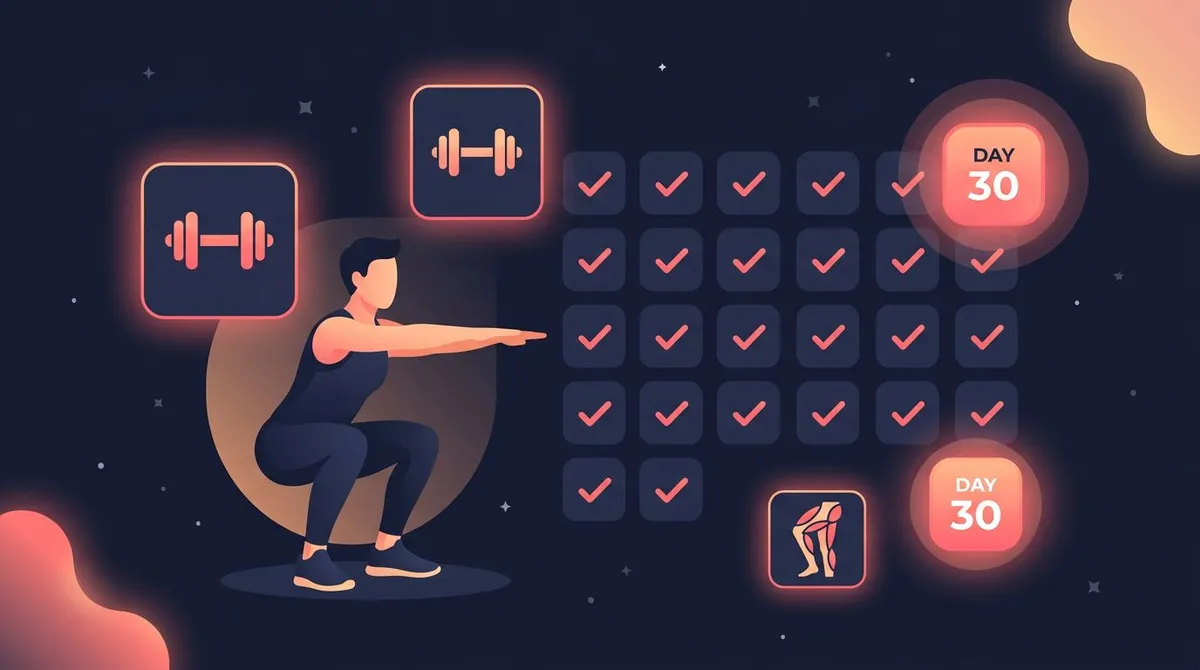
For a structured starting plan, our running streak and 30-day plank challenge guides are both designed around the floor-first principle.
Frequently asked questions
How many workouts a week is enough for fitness consistency?
What if I miss a week?
How long until fitness consistency feels automatic?
Should I do the same workout every time or vary it?
What's a fitness streak and does it actually help?
The bottom line
Fitness consistency isn't a willpower trait. It's a design choice. You design for your tired self by writing a minimum-viable session you'd do on your worst day. You design for the predictable quit points — week 3, week 7, week 12 — by naming them before they hit. You design for misses by deciding in advance that one skip never becomes two.
The science is unambiguous. Frequency beats intensity. Identity beats outcomes. Anchored cues beat motivation. A visible streak beats memory. None of these are tricks; they're the way habit formation works under any name.
If you want a simple way to track the rhythm — which sessions held, which weeks broke, how the pattern shifts month to month — HabitBox is free to start on iOS and Android, with an optional Plus upgrade, and is built around a calendar heatmap that makes consistency visible at a glance. Set your floor at two sessions a week. Mark them done. Protect the chain.
Pick one anchor today. Pick one minimum-viable session. Run it for two weeks before you think about week three.

Mira Hartwell
Editor, HabitBoxEditor at HabitBox. Writes about habit science and productivity, grounding every post in named research (Lally, Wood, Walker, Huberman) instead of recycled advice. Read full bio →