30 Day Pushup Challenge: Beginner Schedule (2026)
A 30 day pushup challenge works best when you start at 5 to 10 reps, ramp by about 10% per week, and use knee pushups on the days a full rep is out of reach. Most plans fail in week two because the rep curve climbs faster than your shoulders can recover. The schedule below builds in a deload day each week so the chain stays unbroken.
TL;DR: the 30-day pushup challenge in one paragraph
Start at 5 to 10 pushups on day one. Add roughly 10% per week, with one deload day every seven days where you do half your usual reps or knee pushups. If you miss a day, do not restart. Repeat yesterday's number tomorrow and keep moving. By day 30 most beginners reach 30 to 40 reps spread across two or three sets. The point is not the rep count. The point is finishing all 30 days.
Why most pushup challenges fail in week two
Open any popular plan and you will see a linear ramp. Day one is 10 reps. Day five is 25. Day ten is 50. The numbers look great on a spreadsheet. They ignore one fact: your shoulders, elbows, and wrists need 24 to 48 hours to recover from pressing work, and that recovery window does not get shorter just because the calendar says you are on day eight.
Here is what the research says. The National Strength and Conditioning Association (NSCA) recommends progressive overload that allows for adaptation between sessions, especially for upper-body pressing patterns where small joints absorb a lot of force. Charging through a linear ramp without rest is the classic shortcut to elbow pain and a quit decision somewhere around day 12 or 14.
The good news is the fix is small. One deload day per week, where you cut reps in half or switch to knee pushups, keeps the streak alive without taxing tissue that is already grumpy. People who try this approach often finish the full 30 days at a higher final rep count than people who tried to grind every day.
The 30-day pushup schedule
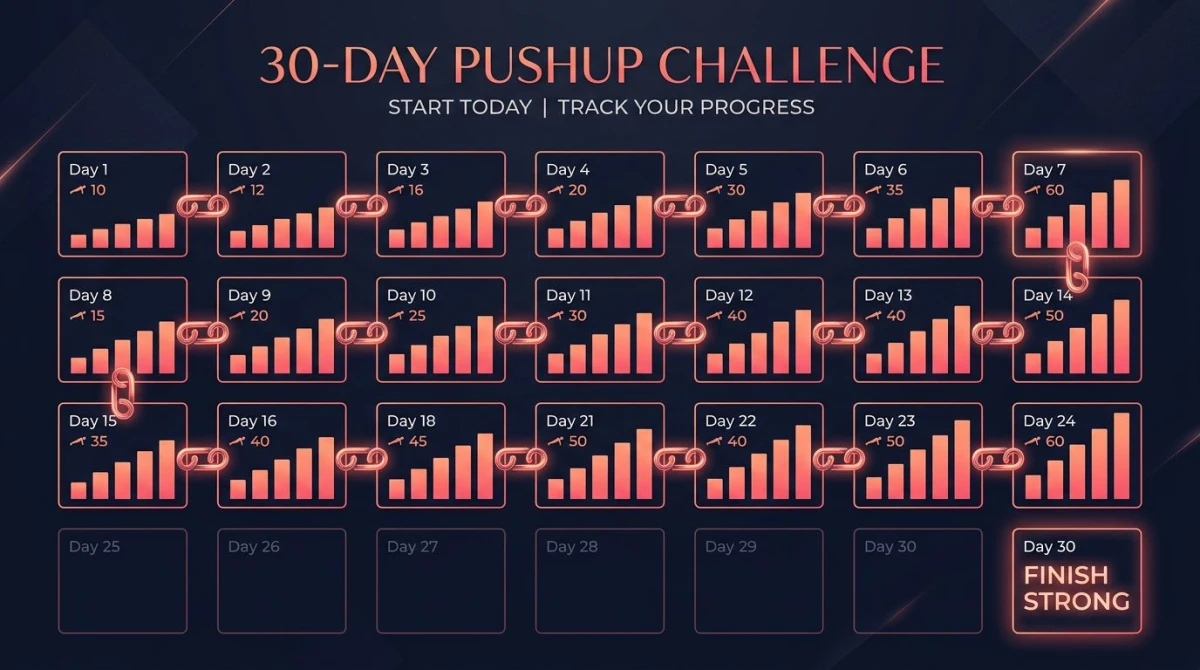
This non-linear schedule starts conservative and includes deload days at the end of each week. Reps are spread across two or three short sets so you keep good form on the last rep — not just the first.
| Day | Pushups | Sets | Notes |
|---|---|---|---|
| 1 | 10 | 2 | Knee pushups OK |
| 2 | 12 | 2 | Same |
| 3 | 14 | 2 | Same |
| 4 | 16 | 2 | Same |
| 5 | 18 | 3 | Split: 6 / 6 / 6 |
| 6 | 20 | 3 | Split: 7 / 7 / 6 |
| 7 | 10 | 2 | Deload day |
| 8 | 18 | 2 | Back to work |
| 9 | 20 | 2 | Same |
| 10 | 22 | 3 | Split |
| 11 | 24 | 3 | Same |
| 12 | 26 | 3 | Same |
| 13 | 22 | 2 | Light day |
| 14 | 12 | 2 | Deload day |
| 15 | 24 | 3 | Halfway |
| 16 | 26 | 3 | Same |
| 17 | 28 | 3 | Same |
| 18 | 30 | 3 | First 30-rep day |
| 19 | 28 | 3 | Slight pullback |
| 20 | 32 | 4 | Split: 8s |
| 21 | 14 | 2 | Deload day |
| 22 | 32 | 3 | Heavy |
| 23 | 34 | 3 | Same |
| 24 | 36 | 4 | Same |
| 25 | 32 | 3 | Light |
| 26 | 36 | 4 | Same |
| 27 | 38 | 4 | Same |
| 28 | 16 | 2 | Deload day |
| 29 | 38 | 4 | Final push |
| 30 | 40 | 4 | Finish |
If 40 sounds far away from where you are starting, that is fine. Cap your daily number at whatever feels like an 8 out of 10 effort and hold there. Finishing the 30 days at 25 reps is a much better outcome than quitting on day 11 with sore shoulders.
Form essentials (the part most plans skip)
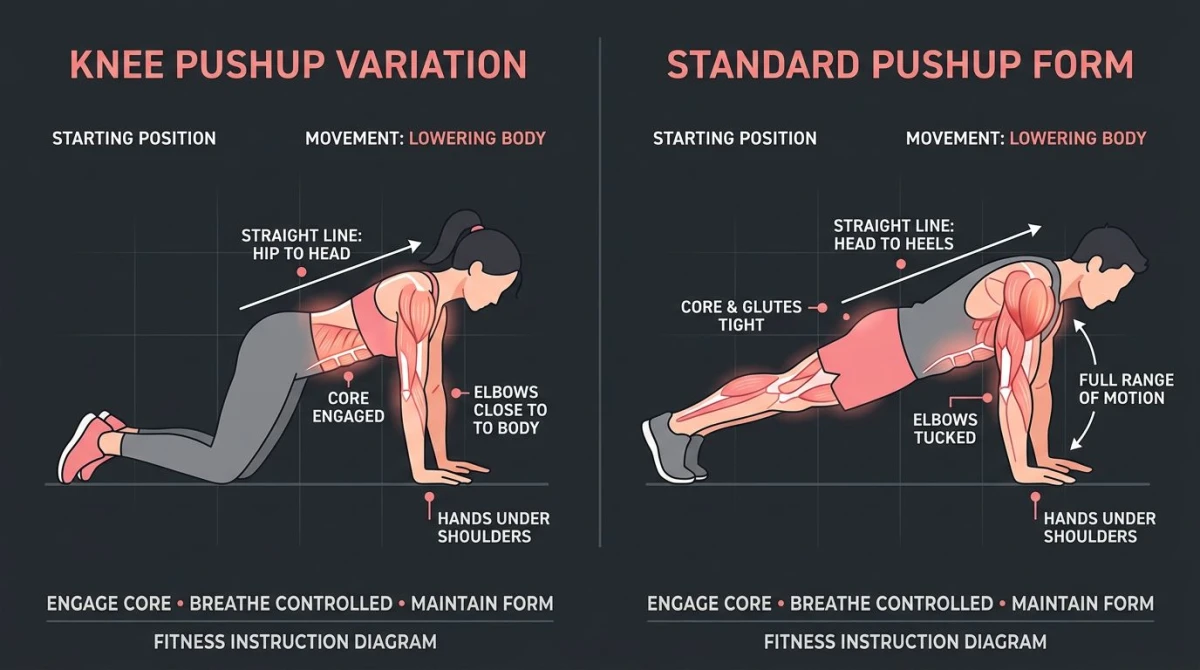
Reps with bad form are not free. They are a slow-cooked elbow injury. The American Council on Exercise (ACE Fitness) breaks down a clean pushup into four checkpoints in their pushup exercise library. Run through these every set:
- Hands under shoulders, fingers spread. Index fingers point straight ahead, not turned out. Spreading the fingers gives your wrists a wider base.
- Body in a straight line, glutes tight. Hips should not sag and they should not pike up. Squeeze your glutes and brace your core like you are about to take a light punch.
- Lower until your chest is a fist's height from the floor. Elbows tuck back at roughly a 45-degree angle from your ribcage — not flared out at 90.
- Push the floor away. Drive through the heel of your palm, lock the elbows softly at the top, and reset before the next rep.
If your hips drop or your elbows flare, the rep does not count. Cut the set short, walk it off, and come back to it. Quality over quantity is not a slogan here. It is the difference between feeling stronger on day 30 and icing your shoulder.
Knee pushup vs incline pushup: pick your regression
If full pushups feel too hard right now, you have two beginner options. Both build the same pressing pattern. The choice depends on what you have at home.
| Variation | What it is | Best for | Difficulty |
|---|---|---|---|
| Knee pushup | Same pushup, but knees stay on the floor | Beginners with limited core strength | About 65% of bodyweight load |
| Incline pushup | Hands on a couch, bench, or counter | Beginners who want a straight-body line | Adjustable — higher surface = easier |
Cleveland Clinic's pushup form guide calls the incline version a smart starter because it preserves the full plank position while removing load. If you are between the two, start with incline. Drop the surface height every five to seven days until you are at the floor.
The knee version is fine too — just keep the same straight line from knees to shoulders that you would have from feet to shoulders. Letting your hips sag turns the move into something else entirely.
The missed-day rule: never restart
Here is the rule that quietly does most of the work in a 30 day pushup challenge: if you miss a day, do not restart from day one. Repeat yesterday's number tomorrow.
Restarts are why people give up on day 14. They feel like they have wasted two weeks. They have not. Research from University College London on habit formation, summarized in the Lally et al. study on PubMed, found that one missed day did not measurably affect the trajectory of habit formation. What matters is the next day, not the missed one.
James Clear says the same thing in Atomic Habits: never miss twice. Missing one day is an accident. Missing two is the start of a new habit — the habit of skipping. So the rule has two parts:
- Missed one day? Repeat yesterday's number on your next session.
- Missed two days in a row? Cut the next session by 30%, then resume the schedule.
This is where a visual streak counter earns its keep. A dedicated tracker like HabitBox shows the chain of completed days as a calendar heatmap, which leans on a behavioral pattern called loss aversion — once you can see 12 green squares in a row, missing a day feels expensive. Pair the pushup streak with habit stacking by anchoring it to something you already do daily, like making coffee.
How to warm up before each set
Two minutes of warm-up cuts injury risk and bumps your top-set rep count by a surprising amount. Before any pushup session, run through this short sequence:
- Arm circles, 30 seconds. Ten forward, ten backward. This wakes up the rotator cuff and the small muscles around the shoulder blade.
- Wrist circles and floor presses, 30 seconds. Press your palms into the floor in a tabletop position to prep the wrists, especially if you sit at a desk most days.
- Two slow incline pushups. Use a counter or a couch. Take five seconds to lower and three seconds to push up. This is your nervous system check — if anything pinches, stop and reassess.
Skip the warm-up only if your pushup count for the day is under 10. Once you cross 15 reps in a single set, the warm-up earns its time back twice over.
What to expect in 30 days
Be honest with yourself: 30 days is not enough time to add visible muscle to most beginners. What it is enough time for is the early neural adaptation phase — the part where your brain gets better at recruiting the muscle fibers you already have.
Most beginners report:
- Higher rep ceiling. Going from 8 reps on day one to 25 to 40 by day 30 is normal.
- Better posture. Stronger anterior shoulders pull the chest up and the upper back into a more neutral position.
- A baseline routine. This is the real win. Daily pushups become something you do without thinking, like brushing your teeth.
If you want visible chest or arm changes, plan for 12 to 16 weeks of consistent training plus a small calorie surplus. The 30 day challenge is a launchpad, not a finish line. For an idea of what week-five-and-beyond looks like, see our piece on fitness consistency — it covers what to do once the novelty wears off.
Pairing the pushup challenge with other habits
A pushup challenge sits well next to other movement habits because it is short and stationary. You can knock out a set in 60 seconds and you do not need a gym. Pair-options that work for most people:
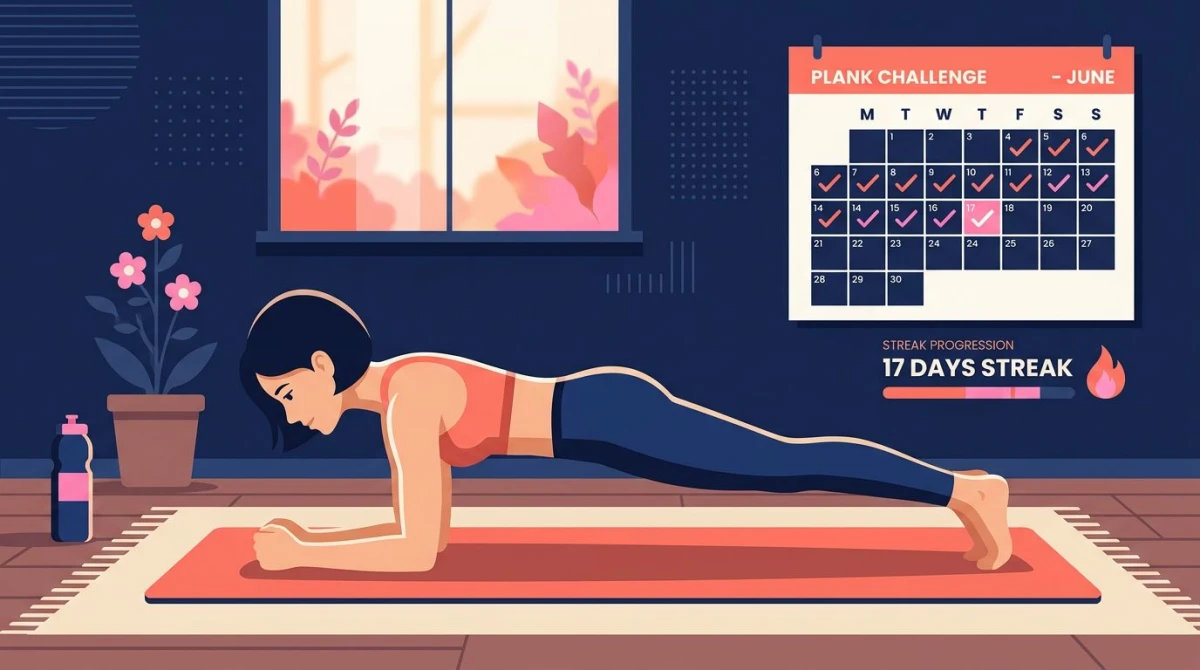
- Plank challenge. Pushups train pressing strength; planks train the bracing strength that makes those pushups stronger. Try our 30-day plank challenge on the same days.
- Running streak. A 10-minute easy run after pushups balances upper-body and lower-body work. Our guide to a running streak covers how to keep the daily run small enough to stay sustainable.
- Habit stacking. Anchor the pushup set to an existing cue — coffee brewing, podcast intro, the moment your laptop starts up. See habit stacking for the full method.
A simple way to track your 30 days
You can absolutely do this challenge with a paper calendar and a Sharpie. Some people prefer that. Others find a visual tracker more motivating because it shows the chain in one glance and warns you on the day you are about to miss.
If you are tracking pushups along with other habits — say, a morning run, water intake, or a reading goal — a habit tracker app handles the multi-habit calendar view in one place. HabitBox uses a calendar heatmap with longest-streak and current-streak counters, which is the same loss-aversion mechanic that keeps people coming back to language learning apps. There is no account required and your data stays on your device.
The format does not matter as much as the act of marking the day. Pick the one you will actually use.
Frequently asked questions
How many pushups should beginners do on day one?
Are knee pushups okay for the full 30 days?
Can I do pushups every single day?
Will I see results in 30 days?
What muscles does a pushup work?
Ready to start?
A 30 day pushup challenge is one of the most efficient habit experiments you can run — five minutes a day, no equipment, and a clear finish line. The schedule above gives you the rep ramp and the deload days. The missed-day rule keeps you from quitting after a bad week.
If you want to see your streak grow as a calendar chain, HabitBox makes it easy to track the pushup challenge alongside your other daily habits — free, no account needed.

Mira Hartwell
Editor, HabitBoxEditor at HabitBox. Writes about habit science and productivity, grounding every post in named research (Lally, Wood, Walker, Huberman) instead of recycled advice. Read full bio →