30 Day Water Challenge: Hydration Plan + Tracker (2026)
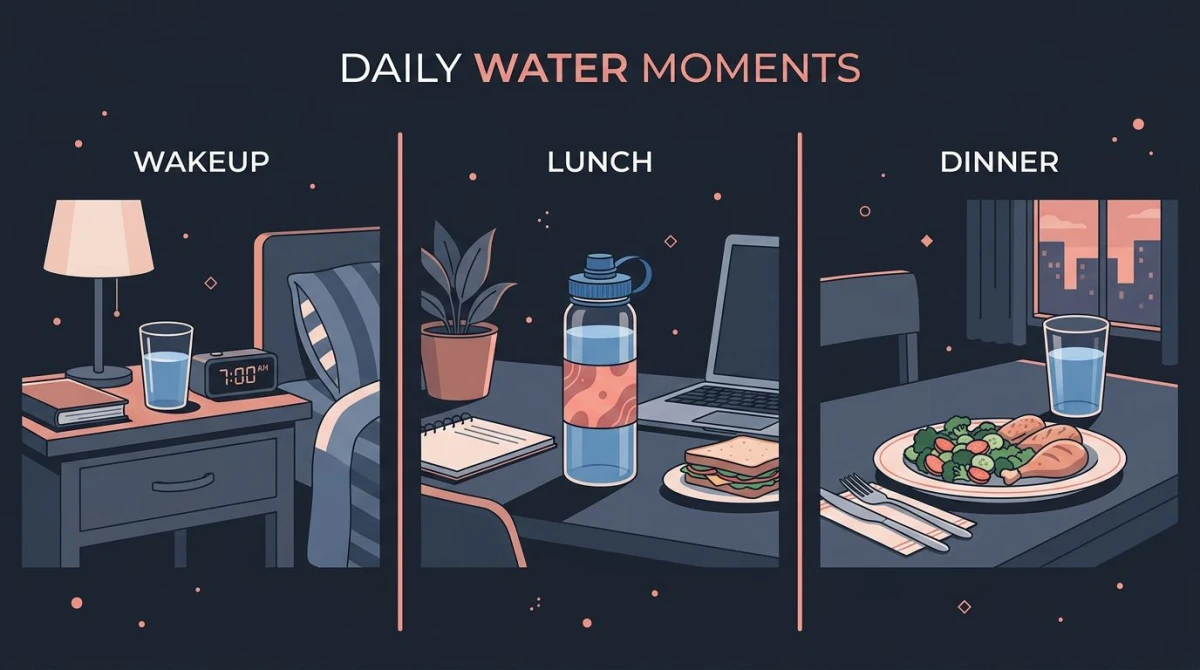
Most 30 day water challenge plans fail for the same reason: they tell you to "drink 8 cups today" and leave the timing up to willpower. A better approach is to anchor each glass to a moment that already happens — wakeup, lunch, dinner — so the cue does the remembering for you. This guide gives you a cue-based 30-day plan, a simple schedule, and a way to track the streak so you actually finish.
Why most water challenges fail
The standard advice — drink eight glasses a day — is a goal, not a habit. Goals describe an outcome. Habits describe a behavior tied to a specific moment. Without a moment, the brain has nothing to attach the action to, and the day fills up with everything else.
Wendy Wood, a behavioral scientist at USC, spent decades studying how habits form. Her core finding, summarized in Good Habits, Bad Habits (2019), is that roughly 43% of daily behavior is repeated in the same context — same place, same time, same trigger. Behavior follows cues, not intentions.
A 2010 University College London study led by Phillippa Lally tracked 96 people forming new daily habits and found that habits became automatic after a median of 66 days, and that consistency in context (the same cue each time) was the strongest predictor of success (Lally et al., 2010).
Translation for hydration: "drink more water" is too vague to stick. "Glass of water after I brush my teeth in the morning" sticks because the cue is already there.
The other reason most challenges break down is the all-or-nothing daily target. If your goal is eight cups and you finish day three with five, the day feels like a failure — even though five cups is a real win against your old baseline. The cue-based approach swaps a number for a series of tiny yes/no decisions: did I drink the wakeup glass? Yes. Did I drink the lunch glass? Yes. Each glass is its own micro-success, and missing one doesn't sink the day.
That framing matters more than it sounds. Behavioral research on habit formation consistently shows that small, repeatable wins build the neural pathway for a habit faster than infrequent large pushes. You're not trying to hit a hydration jackpot once. You're trying to wire five small actions into your day so deeply that skipping them feels wrong.
The cue-based 30 day water challenge
Instead of counting cups, you build five anchor moments — small windows in your day where a glass of water gets attached to something you already do. Over 30 days, you stack the anchors one at a time until all five run on autopilot.
The five anchors:
- Wakeup glass — within five minutes of getting out of bed
- Mid-morning glass — when you start your first work block or check email
- Lunch glass — alongside whatever you eat for lunch
- Afternoon glass — when you take a break, stretch, or step outside
- Dinner glass — with your evening meal
Five glasses of roughly 8 oz each gets most adults to about 40 oz of intentional water — on top of the water already in coffee, tea, food, and other drinks. The U.S. National Academies' general adequate-intake guidance is around 91 oz/day for women and 125 oz/day for men from all sources combined, per the Harvard T.H. Chan School of Public Health. Five tracked glasses gets you most of the way there without obsessive measuring.
The 30-day schedule
You don't add all five anchors on day one. You ramp. This is borrowed from BJ Fogg's tiny-habits research at Stanford — start so small the habit is hard to fail, then expand once it's automatic.
| Phase | Days | Anchors | Daily target |
|---|---|---|---|
| Foundation | 1–7 | Wakeup, lunch, dinner | 3 glasses |
| Expansion | 8–14 | + Mid-morning | 4 glasses |
| Full plan | 15–30 | + Afternoon | 5 glasses |
Days 1–7: foundation
Drink one glass at three anchor moments — wakeup, lunch, and dinner. That's it. Three glasses, three cues. Don't try to "make up" missed glasses. The point of week one is not volume; it's cue-locking. You're teaching your brain that "wakeup" now means "glass of water," not "scroll Instagram."
Pro tip: put a glass next to the bathroom sink the night before. The visible cue makes the behavior far more likely — Wood's research repeatedly shows that environmental friction (or the lack of it) shapes habit completion more than motivation does.
Days 8–14: expansion
Add a fourth glass at mid-morning. Tie it to whatever already starts your work day — opening your laptop, pouring coffee, sitting down at your desk. If you work from home, fill a bottle once and keep it in sight.
If a glass gets missed, don't double up later. Move on. Trying to "catch up" turns hydration into a chore and trains your brain to associate water with guilt.
Days 15–30: full plan
Add the afternoon glass. This one is the hardest because afternoons rarely have a built-in cue — there's no wakeup, no meal, just the slow grind. The fix is to attach it to something you already do reliably: a walk, a meeting, a stretch break, or stepping away to refill coffee.
By day 20, the wakeup and meal glasses should feel automatic. By day 30, all five should run with very little conscious effort. That's the marker of habit formation — not a number on a tracker, but the fact that you'd notice if you skipped.
Habit stacking: the real engine behind this challenge
The technique under all of this is what James Clear calls habit stacking — the formula "after [current habit], I will [new habit]." Stacking works because it borrows the existing behavior's cue. You don't need a new reminder; the old behavior is the reminder.
Apply it to hydration:
- After I get out of bed, I will drink a glass of water.
- After I start my workday, I will fill a glass of water.
- After I sit down for lunch, I will pour a glass of water.
- After I take an afternoon break, I will drink a glass of water.
- After I sit down for dinner, I will pour a glass of water.
Each statement attaches a cue to a behavior. For a deeper walkthrough of how to design these stacks, see our guide on habit stacking. For the broader science of how new behaviors become automatic, our habit formation article unpacks the 66-day finding and what to do during the long middle.
Tracking the challenge with a streak
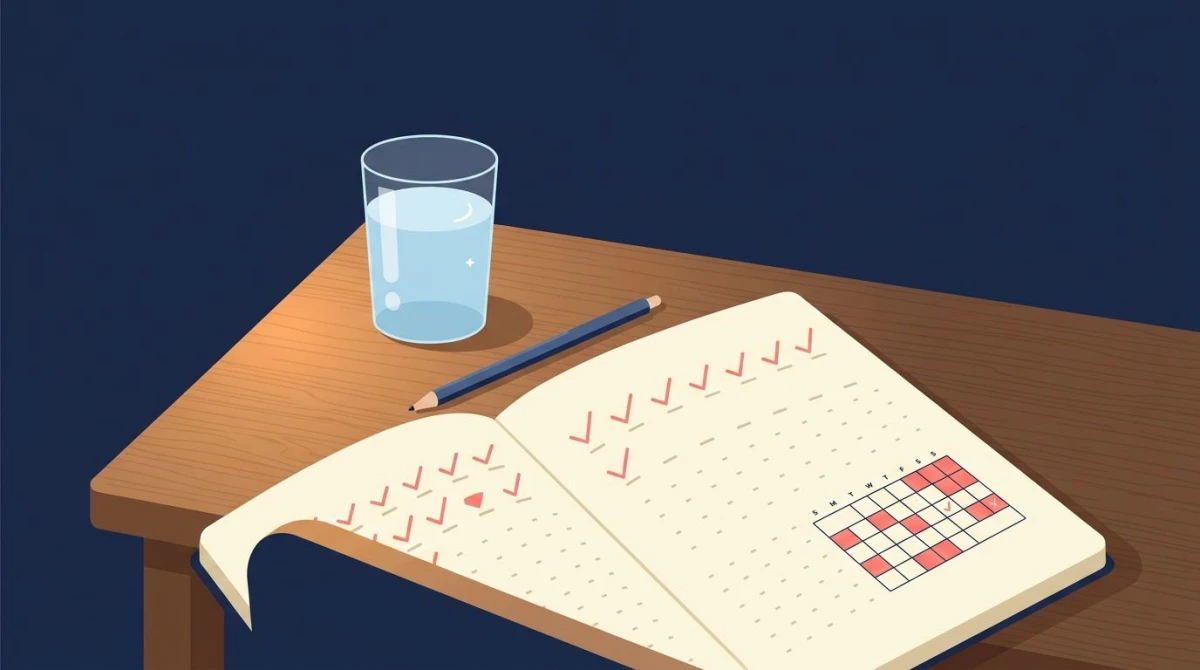
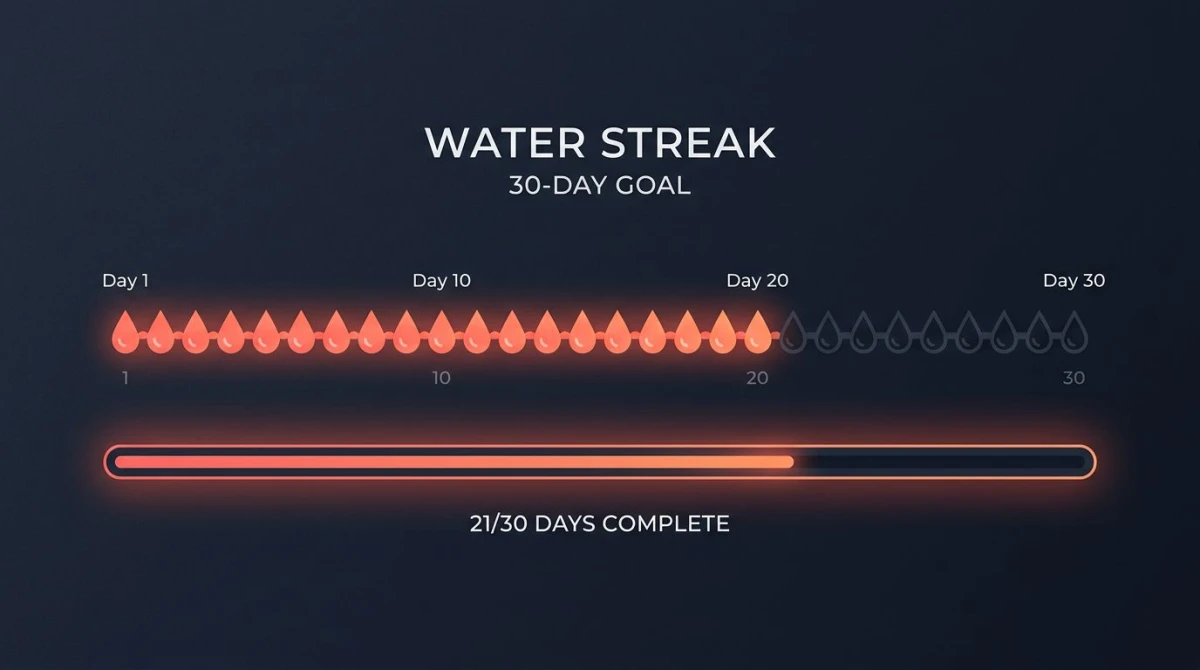
Tracking is what turns intent into evidence. Without it, you'll forget by day four whether yesterday was three glasses or one. With it, the streak itself becomes a small reward — a visible chain you don't want to break.
A few ways to track:
- Paper tracker — a printable 30-day grid on the fridge. Cheap, works, dies if you travel.
- Notes app — fast, but easy to forget if water tracking lives in the same place as everything else.
- Dedicated tracker — a habit app with check-ins and streak visualization. The advantage is the streak is always visible, and reminders fire at the right anchor moment.
A focused habit tracker like HabitBox lets you log each glass with a tap and shows the chain growing day by day. The streak counter is the loss-aversion trick that keeps people honest on day 19 when motivation has worn off. We have a separate breakdown of dedicated water tracker apps if you want a hydration-specific tool, and a guide on which habits to track if hydration is one of several things you're working on.
What to expect by week (and what not to expect)
Some honesty about results, because most challenge articles oversell.
Week 1. You'll pee more. That's it. Your kidneys are recalibrating to higher consistent intake. By day 5–7 the bathroom trips taper.
Week 2. Skin tends to look slightly less dull, and afternoon energy dips often soften. The CDC notes mild dehydration affects mood, focus, and energy (CDC, healthy beverages).
Week 3. Cravings for sugary drinks drop for some people — not because water is magic, but because thirst and hunger share neural signals, and a hydrated baseline makes the difference clearer.
Week 4. The anchors feel automatic. You don't think about them. That's the win — not weight loss, not glowing skin, not transformation. Automaticity. The behavior runs on its own.
A note on what "automatic" actually feels like. People expect a clear mental click — one day they'll wake up and "have the habit." It rarely happens that way. Instead, you'll notice you've already poured the wakeup glass before you remembered the challenge. Or you'll feel mildly off at lunch and realize the missing piece is water. That low-grade noticing is the habit installing itself. It's quieter than the marketing makes it sound, and more durable.
What this challenge will not do: dramatically change your weight, cure headaches you've had for years, or "flush toxins" (your liver and kidneys handle that). Stay skeptical of any article promising those results.
How to handle missed days
You will miss days. Everyone does. The question is what you do next.
The research-backed answer comes from Lally's UCL study: missing a single day had no measurable impact on habit formation. What broke habits was missing many days in a row, especially early on. The rule that emerges, popularized by James Clear, is "never miss twice."
If you skip an anchor, the next anchor is your reset. Don't restart the 30-day count. Don't punish yourself with double water tomorrow. Just hit the next cue and move on. We unpack the same principle in our piece on fitness consistency — consistency over time beats perfection in the moment.
After day 30
The challenge isn't really over on day 30. It's a 30-day on-ramp into a permanent five-glass routine. Most people who finish report that the wakeup and meal glasses become invisible — they happen without thinking — while the mid-morning and afternoon glasses still need a glance at the cue.
Three options for what comes next:
- Hold steady — keep the five anchors, drop the tracker once it feels automatic.
- Add complexity — track type of fluid (water, tea, electrolyte) if you want more data.
- Stack a new habit — use the cue-locked hydration moments as anchors for the next behavior (a vitamin at wakeup, a stretch at the afternoon glass, etc.).
Whichever route you pick, the hard work is done. Five cues are now wired to a behavior. That's the unit of habit change. If the 30-day format itself is what worked for you, the 30 day plank challenge is a natural next one to stack — same daily-checkbox structure, applied to core strength.
Frequently asked questions
How much water should I drink during a 30 day water challenge?
What if I miss a day of the water challenge?
Will I lose weight from a 30 day water challenge?
When should I drink each glass during the day?
How do I remember to drink water for 30 days?
Putting it into practice
If you want to start the 30 day water challenge today: pour a glass of water, drink it, and set a glass on your nightstand for tomorrow morning. That's day one. Tomorrow, add the lunch glass. The day after, add the dinner glass. Stack from there.
When you're ready to track the streak across all 30 days, a clean habit tracker like HabitBox lets you check in each glass, see the chain build, and get a quiet reminder if an anchor moment passes. No accounts, no clutter — just the streak, the cues, and you.

Mira Hartwell
Editor, HabitBoxEditor at HabitBox. Writes about habit science and productivity, grounding every post in named research (Lally, Wood, Walker, Huberman) instead of recycled advice. Read full bio →