Habit Tracker for Couples: 5 Apps That Work for Two (2026)
A habit tracker for couples comes in two flavors. One flavor is a shared app that both partners log into. The other is two solo apps plus a weekly check-in ritual. The second pattern is more flexible, more honest, and works better for most couples over the long run.
This guide covers both patterns, five real apps, what to track as a couple, and a 10-minute Sunday ritual that does most of the work.
TL;DR — the two options for couples
Couples have two real choices when they want to track habits together. Each one has a clear best-fit case, and picking the right one matters more than picking the right app.
Pattern A — Shared app. Both partners log into the same tracker (HabitShare, Habit Huddle, or a Notion couples template). You both see each other's check-ins live. Best for short-term joint challenges, couples who do most things together, and partners who genuinely enjoy visible accountability.
Pattern B — Two solo apps plus a weekly ritual. Each partner uses their own habit tracker. You meet for ten minutes once a week to share what stuck and pick what to focus on next. Best for most couples — especially with kids, different schedules, or different paces.
If you are not sure which one fits, default to Pattern B. It scales better, survives bad weeks, and does not turn a missed day into a relationship issue.
Why "shared" habit apps often fail for couples
Shared habit apps look ideal on the app store. Two avatars. Matching streaks. A friendly nudge when your partner checks in. In real life, three things tend to go wrong.
Pace mismatch is brutal. One partner is consistent. The other is starting fresh after a long break. When both check-ins are visible side by side, the slower partner sees a constant reminder of the gap. That is a tax on the relationship, not a help.
Streak breaks read as judgment. A clean streak is a chain. A broken one is a red mark next to your name. When your partner can see it, even a friendly check-in starts to feel like a performance review. Phillippa Lally's habit formation research found that one missed day does not damage a habit — but most apps are not designed to communicate that calmly to your partner.
The partner who falls behind feels worse than going solo. Solo failure is private. Shared failure is observed. For people who already struggle with consistency, public visibility can shift the experience from "trying again" to "letting them down." That is the opposite of what a tracker should do.
Shared apps work when both partners actually want competition and visibility. They quietly fail when one partner does and the other does not.
The two patterns that actually work
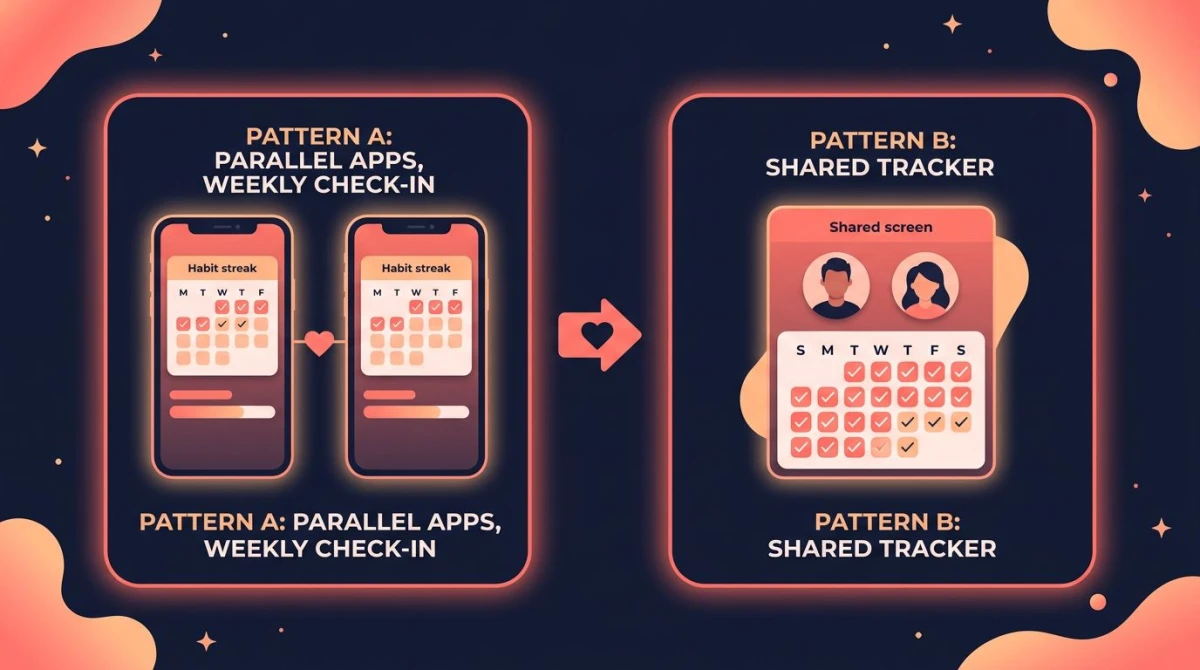
Most successful "habit tracker for couples" setups fall into one of two patterns. Pick deliberately. Switching halfway is fine, too.
Pattern A: Shared habit app
You and your partner share one tracker. Both of you see both habits, both check-ins, both streaks.
Best for: short, defined challenges (a 30-day no-takeout run, a month of evening walks). Couples without kids who already share calendars, finances, and routines. People who genuinely like leaderboards and friendly nudges.
Watch out for: long timelines. The longer a shared streak runs, the more weight it carries when it breaks. After three months, the cost of one missed day starts to outweigh the benefit of visibility.
Pattern B: Two solo apps plus a weekly ritual
Each partner picks a solo habit tracker. You both check in privately. Once a week, you sit together for ten minutes and share what worked, what did not, and what you each want to focus on next.
Best for: most couples. Especially anyone with kids, mismatched schedules, mismatched starting points, or different sensitivities to accountability pressure. Long-term habit work, not 30-day sprints.
Why it scales: privacy in the daily layer means a missed day stays small. The weekly ritual still gives you the togetherness — the reflection, the support, the pattern-spotting — without the live visibility tax.
If you want to read more on the broader app category, our guide to picking a daily habit tracker app covers what features matter most for solo use, and our ranking of the best habit tracker apps overall compares the top solo picks head-to-head.
The 10-minute weekly ritual that does most of the work
The ritual is the engine of Pattern B. Skip it and you are just two people on two apps. Run it consistently and it can outperform any shared app.
For an honest take on the underlying behaviours — communication, shared rituals, mutual support — this short walkthrough is a clean primer on what keeps relationships steady:
Pick a fixed time. Sunday morning over coffee. Friday after dinner. Whatever sticks. The point is that it does not require negotiation each week.
Keep it to ten minutes. Not an hour. Not a project review. Ten minutes is short enough that you will keep doing it.
Use a simple three-question structure:
- What habit stuck for you this week?
- What habit did not, and what got in the way?
- What is the one habit you want to focus on this coming week?
That is it. Each partner answers all three. No advice unless asked. No fixing each other. The Gottman Institute calls this kind of low-stakes opener a soft start-up — and it is one of the most reliable predictors of healthy partner conversations.
Keep the language non-judgmental. Say "I missed three days of reading because I was wiped out by Wednesday," not "I failed reading again." The ritual is for noticing patterns, not assigning blame. If one partner had a hard week, the goal is empathy, not a recovery plan.
End with a tiny shared commitment. One thing you will both do for each other this week. Could be as small as "no phones at dinner Tuesday." This is the seam that ties two solo trackers back into shared life.

5 habit trackers for couples compared
Here are the five apps worth knowing — three shared, two solo. Pick based on which pattern fits you.
How this list is checked. Every platform, price, free-tier limit and store rating below was read off the vendor's own site and the App Store and Google Play listings on 21 September 2026, and re-checked each time this page is updated. Couples apps get rebuilt or abandoned quietly, so the last store-update date is noted where it matters. The patterns and the ritual come from published relationship and habit research, linked where used.
| App | Pattern | Platform | Free tier | Live partner visibility | Account required | Best for |
|---|---|---|---|---|---|---|
| HabitShare | Shared | iOS, Android | Free, no in-app purchases listed | Yes | Yes | Per-habit control over what your partner sees |
| Habit Huddle | Shared | Web, iOS, Android | Free tier, in-app purchases | Yes | Yes | A shared daily check-in chain |
| Companion Habit Tracker (Notion) | Shared | Web, iOS, Android | Free template, needs Notion | Yes | Yes (Notion) | Notion users who want full customization |
| HabitBox | Solo (for Pattern B) | iOS, Android | Free to start (Plus for more) | No | No | Most couples doing the weekly-ritual approach |
| Habitify | Solo (for Pattern B) | iOS, Android, Web | Free (3 habits) | Challenges only | Yes | Couples where one partner is rarely on mobile |
Two notes worth flagging. HabitBox is the only option here that needs no account and still runs on both iOS and Android — free to start, with a Plus upgrade for more. Habitify is the only one with a real web app, which matters if one partner mostly works at a laptop.
The 5 apps in more detail
1. HabitShare — best free shared app, if you can live with a stalled roadmap
HabitShare is the most established shared habit app. You add friends or your partner, share specific habits with them, and both of you see the daily check-ins. You can keep some habits private and share only the ones you want.
Price: free. The developer's site states plainly that HabitShare is 100% free, and neither the App Store listing nor the Google Play listing carries an in-app-purchase or ads badge. Ratings sit at 4.6 from 662 App Store ratings and 4.3 from about 1,600 Play reviews, with 100K+ Android installs.
Why it works: the per-habit privacy switch. You can share "drink more water" while keeping "morning meditation" private. That gives couples a way to opt into visibility on shared goals without exposing every habit.
Watch out for: the release cadence. As of 21 September 2026 the iOS build (2.1.99) was last updated in January 2023 and the Android build in December 2024. It still runs and check-ins still sync, but nothing new has shipped in a long time — worth knowing before you build years of shared history inside it. The other caveat is the social-feed feel: friends and partners blend together, so your couple's habits sit next to friend feeds.
Best for: couples who want one free shared app and like a social-feed style of accountability.
2. Habit Huddle — best shared app for a daily check-in chain
Habit Huddle is the newest entrant here. It is web-first, with iOS and Android apps on top, and organises everything around a "huddle" — a small group, which for a couple is just the two of you. One habit per huddle, one check-in a day, and a shared Checkin Chain that, in the developer's words, "grows a link for every member who checks in that day."
Why it works: the two-tier check-in. Each habit gets a Floor (the minimum that counts on your worst day) and a Ceiling (the stretch version), so a tired day still counts as showing up. That is a kinder shape for a shared streak than a binary tick, and it defuses the pace mismatch that sinks most Pattern A setups.
Watch out for: how small and how new it is. The Play listing shows 500+ installs and an in-app-purchases badge, the App Store listing has a handful of ratings on a build last updated 16 July 2026, and the pricing page sits behind a sign-in — so treat the free tier as "generous for now" rather than settled. If you want a game layer without the group framing, our best Habitica alternatives roundup covers solo options at every intensity.
Best for: couples who want one shared daily check-in and are fine betting on a young app.
3. Companion Habit Tracker for Notion — best shared setup for customizers
If you and your partner already live in Notion, the Companion Habit Tracker template is the most flexible Pattern A option. It is a free community template on Notion's marketplace — not an official Notion product — set up for two or more people to use together. You both edit the same database: habits, weekly reviews, joint goals, all in one place.
Why it works: zero feature ceiling. You can mirror the structure of the weekly ritual, build a couple's dashboard, track joint and solo habits side by side. For Notion users it costs nothing and reshapes however you want.
Watch out for: Notion is not designed for daily check-ins on a phone. Tapping a checkbox there is slower than in a habit app, and it is easy to skip days when the friction is higher. Community templates also come with no support — if the author stops maintaining it, it is on you.
Best for: couples already deep in Notion who value flexibility over speed of daily logging.
4. HabitBox — best solo tracker for Pattern B
For the weekly-ritual approach, both partners need a solo tracker that works fast every day. HabitBox is built for exactly that. It runs on both iOS and Android, needs no account, and is free to start with an optional Plus upgrade.
There is no partner-sharing inside the app — and that is the point. Daily logging stays private. The weekly ritual is where you share what matters. Each partner gets streak tracking, a calendar heatmap, reminders, and category organization in an interface designed to get out of the way. Habits live on the device; on iPhone there is optional sync to your own iCloud, and on Android they stay on the phone unless you move them with the Plus backup file.
Why it works for couples: zero pressure on the daily layer. No live partner visibility means a bad day stays a bad day, not a flag in a shared feed. A mixed iOS-and-Android couple can each use the same app independently.
Best for: the majority of couples — especially anyone doing long-term habit work where flexibility and privacy matter more than live visibility.
Two partners, two private trackers, one weekly ritual. Download HabitBox on iOS and Android — free to start, no sign-up, no ads.
5. Habitify — best solo tracker when one partner is mostly on a laptop
Habitify is a polished cross-platform habit tracker with iOS, Android, and a real web app. Its pricing moved to three tiers in April 2026 — Free, Plus and Pro — and the free tier tracks three habits, which is fine for many couples building one or two habits each.
Why it works for couples: the web app is the differentiator. If one of you works at a desk all day and rarely opens their phone, Habitify lets that partner check in from the browser — which removes a real source of missed days. It also runs friend challenges and monthly leaderboards, so you can opt into a slice of Pattern A visibility without exposing your whole habit list.
Watch out for: subscription pricing for the full feature set, the account requirement, and a noticeably weaker Android rating than iOS.
Best for: couples where one partner spends most of the day on a laptop and a web check-in option matters.
A note on apps that change under you
Cutest Couple, which an earlier version of this guide recommended, has since been rebuilt as "Cutest Couple: Life Organizer" — a shared to-do and XP system, not a joint streak tracker. Couples apps churn like that, so check a store listing's last-updated date before committing a year of data to it.
What to track as a couple — pattern picks
The biggest mistake couples make is tracking too much together. The fix is a simple split: a few habits each, plus one or two truly shared habits. The shared ones are about presence, not performance.
One health habit each (solo). One of you tracks sleep, the other tracks workouts. You each pick something that matters to you, not to your partner.
One growth habit each (solo). Reading, learning, journaling, side-project time. These are about your own development. Tracking them privately keeps your sense of agency intact.
One shared habit (joint). Something you do together that benefits the relationship: a 20-minute walk after dinner, a Wednesday cook-together night, a phone-free dinner. This is the only habit that should live in a shared app or as a shared row in your weekly ritual notes.
Optional second shared habit. A weekly date or a Sunday review. Keep it small.
What not to track: each other's micro-behaviors. Do not track whether your partner left dishes in the sink, called their mom, or did the laundry on time. That is not habit tracking — that is surveillance, and it tends to corrode the relationship faster than the habits build.
If you want a deeper look at choosing the right habits in the first place, identity-based habits is a useful framework: pick habits that reflect the person you each want to become, then track those.
Common failure modes (and how to recover)
Some patterns show up over and over when couples try to track habits together. Knowing them in advance lets you skip past the worst of it.
One partner stops checking in for a few days. Do not chase. Do not fix. At the next weekly ritual, ask what got in the way and listen. The goal is information, not accountability.
One partner is dramatically more consistent. This is the single most common pattern. The fix is to switch from Pattern A to Pattern B. Live visibility makes the gap loud; private tracking lets each partner work at their own pace.
The weekly ritual gets skipped. Three skipped weeks in a row, and it is gone. Anchor it to something you already do — Sunday morning coffee, Friday takeout — so it inherits an existing habit slot.
Tracking turns into a fight. If a check-in conversation becomes adversarial, the metric is wrong. Pull the habit out of the shared layer and put it in the solo layer. Save the shared layer for habits that are genuinely joint.
You start tracking each other. This one is sneaky. If you find yourself logging your partner's missed habits or commenting on their streaks unprompted, stop. Their tracker is theirs. Your job is to celebrate wins they share, not to audit.
How to pick: a 60-second decision
Start with Pattern B if any of these is true: you have kids; you have different work schedules; one of you is at a different starting point than the other; either of you is sensitive to accountability pressure; you are planning to track habits for more than three months. Use HabitBox or Habitify as the solo app, run the weekly ritual, and revisit in a month.
Pick Pattern A if all of these are true: the goal is a defined short-term challenge (under 60 days); both of you are roughly at the same starting point; both of you actively like visible accountability; you are in a phase where you spend most evenings together. Use HabitShare, Habit Huddle, or the Notion template.
You can mix. A common setup is one or two shared habits in HabitShare and solo tracking in HabitBox or Habitify for the rest. The weekly ritual still happens.
FAQ
What is the best free habit tracker for couples?
What habit tracker can I share with friends?
Should we share a habit tracker as a couple?
How do we keep habit tracking from becoming a fight?
What habits should a couple track together?
What is the 2-2-2 rule for couples?
Can we use HabitBox to track habits together?
How long does it take to build a habit as a couple?
Putting it together
Most couples do not need a couples-specific habit app. They need two solo trackers and a ten-minute weekly ritual. Pattern A works for the short, well-matched cases. Pattern B works for almost everything else.
If you want a clean solo tracker for the Pattern B setup, HabitBox runs on iOS and Android, needs no sign-up, and is free to try with an optional Plus upgrade — so each partner can track at their own pace without the weight of live visibility. Pair it with a fixed weekly check-in, and the rest takes care of itself.

Mira Hartwell
Editor, HabitBoxEditor at HabitBox. Writes about habit science and productivity, grounding every post in named research (Lally, Wood, Walker, Huberman) instead of recycled advice. Read full bio →