How to Start Journaling: 7 Steps That Actually Stick (2026)
TL;DR. Most people who try to start journaling quit by day 14. The fix is not more discipline — it is a smaller starting size. Pick one of three formats (free-write, gratitude, or bullet log), set a two-minute floor, anchor it to a daily cue you already have, and track it as a habit. BJ Fogg's Tiny Habits research shows this minimum-viable-habit design roughly triples stick rate. Aim for the streak, not the page count.
If you have ever bought a beautiful journal, written for three days, and then watched it sit on your nightstand for a year — you are normal. Journaling is one of the most-recommended habits in self-help, and one of the fastest to get abandoned. The problem is rarely the writing. It is the system around the writing.
This guide is built for people who have tried and stalled. You will get a small starter format, a seven-day plan, a clear answer for the "I have nothing to write" panic, and a missed-day rule that does not break the chain. The goal is not a perfect journal. The goal is a journaling habit that survives a hard week.
Why most people quit journaling by week two
Two forces collapse a new journaling habit fast: blank-page paralysis and perfectionism. The blank page is a cognitive load problem — you sit down, the page demands a thought, and your brain freezes. Perfectionism is the second hit — the first sentence sounds clumsy, you feel embarrassed reading it back, and the whole thing starts to feel like homework.
BJ Fogg, the Stanford behavior scientist who developed the Tiny Habits method, has a useful frame for this. New behaviors fail when the required effort is higher than your motivation in the worst moment. Motivation moves up and down across a week. Effort needs to fit the bottom of that curve, not the top. A journaling habit designed for your most inspired Sunday morning will collapse on a tired Tuesday.
The fix is not to "be more disciplined." It is to shrink the starting size of the habit until it is laughably small — and to keep it that small for the first two to three weeks. Two minutes. One sentence. The smallest version that still counts. You can always do more on a good day, but the floor stays low.
There is a second, quieter reason people quit: they expect journaling to feel revelatory from day one. Research on expressive writing by James Pennebaker does show real psychological benefits — reduced stress, better mood, improved working memory — but the effects build over weeks of practice, not on day three. If you measure the habit by how profound the entry feels, you will quit. If you measure it by whether you showed up, you will keep going.
The three journaling formats — and how to pick one
You do not need to invent a format. Three formats cover almost every reason people start journaling, and each has a low-friction entry version. Pick one and only one for the first thirty days. Format-hopping is one of the most common reasons people lose momentum.
| Format | Time | Best for | Example prompt |
|---|---|---|---|
| Free-write | 2-10 min | Processing emotions, untangling thoughts, stress relief | "What is on my mind right now? Just write — no editing." |
| Gratitude | 2-3 min | Mood, perspective, end-of-day wind-down | "Three specific things from today I am grateful for, and why." |
| Bullet log | 2-5 min | Productivity, memory, planning, mild anxiety | "Today: 3 wins, 1 thing to fix, 1 thing for tomorrow." |
Free-write is the most-studied format in psychology research. It is also the hardest one to start because the prompt is the widest. If you are journaling for mental health or stress, this is the right pick — but plan to use a starter prompt every day for the first week, instead of a blank page.
Gratitude journaling has the strongest mood evidence in short timeframes. APA-cited research on gratitude practices suggests measurable wellbeing improvements within two to three weeks of regular practice. The catch is specificity — "I am grateful for my family" three nights in a row does almost nothing. "I am grateful that my brother texted me a photo of his dog this afternoon" does the work. If you would rather log on your phone with built-in prompts, we compared the best gratitude journal apps for exactly this format.
Bullet logging — sometimes called a daily log or a "win list" — is the lowest-friction format for productivity-minded readers. There is no demand for emotional depth. You record what happened, what you learned, and what is next. It is the format most likely to survive a busy week, which is why it tends to be the right starting choice for people who have failed at journaling before. And if even two minutes of writing feels like too much on some days, a dedicated mood tracking app keeps the reflection habit alive with a single tap.
The 7-day starter plan
The first week is not about writing well. It is about building the cue-and-response loop. Each day uses a different prompt, ramping gently in difficulty, so blank-page paralysis cannot get traction.
Pick your format first. Each prompt below works in any of the three formats — you adapt the depth, not the topic.
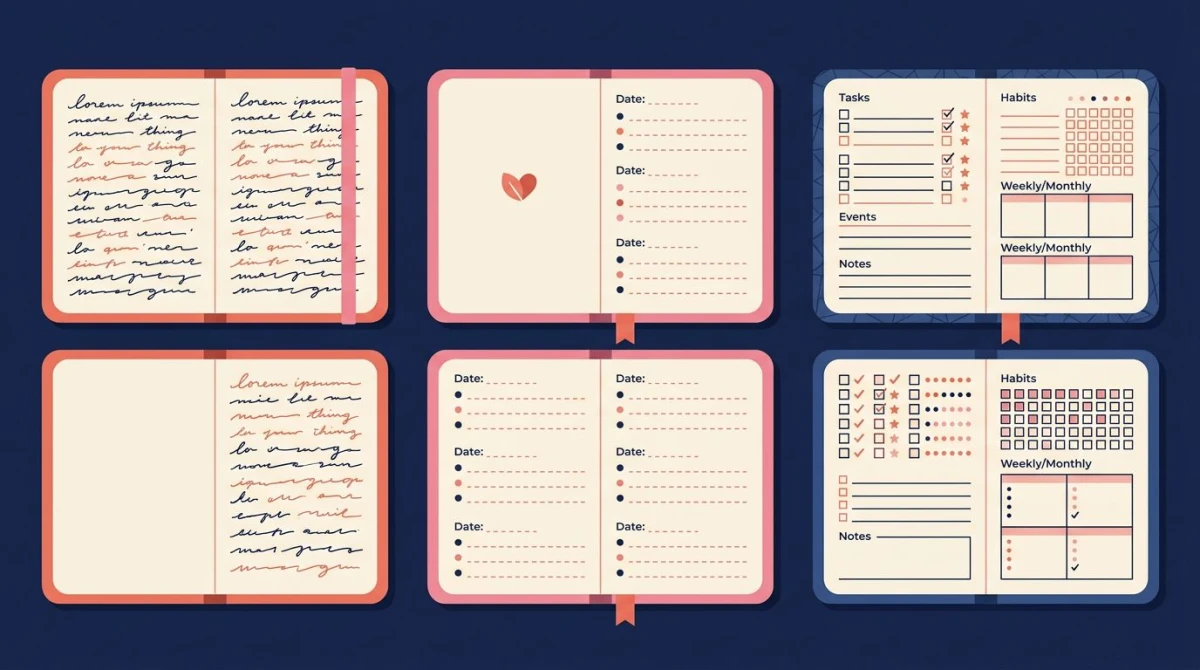
Day 1 — One sentence. Write one sentence about anything. The sentence does not need to be good. The point of day one is to break the seal.
Day 2 — Three things from today. Three concrete things that happened. Not feelings, not interpretations — events. "Got coffee with Sam. Finished the slide deck. Walked the dog at 6."
Day 3 — One thing I noticed. A small observation. Something you saw, heard, or felt that you would not normally write down. The point is to train the noticing muscle.
Day 4 — Yesterday's win. One thing from yesterday that went well, in one or two sentences. Specificity is the whole game here. "I handled the call without rambling" beats "work was fine."
Day 5 — Open prompt. Whatever the format calls for, in your normal voice. Five minutes max. If you stall, return to day 2's three-things structure.
Day 6 — One question. Write a question you have been avoiding answering. You do not need to answer it. Just write the question down.
Day 7 — The week in one paragraph. A short retrospective: what felt heavy, what felt good, what you want next week to look like. This is the prompt that starts to feel like real journaling.
After day 7, repeat any prompts that worked, drop the ones that did not, and keep the two-minute floor for at least another two weeks. Most people overestimate how soon they can graduate to longer entries. A two-minute habit at day 30 is dramatically more valuable than a 20-minute habit at day 4.
The two-minute floor — and why it works
The two-minute rule comes from James Clear's Atomic Habits and Fogg's Tiny Habits. The principle is the same: scale the new habit down until it takes less effort than not doing it. Two minutes of writing is shorter than the time you would spend feeling guilty about skipping it.
The two-minute floor is not a target — it is a minimum. On a good day, you will write for ten minutes and not notice. On a bad day, you will write for two and stop. Both days count the same toward the habit. That sameness is what protects the streak when life gets in the way.
Pair the two-minute floor with a clear cue. "After I pour my morning coffee, I will write for two minutes" works better than "I will journal in the mornings." The first sentence names a specific moment; the second names a wish. This is habit stacking — anchoring a new behavior to an existing one — and it is one of the most reliable ways to install a daily routine. Our habit stacking guide covers the full mechanic if you want to go deeper.
Tools — paper, digital, or app
There is no objectively best tool. There is only the tool you will actually open at 7am on a Tuesday.
Paper notebooks are the lowest-friction starting choice for most people. No notifications, no screen, no autocomplete. The downside is search — finding what you wrote three months ago is painful — and the cue is weaker because the notebook can disappear under a pile.
Digital notes apps (Notes, Bear, Obsidian, Day One) solve the search problem and travel with you. The risk is that the same device hosts every distraction you own. If you find yourself checking notifications while opening your journal app, paper might be the better fit.
Dictation is worth a look if the barrier is the typing itself. Speaking an entry is faster than writing one, and it quietly defuses the perfectionism problem above — you cannot backspace over a sentence you have already said out loud. macOS Dictation (press Fn twice) and Windows (Win + H) both do this for free, which is the cheapest way to test whether talking suits you better than typing. If it does, VoiceSnap Pro turns a held shortcut into punctuated text in whatever window is already open, including your notes app; it is in early access right now, so you join a waitlist rather than download it today.
Habit trackers, including HabitBox, are not journaling apps — but they are the layer most people are missing. Journaling lives or dies by whether you can see the streak. A habit tracker on your phone with a daily check-in for "journaled today" is the simplest way to give yourself the visual feedback that protects the chain. The journal lives in whatever tool you prefer; the streak lives in the tracker.
For a longer comparison of how to choose a tracker that fits this kind of habit, our tracking habits guide walks through the trade-offs.
What to do when you miss a day
You will miss days. Plan for it before it happens, because the recovery rule is more important than the streak itself.
The Lally et al. study at University College London — the most-cited research on habit formation — followed 96 people building daily habits for twelve weeks. One of its most useful findings: missing a single day did not measurably damage the formation curve. What broke the curve was missing several days in a row, or quitting after the first miss out of guilt.
The rule is simple. Never miss twice. Miss a day for any reason — fine. Day two, you write. Even one sentence. Even at 11:55pm. The point is not to be perfect; the point is to refuse to let one missed day become five.
If you have already missed three days, do not try to "make up" the lost entries. Write today. The streak counter restarts; the habit does not. People who restart cleanly after a gap are the ones who end up with a year of journaling. People who try to patch the gap with backfilled entries usually quit again within a week.
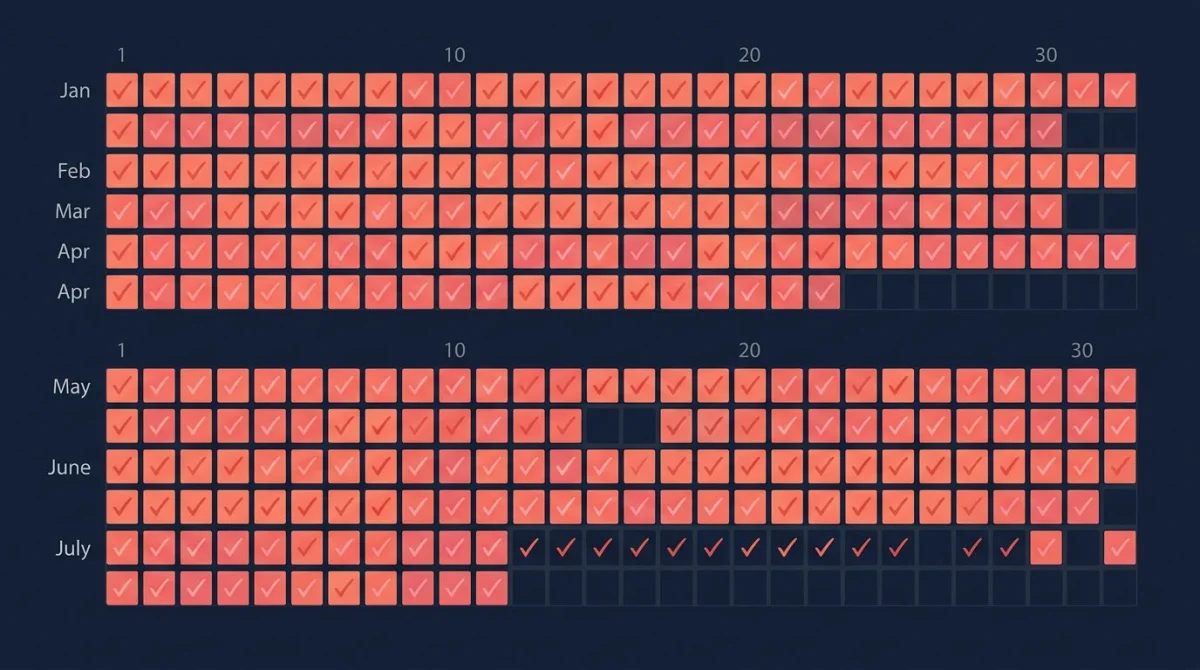
This is also the moment a habit tracker earns its place. Seeing a calendar heatmap with one gray square in a sea of filled squares is a much smaller emotional event than feeling like the whole project is ruined. The visual softens the miss.
How long until journaling becomes a habit
The honest answer is: longer than you want, shorter than you fear.
The Lally study found a median of 66 days for a self-chosen daily behavior to feel automatic, with a wide range from 18 days to 254 days depending on the person and the complexity of the behavior. Journaling sits in the middle of that range. Most people find the habit starts to feel automatic somewhere between week 6 and week 10 — the moment it becomes uncomfortable not to write.
The first two weeks are the hardest. Weeks three and four are quietly the most dangerous, because the novelty has worn off but the automaticity has not arrived. If you can get to week six with the two-minute floor intact, you are usually past the failure zone.
Identity helps here. Instead of "I am trying to journal," try "I am someone who writes for two minutes a day." Identity-based habits — habits framed as a small piece of who you are — are more durable than outcome-based habits in long-term studies. The frame is small, but it changes the question from "should I write tonight?" to "do I still want to be a person who writes?"
A realistic first month
Here is what a realistic first 30 days looks like. Not a fantasy month, not a clean streak — a real one.
- Days 1-7: Use the starter plan above. Two minutes daily, same cue, same place if possible.
- Days 8-14: Drop the prompts. Write whatever the format calls for. Floor stays at two minutes.
- Day 12 or 13: You will probably miss a day. Apply the never-miss-twice rule on day 14.
- Days 15-21: Most people start to notice the habit pulling them — a small "I should write" feeling around the cue.
- Days 22-30: The format starts to fit. Some entries will be three sentences; some will be a page. Both are fine.
If, by day 30, you have written on twenty or more days, you are doing well. That is not a low bar — that is what successful new habits look like in the real research.
FAQ
How long should I journal each day?
For the first month, two to five minutes is plenty. The goal is consistency, not depth. After the habit is automatic, most people settle into 5-15 minutes a day. Anything longer than that risks turning the habit into a chore, which is the fastest way to lose it.
What if I have nothing to write?
Use a structural prompt. The most reliable rescue is "three things that happened today, in one sentence each." It works on every format and bypasses the blank page. If even that stalls you, write the sentence "I have nothing to write today, and that's fine" — and stop. The seal is broken; the habit counts.
Should I journal in the morning or at night?
Whichever cue you can keep. Mornings tend to favor planning, gratitude, and intention-setting; nights tend to favor reflection, processing, and gratitude for what already happened. There is no proven advantage to either timing — only an advantage to consistency. Pick the time you are already sitting still.
Paper or digital — which is better?
Both work. Paper is better for focus and slower thinking; digital is better for search and travel. The honest answer is to pick the one you are more likely to open. If you have failed at a paper journal twice, try digital. If you have failed at a digital journal twice, try paper.
How long until journaling becomes a habit?
Roughly six to ten weeks for most people, based on the Lally et al. UCL data. Simpler formats (gratitude, bullet log) tend to automate faster than free-writing. The strongest predictor is not the format — it is whether you keep the two-minute floor through the first three weeks without inflating it.
Putting it together
If you want a habit that survives the first hard week, here is the smallest version of the system: pick one format, set a two-minute floor, anchor it to a cue you already have every day, and track the streak somewhere you can see it. Miss a day if you have to — never miss twice.
If you want a habit-tracking layer to sit alongside your notebook or notes app, HabitBox is built for this. You can log a daily journaling check-in, see the streak as a calendar heatmap, and use the missed-day visual as a soft nudge instead of a guilt trip. The journaling stays in your notebook. The streak stays in your pocket.
The goal is not a beautiful journal. The goal is the version of you that wrote for two minutes on a Tuesday — the day you almost did not.

Mira Hartwell
Editor, HabitBoxEditor at HabitBox. Writes about habit science and productivity, grounding every post in named research (Lally, Wood, Walker, Huberman) instead of recycled advice. Read full bio →