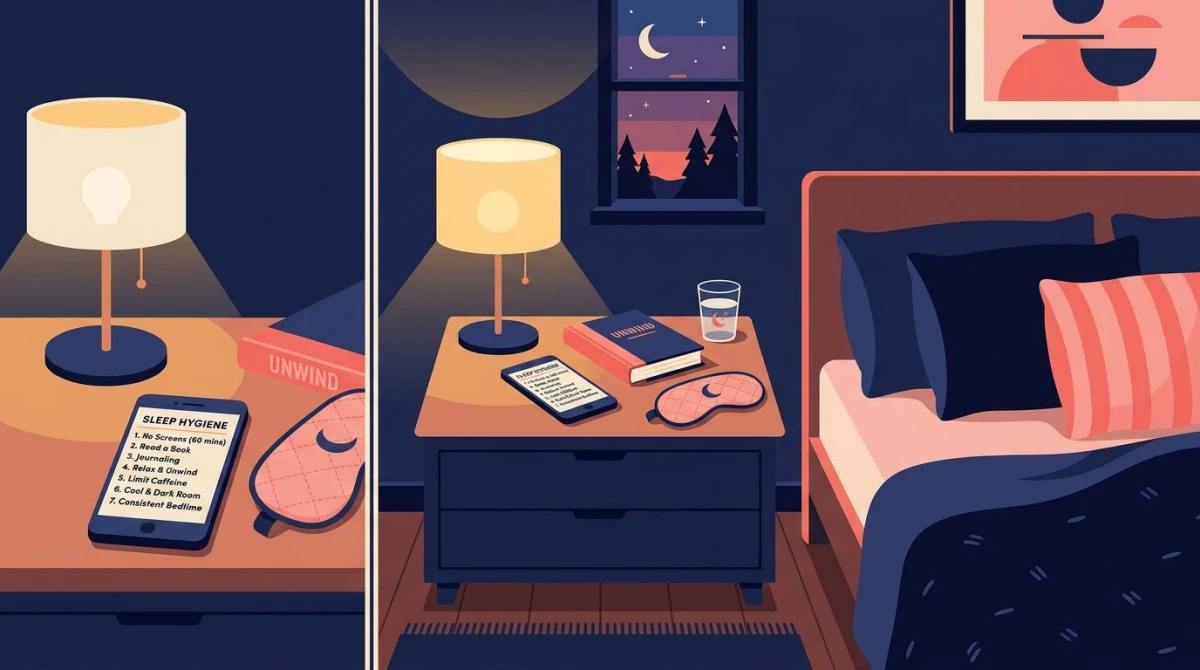
Mental Health Checklist: 10 Daily Habits (2026)
TL;DR. A daily mental health checklist works when it is short — eight to ten lifestyle habits you can run through in under five minutes. The point is awareness, not perfection. Most days you will not hit all ten, and that is fine. The list below is a self-check you can rate each evening: sleep, sun, social contact, walk, food, screen-off window, water, gratitude, one slow breath cycle, and a one-line mood log. It is built on lifestyle-medicine reviews like Sarris and colleagues in Lancet Psychiatry (2015) and lifestyle guidance from the American Psychiatric Association and NIMH. It is not a clinical screening tool — for that, use MHA's free screenings or talk to a clinician.
Important. A daily mental health checklist supports lifestyle habits. It does not replace therapy, medication, or clinical assessment. If you are struggling with persistent low mood, panic, intrusive thoughts, or thoughts of self-harm, please reach out to a clinician or, in the US, contact the 988 Suicide & Crisis Lifeline. In the UK, NHS Every Mind Matters is a good first stop.
What a mental health checklist is (and is not)
A mental health checklist is a short list of daily lifestyle habits you self-check, usually once in the evening. Each item is a small behavior — minutes of sleep, a walk, a glass of water, a moment of gratitude — that has steady research behind it as part of a healthy day.
This is different from a clinical screening tool. A screening tool, like the PHQ-9 for depression or the GAD-7 for anxiety, asks about symptoms over the past two weeks and is used by clinicians to flag conditions. A checklist asks "what did I do today?" not "what is wrong with me?" Mental Health America makes this distinction clearly on its free screening site. Both have value. They answer different questions.
The goal of a daily checklist is awareness. You want to notice patterns over weeks, not score yourself on any single day. People who track sleep, movement, social contact, and mood for two to four weeks usually see one or two patterns they did not expect — and those patterns often point to the change with the highest payoff.
The science: why a daily checklist helps
The research on lifestyle and mental health has gotten much sharper in the last decade. Here are three named-source findings that shape the list below.
1. Lifestyle is medicine for the brain. A 2015 review in Lancet Psychiatry by Jerome Sarris and colleagues made the case that diet, exercise, sleep, and social connection deserve a place in mainstream mental-health care, alongside therapy and medication. The review noted that a single lifestyle habit rarely transforms anyone — but a small bundle of three to five, run consistently, often does.
2. Movement has antidepressant effects. A 2016 meta-analysis of 25 randomized trials in the Journal of Psychiatric Research found that aerobic exercise produced a moderate antidepressant effect compared with control conditions. The dose that showed up most often: about 30 minutes, three to five times a week, at moderate intensity. A daily walk gets you most of the way there.
3. Sleep regularity matters as much as sleep quantity. A 2022 systematic review in Frontiers in Psychiatry tied irregular sleep timing — even with seven to eight hours total — to higher rates of depression and anxiety symptoms. Going to bed and waking up around the same time, give or take an hour, beats sleeping the same total hours on a chaotic schedule.
A few more anchor points: brief, frequent social contact protects against depression in a 2020 review in Annals of the New York Academy of Sciences; regular gratitude practice has small-to-moderate effects on wellbeing per Harvard Health and APA's gratitude topic page; and slow, paced breathing reduces acute stress responses in studies summarized by Cleveland Clinic on box breathing and 4-7-8 breathing.
The list below distills those signals into ten small behaviors you can rate each evening.
The 10-item daily mental health checklist
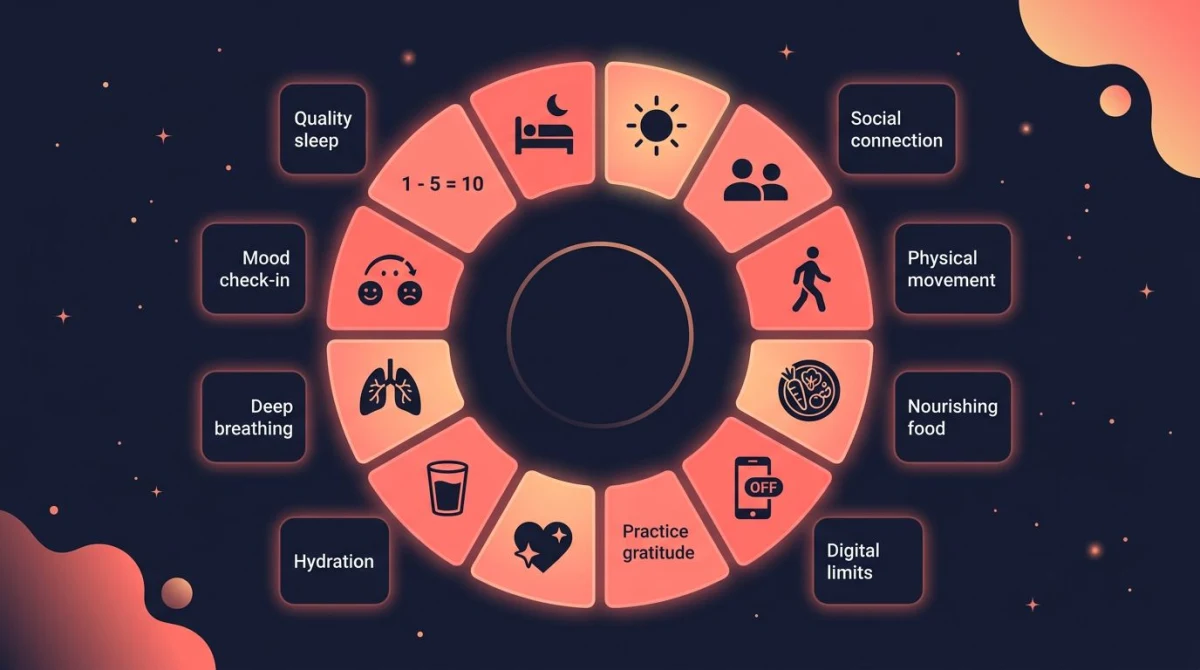
Each item lists the minimum effective dose, what to track, and how to do it without overhauling your day. The mnemonic helps: SLOW-FOG-W plus mood and breath. Sleep, Light, Outreach, Walk, Food, Off-screens, Gratitude, Water — plus a one-line mood log and one slow breath cycle.
| # | Habit | Minimum daily dose | How to track |
|---|---|---|---|
| 1 | Sleep | 7-9 hours, regular wake time | Wake time and rough hours slept |
| 2 | Light | 5-15 min outdoor light early | Yes/no |
| 3 | Outreach (social) | One real exchange | Yes/no plus who |
| 4 | Walk | 20-30 min, easy pace | Minutes |
| 5 | Food | One vegetable-forward meal | Yes/no |
| 6 | Off (screens) | 30-60 min phone-free before bed | Yes/no |
| 7 | Gratitude | Three specific things | Yes/no |
| 8 | Water | 6-8 glasses | Glasses |
| 9 | Breath | One 2-min slow breathing cycle | Yes/no |
| 10 | Mood log | One sentence | 1-10 rating |
Now the detail behind each item — what the research says, the smallest version that still works, and the trap most people fall into.
1. Sleep — 7 to 9 hours with a regular wake time
Sleep is the single highest-leverage item on the list. The National Heart, Lung, and Blood Institute lists adults at seven or more hours per night, and the CDC's adult sleep guidance agrees. The wrinkle is regularity: a 2022 review on sleep regularity and mental health found that variable sleep timing predicted more depression and anxiety than short sleep alone.
What to track: wake time and rough hours slept. You do not need a wearable.
What works in practice: pick one wake time and protect it within an hour, even on weekends. Most people find that anchoring the morning fixes the evening.
The trap: chasing eight hours by sleeping in. A late wake time pushes the next bedtime later, and the cycle drifts.
2. Light — 5 to 15 minutes of outdoor light in the morning
Morning light tells your circadian clock that the day has started. That signal sets the timing of melatonin release in the evening, which is what makes you sleepy at the right hour.
The minimum dose is small. Five to fifteen minutes of outdoor light within an hour of waking is enough for most people, even on a cloudy day — outdoor light is many times brighter than indoor light. If you cannot get outside, sit by a window without sunglasses.
What to track: yes/no.
What works in practice: stack it onto an existing morning habit. Drink your coffee on the porch. Walk to a slightly farther bus stop. Check the mail before opening the laptop.
The trap: counting indoor light through a window with sunglasses on. Sunglasses block the wavelengths that drive the circadian signal. Step outside or sit in a doorway with eyes uncovered for at least a few minutes.
3. Outreach — one real social exchange
A real exchange is more than a like or a one-word text. It is a conversation, a voice message, a shared meal, a five-minute call. The 2020 review on social contact and depression found that frequency of light contact mattered more than depth — daily small touches beat one big call a week.
What to track: yes/no, plus who. Tracking who matters because most people lean on the same one or two relationships and let the wider circle thin.
What works in practice: keep a short list of three to five people you want to stay close to, and rotate. A two-line "thinking of you" text counts on the tough days.
The trap: counting screen scrolling as connection. Passive social media use is associated with worse mood, not better, in a 2018 University of Pennsylvania study — the kind of contact that helps is direct.
4. Walk — 20 to 30 minutes at an easy pace
A daily walk is the single behavior change that comes up most often in lifestyle-medicine reviews of mental health. The WHO physical activity guidelines recommend 150 to 300 minutes of moderate activity per week — a 20 to 30 minute walk most days fits the lower end of that range.
The dose response is not linear. Going from zero to twenty minutes a day produces most of the mental-health benefit. Adding more helps, but with diminishing returns.
What to track: minutes.
What works in practice: walk after a meal or as a transition between work and home. Both of those are strong cues that rarely get skipped.
The trap: trying to start a running habit before a walking habit. Walking is a more durable base. Build the streak first, then upgrade if you want.
5. Food — one vegetable-forward meal
You do not need to overhaul your diet to support your mood. The simplest tracker that still moves the needle is "one vegetable-forward meal today, yes or no." That is the ground-level habit from the lifestyle-medicine literature, including the Sarris review, which found Mediterranean-style eating patterns linked to lower depression risk.
What to track: yes/no.
What works in practice: anchor it to a meal you already make. Add a side salad to dinner. Throw spinach into the morning eggs. Pre-cut vegetables on Sunday so they are ready Tuesday at 7 PM when you are tired.
The trap: rebuilding your whole diet on day one. You do not need a meal plan. You need one defensible vegetable-forward meal — and a yes/no checkbox.
6. Off (screens) — 30 to 60 minutes phone-free before bed
A phone-free wind-down protects sleep two ways: it cuts blue light at the eyes and, more importantly, it cuts the late-evening flood of stimulation, scrolling, and bad news that keeps your nervous system in fight-or-flight when it should be down-regulating.
What to track: yes/no.
What works in practice: charge the phone outside the bedroom. Put a paper book on the nightstand. Set a 30-minute "wind-down" alarm so the cue is a sound, not a decision.
The trap: trading the phone for a TV in bed. The wind-down works because the input is calmer, not because the screen is smaller.
7. Gratitude — three specific things
Gratitude is the most-studied small wellbeing intervention. Harvard Health summarizes the evidence well: people who write down three good things from the day — and why they happened — show small but real improvements in mood after a few weeks.
The key word is "specific." "I am grateful for my family" is too vague to register. "My partner brought me coffee this morning when I was on a call" registers, because the brain can replay the scene.
What to track: yes/no.
What works in practice: piggyback on your mood log. Three specific things, two minutes, in a notebook, a habit tracker on your phone, or a dedicated gratitude journal app with built-in daily prompts.
The trap: writing the same three things every night ("family, health, coffee"). Repetition signals to the brain that this is paperwork. New specifics each day are what register.
8. Water — 6 to 8 glasses
Hydration is not a cure for anything, but mild dehydration affects mood, focus, and headaches in a 2018 study summarized in Nutrients. The CDC's hydration guidance suggests water as the default drink across the day. Six to eight glasses is a generous floor for most adults.
What to track: glasses.
What works in practice: a one-liter bottle on the desk that you refill twice. Visible cue, low friction.
The trap: front-loading water in the evening and waking up at 3 AM. Most of your hydration should land before late afternoon. Treat the last few hours before bed as a slow taper.
9. Breath — one 2-minute slow breathing cycle
Slow, paced breathing is the most reliable way to lower acute stress in two minutes or less. Cleveland Clinic's overviews of box breathing and 4-7-8 breathing describe two well-tested patterns:
- Box breathing: inhale 4, hold 4, exhale 4, hold 4. Repeat for 2 minutes.
- 4-7-8 breathing: inhale 4, hold 7, exhale 8. Four cycles.
Both work because the long, slow exhale activates the parasympathetic branch of the nervous system, which slows heart rate and calms the body's stress response.
What to track: yes/no.
What works in practice: stack it onto an existing transition — at the desk before the first meeting, before lunch, or as the first thing after closing the laptop.
The trap: only practicing the breath cycle when you are already in a panic spike. The whole point is having a pattern your nervous system recognizes — that recognition only forms when you run it on calm days too.
10. Mood log — one sentence and a 1-10 rating
The mood log is the data layer of the whole checklist. One sentence and a number. "Tired but okay, 6/10." "Anxious in the morning, better after a walk, 7/10." That is enough.
A simple rating gives you the variance you need to spot patterns. After two weeks of one-sentence logs, most people can see at least one pattern they did not expect: better mood after early light, worse mood on late-screen nights, a specific person whose company always helps.
What to track: a 1-10 rating plus a sentence.
What works in practice: do it at the same time every day — most people find the evening works best — and pair it with the gratitude entry. If you want a dedicated tool for just this item, our guide to the best mood tracker app compares the options.
The trap: writing a paragraph instead of a sentence. A long entry feels like therapy homework, and the dread builds fast. One sentence and a number is the whole assignment.
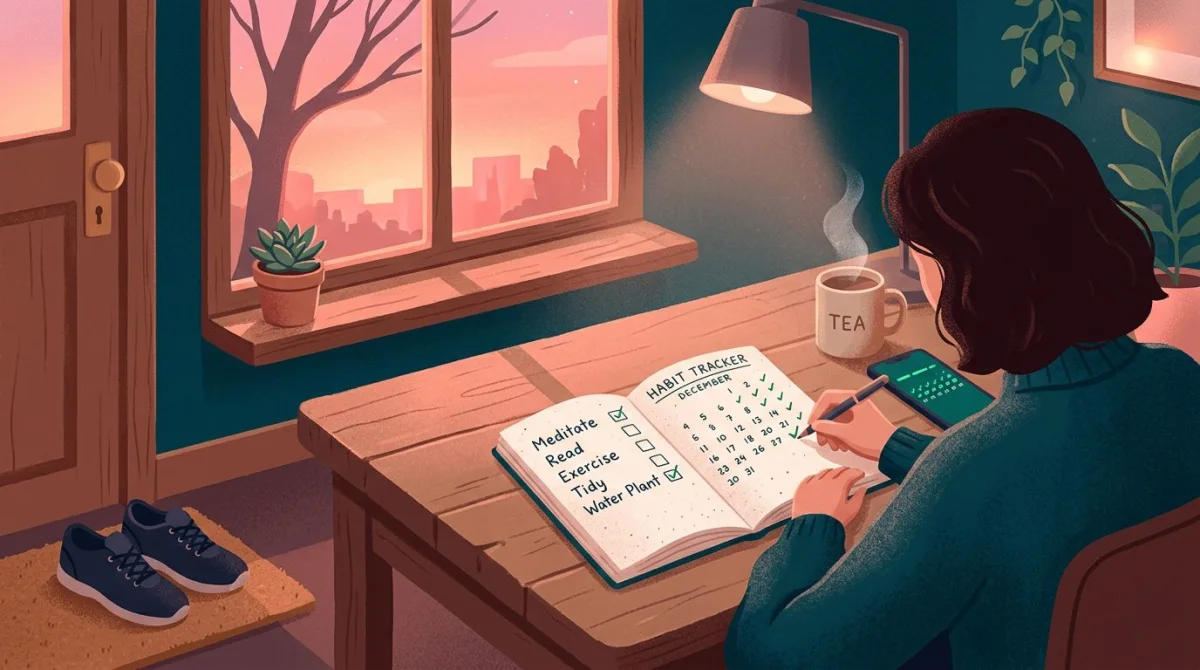
How these items rank by research evidence
Not all ten items carry equal evidence weight. Sleep, daily movement, and social contact have the strongest randomized-trial and meta-analytic support; light, food, screens, and breath have moderate evidence; water, gratitude, and the mood log are lower-cost and more common-sense than rigorously replicated. The ranking matters when you have a hard week and need to triage — running items 1 through 3 captures most of the lifestyle leverage in about thirty minutes a day.
| # | Checklist item | Evidence | Why this ranking |
|---|---|---|---|
| 1 | Sleep — regular wake time | Strong | Sleep regularity predicts next-day mood across multiple studies; NIMH places it at the top of every lifestyle list |
| 2 | Walk — 20 to 30 minutes | Strong | The 2016 walking meta-analysis shows an antidepressant effect; CDC physical activity guidance recommends 150 minutes a week |
| 3 | Outreach — one real social exchange | Strong | Loneliness predicts depression risk across cohort studies; 2020 review of social contact and mental health is consistent |
| 4 | Light — 5 to 15 minutes outdoor morning | Moderate | Anchors circadian rhythm and feeds the sleep loop; direct mood effects smaller but measurable |
| 5 | Food — vegetable-forward meal | Moderate | Diet-quality research (Mediterranean-style strongest) consistently predicts mood outcomes in lifestyle-medicine reviews |
| 6 | Off (screens) — 30 to 60 minutes before bed | Moderate | Late-night screens delay bedtime more than they harm sleep biology directly, but the behavioral effect on sleep and mood is consistent |
| 7 | Breath — 2-minute slow cycle | Moderate | Slow paced breathing (~5–6 breaths/min) shifts autonomic balance toward parasympathetic dominance; effects short-lived but reliable |
| 8 | Gratitude — three specific items | Moderate | Harvard Health's summary shows small but durable effect sizes in brief-format trials |
| 9 | Water — 6 to 8 glasses | Emerging | Mild dehydration shows small experimental effects on mood and vigor; the supporting evidence is the weakest on the list |
| 10 | Mood log — one sentence and rating | Emerging | Mood self-monitoring shows benefits in some studies but the effect mostly comes from acting on the data, not the act of logging |
"Strong" here means multiple randomized trials or a credible meta-analysis. "Moderate" means consistent observational evidence with smaller trials. "Emerging" means the studies are promising but limited. If you can only run three items on a heavy week, run sleep, walk, and outreach — that combination has the best evidence-per-minute on the list.
Daily vs. weekly: how to actually use the checklist
The checklist works when it is short, fast, and not a source of shame. Here is the simplest weekly rhythm.
Daily, in the evening — under 5 minutes. Run through the ten items. Tick yes/no. Write your one-sentence mood log and rating.
Weekly, on Sunday — 10 minutes. Look back at the week. Three questions:
- Which three habits did I run consistently?
- Which two habits did I miss most days?
- What pattern do I notice between specific habits and mood?
That is the whole loop. Daily for awareness, weekly for adjustment.
The trap is making the daily check too elaborate. Adding a fourth question, a separate sleep tracker, and a journaling prompt sounds thorough — and it kills the habit in two weeks. Keep the daily check brief. The weekly review is where the thinking happens.
How to actually build this habit
Most people do not fail at mental health habits because the habits are hard. They fail because the checklist itself is not a habit yet. Here is the simplest way to make the checklist stick — built on habit-formation mechanics from BJ Fogg's Tiny Habits work and the kind of cue-based design used in Atomic Habits.
For a 5-minute primer on stacking these into one workable morning instead of treating them as ten separate tasks, this short walkthrough is worth the time:
Step 1: Pick a single anchor
The anchor is the existing behavior that triggers the new one. The strongest evening anchor for most people is "after I brush my teeth" or "after I get into bed and turn off the main light." Pick one. Write it down: After I [anchor], I will run my mental health checklist.
Step 2: Make it tiny on day one
Day one is not "track all ten habits." Day one is "open the checklist." That is it. The behavior you want to build first is the opening, not the data entry. Once opening is automatic, the rest follows.
If you want to learn the deeper pattern, see our guide to habit stacking — anchoring small new habits to existing ones is the most reliable way to make them stick.
Step 3: Reduce friction
The checklist should live where you will actually open it. A paper journal on the nightstand, a notes app, or a dedicated habit tracker on your phone — pick one. Three apps and a paper notebook means you will use none of them.
Step 4: Keep the streak loose
Streaks are motivating, but they only help when you treat them as direction, not pressure. The rule that works for most people is the two-day rule: never miss two days in a row. Missing one day is normal life. Missing two starts to break the pattern.
Step 5: Review on Sunday
The Sunday review is where the checklist becomes useful. Without it, you are collecting data you never read. Block ten minutes. Look for the one habit that, when you did it, also lifted your mood that day.
If you are not sure which habits to track first, our guide on what habits to track helps you pick a starter set.
The 30-day starter plan
If you want a track-it-from-day-one plan, here is the 30-day ramp. The point is to add one or two items each week, not all ten on day one. People who try to track ten habits from day one usually quit by day eleven.
| Week | Add | Keep tracking |
|---|---|---|
| Week 1 (days 1-7) | Sleep + mood log | Sleep, mood log |
| Week 2 (days 8-14) | Walk + water | Sleep, mood log, walk, water |
| Week 3 (days 15-21) | Light + outreach | Above + light, outreach |
| Week 4 (days 22-30) | Food, off-screens, gratitude, breath | All 10 |
A few notes on how to run this.
Week 1: Sleep and mood log. This is the foundation. Sleep gives you the biological floor; the mood log gives you the data layer. Two items, two minutes. Easy to maintain even on a hard week.
Week 2: Walk and water. Two more low-friction items. Both are easy to attach to existing routines: a walk after lunch or after work, water at every meal.
Week 3: Light and outreach. Two slightly more deliberate items. Morning light needs you to step outside. Outreach needs a five-minute conversation. Both pay back fast.
Week 4: The remaining four. Food, off-screens, gratitude, breath. By now the daily check is automatic and you are adding nuance, not new structure.
By day 30, the checklist takes under five minutes and tells you something useful at the end of every week. That is the goal — a sustainable, low-effort signal you actually read.
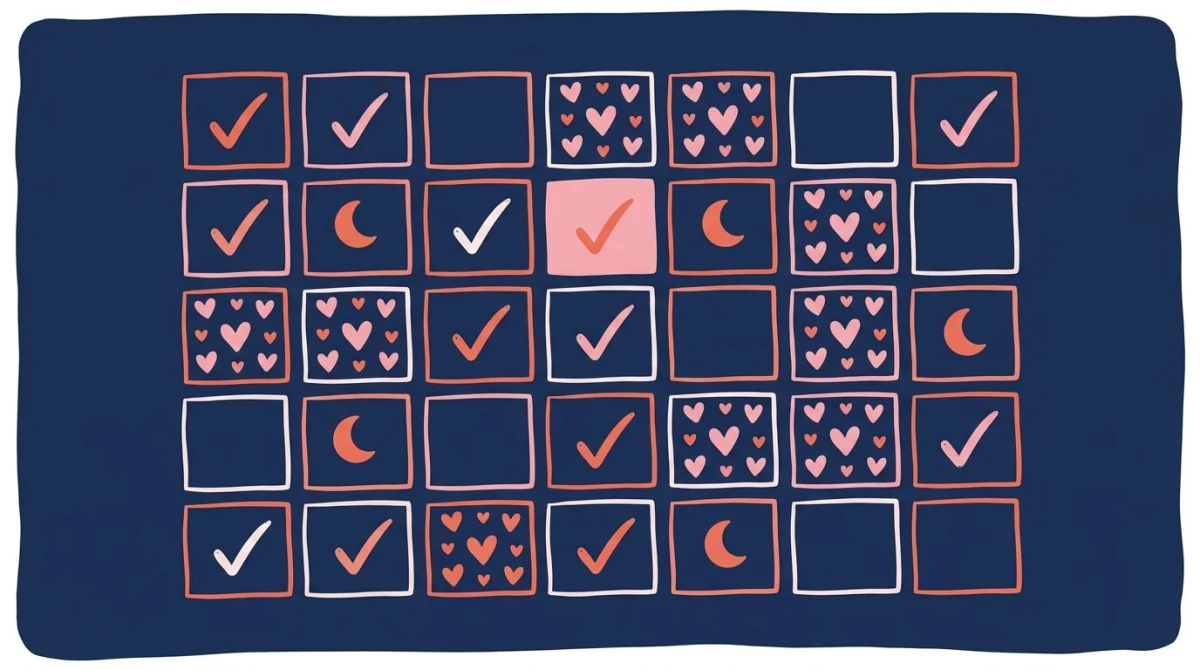
Common variations of the checklist
The 10-item daily mental health checklist is a default, not a rule. The right variation depends on your life, your nervous system, and how much time you have. Here are three versions that come up again and again — and when each is the better fit.
The 5-item minimum (for hard weeks)
Five items is the floor. If life is hard right now — grief, illness, a new baby, a layoff — drop to five. The version that holds up best for most people is sleep, walk, outreach, mood log, and one slow breath cycle. Two minutes a day, five checkboxes, no gratitude or food or hydration tracking on top. The goal during a hard stretch is not optimization. It is staying in contact with yourself.
A 5-item check is also where many people start, especially if they are returning to a checklist after a long gap. Habits compound when they are repeatable. Five-for-thirty-days beats ten-for-five-days every time.
The 7-item version for caregivers and parents
Caregivers — parents of young kids, people looking after aging relatives, single parents — usually have less control over their schedule than a default checklist assumes. Sleep is rarely a clean seven hours. The morning light window may not exist. A 30-minute walk is a fantasy on most weekdays.
A caregiver-friendly version: sleep (track wake time only), light (any outdoor minute counts), outreach, walk (10 minutes minimum), water, mood log, breath. Drop the screen-off window (often impossible during caregiving), the vegetable-forward meal (you eat what is in the kitchen), and the gratitude entry (collapse it into the mood log: "small thing that helped today: ___").
The principle: track what you can actually control, and ignore the rest while the season lasts. A checklist that ignores your reality is a checklist you abandon.
The ADHD-friendly variant
For readers with ADHD, the standard checklist often fails for the same reason most planners do: too many items, too much sameness, no novelty cue. A few small adjustments help.
First, reduce items to 6 or 7 and rotate which two are the focus that week. Sameness is fuel for boredom; novelty keeps a brain with low dopamine engaged. Second, make the cue physical and impossible to miss — the journal in front of the kettle, the notes app pinned to the home screen, the habit tracker as the lock-screen widget. Third, build in a tiny reward at the moment of check-in, not at the end of the week. A 30-second song. A square of dark chocolate. A single sticker.
Most importantly: separate the check from the review. Many ADHD readers can do the daily noticing fine, but the Sunday review collapses because it requires sustained attention. Keeping the review tiny — "name the one thing that helped most this week, in one sentence" — makes it more likely to actually happen. The full review can wait for a calmer week.
Sample week: a real example
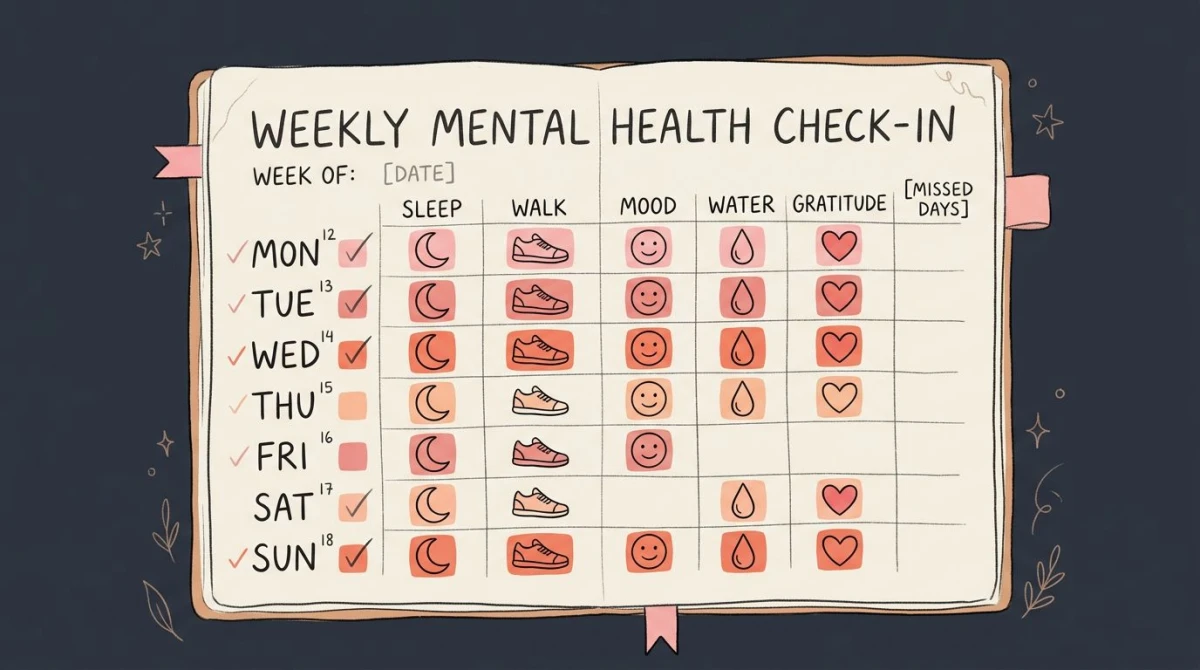
Here is one real week of a 10-item daily mental health checklist, run by a 34-year-old office worker. Names and details are composited from common reader patterns; the structure is what people actually live with. Each row shows the daily yes/no count and the mood rating, with a one-line note. Use this as a template for what your own week might look like — imperfect, real, and useful.
| Day | Items hit | Mood | One-line log |
|---|---|---|---|
| Mon | 8/10 | 7 | Easy start. Walked at lunch. Skipped morning light. |
| Tue | 6/10 | 5 | Stressed at work. No walk, no breath cycle. Late screens. |
| Wed | 7/10 | 6 | Walk after the bad day yesterday helped. Phone-free wind-down held. |
| Thu | 9/10 | 7 | Best day so far. Outreach (called sister). Sun, walk, food all good. |
| Fri | 5/10 | 4 | Drinks with coworkers. Bad sleep. Fewer items, lower mood. |
| Sat | 6/10 | 6 | Slow recovery. Walk in the park. Skipped breath and food. |
| Sun | 8/10 | 7 | Reset. Cooked. Long walk. 10-min weekly review. |
Reflections at the Sunday review. The pattern is loud and useful. On the two days walking happened, mood was 6 or 7. On the day walking did not happen (Tuesday), mood was 5. On the post-drinking day (Friday), mood was 4 — the lowest of the week — and so was the items count. Outreach on Thursday lifted the day visibly. Light exposure was the most-skipped item, and on the day it was hit (Sunday), mood was at the high end.
The takeaway is not "I should have hit 10/10 every day." The takeaway is: walking and outreach were the highest-leverage items this week. Next week, those two get protected first. Light gets a deliberate cue (coffee on the porch). Late-screen Tuesdays get an alarm earlier.
That is what a working checklist looks like. Five minutes a day, ten minutes on Sunday, and one or two real adjustments per week. Not perfection — direction.
Adapting the checklist for shift workers
Most mental health checklists assume a daytime schedule — wake up, see the sun, work, come home, wind down, sleep. Shift workers do not have that schedule, and forcing the standard checklist on a rotating-shift life is a fast way to feel like you are failing at something that does not actually fit you.
A few targeted adjustments make the checklist usable.
Sleep regularity is still the goal — but the anchor changes. The standard advice ("same wake time within an hour") does not survive a swing shift. The shift-worker version: pick a protected sleep window of 7-9 hours that is the same shape on each shift, even if the clock time is different. On day shift, that might be 11 PM to 7 AM. On nights, 9 AM to 5 PM. Track whether the window happened, not the clock time.
Light exposure is the trickiest item to translate. A daytime worker uses morning light to anchor the circadian clock. A night worker needs the opposite — bright light at the start of the shift to mark "this is day," and aggressive darkness on the way home. Sunglasses on the morning commute are not optional after a night shift. The CDC's guidance on shift work and sleep notes that managing light at the boundaries of a shift matters as much as during.
Outreach takes deliberate work. When your awake hours do not match your friends' or family's awake hours, social contact does not happen by accident. The fix is structural: pick two days a week when overlap exists, and protect those for real conversations. Voice messages bridge the gap on the other days — a 30-second voice memo at 4 AM is a real exchange even if no one replies until morning.
The meal item shifts to "one defensible meal per shift" rather than "one vegetable-forward meal today." Three meals a day is a daytime structure. A 12-hour shift often only has two real eating windows. The principle holds: one meal that is not from a vending machine, not entirely from a wrapper, and not skipped.
Screens off before sleep is harder and more important. Shift workers who sleep during the day deal with phone notifications going off through the entire sleep window. A real screen-off period for the 60 minutes before sleep — combined with airplane mode for the sleep block — is the single highest-leverage habit on a non-standard schedule.
Mood log timing. Daytime workers usually log in the evening. A shift worker should log at the same point of the shift cycle, not the same time of day — for example, "right before I go to sleep, regardless of the clock." Consistency of the cue beats consistency of the wall clock.
The broader idea: a mental health checklist is a structure to track what helped today. The specific items bend around your reality. If your reality is shift work, the structure still holds — you just have to translate each item once, then run the translation consistently.
When the checklist stops working
The checklist will fail you sometimes. That is part of the design — life happens, and a checklist is a tool, not a contract. Here are the most common failure modes and what to do about them.
"I missed three days in a row."
Three days in a row is a pattern, not a slip. The fix is not to track harder. The fix is to look at why the pattern broke. Were you traveling? Sick? Going through something hard at work? The checklist is a lifestyle layer; it bends around real life and resumes when the storm passes.
The recovery rule is simple: the next time you do the checklist, write one sentence about why the gap happened. That is the data point. Then run the checklist for that day. No catch-up. No guilt streak-rebuild.
This connects to the broader idea that missing a day does not break a habit — what breaks a habit is treating one missed day as evidence you cannot do it.
"I am ticking everything yes but I do not feel better."
This is the second most common failure mode. Two possibilities. First, you are gaming the checklist — the checks are happening but the dose is too small (a five-minute "walk" to the kitchen, a "social" wave to the cashier). Be honest about doses.
Second, you may be hitting a ceiling that lifestyle habits alone cannot lift. If you have run the full ten honestly for four to six weeks and your mood log is not improving, that is a real signal — not a failure. If the pattern is specifically exhaustion, cynicism, and a fading sense of getting anything done, our free burnout self-check — a 15-question self-assessment, not a diagnosis — can help you name what you are dealing with before that conversation. Take it to a clinician. Lifestyle habits are a strong floor; for some people, therapy or medication is the next layer up.
"I am tracking it but I dread doing it."
Dread means the checklist has crossed from supportive to oppressive. Cut it down. Drop to five items. Drop to three. The shortest version of the checklist is sleep, walk, mood log — three items, ninety seconds. A three-item checklist you actually run beats a ten-item checklist you avoid.
"I am turning every result into a verdict on myself."
This is the trap mental health habit checklists are most prone to. The list is a tool for awareness, not a measure of who you are. A 4/10 mood on a Tuesday is data. It is not a grade. The reframe that works for most people: read the score the way you would read the temperature outside. Information, not identity.
If you are noticing this pattern strongly, our identity-based habits guide unpacks how to use checklists without tying your self-worth to them, and the habit formation explainer covers the science of why short, repeated cues outperform long, infrequent effort.
"I am tracking it in three different places."
This is the most common silent killer of the daily check. A note in the journal at night, a quick log in the phone notes app at lunch, and an attempt to copy them both into a spreadsheet on Sunday. The fragmentation guarantees one thing: the Sunday review never happens because the data is everywhere and nowhere.
The fix is brutal. Pick one place. The paper journal, the notes app, or the habit tracker — only one. Move whatever data you have into that one home. Delete the others. The point of the checklist is the daily ritual and the weekly look-back, and both of those need a single source of truth. If you are unsure which to pick, default to whichever you already open most days without thinking — that is the surface with the lowest friction.
"I keep forgetting to do it in the evening."
Evening forgetting usually means the anchor is wrong, not that you are unmotivated. The most reliable evening anchors for the daily check are physical and unavoidable: brushing teeth, plugging the phone in to charge, climbing into bed. Less reliable anchors are vague ("after dinner") or volitional ("when I have a quiet moment"). If your check fails three nights in a row, the fix is to look at the anchor, not your willpower.
A second move that helps: bring the check forward. Most people assume the mental health checklist has to live at night, but a midday or post-work check works just as well for the awareness purpose. The constraint is not the timing — it is doing it once a day, every day, with a real anchor. If your evenings are chaotic and your mornings are calm, run the check at breakfast and rate yesterday's mood instead of today's.
Mental health checklist for teens
Most of what is on this list works for teens, but a few items shift. Sleep targets are higher (8-10 hours per night per CDC adolescent sleep guidance). The screen-off window is more important and harder to hold. Outreach often happens through social apps, which is fine — but a once-a-day in-person or voice-call exchange should still be on the list.
A teen-version mood log can be even simpler: an emoji and a one-word feeling. The point is the daily noticing, not the writing. And teens benefit especially from making the checklist their own — choosing their own anchor cue, their own reward, their own preferred tracking method (paper journal, notes app, sticker chart, habit-tracker app).
Anchored cues that actually work for teens
The checklist anchor for a teen is rarely "after I brush my teeth." Most teens do not have stable end-of-day routines. Better anchors: after I plug my phone in to charge, when I get into bed and put on headphones, or while the kettle boils for tea. Pair the check with something the teen already does without thinking — that is what makes the new behavior stick.
A second anchor that works for many teens is after the last social app close of the night. The phone is already in hand. Adding a 90-second mood log and three checkboxes before sliding it onto the charger is a low-friction add-on rather than a separate ritual.
App permissions and screen-time considerations
If a teen uses a habit-tracker app, the privacy posture matters. Most apps that require an account will show parents (via family sharing or shared device profiles) more than the teen wants visible. Local-only apps that require no account sidestep that completely — the data lives on the device, never goes to a cloud, and the teen does not have to negotiate with a parent about who sees what. This is one of the strongest reasons a 14-to-18-year-old will keep a checklist running.
If the teen prefers paper, a small notebook tucked inside another book works fine. The point is somewhere private. Visibility from a parent is one of the fastest ways a teen-run checklist dies.
What NOT to track
A few items are common in adult mental health checklists that should not show up on a teen's daily list. Calorie counts, weight, and detailed food tracking can intersect badly with body image at this age and are best left off. Detailed productivity metrics ("hours of homework done," "minutes of focus time") turn the checklist into a school evaluation rather than a wellbeing one. Friend counts or social-app metrics ("how many people I talked to") trend toward gamification of friendship in ways that backfire.
The teen checklist is for how the day felt and what helped. Not for grading effort, body, or popularity.
Caregivers: keep your role light. Asking "did you do your check?" once a day is helpful. Asking about the contents is usually counterproductive. Privacy is part of why a mental health checklist works for teens — it is a space they own.
If a teen's mood log shows persistent low ratings, withdrawal from outreach, or appetite or sleep changes, that is a signal to involve a pediatrician or counselor. The 988 Suicide & Crisis Lifeline is available 24/7 in the US for any age.
When to seek professional help
A daily mental health checklist is one layer of care. It is not the whole stack. Some signals belong with a clinician, not a tracker. From NIMH's guidance on caring for mental health and standard practice, the things that warrant a call to a clinician include:
- Persistent low mood, anxiety, or hopelessness for two weeks or more
- Sleep problems that do not respond to routine improvements
- Loss of interest in things that used to feel good
- Difficulty doing the things you need to do at work, school, or home
- Substance use rising as a coping strategy
- Any thoughts of self-harm or suicide
The line is not always obvious. A useful rule of thumb: if you have run a reasonable lifestyle checklist for four to six weeks and your mood log shows little change, or if any week shows ratings consistently at 3/10 or below, talk to someone. A primary-care doctor, a therapist, a school counselor, or — for immediate crisis support — the 988 Suicide & Crisis Lifeline in the US, NHS Every Mind Matters in the UK, or local crisis services.
A checklist is for awareness. Clinical care is for treatment. Both belong in the picture.
Tracking the checklist (paper, notes, or an app)
Where you track this matters less than that you actually track it. Here is how the three common options compare.
Paper journal. Best for people who already journal or want a non-digital wind-down. The friction of opening a notebook is a feature, not a bug — it forces you to slow down. Downside: harder to spot patterns across weeks.
Notes app. Free, friction-light, already on your phone. Downside: easy to lose items in a long note, and you do not get streak feedback or pattern visualization.
Habit-tracker app. Built for this. Tap to check off habits, see streak counts, get a calendar heatmap of how each habit is going across the month. The good ones stay out of your way and surface patterns at the weekly review.
A focused habit tracker — built for one-tap check-ins, streak counts, and a calendar heatmap of how each habit goes across the month — is the path of least resistance for a 10-item daily list. The good ones stay local, so your mood log and notes never leave the phone.
Whichever you choose, the rule is the same: one tracker, not three. The point is the daily check, not the tooling.
Comparison: lifestyle checklist vs. clinical screening
These two often get conflated. They are different tools, and using one for the other is where people get into trouble.
| Aspect | Daily checklist (this guide) | Clinical screening (PHQ-9, GAD-7, etc.) |
|---|---|---|
| Question it answers | What did I do today? | What symptoms have I had over 2 weeks? |
| Frequency | Daily | Periodic, often once or twice a year |
| Goal | Awareness, pattern-spotting | Flag a possible condition |
| Output | Streak, patterns, mood log | A score that suggests next steps |
| Source | Lifestyle medicine, habit research | Validated psychiatric instruments |
| Use case | Self-care lifestyle support | Decision aid, often used with a clinician |
| Replaces care? | No | No (still requires clinical interpretation) |
If you want a clinical screening, Mental Health America's free screenings include PHQ-9 (depression), GAD-7 (anxiety), and several others. The APA's assessment measures page is the underlying research source. Use those for symptoms; use the daily checklist for habits.
FAQ
What is on a mental health checklist?
Daily vs. weekly mental health checklist — which is better?
Mental health checklist vs. mental health screening — what's the difference?
Is there a mental health checklist for teens?
How do I track a mental health checklist?
When should I seek professional help instead of relying on a checklist?
How long does it take before a mental health checklist starts to help?
The bottom line
A mental health checklist is a small daily ritual: ten lifestyle habits, under five minutes, evening rating, weekly review. The point is awareness — noticing patterns over weeks, not scoring yourself on any one day. The research behind these specific items is solid, but no checklist replaces a clinician. Use it as the floor, not the ceiling.
Start small. Two items in week one. One ramp-up per week. By day 30 you will have a quiet daily ritual and a month of mood data to learn from.
If you want a place to track all of this in one tap per habit, HabitBox is built for exactly this kind of lifestyle checklist — local data, calendar heatmap, no account required. Whatever tool you choose, the most important thing is the daily noticing.

Mira Hartwell
Editor, HabitBoxEditor at HabitBox. Writes about habit science and productivity, grounding every post in named research (Lally, Wood, Walker, Huberman) instead of recycled advice. Read full bio →