How to Learn a Language on Your Own (2026)
TL;DR: You can learn a language on your own in roughly 600–750 focused hours for an easier language, according to U.S. Foreign Service Institute estimates. At 30 minutes a day, that is a multi-year project — which is exactly why consistency, not resources, is the real bottleneck. This guide gives you the four pillars of self-study (comprehensible input, spaced repetition, speaking practice, and immersion swaps), a 30-minute daily routine, and a habit-and-streak system to keep the daily rep alive even on bad days.
You know the pattern. You download a shiny app, hit a 3-day streak, feel unstoppable — then life happens, the streak dies, and six weeks later you have forgotten how to say "good morning." The problem was never the app or the method. The problem was that language learning is a long game, and most advice hand-waves the one thing that actually decides the outcome: showing up every day for months.
Here is the reframe that changes everything. Stop treating language learning as a resource-collection problem ("which app? which book? which YouTube channel?") and start treating it as a daily habit you protect. The methods below are simple and well-established. What almost nobody teaches is how to make them survive contact with a busy, distractible human life. That is what we will fix.
How long does it really take?
Before we talk method, let's set an honest expectation — because unrealistic timelines are why most self-learners quit.
The U.S. Foreign Service Institute (FSI) has trained American diplomats for decades and publishes the best-known estimates for how long it takes an English speaker to reach "Professional Working Proficiency" (roughly, comfortable conversation and reading). FSI sorts languages into difficulty categories based on how far they are from English.
These are full-time classroom hours with expert instruction. Self-study is messier and usually slower, but the categories still give you a realistic map of the terrain.
| FSI category | Example languages | Approx. class hours | At 30 min/day |
|---|---|---|---|
| Category I (closest to English) | Spanish, French, Italian, Portuguese, Dutch | 600–750 hours | ~3.5–4 years |
| Category II | German, Indonesian, Swahili | ~900 hours | ~5 years |
| Category III (hard) | Russian, Hindi, Vietnamese, Turkish, Polish | ~1,100 hours | ~6 years |
| Category IV (super-hard) | Arabic, Mandarin Chinese, Japanese, Korean | ~2,200 hours | ~12 years |
Two things jump out. First, "easy" is relative — even Spanish is hundreds of hours. Second, the "at 30 min/day" column looks brutal, and it is meant to. If you want conversational Spanish in a year, 30 minutes a day will not get you there; you would need closer to two focused hours daily.
But most people are not on a one-year deadline. They want to genuinely learn a language over time without burning out. For them, the real question is not "how do I go fast?" but "how do I keep going at all?" A slow habit you keep beats a fast plan you abandon in week three. The good news is that the hours compound: 30 minutes a day is 182 hours a year, and steady input plus retrieval makes those hours count more than the raw number suggests.
It also helps to reframe what "fluent" even means, because the word scares people off. You do not need all 600 hours before the language becomes useful. Somewhere in the first hundred hours you can order food, ask directions, and handle small talk. By a few hundred you can follow shows and hold real conversations, if clumsily. Fluency is a slope, not a finish line — every hour you bank makes the language a little more usable that same week. Waiting to "be fluent" before you enjoy it gets the logic backwards. Use the language badly, early, and often, and the hours take care of themselves.
The 4 pillars of self-study
Almost every effective self-study system rests on the same four pillars. Master these and the specific tools become interchangeable.
1. Comprehensible input
Linguist Stephen Krashen's Input Hypothesis argues that we acquire language primarily by understanding messages slightly above our current level — what he calls "i+1." In plain terms: you learn by consuming content you can mostly follow, where context fills the gaps.
In practice this means listening and reading far more than most beginners expect. Podcasts made for learners, graded readers, dubbed shows with subtitles, and children's content are all input goldmines. You are not translating word by word — you are soaking in patterns until they feel normal. Input is the engine; everything else steers it.
A common beginner mistake is jumping straight to native-level material — a fast news podcast or an adult novel — and drowning. That is not input; that is noise. The "comprehensible" part is the whole point. Start where you understand maybe 80 percent, so context can carry the missing 20. As your ear improves, level up the difficulty. If a source leaves you constantly reaching for a dictionary, it is too hard right now; save it for later and pick something gentler. The right level should feel almost easy, which is exactly why it works.
2. Spaced repetition (SRS)
In the 1880s, German psychologist Hermann Ebbinghaus mapped the "forgetting curve" — the way newly learned information decays rapidly unless you review it. Modern spaced-repetition systems (SRS) exploit this by showing you a fact right before you would forget it, then stretching the interval each time you succeed.
This is why flashcard apps schedule reviews the way they do. Instead of re-reading a word list ten times in one sitting (which feels productive but fades fast), you review a word today, in three days, in a week, in a month. Vocabulary is where SRS shines. Load the words you actually encounter in your input, and let the algorithm defend them against forgetting.
Focus your flashcard energy on high-frequency words. Vocabulary researcher Paul Nation's work shows the most common 2,000–3,000 word families cover the overwhelming majority of everyday speech — so the first few hundred words you drill deliver wildly more comprehension than obscure ones.
One more SRS rule that saves hours: only add words you have actually met in context. Mining vocabulary from your own input — a word from the podcast you just heard, a phrase from the show you watched — beats pre-made lists of random nouns. You already have a memory hook for it, so it sticks faster, and you know it is a word real speakers use. Aim to add just a handful of new cards per day. It feels slow, but ten new words daily is over 3,000 in a year, which is most of the everyday language. Overloading the deck is how people burn out on reviews and quit.
3. Speaking practice
Input builds understanding, but output builds fluency. You have to produce the language, awkwardly and often, to make it automatic. The fear here is real — nobody enjoys sounding like a toddler — but avoidance is the single biggest reason self-learners plateau at "I can understand but I can't speak."
You do not need a partner to start. Read passages aloud, narrate your day under your breath, shadow (repeat immediately after) a native audio clip, or record voice memos and play them back. When you are ready for real conversation, tutoring marketplaces and language-exchange apps connect you with speakers for the price of a coffee. The goal is reps, not perfection.
Shadowing deserves special attention because it does double duty. When you repeat a native clip in real time, you are training pronunciation, rhythm, and listening all at once — and because you are copying rather than composing, there is no pressure to be original. Start with slow, learner-oriented audio. Play a sentence, pause, repeat it aloud trying to match the intonation, then move on. Ten minutes of this most days quietly rebuilds your mouth and ear for the new language. Do not wait until you "feel ready" to speak; readiness comes from the speaking, not before it.
4. Immersion swaps
You cannot move to Lisbon, but you can move Lisbon into your phone. Immersion swaps are small substitutions that surround you with the language without adding time to your day.
Switch your phone's system language. Change your music playlists and podcast queue. Follow creators in your target language. Set your streaming defaults to dubbed audio. Each swap converts dead time — your commute, dishes, the gym — into passive exposure. None of these replace focused study, but together they multiply the hours the language lives in your head.
The beauty of immersion swaps is that they cost no willpower. You were going to listen to music and scroll your feed anyway; you just changed the language it happens in. Add them gradually so you are not overwhelmed — one swap a week is plenty. Switching your phone's interface is a great first move because you use it constantly, and you will pick up dozens of everyday words (settings, delete, search, back) without a single study session. Over months, these background hours add up to a meaningful share of your total exposure, entirely for free.
A daily 30-minute routine you can actually keep
Here is a concrete routine that touches all four pillars in half an hour. Adjust the ratios to your level, but keep the shape.
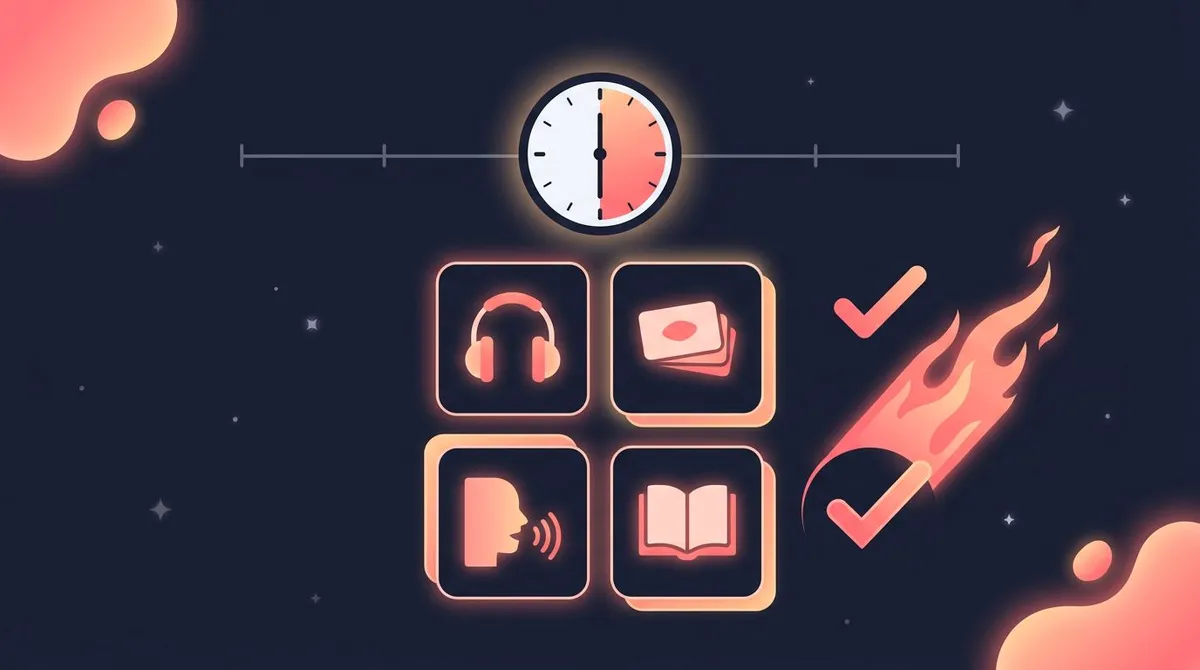
Minutes 0–10 — Input (listen or read). Start with comprehensible input while your focus is fresh. A learner podcast episode, a page of a graded reader, or a short dubbed clip with subtitles. Understand the gist; do not stop for every word.
Minutes 10–20 — Spaced repetition. Run your SRS deck. Add two or three new words you met during your input, and clear the reviews the algorithm serves you. This is the least glamorous block and the highest-leverage one.
Minutes 20–27 — Speaking. Shadow a native clip, read a paragraph aloud, or narrate what you did today. Record thirty seconds and listen back once. Notice one sound to fix tomorrow.
Minutes 27–30 — Log and preview. Mark the session done, jot one thing that clicked, and glance at what you will study tomorrow. This tiny close-out is what turns a session into a streak.
If you have more time, extend the input block — input scales better than drilling. If you have less, we will handle that in the next section, because the whole system lives or dies on what you do when 30 minutes is not available.
The habit layer: how to actually stay consistent
This is the part the other guides skip, and it is where most language journeys are won or lost. Methods are abundant; the ability to run them daily for a year is rare. Treat consistency as its own skill.
Habit-stack onto an existing cue
The most reliable way to remember a new habit is to anchor it to one you already do without thinking. This is habit stacking — the formula is "after I [current habit], I will [new habit]." After I pour my morning coffee, I will open my language podcast. The existing routine becomes the alarm clock for the new one, so you are not relying on motivation to remember.
Pick a cue that already happens every single day at a stable time. Coffee, commute, brushing teeth, sitting down after dinner. The stronger and more automatic the anchor, the more your language rep inherits that reliability. For a deeper walkthrough of building consistency that survives busy weeks, see how to be consistent.
Be specific about where and how the stack fires. "I'll study more" is a wish; "after I sit on the train, I open my flashcard app before I open anything else" is a plan with a time, a place, and a trigger. The friction matters too — if your first action every day is to hunt for the app, you have added a hurdle right where willpower is weakest. Put the app on your home screen, queue tomorrow's podcast tonight, leave the notebook open on the desk. Make the right rep the easy rep, and the stack runs almost on autopilot.
Protect the daily rep with a streak
Streaks work because of a quirk of human psychology: we hate breaking a chain we have built. Watching a run of completed days grow creates real reluctance to zero it out. That reluctance is free motivation — use it deliberately.
Track your language practice as a daily habit and let the streak count become a small thing you defend. A dedicated tracker like HabitBox makes this concrete — you can log a simple daily check-in or count your practice minutes, and the streak view turns "I should study" into "I don't want to break my run." The visual chain does quiet work on the days willpower is thin.
Have a minimum-viable 5-minute day
Here is the rule that saves streaks: on a terrible day, you are allowed to do the smallest possible version. Five flashcard reviews. One podcast segment on the walk to the car. Read one paragraph aloud. It counts.
The point is not that five minutes builds fluency — it obviously doesn't. The point is that it keeps the identity intact. You are still "someone who studies this language every day," and tomorrow you pick the full routine back up. All-or-nothing thinking is what kills habits: miss the perfect session, decide the day is blown, spiral into a week off. A minimum-viable day breaks that trap.
Know what to do when you break the streak
You will miss a day eventually. Everyone does. What matters is the rule you follow next, not the miss itself.
Research on habit formation from University College London, led by Phillippa Lally, found that missing a single day did not meaningfully hurt people's long-term habit strength — as long as they got back on track. The danger is never one miss; it is the second and third that turn a lapse into a quit. Adopt a "never miss twice" rule: one off day is life, two in a row is the start of a new (bad) pattern. When you break a streak, restart it the very next day and do not spend a single minute on guilt. Speed of return is the only variable that matters.
How to measure progress so you don't quit
One reason self-learners lose steam is that language progress is invisible day to day. You cannot see yourself getting better the way you can watch a number climb at the gym, so it feels like nothing is happening even when a lot is. Building in visible markers fixes this.
Track two different things and do not confuse them. The first is input metrics — did you do the rep? Studied today, yes or no. Minutes practiced. Streak length. These are fully in your control and they are what your daily habit protects. Rewarding yourself for showing up, regardless of how it went, is what keeps the behavior alive through the inevitable plateaus.
The second is outcome metrics — are you actually improving? These move slowly and you should check them monthly, not daily. Good signals include how much of a podcast you can follow without subtitles, how many words your flashcard deck holds, whether you can hold a five-minute conversation, or a periodic self-recording you compare against one from a month ago. Watching your old recordings feel clumsy is oddly motivating.
The trap is judging yourself by outcome metrics on a daily timescale. Fluency does not improve on Tuesday because you studied on Tuesday; it improves over weeks of Tuesdays. So let the daily streak carry your motivation, and let the monthly check-ins confirm the direction. Keep the two separate and you sidestep the discouragement that ends most self-study attempts around week six.
Free and low-cost tools by category
You do not need to spend money to learn a language on your own. Rather than name specific apps — that landscape changes fast — here are the categories to assemble, most of which have solid free options.
Comprehensible input libraries. Learner podcasts, graded readers, and "easy" news sites give you leveled material. Many public libraries also lend language courses and audiobooks for free.
Spaced-repetition flashcards. An SRS app is non-negotiable for vocabulary. Free, open options exist; the key feature is scheduling reviews for you, not the deck design.
Speaking and exchange. Language-exchange apps pair you with native speakers who want to learn your language — free conversation in both directions. Tutoring marketplaces add affordable one-on-one time when you are ready.
Dictionaries and grammar references. A good bilingual dictionary and one clear grammar reference cover almost every question. Machine translation is fine for quick checks, imperfect for nuance.
A habit tracker. The tool that holds the rest together is the one that tracks whether you showed up. Pairing your study apps with a streak-based tracker is what converts a pile of resources into a daily practice.
To make the hours themselves count for more, it helps to study the way memory research recommends — see how to learn faster for evidence-based techniques like active recall and interleaving, and how to memorize faster for encoding tricks that make vocabulary stick. If you are learning alongside school or a job, the same principles that build strong study habits apply directly to language practice.
FAQ

Mira Hartwell
Editor, HabitBoxEditor at HabitBox. Writes about habit science and productivity, grounding every post in named research (Lally, Wood, Walker, Huberman) instead of recycled advice. Read full bio →