Study Habits: 11 Daily Routines That Work
TL;DR: Good study habits decide whether good study methods get used at all. Two habits carry the most evidence: testing yourself and spacing your review over days. They were the only two of ten techniques that a 2013 review of learning research rated "high utility." Below are 11 study habits, easiest first, with a way to track each one, a sample study week and a five-week plan to build them.
Quick answer
| Question | Answer |
|---|---|
| What's the most important study habit? | A few minutes of self-testing every day. |
| What should you stop doing first? | Re-reading and highlighting as your main way to study. |
| Best study habit for procrastinators? | Same place, same time, so the cue starts the session for you. |
| Best habit for exam weeks? | Protect your sleep. It's when the brain consolidates what you studied. |
| How long until the routine feels automatic? | Weeks, not days. Keep the first version small. |
Study habits vs. study techniques
Quick distinction so the rest of the article makes sense.
A study technique is a method you apply during a study session — flashcards, the Feynman method, Cornell notes. They're tools.
A study habit is the recurring behavior that determines whether you sit down to use those tools at all. Sitting at your desk at 7 p.m. is a habit. Using flashcards once you're there is a technique. Habits decide whether techniques get used.
Students who say "I have bad study habits" often have decent techniques but inconsistent behavior. The fix is the cue, not the method. See our guide on habit formation for how the cue-routine-reward loop works. This guide covers the habits; for the techniques themselves, ranked by evidence, see how to study effectively.
What the research says: recall beats re-reading, spacing beats cramming
Two findings shape almost every habit below.
Testing yourself makes memories stick. In a 2008 study in Science, Jeffrey Karpicke and Henry Roediger had students learn foreign-language vocabulary. Once a word had been recalled correctly, studying it again had no effect on a delayed test, while testing it again produced a large gain. The students' predictions of how well they'd do were unrelated to how well they did.
Spacing beats cramming. Memory fades fast without review. Hermann Ebbinghaus charted this forgetting curve in the 1880s, and a 2015 replication found results similar to his original data. Reviewing across days interrupts the decay.
How far apart should reviews be? In a study of more than 1,350 people, Nicholas Cepeda and colleagues found the best gap depends on how long you need to remember. It was about 20 to 40% of the wait for a test one week away, falling to about 5 to 10% for a test a year away. For a quiz next week, that means reviewing after a day or two; for material you need at the end of the year, gaps of a few weeks work better.
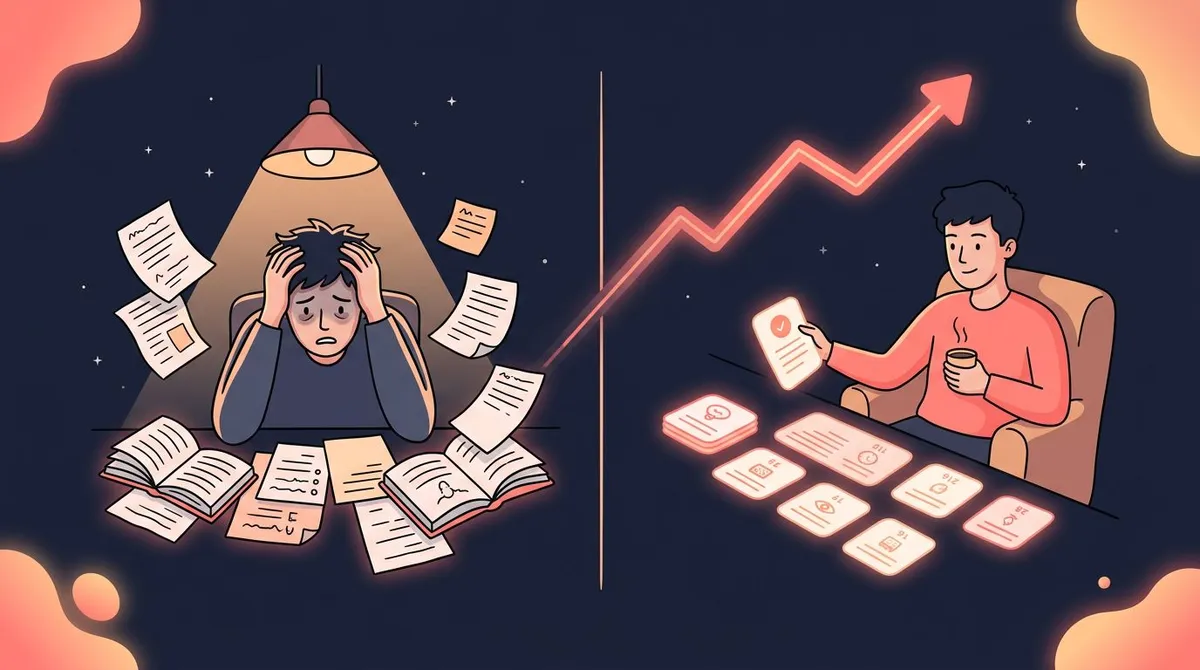
The 2013 review of ten study techniques by John Dunlosky and colleagues lands in the same place. Practice testing and distributed practice were the only two rated high utility, while re-reading and highlighting were rated low.
The 11 study habits, ranked from easiest to start
Each habit below has a reason it works and a way to track it as a yes/no or a count. Easiest first. Read it as a menu, not a list to finish this week.
| # | Habit | Why it works | Track it as |
|---|---|---|---|
| 1 | Same study spot, same time | The place and time become the cue | Days you sat down on time |
| 2 | Plan tomorrow's study blocks | Removes the daily "when?" decision | Evenings you wrote the plan |
| 3 | Pre-class skim (5 min) | Previewing is step one of the study cycle | Classes you previewed |
| 4 | Post-class recall (5 min) | Retrieval practice | Classes summarized from memory |
| 5 | Phone in another room | A phone in sight drains attention | Phone-free sessions |
| 6 | Daily self-testing (10 min) | Practice testing is high utility | Days you self-tested |
| 7 | 25-minute focus blocks | One task at a time, with planned breaks | Blocks completed |
| 8 | Spaced review on a schedule | Distributed practice is high utility | Reviews done on their due day |
| 9 | Weekly review with a "keep missing" page | Spacing applied to the whole course | Sundays done |
| 10 | Sleep before and after you study | Sleep helps consolidate memory | Nights in your target window |
| 11 | Ask for help early, check in weekly | Gaps get closed before they grow | Questions asked per week |
Now the detail.
1. Same study spot, same time (cue locking)
Pick one spot. Pick one time. Use them every day, even if it's only 10 minutes. The location and clock become your cue — the brain learns "this chair at this time means work" and the slow start gets easier each week.
James Clear calls this the first law of behavior change in Atomic Habits: make it obvious. The cue does the work that motivation can't sustain on hard days.
Start with: 7:00–7:15 p.m. at your desk, even if you don't open a book the first three nights. Sit there. Show up.
2. Plan tomorrow's study blocks (2 minutes)
Decide when you'll study before the day starts, so the decision isn't up for debate when you're tired. A plan removes the daily negotiation with yourself, and blocking specific times protects study from the "I'll get to it later" that never arrives.
Our guide on how to plan your day walks through time-blocking step by step.
Start with: Each evening, write down tomorrow's two or three study blocks with start times.
3. Pre-class skim (5 minutes)
Five minutes before class, skim the textbook section or the lecture slide titles. You're not learning the material yet. You're building the scaffold it will land on.
The University of North Carolina's Learning Center puts previewing first in its study cycle: preview, attend class, review, study, check your understanding. Skipping the reading because the lecture covers it, the guide notes, misses the chance to meet the material twice, in two different ways.
Start with: Skim during the walk to class or the minute before the lecturer starts.
4. Post-class recall (5 minutes)
After class, write 3–5 bullet points of what you learned without looking at your notes. This is retrieval practice, the habit behind the Karpicke and Roediger result above: pulling information out of memory strengthens it more than reading it again.
Start with: Two bullets, scribbled in the corner of your notebook. The point isn't the bullets — it's the act of recalling.
5. Phone in another room while studying
In a 2017 study, Adrian Ward and colleagues had participants leave their phones face-down on the desk, in a pocket or bag, or in another room, all on silent. Those whose phones were in another room did best on tests of available cognitive capacity. The university's summary describes the trend: the more noticeable the phone, the lower the capacity.
This is friction in the right direction: you can still get the phone, you have to stand up first. That one step stops most reach-for-the-phone impulses. If you study on a laptop, turn on a focus or do-not-disturb mode for the same reason.
Start with: Phone in a drawer in another room. Use a timer on your laptop instead.
6. Daily self-testing (10 minutes of flashcards)
Cover the material. Try to retrieve it. Check. Repeat the misses.
This is the practical version of the retrieval-practice effect, and it's the technique the Dunlosky review rated most useful. Apps like Anki and Quizlet automate the spacing. For the method in more detail, see the active recall section of how to study effectively.
The trick is daily. Ten minutes a day turns every session into a spaced retrieval, which a single long session the night before can't do.
Start with: Make 10 cards on today's lecture before bed. Review them tomorrow.
The most common mistake here is making cards that ask you to recognize an answer instead of produce it. "What is photosynthesis?" with a paragraph on the back is a re-read in disguise. "Photosynthesis converts ___, ___, and ___ into ___" forces recall. Make the front of the card test something specific.
7. 25-minute focus blocks (Pomodoro)
Set a timer for 25 minutes. Work on one thing. When the timer rings, take 5 minutes off. After four blocks, take a longer break (15–30 minutes). Our free Pomodoro timer runs the cycle for you.
The structure isn't magic. The timer gives you a small commitment to push through, and the breaks stop a long session from fading into zoning out. Cal Newport's Deep Work extends the idea to longer sessions, but the 25-minute version is the easiest place to start.
Use one break to move. A walk around the block between the second and third block, with no phone, resets your attention better than scrolling does.
Start with: One block a day for a week. Add a second block in week 2.
8. Spaced review on a schedule
Give each lecture two review dates: a day or two later, and a week later. That follows the Cepeda finding for material you need soon, and the weekly review below stretches it across the term.
A paper list works fine. Spaced-repetition apps like Anki schedule each card for you, which takes the bookkeeping off your plate.
Start with: After each lecture, write its two review dates in your planner.
9. Weekly review with a "keep missing" page (30 minutes)
Once a week, sit down with your notes from the last 7 days. Summarize each lecture in three sentences from memory, then check. Mark the things you don't remember well — those are next week's flashcard targets.
Keep a separate page in your notebook called "things I keep missing." Each Sunday, copy any concept you struggled to recall onto that page. By midterm, that page is your highest-yield study guide: a list of exactly what your brain hasn't locked in yet. Students tend to study what's easy and skip what's hard, and this habit flips that.
Start with: Sunday evening, 20 minutes. Use the same time each week so it stops feeling optional.
10. Sleep before and after you study
Sleep is part of studying. The Sleep Foundation's summary of the research puts it this way: sleep before learning prepares the brain to take in new information, and sleep afterward helps preserve what you learned. The CDC recommends 8 to 10 hours for teens aged 13 to 17 and 7 or more hours for adults.
Short sleep is easy to underestimate. In a lab study, adults limited to 6 hours in bed a night for two weeks built up thinking deficits equal to up to two nights without sleep, while rating themselves only slightly sleepier. Build sleep into your plan early instead of waiting for finals to find out.
Start with: Set lights-out so you get at least 7 hours before your alarm (8 or more if you're under 18). Our sleep hygiene checklist covers the cues that make this easier.
11. Ask for help early, and check in weekly
Strong students ask before small confusions snowball. Asking a professor, TA or classmate in week 2 is far easier than in week 10, when the gap has widened. Asking early isn't weakness; it shows you're tracking your own understanding.
A weekly check-in with a study partner adds a report-back. It doesn't have to be elaborate: a 10-minute Sunday call, exchanging the week's plan, is enough. Saying "I'll finish chapter 4 by Friday" to a person who will ask about it is harder to quietly drop than a note to yourself. The partner doesn't need to be in your class.
Start with: When something doesn't click after one honest attempt, email the question that day. Then text one classmate and set up a 10-minute Sunday check-in.
A sample study week
Here is what the habits look like in a real week, for a student with lectures on Monday, Wednesday and Friday. The main session runs at the same spot and time every weekday. Each lecture gets a spaced review two days later and a week later.
| Day | Main session (same spot, 7 p.m.) | Spaced review (10 min) | Small habits |
|---|---|---|---|
| Mon | Recall today's lecture from memory, then one focus block | Last Monday's lecture | Pre-class skim; plan Tuesday |
| Tue | Two focus blocks on assignments | Five cards from the "keep missing" page | Phone in another room |
| Wed | Recall today's lecture, then one focus block | Monday's lecture and last Wednesday's | Pre-class skim; plan Thursday |
| Thu | Two focus blocks, with a walk between them | Five cards from the "keep missing" page | Ask about anything still unclear |
| Fri | Recall today's lecture, then one focus block | Wednesday's lecture and last Friday's | Plan the weekend |
| Sat | Day off, or one short block | None | Keep your usual wake time |
| Sun | 30-minute weekly review; update the "keep missing" page | Friday's lecture | 10-minute check-in with your study partner; plan Monday |
Adjust the days to your timetable but keep the pattern: recall on lecture days, a short spaced review every weekday, a longer review on Sunday. The daily self-test in habit 6 is the spaced-review column.
Build the habits over five weeks
Don't try to install all 11 at once. Pick the two or three that would help most right now, usually self-testing, spaced review and sleep, and add the rest one at a time. Use habit stacking to anchor each new habit to something you already do; your class times make good anchors because they repeat every week.
| Week | Add this habit | Anchor it to |
|---|---|---|
| 1 | Same spot, same time (15 min/day) | After dinner |
| 2 | Post-class recall (5 min) | End of every class |
| 3 | Daily self-testing (10 min) | First thing in your spot-and-time block |
| 4 | Phone in another room | Before you sit at your spot |
| 5 | Weekly review (30 min, Sunday) | After Sunday dinner |

By week 5, the core of the sample week is in place, and almost none of it needs motivation once the cues are set.
To see which habits are sticking, track them. HabitBox, our own app, shows each habit as a calendar heatmap with a streak, which helps when week 3 hits and the novelty wears off. The free plan covers up to 2 active habits, enough for the first two weeks of this plan, with no account required on iOS and Android. If you'd rather log hours per subject, our study tracker app roundup compares apps built for that.
Bad study habits to drop
These show up on every "best students" list, and the research is unkind to them.
Passive re-reading. In the Karpicke and Roediger study, studying words again after they'd been learned did nothing for later recall, and students couldn't tell which strategy was working. Recognition isn't recall.
Highlighting and underlining. The Dunlosky review rated highlighting low utility. It feels productive because it's active, but it doesn't force retrieval.
All-nighters. They trade away the sleep that helps you keep what you studied, right before the moment you need it.
Studying with music with lyrics. Some people focus better with background music and some worse. If you notice lyrics pulling your attention on reading-heavy work, switch to instrumental or silence.
Marathon sessions without breaks. Long, unbroken sessions tend to fade into re-reading. Several shorter blocks with breaks in between keep you doing the active work.
Studying right before bed without a buffer. Reviewing up to lights-out is fine, but staring at notes until midnight pushes back sleep and undercuts the consolidation you were studying for. Stop 30 minutes before bed. Use that window to put materials away, write a 3-sentence summary of the day, and brush your teeth.
Group "study sessions" that are mostly talking. Group sessions work when each person has prepared and the time is spent quizzing each other. They fail when the session is the first time anyone has looked at the material — that turns into shared procrastination dressed as productivity.
If you've been doing one of these for years and your grades aren't suffering, you're probably also doing some of the right things. The point isn't to feel guilty — it's to know which lever to pull first when something needs fixing.
How to start (and not quit)
The biggest mistake students make is trying to overhaul their routine the week before midterms. That's the worst possible moment — high stress, no slack, no time for the cue to lock.
Build study habits in low-stress weeks. The first 2 weeks of a semester are ideal. The week after a break is second best. By the time the stakes climb, the cues are set.
Expect to miss days. Missing one day doesn't break a habit: in a well-known study of habit formation, missing a single opportunity did not materially affect how the habit formed. What breaks it is treating one slip as proof you've failed. Start again the next day.
If you only do one thing this week: pick a spot and a time. Sit there for 15 minutes every day. You don't even have to study at first. The cue is the habit; the studying follows. For what to do once you're sitting there, see how to study effectively, and for keeping a tracker light, see tracking habits.
FAQ
What are good study habits?
What are the habits of successful students?
How many hours a day should you study?
Is cramming or spaced study better?
How much sleep do students need?
Are flashcards a study habit or a study technique?
What's the worst study habit?
The bottom line
Top students aren't smarter or more disciplined — they've installed a small set of repeating behaviors that make the deliberate work easier to start. Pick one habit from the table. Start it this week. Add the next one in seven days.
If the streak matters to you and you want it visible, a tracker like HabitBox keeps each habit on a daily heatmap so you can see week 1 turn into week 5. The grades follow the consistency, not the other way around.
Sources
- Dunlosky, J., Rawson, K. A., Marsh, E. J., Nathan, M. J., & Willingham, D. T. (2013). Improving Students' Learning With Effective Learning Techniques. Psychological Science in the Public Interest.
- Karpicke, J. D., & Roediger, H. L. (2008). The Critical Importance of Retrieval for Learning. Science.
- Cepeda, N. J., Vul, E., Rohrer, D., Wixted, J. T., & Pashler, H. (2008). Spacing Effects in Learning: A Temporal Ridgeline of Optimal Retention. Psychological Science.
- Murre, J. M. J., & Dros, J. (2015). Replication and Analysis of Ebbinghaus' Forgetting Curve. PLOS ONE.
- Ward, A. F., Duke, K., Gneezy, A., & Bos, M. W. (2017). Brain Drain: The Mere Presence of One's Own Smartphone Reduces Available Cognitive Capacity. Journal of the Association for Consumer Research.
- Van Dongen, H. P. A., Maislin, G., Mullington, J. M., & Dinges, D. F. (2003). The Cumulative Cost of Additional Wakefulness. Sleep.
- Sleep Foundation. Memory and Sleep.
- CDC. About Sleep.
- UNC Learning Center. Studying 101: Study Smarter Not Harder.
- Clear, J. (2018). Atomic Habits. Avery.

Mira Hartwell
Editor, HabitBoxEditor at HabitBox. Writes about habit science and productivity, grounding every post in named research (Lally, Wood, Walker, Huberman) instead of recycled advice. Read full bio →