30 Day Abs Challenge: Realistic Plan & Schedule (2026)
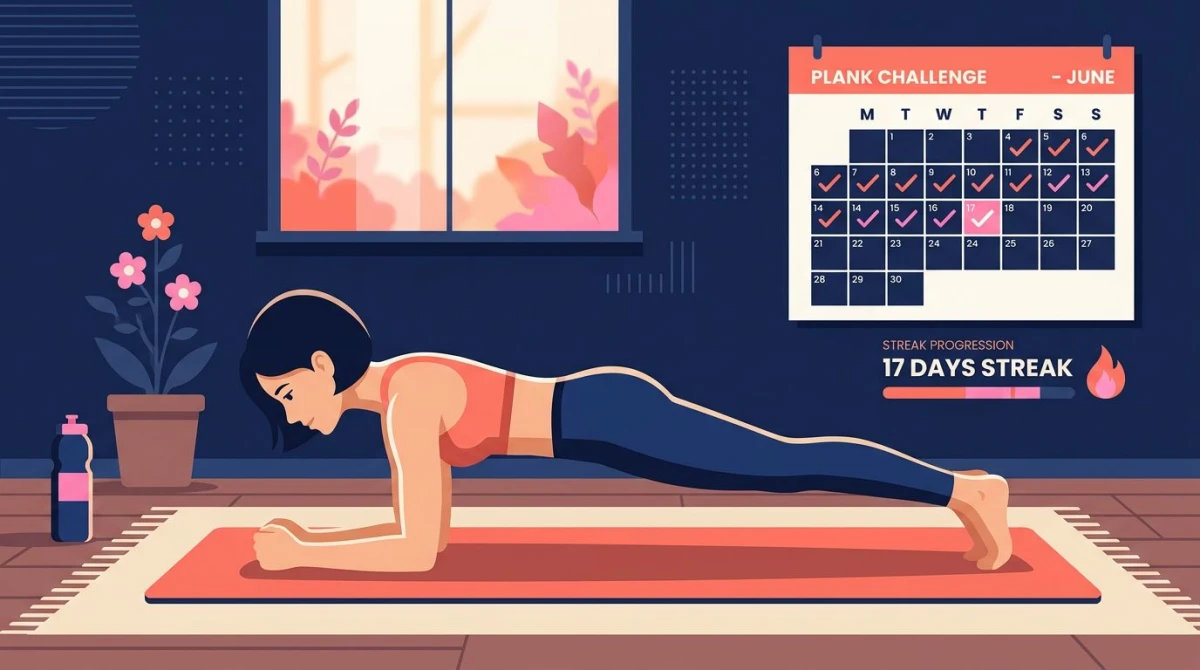
A realistic 30 day abs challenge builds core strength and endurance through a progressive daily schedule with built-in rest days — not a visible six-pack in 30 days. The first week or two is often where a challenge like this stalls, so the plan below pairs the moves with consistency mechanics: a fixed daily cue, streak tracking, and a no-zero rule. Finishing depends far less on the exercises than on showing up for all 30.
TL;DR: the 30 day abs challenge in one paragraph
You do a short core circuit each day — crunches, planks, leg raises, and bicycle crunches — that gets a little harder each week, with two rest days built into every seven-day block. Over 30 days you build noticeable core strength and endurance. You probably will not see a defined six-pack, because visible abs depend on body-fat levels, not on how many crunches you do. The real challenge is not the workout. It is finishing without quitting in week two. The schedule, the form notes, and the finishing strategy below are built around that.
What to realistically expect in 30 days
Here's what the research says: you can build real core strength in a month, but you can't spot-reduce belly fat with crunches.
The Mayo Clinic is clear that belly-focused exercises strengthen and tone the abdominal muscles but won't remove the fat sitting on top of them. Fat loss happens across the whole body when you're in a steady calorie deficit — not in the spot you feel the burn. So the rectus abdominis (the "six-pack" muscle) gets stronger and thicker over 30 days, but whether you see it depends on your overall body-fat percentage.
That honesty matters, because a challenge sold on "abs in 30 days" sets you up to feel like you failed even when your core got measurably stronger.
And the strength itself is worth more than the look. According to Harvard Health, a strong core stabilizes the spine and pelvis, improves balance and posture, and makes everyday movement — bending, lifting, sitting at a desk, getting off the floor — easier and less injury-prone. The "core" is more than the front abs you see in the mirror. It's the whole band of muscle wrapping your trunk, including the deep stabilizers and the obliques, and it's what transfers power between your upper and lower body. That's the real payoff of 30 days of consistent core work, and it shows up whether or not your abs ever become visible.
What you can realistically expect after 30 consistent days:
- A stronger, more stable core — easier to hold a plank, lift, and sit with good posture
- Better core endurance — the same crunch set feels lighter than it did on day 1
- A daily movement habit you can keep going after the challenge ends
- Possibly a slightly flatter look if you also tighten up your nutrition and sleep
What you should not expect:
- A visible six-pack from crunches alone
- Spot-reduced belly fat (it's a myth — more on that in the FAQ)
- Permanent results if you stop the day the challenge ends
As the old gym line goes, abs are made in the kitchen. A 30 day abs challenge is best understood as a habit foundation, not a body transformation. Build the daily core habit here, and the visible results follow over months of training plus nutrition.
Before you start: setup, warm-up, and safety
You need almost nothing for this challenge — that's part of why it works as a daily habit. A bit of floor space and an exercise mat (or a folded towel) is enough. No gym, no equipment, no excuses about getting somewhere.
Spend 60 seconds warming up before each session so you don't strain a cold core. A few cat-cow stretches, some gentle torso twists, and a couple of slow knee-to-chest pulls wake up the area. It feels trivial, but a warm core moves better and aches less the next day.
A couple of safety notes worth taking seriously. If you have lower-back issues, lean toward the planks and bird-dogs and go easy on full leg raises, which load the lumbar spine when your form slips. If you're pregnant, recently postpartum, or recovering from abdominal surgery, talk to your doctor first — some of these moves aren't appropriate, and there are safer core options for you. Sharp pain is always a stop signal; a working burn in the muscle is fine, but pain in a joint or your lower back is not.
Finally, pick your time before day 1, not on day 1. Deciding "I'll do it later" is how later becomes never. Lock in a slot — morning before the shower, evening before bed — and treat it as fixed. The whole consistency layer later in this guide hangs on that one decision.
The full 30 day abs schedule
This plan progresses week by week and keeps two rest days in each block so your core actually recovers. Recovery is when muscle adapts — skipping rest is how week-two soreness turns into a quit.
Each "session" is one round of the listed moves. Do it at the same time each day. The whole thing takes 6 to 12 minutes.
| Week | Days | Focus moves | Reps / time per move | Rest days |
|---|---|---|---|---|
| Week 1 | 1–7 | Crunches, forearm plank, lying leg raises | 12 crunches, 20s plank, 8 leg raises | Days 4 & 7 |
| Week 2 | 8–14 | Crunches, plank, leg raises, bicycle crunches | 16 crunches, 30s plank, 10 leg raises, 16 bicycles | Days 11 & 14 |
| Week 3 | 15–21 | Crunches, plank, leg raises, bicycle crunches | 20 crunches, 40s plank, 12 leg raises, 20 bicycles | Days 18 & 21 |
| Week 4 | 22–30 | Full circuit + side plank | 24 crunches, 50s plank, 14 leg raises, 24 bicycles, 20s each side plank | Days 25, 28 & 30 |
On rest days you still "check in" — do 2 minutes of light stretching or a single slow plank hold. This keeps the daily streak alive without overloading your core, which is the whole point of the consistency layer below.
If a day feels too hard, scale down rather than skip. A shorter plank or fewer crunches still counts. A skipped day is what breaks challenges; a smaller day never does.
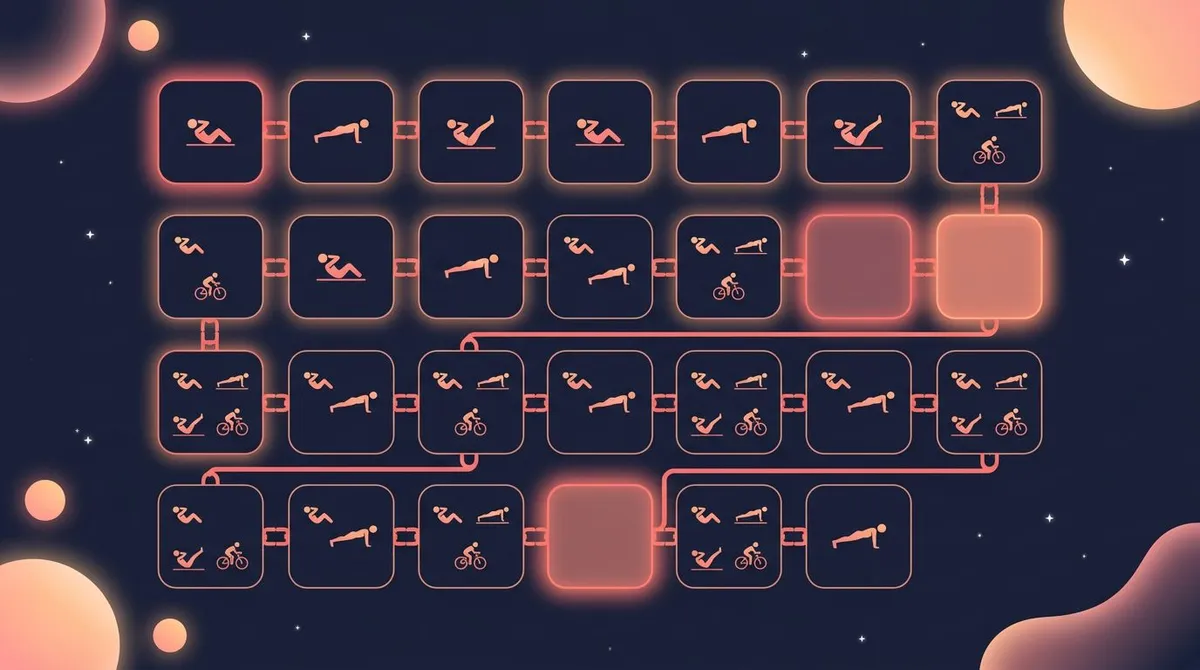
How each week builds
Week 1 is about showing up, not burning out. The reps are deliberately light. Your only job this week is to prove to yourself that the daily slot exists and you can fill it. If the circuit feels too easy, resist the urge to crank the reps up — the point is to bank seven easy wins and build the cue, not to crush yourself before week 2.
Week 2 adds bicycle crunches and a little volume. This is the danger zone — the novelty has worn off and the soreness hasn't. If a challenge is going to stall, this is often where it happens. Lean hard on the no-zero rule this week: even a single plank keeps the chain alive while your body adapts.
Week 3 raises the numbers again. By now the daily session should feel routine. The crunch and plank targets climb, and you'll notice the early-week sets feel genuinely easy compared to day 1 — that's the endurance gain showing up. Keep your form tight as the reps grow; sloppy high-rep crunches do less than clean moderate ones.
Week 4 adds the side plank and pushes to the finish. The full circuit plus obliques rounds out your core training. With three rest days in the final stretch, the schedule eases you across the line rather than grinding you down at the end. Finishing week 4 means you've built the habit, not just survived a month.
Beginner form notes for each move
Good form is what makes these moves work your core instead of your neck and hip flexors. Slow and controlled beats fast and sloppy every time.
Crunches
Lie on your back, knees bent, feet flat. Curl your shoulder blades off the floor by contracting your abs — not by yanking your head with your hands. Keep a gap the size of a fist between chin and chest. Lower slowly. If your neck aches, you're pulling with your arms.
Forearm plank
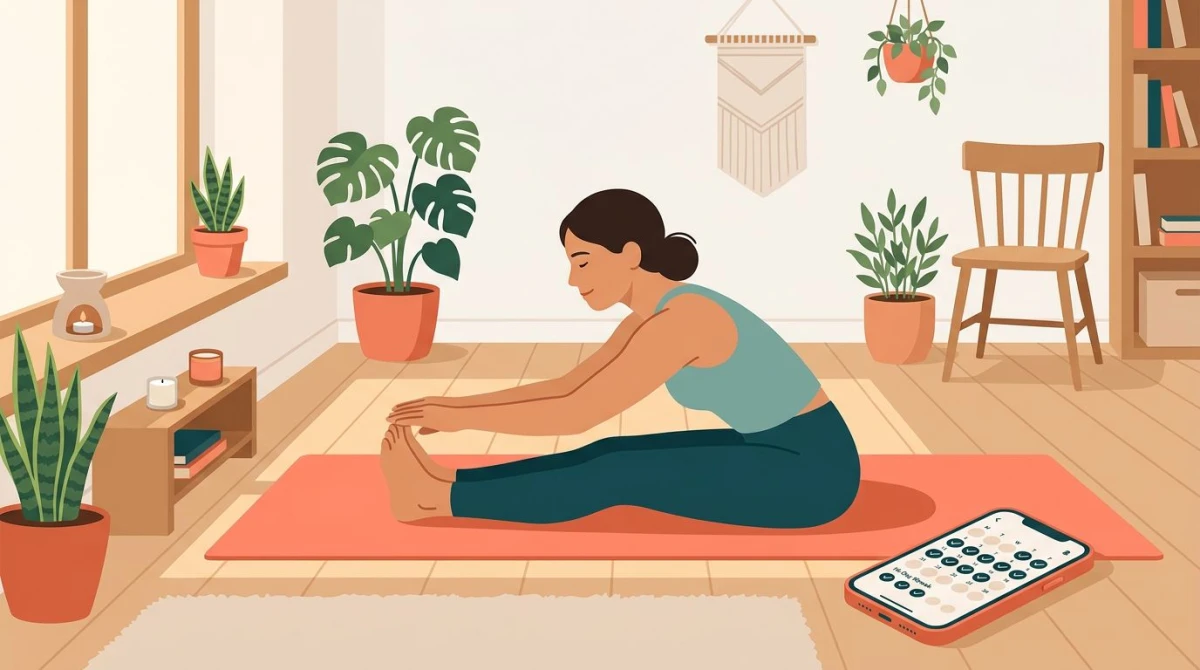
Forearms on the floor, elbows under shoulders, body in one straight line from head to heels. Squeeze your glutes and brace your abs as if bracing for a light punch. Don't let your hips sag or pike up. Quality over time — a clean 20-second hold beats a sagging 60. A plank timer keeps you honest on the hold without staring at a clock.
Lying leg raises
Lie flat, legs straight, hands tucked under your lower back or by your sides. Raise both legs to about 90 degrees, then lower slowly without letting your heels touch the floor. If your lower back lifts or strains, bend your knees slightly and reduce the range.
Bicycle crunches
On your back, bring opposite elbow toward opposite knee while extending the other leg. Move slowly and rotate from your torso, not your arms. Each side counts as one rep. This one hits the obliques, which the simpler moves miss.
Side plank (week 4)
On your side, forearm under your shoulder, body in a straight line, hips lifted. Hold, then switch. It targets the deep stabilizers and obliques and rounds out the challenge.
Common form mistakes to avoid
A few errors show up again and again and quietly cap your progress:
- Pulling your neck during crunches. If your neck is sore, your abs aren't doing the work. Keep your hands light and curl from the core.
- Holding your breath. Brace and breathe — exhale as you contract. Holding your breath spikes pressure and tires you out fast.
- Letting your hips sag in a plank. A sagging plank stresses your lower back and skips the abs. Squeeze your glutes and shorten the hold if you can't keep the line.
- Rushing the reps. Speed turns a core exercise into momentum. Slow, controlled reps recruit more muscle and protect your back.
- Chasing soreness as proof. Soreness isn't the goal — strength is. You can progress without being wrecked the next day.
Fixing these is often the difference between a session that builds your core and one that just makes your neck hurt.
The consistency layer: why people quit around day 7
The exercises aren't the hard part. The hard part is day 8, when the novelty has worn off, you're a little sore, and skipping "just today" feels harmless.
Here's the trap: motivation is highest on day 1 and dips hard in the first two weeks. If your plan relies on feeling motivated, week two is where it dies. The fix is to stop relying on motivation and lean on structure instead.

These four mechanics do most of the work of finishing:
- Anchor it to a fixed cue. Don't do abs "sometime today." Tie the session to something you already do every day — right after you brush your teeth, right before your shower, right after your morning coffee. A consistent cue removes the daily decision, and removing the decision is what makes a behavior automatic. (This is the same principle behind making exercise a lasting habit.)
- Track the streak. Watching an unbroken chain grow taps into loss aversion — once you're on day 14, you don't want to be the reason it resets to zero. Mark each session as done so day 18 feels as motivating as day 2. A streak you can see is far stickier than one you're keeping in your head.
- Use the no-zero rule. On a bad day, you don't have to do the full circuit — you just can't do nothing. One plank. Ten crunches. Two minutes. A tiny session keeps the chain alive and protects the identity of "someone who shows up." This is the single biggest difference between people who finish and people who don't.
- Respect the rest days. Rest days aren't cheat days — they're scheduled. Doing your light 2-minute check-in on a rest day keeps the daily habit intact while your core recovers, so you're not choosing between overtraining and breaking the streak.
The data point worth remembering: consistency beats intensity for a 30-day block. A modest circuit done all 30 days builds more strength and a stronger habit than a brutal one you abandon on day 9. The same finishing logic applies to any short challenge — it's why the 30 day pushup challenge plan also builds in deload days and a streak rule instead of a relentless rep curve.
What to do after day 30
Finishing is the start, not the finish line. The goal was never 30 days — it was to make core work a normal part of your week.
Here's a simple way to keep it going:
- Drop to 3–4 core sessions a week. Daily was a kickstart; maintenance is a few focused sessions. Your core only needs regular stimulus, not daily punishment.
- Add progressive overload. Increase reps, hold time, or difficulty (weighted plank, hanging leg raises) every couple of weeks so you keep adapting.
- Pair it with full-body work and nutrition. If visible abs are the goal, this is where they're built — overall training plus a sustained calorie deficit, not more crunches.
- Keep the streak philosophy, loosen the schedule. Track weekly consistency instead of daily. The chain mindset that got you through 30 days works just as well at a 3-times-a-week cadence.
Most people find that the habit itself is the real win. The flatter core, the stronger back, the better posture — those come from the months after the challenge, built on the foundation you just laid. If you want help making it stick, a tracker like HabitBox lets you log each core session and watch the streak build, so the months after day 30 feel as motivating as the challenge did. Building a durable routine is its own skill — see our guide on fitness consistency for how to keep showing up long after the novelty fades.
30 day abs challenge FAQ
Does a 30 day abs challenge really work?
Can you get abs in 30 days?
How long should I plank each day?
Should I do abs every day?
What should I do after the 30 days?

Mira Hartwell
Editor, HabitBoxEditor at HabitBox. Writes about habit science and productivity, grounding every post in named research (Lally, Wood, Walker, Huberman) instead of recycled advice. Read full bio →