30-Day Yoga Challenge: How to Finish It (2026)
TL;DR. Most people quit a 30 day yoga challenge somewhere around day 12 to 14 — not because the poses are too hard, but because day-skipping compounds. Finishing comes down to two rules: a 5-minute minimum-day floor (so a busy day still counts) and a never-miss-twice recovery rule. Habit research from University College London found new behaviors take a median of 66 days to feel automatic, so 30 days won't make yoga effortless. It will, however, get you onto the mat enough times that quitting feels worse than continuing.
If you've started a 30 day yoga challenge before and trailed off in the second week, the program wasn't the problem. The structure was. Most challenge plans assume you'll show up every day with 30 free minutes and a clear head. Real life doesn't work that way, and the schedules don't survive contact with a hard week at work, a cold, or a single late night.
This guide gives you the realistic dropoff numbers, the two rules that actually predict finishing, a 4-week pacing plan, and a missed-day recovery rule that keeps the streak intact when life gets in the way.
What a 30 day yoga challenge actually is
A 30 day yoga challenge is a structured commitment to practice yoga — usually for 10 to 30 minutes — every day for 30 consecutive days. The goal is not perfection of the poses. It is consistency: enough repetition to find a time of day, a sequence, and a setup that you'd actually keep doing in month two.
Most people do these challenges with a video program (Yoga With Adriene's 30 Days of Yoga being the most common starting point), but the real outcome is whether you build a practice that survives day 31.
The science: why 30 days isn't enough on its own
Here's the honest part: a 30 day yoga challenge will not, by itself, install yoga as an automatic habit.
Phillippa Lally and colleagues at University College London tracked 96 people building new daily habits and found the median time to "automaticity" was 66 days, with a range of 18 to 254 days. Thirty days is not a magic number — it's a starter pack. What you're actually doing in 30 days is closing the gap from "I never do yoga" to "yoga is something I do."
Three things make that gap easier to close:
- A consistent cue. James Clear's habit research argues that habits stick when they're attached to a time and place that already exists in your day — right after coffee, right before the shower, right after closing your laptop. Pick one cue and don't change it during the challenge.
- Low friction on bad days. Behavior scientist BJ Fogg's "Tiny Habits" framework shows that the smallest version of a habit is the version that survives. A 5-minute mat session counts. A 90-second cat-cow before bed counts. The point is to never break the chain.
- Streak visibility. Tracking your streak — even just on paper — taps loss aversion. You don't want to break the chain you've built. This is the mechanism behind why streak-based apps work.
Yoga itself has solid evidence behind the time investment. The NIH's National Center for Complementary and Integrative Health notes that regular yoga practice can improve balance, flexibility, and stress markers. Harvard Health and the NHS yoga guide cover the lifestyle benefits in more detail. (Yoga is a movement practice and stress-reduction tool — it's not a substitute for professional care for any clinical condition.)
If you want a guided day-1 session to actually start, Yoga with Adriene's free 30-day program is the highest-quality on-ramp on YouTube. Press play and you have your first session done:
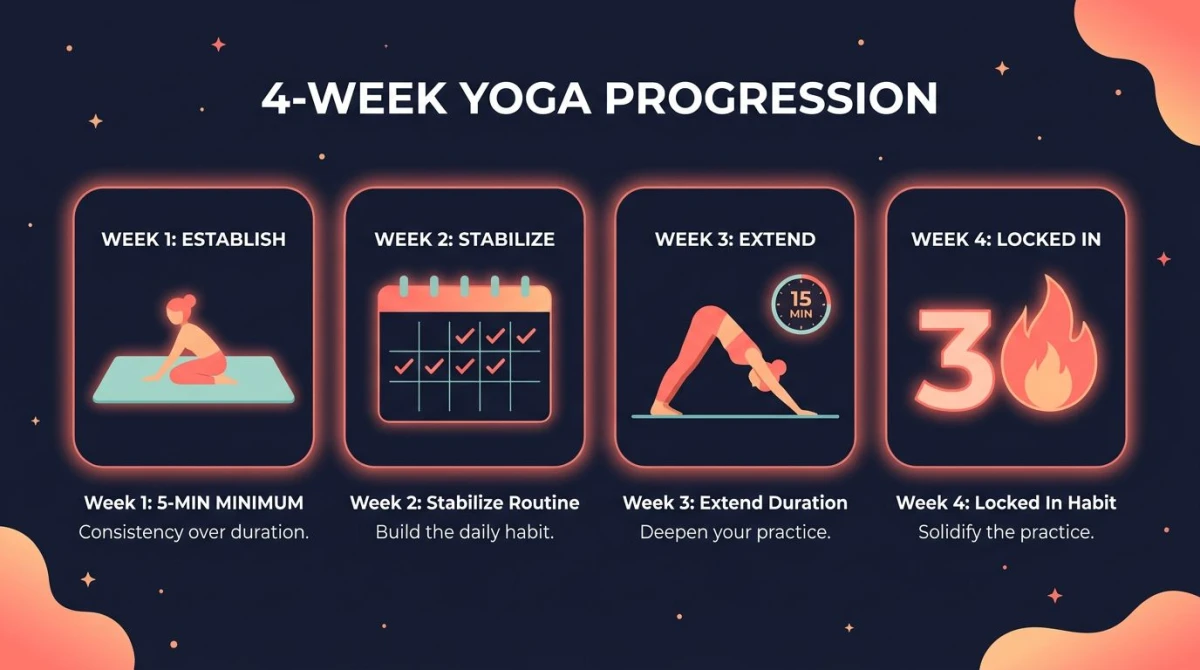
The 4-week pacing table
Most challenges fail because every day looks the same on paper. Yours shouldn't. Here's a realistic 4-week shape with a built-in rescue rule for each week.
| Week | Focus | Rescue rule |
|---|---|---|
| 1 (days 1–7) | Show up. 10–15 min any style. | If a day is hopeless, do 5 minutes of cat-cow, child's pose, and forward fold. That counts. |
| 2 (days 8–14) | Lock the cue. Practice at the same trigger every day. | Most quitting happens this week. If you miss day X, do day X the next morning — never miss two in a row. |
| 3 (days 15–21) | Push to 20 min and add one harder session per week. | If energy is low, do a restorative or yin session instead of skipping. Slow yoga is still yoga. |
| 4 (days 22–30) | Hold the line. Finish the challenge clean. | Plan the last 9 days the night before week 4 starts, including travel days and busy nights. |
Print this, screenshot it, or paste it into a habit tracker. The rescue rules matter more than the targets.
How to actually build the habit (5 steps)
These are the five mechanics that separate finishers from quitters. Do all of them — they compound.
1. Pick one anchor cue and don't change it
Decide today what triggers your practice. "After my morning coffee" is an anchor. "When I have time" is not. The cue is the single most predictive variable for habit consistency. Write it down: "After ___, I roll out my mat."
2. Set a 5-minute minimum-day floor
On a "do everything" day, you do the full session. On a hard day, you do five minutes. This is the rule that prevents the entire challenge from collapsing on day 11 when you're sick or behind on work. A five-minute session counts as a finished day. You don't break the streak.
3. Use a never-miss-twice rule
You will miss a day. Plan for it. The rule from Atomic Habits is simple: missing once is an accident, missing twice is the start of a new habit (the wrong one). If you miss day 9, day 10 is non-negotiable, even if it's the 5-minute floor.
4. Reduce friction the night before
Lay out the mat. Queue up the video. Charge your earbuds. Put the yoga clothes on top of the regular clothes. Every step you remove from "practice yoga" raises the odds you actually do it. This is mechanical, not motivational.
5. Track every session visibly
Use a paper grid, a calendar, or a habit app. The streak matters more than the duration of any single session. If you're already tracking other habits, a dedicated tracker like HabitBox lets you log a 30 day yoga challenge alongside the rest of your routine in one tap.
The 30-day starter plan
Here's a track-it format for the full 30 days. Tick each day as you finish.
- Day 1: 10 min, gentle full-body flow. Set your anchor cue.
- Days 2–4: 10–12 min, same cue, same time of day.
- Day 5: 15 min, slightly longer flow.
- Days 6–7: Repeat day 5 length.
- Day 8: Hardest psychological day — show up no matter what. 5-minute floor allowed.
- Days 9–11: 15 min, lock the cue.
- Day 12: Try a slightly harder sequence (a longer hold, a balance pose).
- Days 13–14: 15 min, week 2 wrap.
- Day 15: 20 min. You're past the dropoff.
- Days 16–18: 15–20 min.
- Day 19: Restorative or yin session.
- Days 20–21: 20 min.
- Day 22: 20 min, plan the rest of week 4 tonight.
- Days 23–25: 15–20 min.
- Day 26: Optional: try a new style (vinyasa, slow flow, hatha).
- Days 27–29: 20 min.
- Day 30: Same length as day 1. Compare how the same poses feel now.
The day-30 vs day-1 comparison is the part most people skip. It's also the part that decides whether you keep going past the challenge.
When it doesn't work: how to recover
You're going to miss a day. Three rules for recovery:
- Never miss twice in a row. This is the rule that protects the chain. If you miss day 14, day 15 is mandatory. Use the 5-minute floor if you have to.
- Don't restart from day 1. Resetting is a punishment, and punishments make habits feel worse, not stickier. If you miss day 14, day 16 is just day 16. Keep counting forward.
- Audit the cue, not your willpower. If you missed because the cue didn't fire (e.g., you traveled and your coffee routine changed), pick a new anchor for the new context — not a new mindset. Habit failures are usually environment failures.
If you're using a habit app to track this, log the missed day honestly. Apps like HabitBox show you the pattern over time, which makes it obvious whether you're missing because of one rough week or a structural problem with your cue.
FAQ
Is 30 days enough to build a yoga habit?
How do I not quit a yoga challenge?
What's the best 30-day yoga program for beginners?
Should I do yoga every day or take rest days?
What's the minimum yoga session that counts?
Building yoga into a longer-term routine
The 30 day yoga challenge is the start, not the finish line. Once you're through day 30, the question is how to fold yoga into the rest of your wellness habits without it taking over.
A few patterns worth reading next:
- Habit stacking — chain yoga onto an existing habit (like your morning coffee) for a stickier cue.
- Fitness consistency — the broader rules for staying consistent with movement, not just yoga.
- 30-day plank challenge — the same finishing rules applied to a strength-focused challenge.
If you're tracking yoga alongside other daily habits — water, sleep, reading, workouts — a single mobile habit tracker keeps the streaks visible in one place. HabitBox is built for exactly this: simple daily check-ins, a calendar heatmap, and streak tracking, with no account required. The 5-minute floor and never-miss-twice rule both work better when the streak is visible from your home screen.
Pick your anchor cue tonight. Do day one tomorrow. The rest is just showing up — and the rules above are designed to make showing up the easiest option, even on the days you don't feel like it.

Mira Hartwell
Editor, HabitBoxEditor at HabitBox. Writes about habit science and productivity, grounding every post in named research (Lally, Wood, Walker, Huberman) instead of recycled advice. Read full bio →