30 Day Walking Challenge: 4-Week Plan (2026)
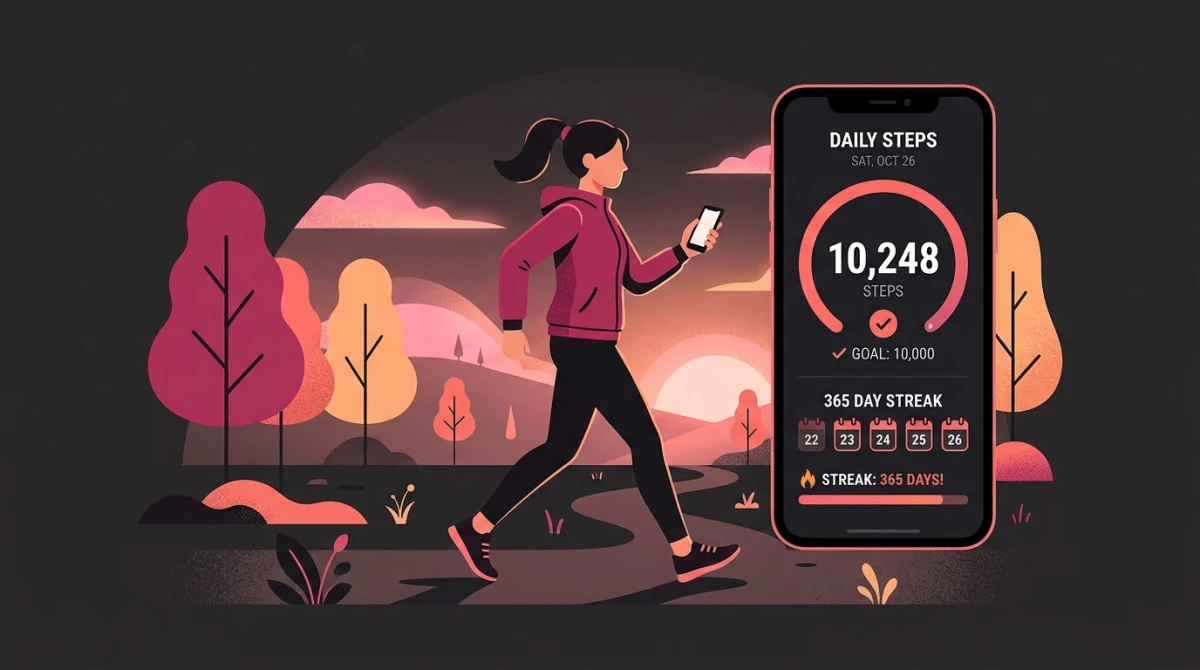
TL;DR: This 30 day walking challenge ramps you from about 15 minutes of walking a day in Week 1 to 45 minutes by Week 4 — roughly 6,000 steps building toward 10,000. But the real goal isn't the 30 days. It's owning a daily walk that's still there on day 60, day 100, and beyond. Below is a week-by-week table, the research on why walking is underrated, and a plan for what to do on day 31.
Here's the honest problem with most walking challenges: enthusiasm is highest on day one and lowest around day 12. You start strong, weather turns, a busy week hits, and the streak quietly dies. Most plans treat 30 days as a finish line, so when the month ends, so does the walking.
We're going to treat it differently. The 30 days are training wheels for a habit — a structured ramp with a built-in streak and a same-time cue, so that when the challenge officially ends, walking has already become something you just do.
The 30 day walking challenge: your week-by-week plan
The plan ramps gradually. Each week nudges your daily duration and step target up so your body adapts without the soreness that makes people quit. Time goals are more beginner-friendly than step goals, so both are listed — pick whichever you'll actually check.
| Week | Daily walk | Rough step target | Focus |
|---|---|---|---|
| Week 1 (days 1-7) | 15 min | ~6,000 steps | Show up every day. Same time, low pressure. |
| Week 2 (days 8-14) | 25 min | ~7,500 steps | Add a slightly brisker pace for 5 of the minutes. |
| Week 3 (days 15-21) | 35 min | ~9,000 steps | Alternate 3 min brisk / 3 min easy (interval walking). |
| Week 4 (days 22-30) | 45 min | ~10,000 steps | Hold the habit steady; make one walk a "no-phone" walk. |
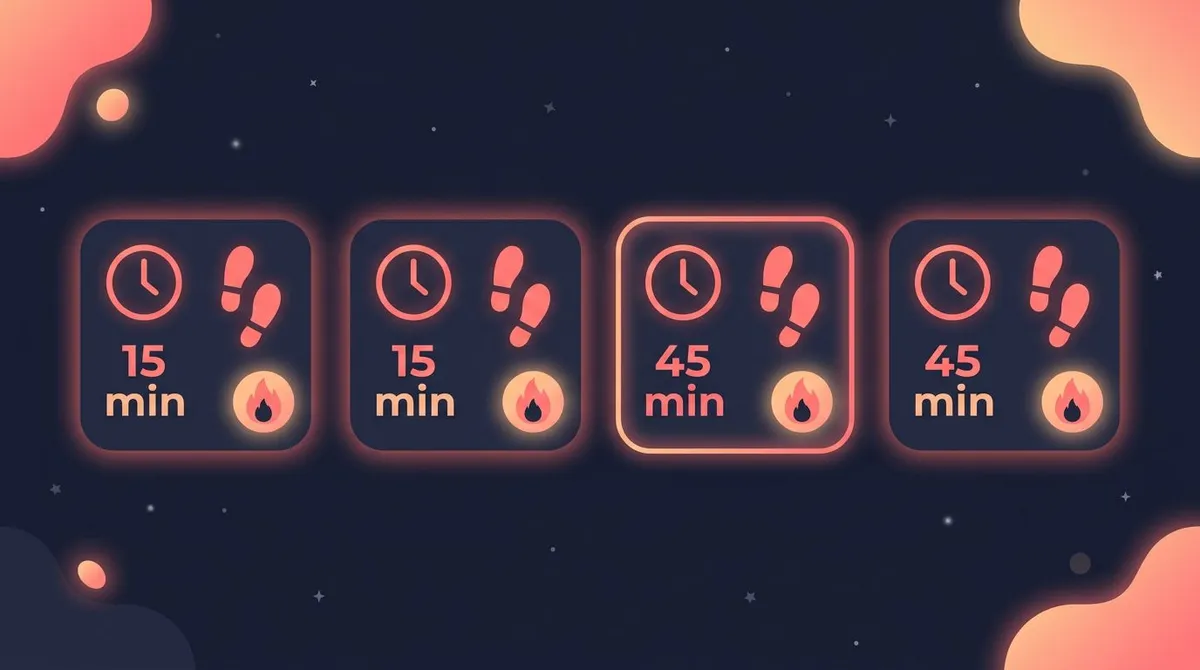
Two rules keep this realistic. First, one flexible day per week can be a minimum-viable 10-minute walk if life explodes — it still counts toward your streak. Second, you don't have to do the whole walk at once. Three 15-minute walks add up the same as one 45-minute walk, and research on activity accumulation supports counting them together.
Brisk means you can talk but not sing. If 45 minutes feels like too much by Week 4, hold at 30-35 minutes — consistency beats a bigger number you'll abandon.
Why walking is underrated
Walking rarely gets credit because it feels too easy to matter. The research says otherwise.
In a large 2019 study published in JAMA Internal Medicine, I-Min Lee and colleagues tracked step counts in older women and found that mortality dropped sharply as daily steps rose — with benefits leveling off around 7,500 steps, not the mythical 10,000 (PubMed). The takeaway: you get most of the longevity benefit well before you hit a "perfect" number, so a doable target beats a heroic one.
Walking also hits the cardiovascular guidelines almost by itself. The American Heart Association recommends at least 150 minutes of moderate activity per week (AHA). This challenge clears that bar by Week 3 without a single gym visit.
Then there's mood. The National Institute on Aging notes that regular physical activity like walking supports better sleep, mood, and brain health (NIH/NIA). Plenty of people in month-long walking experiments report the mental shift — calmer, clearer, less anxious — as the change they notice first, before anything shows up on a scale.
How to fit a daily walk into a busy day
The plan only works if the walk actually happens. The most reliable trick is habit stacking — attaching the walk to something already fixed in your day, so you don't rely on motivation to remember it.
- The post-lunch walk. Walk right after you finish eating lunch. The meal is your cue, and a gentle post-meal walk also helps with digestion and afternoon energy.
- Walking meetings. For any one-on-one call that doesn't need a screen, take it on foot. A 25-minute check-in becomes a 25-minute walk you were going to spend sitting anyway.
- Park farther, get off early. Park at the far end of the lot, or get off the bus one stop early. It's a small, automatic way to bank steps without carving out a separate block of time.
- The wind-down walk. A 15-minute loop after dinner doubles as a screen break and a sleep aid.
If you're already working on a step-target habit, our guide to walking 10,000 steps a day digs deeper into fitting volume into a schedule. This challenge is the on-ramp; that guide is where you go once daily walking is automatic.
Make it a habit that outlasts day 30
This is the part every other walking challenge skips. Finishing 30 days is an achievement — but the point was never the 30 days. It's day 31 onward. Here's how to make the walk stick.
Lock a same-time cue. Habits form fastest when the trigger is consistent. Pick one anchor — after morning coffee, right after lunch, before dinner — and defend it. When the when is decided in advance, you skip the daily "should I go now or later?" negotiation that erodes willpower. Our guide on how to be consistent covers why fixed cues beat willpower every time.
Use a flexible minimum. A shorter walk may fit a busy day, but illness, pain, or recovery can justify rest. A missed day—or several—does not make restarting impossible.
Use a visible streak. Watching a chain of completed days grow is a genuine motivator — it taps into loss aversion, the discomfort of breaking something you've built. A tracker like HabitBox lets you log the walk with one tap and see your current and longest streaks, whether you track by minutes or by steps. Seeing the streak is often what gets you out the door on a lukewarm evening.
Have a day-31 plan. When the challenge ends, don't stop — shift the goal. Hold at 30-45 minutes daily, or fold walking into a broader routine. If you want to level up, our guide on how to make exercise a habit shows how to keep the momentum, and if walking has you itching to go faster, how to start running for beginners is a natural next step.
The mindset shift is everything: a challenge with an end date creates a cliff. A habit with a same-time cue and a streak just keeps rolling.
FAQ
How long should I walk during a 30 day walking challenge?
How many steps a day is good?
Can I lose weight with a 30 day walking challenge?
What if I miss a day?
How do I keep walking after 30 days?
Ready to turn 30 days into a lasting daily walk? HabitBox lets you track your walking streak by minutes or steps and see your progress build day by day — download it free.

Mira Hartwell
Editor, HabitBoxEditor at HabitBox. Writes about habit science and productivity, grounding every post in named research (Lally, Wood, Walker, Huberman) instead of recycled advice. Read full bio →