Walking 10,000 Steps a Day: Make It a Habit (2026)
TL;DR. Walking 10,000 steps a day is roughly 75 to 90 minutes of cumulative walking, depending on stride. Most people who try this fail in week one because they jump from a 4,000-step baseline to a 10,000-step goal overnight. The fix is a 4-week ramp that adds about 1,500 steps each week, anchored to two or three existing daily cues (after coffee, after lunch, on a phone call) and a 3,000-step floor for bad days. The number isn't sacred — it came from a 1965 Japanese pedometer marketing campaign — but as a daily habit anchor, it works.
If you've tried walking 10,000 steps a day before and fallen off in the first ten days, the problem probably wasn't your legs. It was the pacing. Most articles on the topic give you a benefits list and a goal, then leave you to figure out how to actually fit two extra hours of walking into a normal day. This guide does the opposite: it gives you the daily ramp, the anchor cues, the missed-day rule, and the tracking setup so the habit survives past week three.
What "walking 10,000 steps a day" actually means
Ten thousand steps is a daily walking volume goal. For an average adult with a stride of about 2.1 to 2.5 feet, that's roughly 4 to 5 miles, or about 75 to 90 minutes of cumulative walking spread across the day. The steps don't have to be one continuous walk — three 25-minute sessions count the same as one 75-minute walk, and short bursts of housework and errands also add up.
The number itself has a quirky origin. As researcher I-Min Lee and colleagues note in their 2019 JAMA Internal Medicine study, the 10,000-step target came from a 1965 marketing campaign for a Japanese pedometer called the Manpo-kei, which translates to "10,000-step meter" (Lee et al., 2019). It was a round number that sold pedometers, not a clinical recommendation. That doesn't mean it's a bad target — it just means there's nothing magical about that exact figure.
The science: why daily walking volume matters
Three findings from credible research shape how to think about this habit.
First, more daily steps are linked to lower mortality risk, but the curve flattens before 10,000. The Lee study tracked older women and found that mortality risk dropped sharply between 2,700 and 4,400 steps a day, kept dropping through 7,500 steps, and then plateaued. For women aged 60 and older, the benefit largely topped out at about 7,500 steps. For most younger and middle-aged adults, benefits keep rising up to 10,000. The takeaway: any consistent increase from a sedentary baseline matters, and 10,000 is a sensible upper anchor for most people, not a minimum.
Second, the U.S. Centers for Disease Control and Prevention recommends adults get at least 150 minutes of moderate-intensity activity per week, and brisk walking counts (CDC adult activity guidelines). Walking 10,000 steps daily, with even a portion at a brisk pace, comfortably clears that threshold.
Third, on the habit side, a University College London study by Phillippa Lally and colleagues followed 96 people forming new daily behaviors and found that habits take a median of 66 days to feel automatic, with a wide range from 18 to 254 days (Lally et al., 2010). They also found that missing a single day had no measurable effect on the long-term automaticity curve. The behavior breaks when misses cluster, not when they happen once.
This is why a streak-based approach beats a motivation-based one. Wendy Wood, a USC researcher who has spent two decades studying habit psychology, has shown that about 43 percent of daily behavior is repeated in the same context — the cues drive the action, not the feeling. James Clear builds on this in Atomic Habits, where he argues that environment design and visible progress trackers do more for consistency than willpower. For a walking habit, that means anchoring walks to existing daily cues and making the streak visible enough that you don't want to break it.
For a 4-minute primer on where the "10,000 steps" number actually comes from (spoiler: a 1960s Japanese pedometer ad, not a health study), this TED-Ed explainer is the cleanest myth-buster on the internet:
How a 10,000-step day actually fits into your schedule
A common reaction to "walk 10,000 steps a day" is "I don't have 90 minutes." Almost no one does — in one block. The point is the cumulative total, not a single walk. Here's a comparison of three realistic daily patterns that all hit 10,000.
| Pattern | Walk slot 1 | Walk slot 2 | Walk slot 3 | Approx. steps |
|---|---|---|---|---|
| The commuter | 25-min walk to/from transit | 15-min lunch loop | Evening errand walk | ~10,200 |
| The desk worker | 20-min morning coffee walk | Two 10-min phone-call walks | 30-min after-dinner walk | ~10,400 |
| The parent | School-run round trip | 15-min stroll with kids | 20-min after-bedtime walk | ~10,100 |
Notice what's missing: a "go to the gym for 90 minutes" slot. None of these patterns require carving out a single big block of time. Each slot is 10 to 30 minutes, anchored to something that's already on your calendar — a meal, a meeting, a school drop-off. That's the leverage. You're not adding a new event to your day; you're attaching movement to events that already happen.
If your current daily count is around 4,000 steps (the typical desk-worker baseline), reaching 10,000 means adding roughly 6,000 steps — about 45 to 60 minutes of additional walking. Spread across three slots, that's three 15- to 20-minute walks. Manageable, but only if you ramp into it.
The 4-week ramp from a 3,000-step floor to 10,000
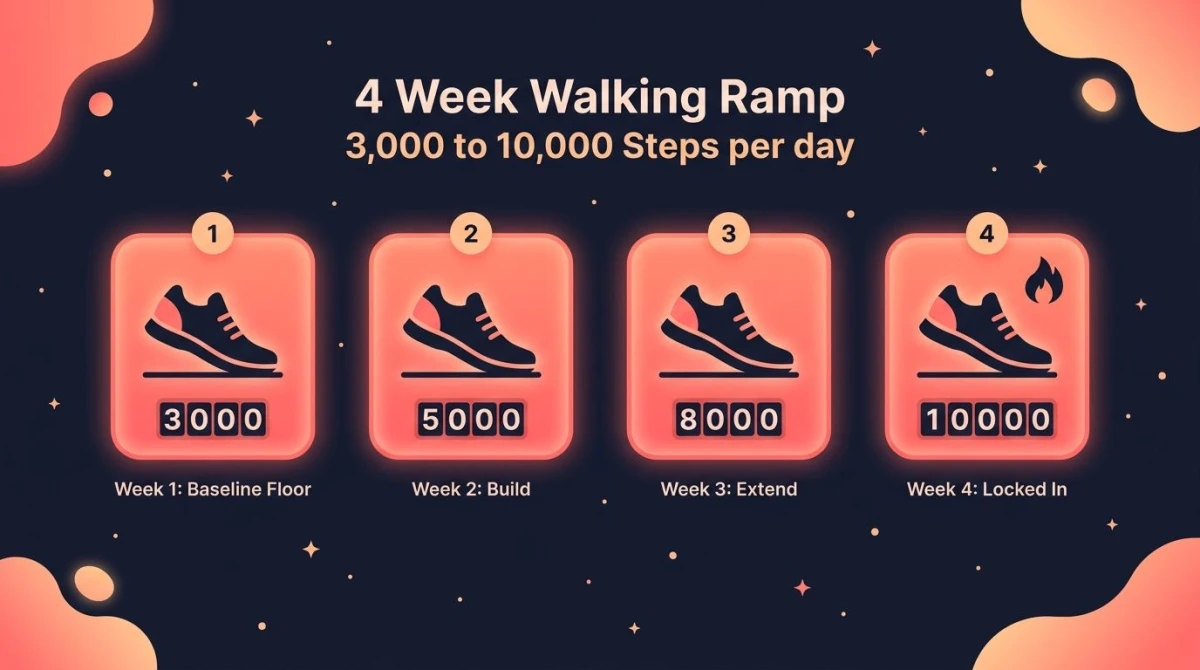
Here's the ramp. The structure: each week adds roughly 1,500 steps to the daily target, and every fourth day in week 1 and 2 has a "floor day" you can fall back to without feeling like you broke the habit.
| Week | Daily target | New habit-stack to add | Floor / bad-day rule |
|---|---|---|---|
| Week 1 | 5,500 steps | One 15-min walk after lunch | 3,000 steps minimum |
| Week 2 | 7,000 steps | Add a 10-min morning coffee walk | 3,500 steps minimum |
| Week 3 | 8,500 steps | Add a 15-min after-dinner walk | 5,000 steps minimum |
| Week 4 | 10,000 steps | Add a 10-min phone-call walk | 6,000 steps minimum |
The floor rule is the part that matters most and is the part most plans skip. On bad-weather days, sick days, travel days, and packed work days, the goal isn't 10,000 — it's the floor for that week. Hitting the floor still counts as a "yes" on your tracker. This keeps the streak intact and stops one rough day from cascading into a quit.
By the end of week 4 the four habit-stacks (lunch, coffee, dinner, phone) are anchored. They run more or less on autopilot, and 10,000 starts feeling like a normal day, not an event.
How to actually build the habit: 6 anchor cues that work
Habits stick when they're attached to existing routines. BJ Fogg, the Stanford behavior researcher, calls this "anchor design": you take a behavior that already happens reliably (the anchor) and stack the new behavior right after it. Here are six anchors that work especially well for walking.
- The post-coffee anchor. Take your first coffee on a 10-minute walk around the block instead of at your desk. The caffeine kicks in during the walk, and you start the day with movement and daylight. This adds about 1,200 steps with almost no friction.
- The post-meal anchor. A 15-minute walk after lunch (or any meal) is one of the highest-leverage walking habits. It naturally fits into a break, helps with post-meal energy, and adds about 1,800 steps. The cue is putting your fork down.
- The phone-call anchor. Take any call longer than 5 minutes on your feet. Pacing while talking turns work calls and personal calls into walking time. Two 10-minute calls add roughly 2,400 steps a day.
- The commute anchor. If you drive to work or transit, get off one stop early or park 10 minutes farther away. Same destination, two extra walks bolted onto the day.
- The walking-meeting anchor. For one-on-one meetings that don't need a screen, suggest "walk and talk." It's been shown to feel less formal and lower-pressure for both people. About 1,500 steps per 15-minute meeting.
- The bedtime anchor. A short 10-minute loop after dinner or before bed is a low-stress way to close the day. It also helps with digestion and sleep onset for many people.
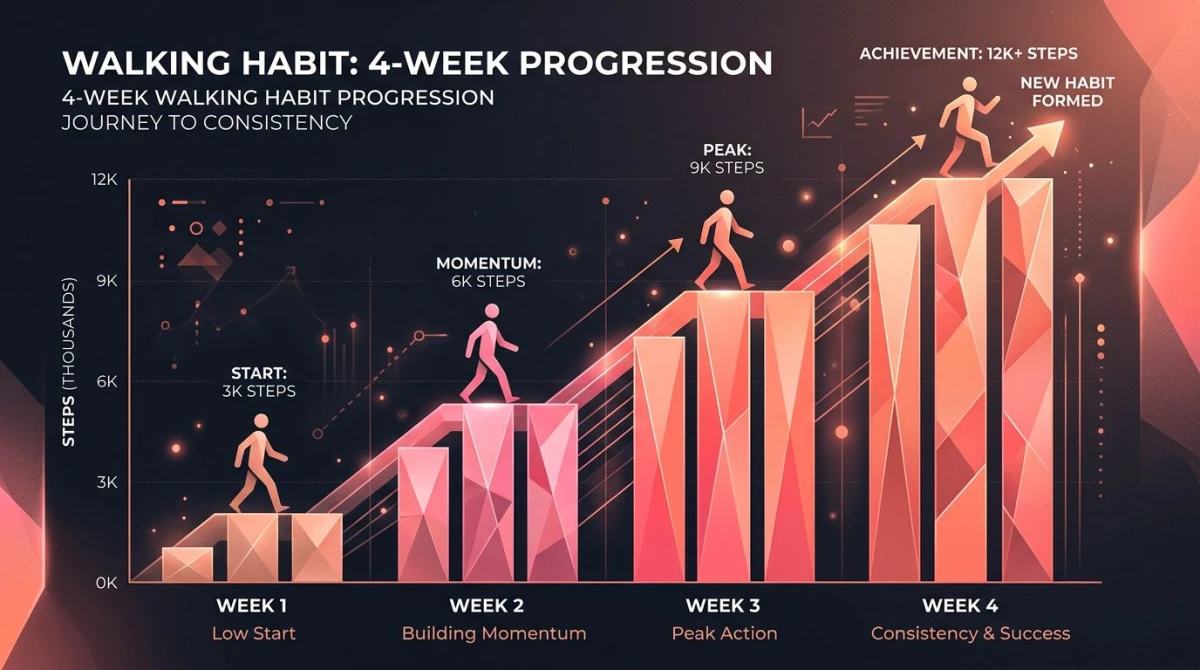
You don't need all six. Pick two for week 1, add one a week, and you're at four anchors by week 4 — exactly enough to land 10,000.

For the full method on stacking new habits onto existing ones, see our deeper guide on habit stacking. It covers anchor selection, friction reduction, and the trap most people fall into when their stack gets too long.
A 7-day starter plan you can run today
If 4 weeks feels far away, here's a 7-day starter to get you moving this week. Track each day with a checkmark — paper, app, whatever — so you can see the streak forming.
| Day | Step target | Anchor walk | Notes |
|---|---|---|---|
| Day 1 | 5,000 | 10-min after-coffee walk | Baseline. Just notice your current count. |
| Day 2 | 5,500 | + 10-min after-lunch walk | Two anchors. |
| Day 3 | 6,000 | Same two | Repeat day. Anchors are settling in. |
| Day 4 | 5,500 | One anchor only | Recovery day. Still counts. |
| Day 5 | 6,500 | + 10-min phone-call walk | Add one new anchor. |
| Day 6 | 7,000 | All three anchors | Full stack day. |
| Day 7 | 7,500 | All three + a longer weekend walk | Push day, then take stock. |
By the end of day 7 you'll know whether your three anchors fit your real life. Most people find one doesn't survive contact with their actual schedule — the "phone-call walk" is usually the first to drop — and they swap it for another. That's normal. After day 7, slide into the week 2 line of the 4-week ramp.
When it doesn't work: the missed-day recovery rule
Three things break a walking habit. Bad weather. Travel. Illness. Each of them gives you a legitimate reason to skip — and one skip can quietly turn into seven if you don't have a recovery rule in place.
Here's the rule: never miss two days in a row. This is the "never miss twice" principle from James Clear, and it's grounded in the Lally UCL data. A single missed day has no measurable effect on the long-term habit curve. Two missed days in a row starts a new pattern, and that pattern is "this isn't a habit anymore."
In practice:
- Miss one day: No fix needed. Hit your floor or your full target the next day.
- Cannot hit the day's target: Hit the floor (3,000 steps in week 1, 6,000 by week 4) and check it off. The floor is a "yes" day, not a fail.
- Miss two days: Drop back one week on the ramp the next day. If you were on week 3's 8,500 target, do week 2's 7,000 target tomorrow. You're not starting over; you're resetting the cadence.
- Miss a full week (sick, travel): Restart at week 2's 7,000 target, not week 1's 5,500. You won't lose all your progress; you'll just need a few days to rebuild the rhythm.
The recovery rule is what separates a 90-day streak from a 9-day streak. The ramp gets you to the number; the rule keeps you there.
How tracking changes the outcome
Whether you finish a 4-week walking ramp has more to do with whether you can see the streak than with how willing your legs are. Wendy Wood's research on context cues and Charles Duhigg's work on cue-routine-reward loops both point to the same conclusion: visible progress is itself a cue.
Streak visibility also taps loss aversion, which behavior economists have measured at roughly 2-to-1 against gain seeking. Once you've built a 12-day chain of green checkmarks, breaking it feels worse than today's walk. That asymmetry is why streak-based tracking works where motivation alone doesn't.
You can track this on paper — a wall calendar with a daily check works fine. A step count is built into most modern phones, so the data is already there. The discipline is making the daily check happen.
If you'd rather have the streak on your phone than on a wall, HabitBox is a habit tracker built around exactly this mechanic: one-tap daily check-ins, a streak counter that survives a single missed day, and a calendar heatmap so you can see the pattern at a glance. It pulls double duty if you're also stacking other small habits like a morning workout routine or a daily reading habit, since you can see all your streaks together. The point isn't the app — it's making the streak visible enough that you don't want to break it.
How walking 10,000 fits into a longer fitness habit
Thirty days of consistent walking is a useful container, not a finish line. Most people who hit 10,000 a day for a month report something they didn't expect: their non-walking workouts feel easier, and the daily pace of life slows down a little.
Three ways to land the habit into something durable past day 30:
- Treat 10,000 as the median, not the minimum. Some days you'll hit 12,000; some days you'll hit 6,000. Aim for a weekly average around 70,000 instead of treating each day as pass-fail. This is how trainers think about training volume, and it's a more sustainable mental model.
- Layer it with other small streaks. Walking pairs well with a short morning routine or a mobility habit. People who finish one fitness streak often start another within a month — see fitness consistency for why this transfer effect happens.
- Re-evaluate the target every 90 days. If 10,000 starts feeling like a chore, drop to 7,500 for a season. If it feels easy, push to 12,000 or add hills and pace work. The daily-walking habit is the point, not the round number.
If four weeks of consistent walking teaches you anything, it's that consistency moves outcomes more than intensity. People overestimate what a single epic workout does and underestimate what a daily 75-minute walk does over a year.
FAQ
Is 10,000 steps a day backed by science?
How long does it take to walk 10,000 steps?
Do I have to do all 10,000 in one walk?
What if I can't hit 10,000 every day?
Is it okay to walk 10,000 steps every day, or do I need rest days?
What's the easiest way to add steps without a "walking" workout?
Putting it into practice
Walking 10,000 steps a day is mostly a pacing and tracking problem, not a fitness problem. The 4-week ramp gives you the gradient. The anchor cues make it automatic. The floor rule and never-miss-twice rule keep the streak alive on the days that don't go to plan.
If you want a clean way to track the daily walk after this ramp ends, HabitBox handles the check-in and calendar heatmap in one tap. Whatever you use, start today with a 5,000-step day and one walk after lunch. Day 1 is the only one that's hard to start.

Mira Hartwell
Editor, HabitBoxEditor at HabitBox. Writes about habit science and productivity, grounding every post in named research (Lally, Wood, Walker, Huberman) instead of recycled advice. Read full bio →