Atomic Habits Cheat Sheet: The 4 Laws (2026)
TL;DR: This atomic habits cheat sheet puts James Clear's 4 laws, their inverses, the core tactics, the habit scorecard, and 2 fill-in templates on one scannable page. Bookmark it, print it, keep it next to your desk. For the full walkthrough, read our Atomic Habits summary.
The 4 laws at a glance
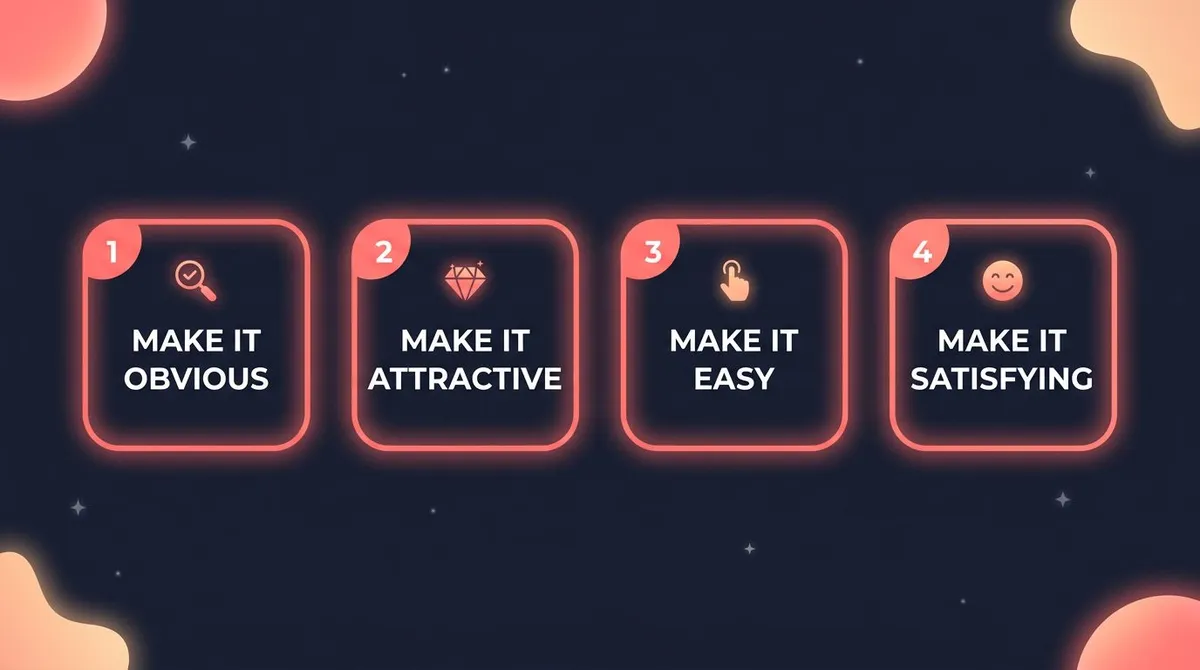
Every habit runs on four stages: cue, craving, response, reward. Clear turned each stage into an instruction. To build a good habit, follow the middle column. To break a bad one, invert it with the right column.
| Law | To build a good habit | To break a bad habit |
|---|---|---|
| 1st Law (Cue) | Make it Obvious | Make it Invisible |
| 2nd Law (Craving) | Make it Attractive | Make it Unattractive |
| 3rd Law (Response) | Make it Easy | Make it Difficult |
| 4th Law (Reward) | Make it Satisfying | Make it Unsatisfying |
That is the whole framework from Atomic Habits by James Clear (2018). The tactics under each law are where it gets usable.
1st Law — Make it Obvious
- Implementation intentions: write "I will [behavior] at [time] in [location]."
- Habit stacking: anchor the new habit to one you already do.
- Environment design: put the cue in plain sight (running shoes by the door, book on the pillow).
2nd Law — Make it Attractive
- Temptation bundling: pair something you want to do with something you need to do.
- Join a culture where your desired behavior is the normal thing.
- Reframe your mindset: swap "I have to" for "I get to."
3rd Law — Make it Easy
- The 2-minute rule: scale the habit down until it takes two minutes to start.
- Reduce friction: cut the steps between you and the good habit.
- Prime the environment: set things up in advance so the next action is ready.
4th Law — Make it Satisfying
- Immediate reward: give yourself a small payoff the moment you finish.
- Habit tracking: mark it done so progress is visible.
- Never miss twice: Clear’s reminder to return after a lapse; a useful heuristic, not a scientific rule that a second miss creates a new habit.
The habit scorecard
Before you change anything, see what you already do. Clear calls this the habit scorecard, and it takes five minutes.
- List your typical daily habits, from waking up to going to sleep.
- Read each one back and ask: is this moving me toward the person I want to be?
- Mark each habit:
- + for a good habit
- = for a neutral habit
- − for a bad habit
The point is not to fix anything yet. It is awareness. You cannot make a cue obvious or invisible until you can name it.
Two fill-in templates
Copy these two lines and fill in the brackets. They cover the 1st and 3rd laws, which is where most habits succeed or fail.
Implementation intention:
I will [BEHAVIOR] at [TIME] in [LOCATION].
Example: I will meditate for two minutes at 7:00 a.m. in the kitchen.
Habit stacking:
After [CURRENT HABIT], I will [NEW HABIT].
Example: After I pour my morning coffee, I will write one sentence.
For more anchor examples, see our habit stacking guide, or build a stack in the habit stacking builder.
How to use this cheat sheet
Do not try all four laws on ten habits at once. Pick one habit, run it through the checklist, and adjust the weakest stage.
- Struggling to start? That is usually the 1st or 3rd law — make the cue obvious and the first step easy.
- Starting but not sticking? That is usually the 4th law — add an immediate reward and track it.
- Trying to quit something? Work the right column: make it invisible, unattractive, difficult, and unsatisfying.
Habit tracking is the tactic people skip most, and it is the one that makes the 4th law work. A dedicated tracker like HabitBox gives you the visible streak that turns "I did it" into a reward you do not want to break.
Keep going deeper with these:
- Atomic Habits summary — the full one-page book summary, 1% math, and identity layers.
- The 4 laws of behavior change — each law explained in depth, with the inverse laws.
- Implementation intentions — how to write cues that actually fire.
- Habit stacking — anchoring new habits to existing routines.
- Two-minute rule timer — start any habit in two minutes.
FAQ
What are the 4 laws of atomic habits?
Is there a printable atomic habits cheat sheet?
What is the 2-minute rule?
How is a cheat sheet different from the Atomic Habits summary?
Who wrote Atomic Habits?

Mira Hartwell
Editor, HabitBoxEditor at HabitBox. Writes about habit science and productivity, grounding every post in named research (Lally, Wood, Walker, Huberman) instead of recycled advice. Read full bio →