How to Enter a Flow State: 7 Triggers You Can Control
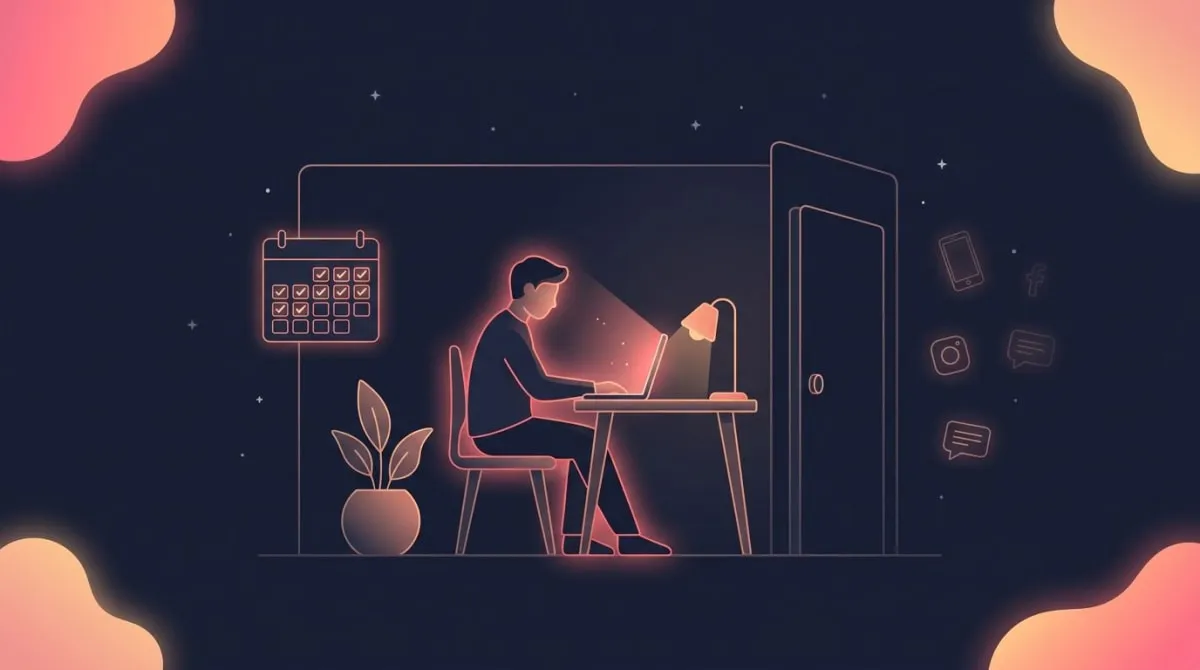
To enter a flow state, match a clear, slightly challenging task to your current skill level, strip out every distraction, and run the same short pre-focus ritual every time you sit down. Flow is triggered by 7 specific conditions you can engineer, not by luck or mood. Settling in can take 10 to 15 minutes of uninterrupted focus, which is why the single biggest lever is protecting a 90-minute block from interruption.
You have felt it before. The hours that vanish while you write, code, paint, or train, where the work seems to do itself and you forget to check your phone. Psychologist Mihaly Csikszentmihalyi popularized the name "flow" for it in his 1990 book Flow: The Psychology of Optimal Experience, drawing on interviews with surgeons, climbers, chess players, and artists who all described the same total absorption.
The good news is that flow is not a personality trait. It is a set of conditions. When you reliably create those conditions, you can get into flow far more often, and you can turn the whole thing into a daily habit.
What a flow state actually is
Flow is a state of complete absorption in a task, where your sense of time distorts, your inner critic goes quiet, and your full attention locks onto what you are doing. Csikszentmihalyi described it as the "optimal experience," the moments people report as the most satisfying of their lives.
A few hallmarks show up again and again. Time speeds up or disappears. Self-consciousness fades. Action and awareness merge, so you stop thinking about doing the task and simply do it.
This matters for two reasons. Output quality jumps, because all of your cognitive resources point at one thing. And the work feels good, which makes you want to come back, the loop that turns a hard practice into a sustainable habit.
Flow is not reserved for elite athletes or famous artists, either. The original research found it in surgeons mid-operation, in factory workers who had turned a dull line job into a personal game of speed and precision, and in readers lost in a book. The common thread was never the activity. It was the conditions: a clear task, fast feedback, and a difficulty that matched the person's skill.
That is the reframe worth holding onto. Flow is not something that happens to lucky people on good days. It is the predictable output of a setup you can build on purpose, which means the question shifts from "how do I feel inspired?" to "how do I arrange my next 90 minutes?"
The challenge-skill balance: the one condition that matters most
If you remember nothing else, remember this. Flow lives in the narrow band where the difficulty of a task slightly exceeds your current skill.
Csikszentmihalyi mapped this as a channel between two failure states. When a task is too hard for your skill, you feel anxiety and stress, and you bail. When it is too easy, you feel boredom, and your mind wanders to your phone. Flow sits in the middle, where the task stretches you slightly beyond comfortable.
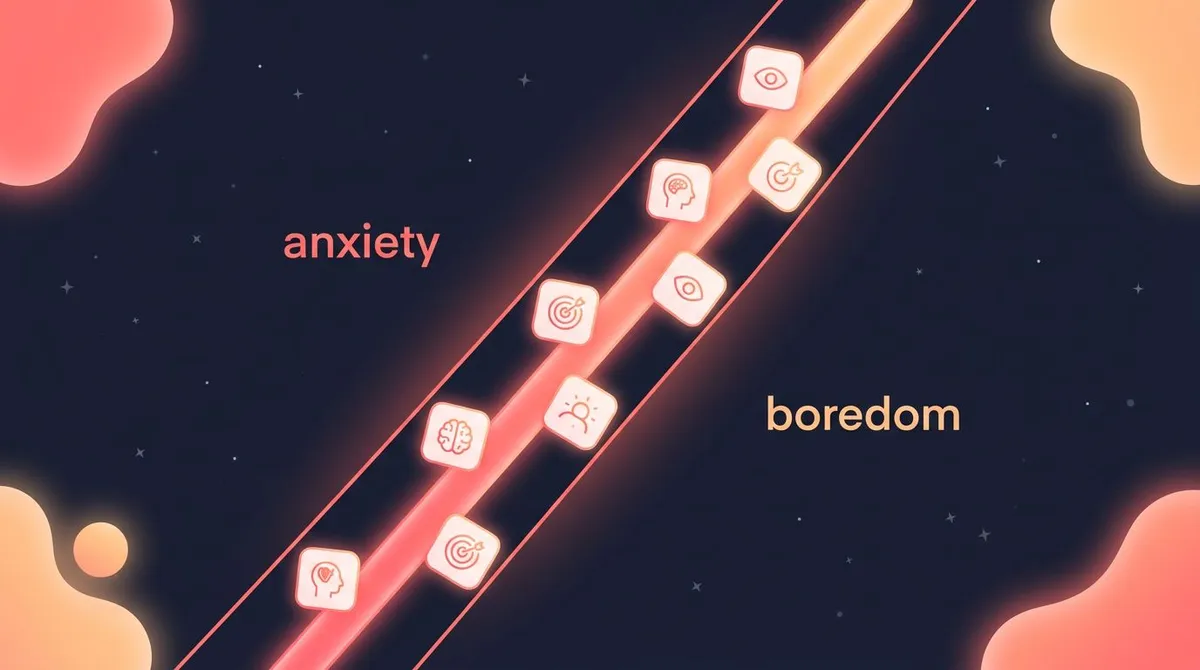
The practical move is to tune the task, not your willpower. If you feel anxious, shrink the scope or break the work into a smaller piece you know how to start. If you feel bored, add a constraint: a tighter deadline, a higher standard, or a harder variant of the same task.
This is why the same activity puts you in flow some days and not others. Your skill grows, so yesterday's stretch becomes today's boredom. Flow asks you to keep nudging the difficulty up as you improve.
A quick self-check works in the moment. If you notice your jaw tightening and your thoughts racing toward "I can't do this," you have drifted into the anxiety zone, and the fix is to make the next step smaller and more concrete. If you notice yourself reaching for your phone or rereading the same line, you have slipped into boredom, and the fix is to raise the bar. Most people default to one of these two patterns, so it helps to know which way you tend to drift.
7 flow triggers you can control
Researcher Steven Kotler, who studies peak performance in his book The Rise of Superman, catalogs more than a dozen flow triggers. The seven below are the ones you can switch on at a desk, today, without changing your job or your environment.
| Trigger | Why it works | How to do it today |
|---|---|---|
| Clear goals | Removes the friction of deciding what to do next, so attention stays on the task | Write one specific outcome for the block: "draft section 3," not "work on report" |
| Immediate feedback | Tells your brain whether you are on track, keeping you engaged moment to moment | Pick work that shows progress fast: word count, tests passing, problems solved |
| Challenge-skill balance | Sits you in the stretch zone between boredom and anxiety | Tune difficulty up or down until the task feels slightly hard but doable |
| Eliminating distraction | Protects the settling-in period, often 10 to 15 minutes, from being reset | Phone in another room, notifications off, one tab or one document open |
| A pre-focus ritual | Cues your brain that focus time has started, the way a warm-up cues a workout | Same trigger every time: a drink, a song, a 60-second breathing reset |
| Single-tasking | Stops the attention-residue cost of switching, which fragments deep focus | Close every app unrelated to the one task; do not "quickly check" anything |
| Adequate rest | A tired brain cannot sustain the concentration flow demands | Protect sleep and take a real break after each 90-minute block |
Notice that none of these require talent or a special mood. They are levers. The skill of getting into flow is mostly the skill of pulling these levers in the same order, every day, until it runs on autopilot.
Clear goals and immediate feedback
These two work as a pair. A clear goal gives your attention a target; immediate feedback keeps it locked on. Vague tasks ("be productive," "study") leave your brain re-deciding what to do every few minutes, and every re-decision is a doorway for distraction.
Before a block, write the single concrete outcome you want. Then choose work where you can see progress quickly. If feedback is naturally slow, build your own: a checklist you tick, a timer, a running word count.
The clearer the goal, the less your brain has to spend on navigation. Compare "work on the presentation" with "build slides 4 through 8 with one chart each." The first leaves you re-deciding every few minutes; the second points your attention at a finish line. Each re-decision is a small opening for a distraction to slip through, so removing them is one of the cheapest flow upgrades available.
Eliminating distraction and single-tasking
Cal Newport, in Deep Work, argues that the ability to focus without distraction is becoming both rare and valuable. The enemy is not just the interruption itself but the recovery time. A single notification can cost far more than the seconds it takes to glance at it, because your brain leaves "attention residue" on the thing you switched away from.
So the rule is blunt: one task, zero open doors. Phone out of reach, browser down to what you need, and a firm no to "I'll just check this one thing." If you want a structured way to protect these blocks, our guide on how to focus better ranks nine distraction-control techniques by effect size.
A consistent pre-focus ritual and adequate rest
A ritual is a cue. Athletes have warm-ups; you need an on-ramp that tells your brain "deep work starts now." It can be tiny: pour the same drink, play the same instrumental track, do 60 seconds of slow breathing, then open the one document. Repeated daily, the ritual itself starts to trigger the focused state before you have done any work at all.
Rest is the unglamorous trigger people skip. Flow is metabolically expensive, and a sleep-deprived brain cannot hold the concentration it requires. Protect your sleep, and end each focus block with a genuine break rather than rolling straight into the next thing.
There is also a timing dimension to rest. Almost everyone has a window of the day when focus comes easiest, often the first few hours after waking, sometimes late at night. Scheduling your hardest, most flow-worthy work inside that peak window stacks the deck in your favor, while saving shallow tasks like email for the trough hours. Fighting your own rhythm is a quiet flow blocker that no amount of willpower fully overcomes.
Build a repeatable flow ritual
Triggers work best stacked into a fixed sequence you run the same way every day. Here is a simple, repeatable structure.
- Same cue. Same time, same place, same first action. Consistency is what makes the ritual automatic, so pick a slot you can actually defend most days.
- Set one clear goal. Write the single outcome for this block on paper or at the top of your file.
- Clear the field. Phone away, notifications off, one task open. Do this before you start, not after the first interruption.
- Run a 90-minute block. Work in one uninterrupted stretch. Settling in can take 10 to 15 minutes, so very short sessions leave little room for deep flow.
- Take a real break. Step away, move, look at something far away. Then repeat or stop for the day.
The 90-minutes-then-break rhythm is loosely based on the idea that alertness rises and falls in roughly 90-minute ultradian cycles. If 90 feels long at first, start with a 50-minute block and grow it. A simple Pomodoro timer can fence off the block and keep you honest about the break.
When you finish for the day, a brief shutdown ritual closes open loops so unfinished tasks stop pulling at your attention after hours, which protects the rest that tomorrow's flow depends on.
Common flow blockers and how to fix them
Most failures to reach flow trace back to three culprits. Each has a direct fix.
| Blocker | What it looks like | The fix |
|---|---|---|
| Notifications and switching | You drop in, then a ping or a "quick check" resets you to zero | Phone in another room, Do Not Disturb on, one task open before you start |
| Vague tasks | You sit down unsure what "done" means and drift | Write one concrete outcome per block; break large tasks into a clear next action |
| Fatigue and poor sleep | You cannot hold focus; your mind keeps sliding off | Protect sleep, schedule deep work at your peak hours, break after each block |
There is a fourth, quieter blocker: trying too hard. Flow is something you set up conditions for and then allow, not something you force by clenching. If it does not come in the first few minutes, keep working on the task anyway. The state usually arrives once you are absorbed in the doing, not before.
A related trap is treating flow as the goal instead of the work. The moment you start monitoring "am I in flow yet?" you have pulled attention off the task and onto yourself, which is exactly what flow dissolves. The fix is to forget the state entirely once you start. Set up the conditions, begin the work, and let the absorption sneak up on you. Judge a session by whether you protected the block and made progress, not by how transcendent it felt.
Make flow a trackable daily habit
Here is the move competitors miss. A single great flow session is nice. The real payoff comes when entering flow becomes a habit your brain expects, the same way a regular bedtime makes sleep come faster.
Habits form through repetition of the same cue-routine-reward loop. Your pre-focus ritual is the cue. The 90-minute block is the routine. The satisfying, absorbed work is the reward. Repeat that loop daily and the ritual starts pulling you into flow with less and less effort.
The simplest way to lock it in is to treat your daily deep-focus block as a habit you check off, the same as exercise or meditation. Tracking one daily flow block in an app like HabitBox turns an abstract intention into a streak you can see, and the visual progress makes the ritual easier to keep on the days motivation dips. If discipline is the part you struggle with, our guide on how to be more disciplined covers the daily systems that make showing up automatic.
Start with one defended block a day, four days a week. Once that is automatic, add a second block or a fifth day. You are not chasing a perfect flow session; you are building the conditions that make flow likely, then repeating them until they run themselves.
Expect the first two weeks to feel clunky. The ritual will not pull you in automatically yet, distractions will win some days, and a few blocks will end with little to show. That is normal, and it is not evidence the method is failing. Habit research consistently shows that consistency, not intensity, is what turns a deliberate routine into an automatic one, so a string of imperfect-but-completed blocks beats a single heroic session followed by a week of nothing.
Track the block, not the outcome. Whether a session reached deep flow or just steady focus, you check it off for showing up. That distinction matters, because flow itself is partly out of your control on any given day, while the conditions that invite it are fully in your hands. Reward the part you control, and the state you want shows up more and more often as a side effect.
How to enter a flow state FAQ
How do I get into a flow state?
What is the challenge-skill balance?
How long does it take to enter flow?
Can you train flow state?
What blocks flow state?
If you want flow to become a reliable part of your day rather than a happy accident, the trick is consistency: same cue, same block, every day. HabitBox lets you track your daily deep-focus block as a habit and watch the streak build, so the ritual gets easier to keep until it runs on its own.

Mira Hartwell
Editor, HabitBoxEditor at HabitBox. Writes about habit science and productivity, grounding every post in named research (Lally, Wood, Walker, Huberman) instead of recycled advice. Read full bio →