Monk Mode: 30-Day Focus Sprint Guide (2026)
Monk mode is a fixed-length focus sprint — usually 30 days — where you cut your biggest distractions and pour the reclaimed time into one goal. Most people run a 30-day version with 3 to 4 hours of deep work a day, a short list of rules, and a daily check to stay honest. This guide gives you the rules, a week-by-week plan, a daily template, and a way to track it that doesn't end in burnout.
The term gets thrown around a lot, and half of what you'll find online is either a philosophical essay or a recruitment pitch for a particular lifestyle. This is neither. It's a concrete, trackable protocol you can start Monday and finish in a month — built to be sustainable, not punishing.
TL;DR — what monk mode is in one paragraph
Monk mode is a self-imposed sprint of focused effort. You pick one goal, you cut the inputs that pull you away from it, and you protect a few hours of deep work every day for a fixed window — most commonly 30 days. The point is not to live like a monk forever. It's to stop negotiating with distractions all day long, make a visible leap on something that matters, and walk away with a couple of habits that survive the sprint.
What monk mode actually is (and what it isn't)
The core idea is simple: for a set period, you radically simplify your inputs so that almost all your discretionary energy flows toward a single outcome.
That outcome could be shipping a side project, writing a thesis, getting fit, learning a language, or building a business. The goal is yours. The structure is the same: cut, add, protect, repeat — for 30 days.
What it is:
- A time-boxed sprint, not a permanent lifestyle.
- A focus protocol — you decide the rules in advance so you're not deciding in the moment.
- A way to compress weeks of scattered progress into a month of concentrated progress.
What it isn't:
- It isn't a personality overhaul or a vow of silence.
- It isn't a cure for addiction, anxiety, or burnout. If you're struggling with those, a 30-day grind is the wrong tool.
- It isn't the "grindset" caricature where you sleep four hours and white-knuckle your way through. That version fails fast and teaches you nothing.
A quick note on framing. A lot of the loudest monk mode content online leans into a particular self-improvement subculture aimed at young men, sometimes with extreme or isolating advice. You don't need any of that. The useful, evidence-aware version of monk mode is just a structured deep-work sprint with guardrails. That's what this guide describes.
The intellectual backbone here comes from Cal Newport's Deep Work (2016), which argues that the ability to focus without distraction on a cognitively demanding task is both rare and increasingly valuable. Monk mode is essentially a way to manufacture deep work conditions on purpose, for a bounded stretch of time.
The reason this works better than just "trying harder" is mechanical, not motivational. Every time you decide whether to check your phone, open a new tab, or say yes to a meeting, you spend a small amount of willpower. Across a day, those micro-decisions add up to real depletion — and they're invisible, so you blame yourself for being lazy when really you've just been nickel-and-dimed out of your focus. Monk mode removes the decisions. The rule is the rule. You don't debate whether to open Instagram at 2pm because Instagram isn't installed. That's the whole trick: you front-load the hard choices into a one-time setup, so the daily version is easy.
Why a fixed window matters
The "fixed" part is doing as much work as the "focus" part. An open-ended commitment to focus more is the kind of vague goal that quietly evaporates. A 30-day sprint has a start, an end, and a finish line you can see — which makes it far easier to push through the rough patches. You're not signing up to live like this forever; you're signing up for a month. That bounded commitment is psychologically much lighter, and paradoxically, that's exactly why people stick with it.
There's also a practical benefit: a fixed window forces you to scope your goal. "Get fit" is not a 30-day goal. "Run a 5K without stopping" or "do 30 workouts in 30 days" is. The deadline does the work of turning a wish into a project.
First, choose your one goal
Before you write a single rule, pick the one outcome the sprint exists to serve. This is the step people skip, and skipping it is why so many monk mode attempts end up as 30 days of feeling disciplined while accomplishing nothing in particular.
The constraint is the word "one." Not three goals, not a balanced portfolio of self-improvement — one. The entire power of monk mode comes from concentration, and concentration is impossible if you're splitting four hours of daily deep work across a startup, a fitness transformation, a new language, and your reading list. Pick the goal that, if you made a real leap on it this month, would matter most three months from now.
Then make it concrete and finishable. A good monk mode goal passes three tests:
- It's specific. "Write more" fails. "Finish the first draft of my book — 30,000 words" passes.
- It's measurable. You can tell at any moment whether you're ahead or behind.
- It fits in 30 days. Ambitious is fine; impossible just sets up failure. If the real goal takes six months, define the 30-day slice of it.
If you've never set goals this way, our walkthrough on how to set goals covers the difference between outcome goals and process goals — and why monk mode runs on the process ones (the daily inputs you control) while pointing at an outcome.
Write the goal at the top of the page where you'll list your rules. Every rule below it should earn its place by serving that goal. If a rule doesn't protect or advance the one outcome, cut it. Simplicity is the point.
The rules: what to cut and what to add
Monk mode lives or dies on its rules. The trick is to make them specific enough to follow and few enough to remember. Five to seven rules is plenty.
Split them into two columns: things you remove, and things you install.
What to cut
- Social media — the single biggest lever for most people. Log out, delete the apps, or use a blocker. If you need one platform for work, set a hard daily cap.
- News and doomscrolling — once or twice a day at most, on a timer.
- Low-value meetings — decline or shorten anything that isn't directly tied to your goal.
- Alcohol — it wrecks sleep quality, which wrecks focus the next day.
- Notifications — turn off everything non-essential. Your phone should be quiet by default.
You don't have to cut all of these. Pick the three that steal the most of your attention right now and start there.
What to add
- Deep work blocks — 2 to 4 hours a day, in 60 to 90 minute chunks, aimed at your one goal.
- Sleep — 7 to 9 hours, protected. This is non-negotiable; everything else degrades without it.
- Exercise — 20 to 40 minutes most days. Movement is a focus multiplier, not a luxury.
- A shutdown ritual — a fixed end-of-day routine that closes the workday so your brain can recover.
Here's the key insight from behavior science: the rules that survive are the ones that are easy to start. BJ Fogg's Tiny Habits (2019) showed that making a behavior small and obvious dramatically raises the odds you'll actually do it. So "meditate for two minutes" beats "meditate for an hour," and "10 push-ups after I close my laptop" beats "go to the gym." Start tiny, then let the sprint build the volume.
Make the cuts physical, not willpower-based
There's a difference between a rule you have to resist and a rule you can't break. "I won't check social media" relies on willpower every time the urge hits — and the urge hits dozens of times a day. "I deleted the apps and logged out on my laptop" removes the option entirely. Wendy Wood's research on habits (Good Habits, Bad Habits, 2019) makes this point repeatedly: the most reliable way to change behavior isn't to fight your impulses but to redesign the environment so the impulse never gets a target.
So wherever you can, make the cut structural:
- Delete the apps, don't just promise not to open them.
- Put the phone in another room during deep work, don't just flip it face-down.
- Use a website blocker with a schedule, so the friction is automatic.
- Tell the people around you that you're doing a focus sprint, so the social pressure works for you instead of against you.
The cuts that hold are the ones you only have to make once.
Don't over-restrict
A common beginner mistake is treating monk mode as a contest in deprivation — cut everything, eliminate all pleasure, prove how hardcore you are. This backfires within a week. The brain treats extreme, sudden restriction as a threat and starts looking for the exit. You'll either quit entirely or rebound hard the moment the sprint ends.
Cut what genuinely steals attention from your goal. Keep the things that keep you human and stable: good food, a workout you enjoy, time with people you love, a hobby that recharges you. Monk mode is subtraction in service of one addition — not subtraction for its own sake.
If you want to go deeper on the inputs that move focus the most, our guide on how to focus better ranks nine techniques by effect size — sleep, single-tasking, and phone-away rules all near the top.
The 30-day monk mode structure, week by week
A 30-day sprint works best when you don't treat all four weeks the same. The first week is about detox, the middle weeks are about output, and the last week is about landing softly so you keep the gains.
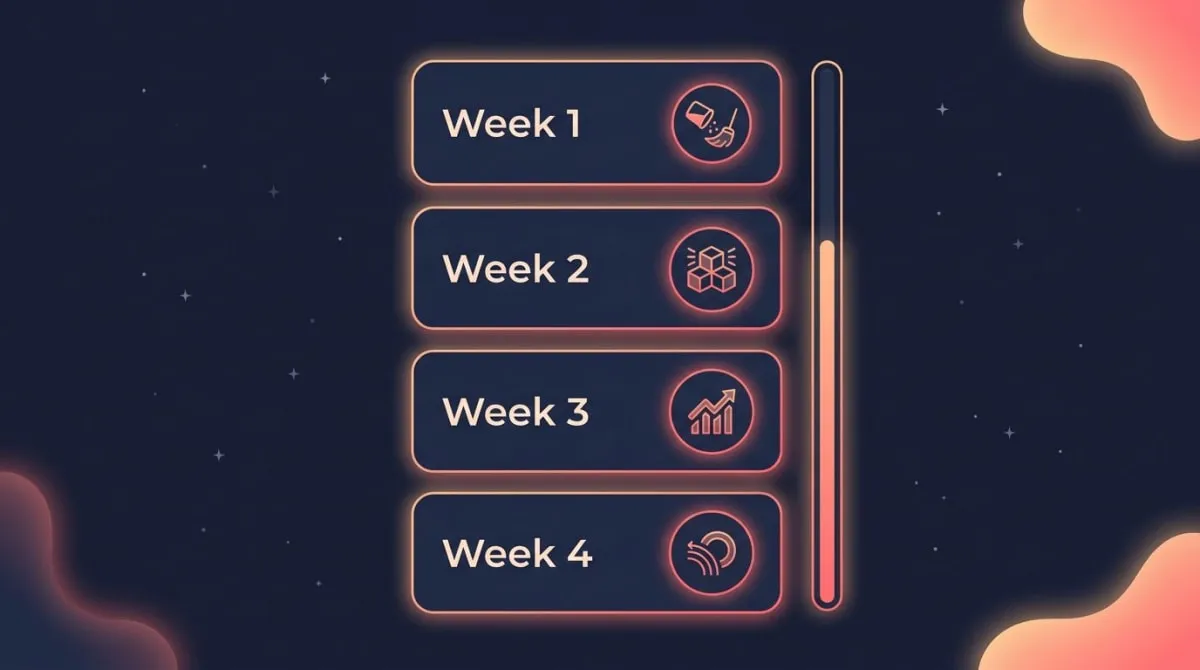
Use this table as your scaffold. Adjust the focus and metrics to your specific goal.
| Week | Focus | What to cut | What to add | Success metric |
|---|---|---|---|---|
| Week 1 | Detox & setup | Social media, news, notifications | Phone-away deep work, fixed wake time | 5/7 days you hit your deep work block at all |
| Week 2 | Build the rhythm | Late-night screens, alcohol | A second deep work block, daily exercise | 3 hrs deep work on 5+ days |
| Week 3 | Peak output | Remaining low-value commitments | Shutdown ritual, weekly review | Your one goal is visibly past its midpoint |
| Week 4 | Land & re-enter | Nothing new — start adding inputs back slowly | Reflection, a "keep" list of habits to retain | Goal shipped or 80%+ done; you know which 2–3 habits stay |
Here's how each week tends to actually feel, so you're not surprised.
Week 1 is the detox, and it's the hardest. Cutting your biggest inputs creates a strange restlessness — you'll reach for your phone that isn't there, feel bored in a way you're not used to, and probably doubt the whole thing around day 3. This is normal. You're not failing; you're detoxing from a steady drip of novelty. Keep the bar low: just show up to your deep work block, even badly.
Week 2 is where the rhythm clicks. The cravings fade, the boredom turns into spaciousness, and your deep work starts to feel less like dragging and more like flow. This is the week to add your second deep work block and lock in daily movement. Most people report their first "this is actually working" moment somewhere in week 2.
Week 3 is peak output. You're adapted, the rules are automatic, and your goal should cross its midpoint. This is the week to push — but it's also the week to install the shutdown ritual hard, because peak output without a hard stop is the express route to burning out in week 4.
Week 4 is the landing. Don't add anything new. Start reintroducing a few inputs deliberately, reflect on what worked, and build your "keep" list. The goal here is to finish strong and decide which habits survive the sprint — not to white-knuckle a few extra percent of output.
Notice that week 1's success metric is deliberately low — just showing up. That's on purpose. The first few days of any input change feel worse before they feel better, partly because you're fighting the pull of habits that took months to wire in. Lowering the bar early keeps you from quitting during the hardest stretch.
One honest expectation to set: a 30-day sprint will not fully automate your new habits. The often-cited University College London study by Phillippa Lally and colleagues (2009) found it took a median of 66 days for a behavior to become automatic, with a wide range across people. Thirty days is enough to make real progress on a goal and to get a habit rolling — it's not enough to make that habit run on autopilot forever. Treat the sprint as a launch, not a finish line.
Your monk mode daily template
The schedule matters less than the blocks. You want a protected morning, a clear shutdown, and your deep work front-loaded before the day's friction piles up.
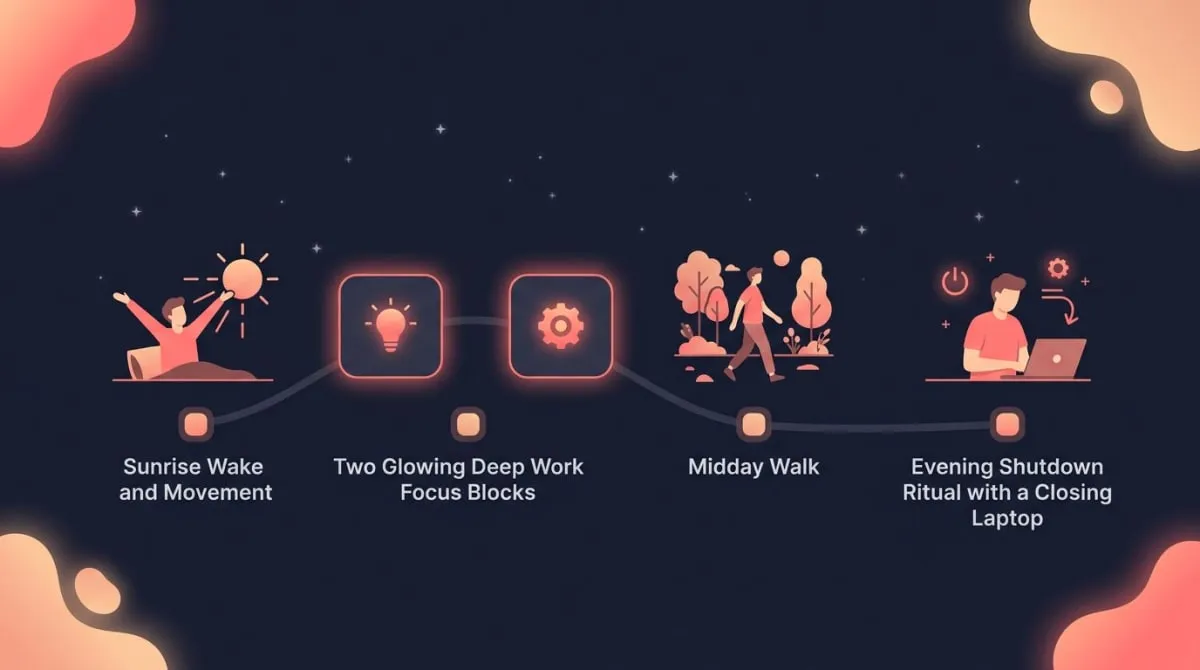
Here's a template you can adapt. Times are illustrative — shift them to your life.
- Wake at a fixed time — same time every day, including weekends. A stable wake time anchors everything downstream.
- Move first — 20 to 30 minutes of exercise or a walk before you touch a screen. This wakes up your brain and protects you from opening your phone first thing.
- Deep work block 1 — 90 minutes on your one goal, phone in another room. This is the most valuable slot of your day; spend it on the hardest, most important task.
- Break and refuel — a real meal, a walk, no screens if you can manage it.
- Deep work block 2 — another 60 to 90 minutes. Pair it with a focus timer if your attention drifts; a simple Pomodoro rhythm keeps you in the chair.
- Admin window — batch email, messages, and shallow tasks into one short window instead of letting them leak across the day.
- Shutdown ritual — a fixed routine that closes the workday: review what you finished, write tomorrow's first task, then say a literal stop phrase and step away.
That last step does more than it looks. A consistent shutdown ritual gives your mind permission to stop chewing on work, which is what actually lets it recover overnight. Without one, monk mode quietly turns into "thinking about work 16 hours a day," and that's the fast lane to burnout.
If your problem is less about adding focus and more about plugging leaks, our breakdown of how to stop wasting time covers the specific traps — the open tab, the "quick check," the meeting that should've been an email — that monk mode is designed to seal off.
How to track monk mode (so you actually finish)
Here's where most monk mode attempts fall apart: people rely on motivation and vibes. By day nine, the novelty's gone, nobody's watching, and the rules quietly dissolve.
The fix is to turn each rule into a daily checkbox. Not a vague intention — a yes/no you tick off every night.
Make each rule binary and trackable:
- "No social media before 6pm" → check.
- "90+ minutes of deep work" → check.
- "In bed by 11" → check.
- "Moved my body" → check.
When you log these every day, two things happen. First, you get an honest adherence rate instead of a fuzzy memory — and you'll usually find you're doing better, or worse, than you thought. Second, you build a streak, and streaks tap into loss aversion: once you've ticked a rule nine days running, you really don't want to break the chain.
This is exactly the kind of thing a habit tracker handles well. In a tracker like HabitBox, you'd set up each monk mode rule as its own daily habit, then watch the calendar heatmap fill in. A green grid is instant proof you're holding the line; a gap is an early warning, not a verdict. Seeing adherence as a picture is far more motivating than trying to hold it all in your head.
A practical setup: create 4 to 6 habits matching your rules, check them off each evening as part of your shutdown ritual, and glance at the heatmap every Sunday during your weekly review. That review is where you decide if next week's rules need tightening or loosening.
If discipline itself is the thing you're trying to build — not just this one sprint — our guide on how to be more disciplined covers the environment-design tricks that make consistency run without constant willpower, which pairs naturally with a monk mode setup.
Who monk mode is for — and who should skip it
Monk mode is a tool, and tools fit some jobs and not others.
It's a good fit if you have a clear, finite goal that's been stalling because your attention is scattered. Launching something, finishing a degree milestone, getting into shape, learning a skill with a deadline — these reward concentrated effort, and monk mode concentrates effort. It also fits people who already know what to do but keep getting pulled away from doing it. If your problem is execution, not knowledge, the sprint is for you.
It's a poor fit if your real issue is something a focus protocol can't touch. If you're burned out, anxious, or depressed, a 30-day grind will make it worse, not better — rest and support come first. If you don't actually know what your goal should be, a sprint will just amplify the confusion; figure out the direction first. And if your life genuinely can't accommodate three protected hours a day right now — newborn at home, two jobs, a crisis — that's not a personal failing, it's just bad timing. Monk mode will still be there when the season changes.
The honest version of this advice is the part the loud online content usually leaves out: discipline is a means, not a personality. Building it can help, but if you're constantly white-knuckling your way through, something upstream is wrong. Our piece on how to be more disciplined makes the case that sustainable discipline comes from design — good defaults and a friendly environment — far more than from grit.
Common monk mode mistakes
Most failed sprints fail for predictable reasons. Watch for these.
Going too long, too soon. A first-timer who commits to 90 days usually quits around day 18. Start with 30, or even a one-week trial run, and earn the longer sprints.
Vague rules. "Focus more" isn't a rule; it's a wish. Every rule needs to be a yes/no you can check at the end of the day. If you can't tell whether you followed it, rewrite it.
No tracking. Relying on memory means you'll quietly drift and tell yourself you're "basically doing it." A visible log is the difference between a real sprint and a vibe.
Cutting sleep for output. The single most common and most self-defeating error. More hours of tired, low-quality work is a worse trade than fewer hours of sharp work plus a full night's sleep.
Total isolation. Cutting every social input — not just the draining ones — is where monk mode stops being healthy. Keep your real relationships.
No re-entry plan. Sprinting hard for 30 days and then slamming every distraction back on at midnight on day 30 is how people lose everything they built. Plan the landing before you take off.
Treating it as a one-time fix. A single sprint rarely rewires your life permanently. The people who get the most out of monk mode treat it as a repeatable tool — run one, keep what works, run another next quarter.
Avoiding burnout and planning your re-entry
Monk mode done wrong is just a 30-day burnout speedrun. Three guardrails keep it sustainable.
Protect sleep above everything. If you're cutting sleep to fit in more deep work, you've inverted the whole thing. Tired focus is fake focus. The American Psychological Association has long documented how sleep deprivation degrades attention, working memory, and mood — the exact faculties monk mode depends on.
Keep one human connection. Total isolation is where monk mode tips from healthy into harmful. You can cut social media and idle small talk while still seeing a friend, a partner, or family. Cut the inputs that drain you, not the people who sustain you.
Build in rest, not just grind. A deep work block followed by a real break beats grinding for six straight hours, which mostly produces low-quality work and resentment. Newport's own argument is that deep work is finite — most people max out around 3 to 4 hours of true deep work a day. Trying to force more doesn't get you more; it just burns the tank.
Then there's re-entry, the part almost every guide skips. When day 30 ends, don't slam every distraction back on at once. That's how people lose everything they built. Instead:
- Make a "keep" list. Which 2 to 3 habits clearly helped? Those stay.
- Reintroduce inputs one at a time. Add social media back, see how it feels for a few days, then decide whether it earns a permanent spot — and on what terms.
- Schedule your next sprint. Many people run monk mode quarterly: a focused month, then a lighter stretch, then another sprint. The off-weeks are where the kept habits prove they can survive without the scaffolding.
The goal of the sprint was never to live in monk mode forever. It was to make a leap, learn what actually moves you, and keep the handful of habits worth keeping. If you finish with a shipped goal and two habits that stuck, the month did its job.
Cal Newport, whose Deep Work framework underpins this whole approach, has weighed in directly on whether monk mode works and where it helps versus where it's oversold — worth a watch before you start your own sprint.
Monk mode FAQ
What is monk mode?
Monk mode is a self-imposed focus sprint where you cut your biggest distractions for a fixed period — usually 30 days — and channel the reclaimed time and energy into one specific goal. You set a short list of rules in advance (what to cut, what to add), protect a few hours of deep work daily, and track your adherence so you actually finish. It's a temporary protocol, not a permanent lifestyle.
How long should monk mode last?
Thirty days is the most common and most practical length. It's long enough to make a real dent in a goal and get a habit rolling, but short enough that you can see the finish line and stay motivated. If a month feels like too much, start with a week. Some people run longer 60 or 90-day versions (the 90-day Winter Arc is a popular example), but be aware that a 30-day sprint won't fully automate new habits — UCL research found that takes a median of about 66 days.
Does monk mode work?
It works for the specific job it's designed for: making concentrated progress on one goal by removing the friction of constantly deciding whether to give in to distractions. It works less because you suddenly become superhuman and more because you've pre-decided your rules, so willpower isn't being spent all day. It does not work as a fix for addiction, anxiety, or existing burnout — those need different tools. Healthy monk mode protects sleep, keeps at least one human connection, and plans a soft re-entry.
What does a monk mode daily schedule look like?
A typical monk mode day has a fixed wake time, exercise or a walk before screens, a 90-minute deep work block first thing, a real break, a second 60 to 90-minute deep work block, a short batched admin window, and a shutdown ritual to close the day. Total deep work usually lands around 3 to 4 hours, which is about the realistic ceiling for high-quality focused work. Everything else — meals, errands, rest — fills in around those protected blocks.
How do you track monk mode?
Turn each rule into a daily yes/no checkbox and log it every evening, ideally as part of your shutdown ritual. Set up 4 to 6 habits matching your rules ("no social media before 6pm," "90+ minutes deep work," "in bed by 11," "moved my body") in a habit tracker, then watch the calendar heatmap fill in. The streak and the visible green grid tap into loss aversion and give you an honest adherence rate, which is far more reliable than relying on memory or motivation. Review the heatmap weekly and adjust next week's rules.
Ready to run your own sprint? Set up your monk mode rules as daily habits in HabitBox, check them off during your evening shutdown, and let the heatmap show you exactly how well you're holding the line across all 30 days.

Mira Hartwell
Editor, HabitBoxEditor at HabitBox. Writes about habit science and productivity, grounding every post in named research (Lally, Wood, Walker, Huberman) instead of recycled advice. Read full bio →