What Is Sleep Debt? How to Calculate & Repay It (2026)
TL;DR. Sleep debt is the cumulative difference between the sleep you need — about 7 to 9 hours a night for adults, per the NIH — and the sleep you actually get. Miss 90 minutes a night for five nights and you carry a 7.5-hour deficit into the weekend. You can repay some of it with earlier bedtimes and a short weekend recovery, but research is clear that you can't fully "bank" catch-up sleep, and the fastest fix is preventing the debt in the first place.
You already know the feeling. You told yourself you'd get eight hours, then a deadline, a late episode, or a restless toddler shaved an hour off five nights running. By Friday you're foggy, irritable, and reaching for a third coffee. That running tab of missed sleep has a name, and understanding it is the first step to paying it down.
What sleep debt is
Sleep debt (also called sleep deficit) is the accumulated gap between the amount of sleep your body needs and the amount you actually get. It works like a financial account. Every night you sleep less than your need, you add to the balance. The debt doesn't reset at midnight — it carries forward and compounds.
The key word is cumulative. One short night is a minor withdrawal. But most sleep loss is chronic and quiet: a consistent 30 to 90 minutes short, night after night, that never gets an alarm bell but slowly drains your reserves. The CDC's occupational sleep training materials describe this exact pattern — small nightly deficits that stack into a large debt over a work week.
Here's the honest part. Because the shortfall is gradual, your sense of how tired you are stops tracking reality. A 2022 review in Sleep Advances (PMC10108639) notes that subjective sleepiness ratings largely stabilize after two to three days of restriction even while cognitive performance keeps declining. In other words, you feel "used to it" long before your brain has actually adapted.
Sleep debt vs. sleep deprivation
People use these terms interchangeably, but the distinction is useful. Sleep deprivation usually refers to an acute event — one all-nighter, one brutal red-eye flight, one night with a newborn. Sleep debt is the chronic, running balance that accumulates from repeated smaller shortfalls. Acute deprivation is dramatic and obvious; chronic debt is the quieter, more common problem, and it's the one most people are actually living with.
The two also feel different. After a single all-nighter you know you're wrecked, so you compensate — you skip the drive, you go to bed early. Chronic debt gives you no such warning, which is exactly what makes it dangerous. You keep making decisions, driving, and working while operating below your baseline, convinced you're fine.
Why the "account" metaphor holds — and where it breaks
The banking metaphor is helpful because sleep debt genuinely accumulates and genuinely has to be repaid. But it breaks in one important way: unlike money, you cannot save up sleep in advance. Sleeping ten hours on Sunday does not create a credit you can spend on Wednesday's late night. Your body clears a limited amount of recent debt and then discards the rest. Keep that asymmetry in mind — you can pay down a recent balance, but you can't pre-fund future losses.
What causes sleep debt
Sleep debt rarely comes from a single villain. It's usually a stack of small, ordinary causes that each shave off a few minutes. Recognizing yours is the first step to plugging the leak.
Voluntary bedtime procrastination. The single most common cause in healthy adults is simply staying up when you don't have to — one more episode, one more scroll session. Researchers call it revenge bedtime procrastination: reclaiming late-night hours as personal time after a day that felt controlled by other people. It feels like rest but it's the biggest source of self-inflicted debt.
Inconsistent schedules. Shifting your bedtime by an hour or two across the week keeps your body clock unsettled, which makes it harder to fall asleep on the early nights — so you lose sleep on both ends.
Caffeine and alcohol timing. Caffeine has a long half-life and can quietly cut into sleep even when consumed in the early afternoon; our caffeine half-life calculator shows how much is still in your system at bedtime. Alcohol helps you fall asleep but fragments the second half of the night, reducing sleep quality even when duration looks fine.
Screens and light. Bright light in the evening — especially from phones held close to your face — delays the melatonin release that signals sleep, pushing your natural bedtime later.
Life stage and circumstance. New parents, shift workers, students in exam season, and caregivers face structural sleep loss that isn't about discipline. For these situations, the goal is damage control and strategic recovery, not perfection.
Most people find two or three of these are their main culprits. Fixing the top one or two usually does more than trying to overhaul everything at once.
How much sleep you actually need
You can't measure a debt without knowing the target. Sleep need is largely set by biology and age, not willpower. The National Heart, Lung, and Blood Institute (NHLBI), part of the NIH, publishes the age-based recommendations below, endorsed by the American Academy of Sleep Medicine.
| Age group | Recommended sleep per day |
|---|---|
| Infants (4–12 months) | 12–16 hours (including naps) |
| Toddlers (1–2 years) | 11–14 hours (including naps) |
| Preschoolers (3–5 years) | 10–13 hours (including naps) |
| School-age (6–12 years) | 9–12 hours |
| Teens (13–18 years) | 8–10 hours |
| Adults (18+ years) | 7–9 hours |
For adults, the NHLBI lists 7 to 9 hours, and the CDC and AASM converge on 7 or more hours a night as the floor for healthy adults. A small minority of people genuinely function on less, but true "short sleepers" are rare — most people who claim they run fine on five hours are simply carrying a debt they've stopped noticing.
Pick your personal need from this table before you calculate anything. Most adults should use 8 hours as a working target unless they have strong evidence otherwise. If you'd rather not eyeball the table, our free sleep need calculator returns your target by age along with deep and REM stage goals.
How to find your personal sleep need
The table gives a range because individual need varies within it. To find where you fall, run a low-tech experiment: for a week or two when you don't have to set an alarm — a vacation works well — go to bed at a consistent time and let yourself wake naturally. After the first few nights repay your existing debt, your natural wake time settles into a stable pattern. The amount you sleep on those settled nights is a good estimate of your true need.
A few factors nudge the number:
- Age. Need drifts down slightly from the teen years into adulthood, but healthy older adults still need at least 7 hours — the myth that seniors need far less sleep is mostly a story about reduced ability to sleep, not reduced need.
- Genetics. A tiny fraction of people carry gene variants that let them thrive on 6 hours. It's rare enough that you should assume you're not one of them.
- Recovery demand. Intense physical training, illness, and high stress temporarily raise your need. Elite athletes often sleep 9 or more hours to recover.
When in doubt, err toward more. The cost of an extra 30 minutes in bed is trivial next to the cost of a chronic deficit you can't feel.
How to calculate your sleep debt
The formula is simple arithmetic:
Sleep debt = (your nightly sleep need × number of nights) − (total sleep you actually got)
Track your actual sleep for a week, add it up, and subtract it from your target. The result is your deficit in hours. Here's a worked example for an adult whose need is 8 hours.
| Night | Sleep need | Actual sleep | Nightly deficit |
|---|---|---|---|
| Monday | 8h | 6h 30m | 1h 30m |
| Tuesday | 8h | 7h 00m | 1h 00m |
| Wednesday | 8h | 6h 45m | 1h 15m |
| Thursday | 8h | 7h 15m | 45m |
| Friday | 8h | 6h 00m | 2h 00m |
| Saturday | 8h | 9h 00m | −1h 00m (surplus) |
| Sunday | 8h | 8h 30m | −30m (surplus) |
| Total | 56h | 51h 45m | 4h 15m debt |
Even with two longer weekend nights, this person ends the week 4 hours and 15 minutes in the red. That's a realistic, common pattern — and it explains the low-grade fatigue that never quite lifts.
To see how quickly the number moves, compare two profiles over the same week. The "modest" sleeper above lands at 4h 15m. Now picture a "heavy" pattern — a new parent or a student in crunch — averaging just 5 hours 30 minutes a night against an 8-hour need:
| Profile | Avg nightly sleep | Weekly need | Weekly actual | Weekly debt |
|---|---|---|---|---|
| Modest deficit | ~7h 24m | 56h | 51h 45m | 4h 15m |
| Heavy deficit | ~5h 30m | 56h | 38h 30m | 17h 30m |
The heavy sleeper accrues nearly 17.5 hours of debt in a single week — the equivalent of skipping two entire nights of sleep. No weekend can plausibly repay that, which is why chronic short sleepers so often feel a fatigue that never resolves. The math makes the problem visible in a way that "I'm tired" never does.
If you'd rather not do the math by hand, our free sleep debt calculator does it for you: enter your target and each night's sleep, and it returns your running deficit. Pair it with the sleep cycle calculator to find a bedtime that lands your wake-up at the end of a 90-minute cycle, so the hours you do get feel more restorative.
How far back should you count?
A practical question: if you've been short on sleep for months, do you owe hundreds of hours? Not in any meaningful sense. Your body does not carry an unbounded ledger stretching back to college. Research on recovery suggests the debt that actually matters for how you feel and function is mostly your recent balance — roughly the last one to two weeks. Older deficits either got partially repaid along the way or settled into a chronic baseline that fresh, consistent sleep will lift.
So when you calculate, use a rolling window of about 7 to 14 nights. That's long enough to capture the pattern driving your current fatigue and short enough to be actionable. A month-long tally is more discouraging than useful.
A quick accuracy note
Your calculation is only as good as your input, and most people overestimate how much they sleep. Time in bed is not time asleep. If you're in bed for 8 hours but take 20 minutes to fall asleep and wake twice, your actual sleep might be closer to 7. When you log, estimate time asleep, not lights-out to alarm. If you use a wearable or phone sensor, use its sleep figure — it's imperfect but usually more honest than memory.
The effects of sleep debt
A deficit isn't just about feeling groggy. The costs show up across your brain and body, and they accumulate the same way the debt does.
Cognition. A landmark study by Van Dongen and colleagues (Sleep, 2003) found that restricting sleep to 4 to 6 hours a night for two weeks produced cognitive deficits comparable to going two full nights without any sleep at all. Attention, reaction time, and working memory all degrade — and, critically, you underestimate how impaired you are.
Mood. Sleep debt erodes emotional regulation. Irritability, low frustration tolerance, and blunted positive mood build progressively across a run of short nights. Many people mistake chronic sleep debt for stress or burnout when the root cause is simpler.
Metabolism and health. Short sleep disrupts glucose regulation and appetite hormones. The Sleep Advances review reports research finding that weekend recovery sleep did not protect against metabolic disruption during a following week of restriction — the metabolic cost of sleep debt isn't erased by a lie-in.
Here's how the effects break down by how long you've been running the deficit:
| Domain | Short-term (a few nights) | Chronic (weeks to months) |
|---|---|---|
| Attention & reaction time | Slower responses, more lapses | Deficits rivaling two nights of no sleep |
| Memory & learning | Harder to consolidate new information | Persistent trouble retaining and recalling |
| Mood | Irritability, shorter fuse | Higher risk of low mood and burnout |
| Appetite & metabolism | Increased hunger, cravings | Impaired glucose control, weight-gain risk |
| Safety | Drowsy-driving risk on long drives | Chronically elevated accident and error risk |
The pattern is consistent: short-term effects are annoying, chronic effects are costly, and both are easy to under-rate because your self-awareness dulls exactly as your performance drops.
Safety. One effect deserves its own mention: drowsy driving. Impaired reaction time and microsleeps from sleep debt are a well-documented crash risk, and the impairment resembles that of alcohol intoxication. If you're running a significant deficit, treat a long solo drive the way you'd treat drinking before one.
The takeaway: the debt is real, it has measurable effects, and it's easy to under-rate because your self-awareness dulls exactly when your performance drops.
Signs you're carrying a debt
Because you can't rely on feeling sleepy, watch for the indirect tells instead:
- You fall asleep within five minutes of your head hitting the pillow. Fast sleep onset sounds enviable but often signals significant debt — well-rested people usually take 10 to 20 minutes.
- You need an alarm to wake every single day and hit snooze repeatedly.
- You sleep dramatically longer on weekends than weekdays. A gap of two-plus hours suggests weekday deprivation.
- You depend on caffeine to function before noon, not just to enjoy it.
- Your mood, focus, and patience noticeably improve after a rare full night.
If several of these describe you, you're likely carrying more debt than you feel.
Can you catch up on sleep?
Partly — but not fully, and not the way most people hope. This is where the popular "just sleep in on Saturday" advice falls apart.
The research is consistent. In the studies summarized by the Sleep Advances review, participants who spent five nights on restricted sleep, then got a full night of recovery sleep, were still impaired relative to their baseline across multiple measures. Recovery is real but incomplete, and different functions bounce back at different speeds — vigilant attention and subjective alertness recover more slowly than you'd expect.
There's a sharper warning too. When people returned to sleep restriction after only partial recovery, their cognitive impairment was nearly twice as severe as during the first round. Chronically running a deficit and topping it up on weekends doesn't reach equilibrium — it leaves you progressively more vulnerable.
So can you catch up? You can recover some of a recent, modest debt. You cannot bank sleep in advance, you cannot fully erase a large chronic debt in one weekend, and the weekend catch-up cycle carries its own costs. The reliable fix is fewer withdrawals, not bigger deposits.
The problem with "social jet lag"
There's a specific downside to the sleep-in-on-weekends strategy that's worth naming. When you wake at 6:30 on weekdays and 10:00 on weekends, you effectively fly your body clock two or three time zones west every Saturday and back every Monday. Sleep scientists call this social jet lag, and it's associated with the same grogginess, mood dips, and metabolic strain as travel jet lag — without the vacation.
That's why the advice below leans so hard on a consistent wake time. A modest, consistent repayment beats a dramatic weekend swing not because sleeping in is forbidden, but because the swing itself creates a new problem while solving an old one.
What partial recovery actually looks like
Recovery isn't all-or-nothing. After a few short nights, one or two nights of adequate sleep will restore most of your alertness and mood — you'll feel meaningfully better. What lags is the deeper stuff: sustained attention, some metabolic markers, and your resilience to the next round of restriction. So the honest framing is: you can feel recovered before you are recovered. That gap is exactly why chronic debt sneaks up on people who "catch up every weekend" and still feel worn down.
How to repay sleep debt
Treat repayment like paying down a loan: steady, consistent payments beat one dramatic gesture. Here's a plan that respects what the research actually shows.
1. Add sleep gradually, not all at once. Go to bed 30 to 60 minutes earlier than usual rather than trying to sleep 11 hours on Saturday. An extra hour a night, held for a week or two, chips away at a modest debt without wrecking your rhythm.
2. Anchor a consistent wake time. Your wake time is the lever that stabilizes your body clock. Keep it the same every day — including weekends — and let bedtime drift earlier as you get sleepy. A fixed wake time is the single most effective anchor for repaying and preventing debt.
3. Use naps strategically. A short 20-minute nap in the early afternoon can offset acute sleepiness without stealing from that night's sleep. Avoid long or late naps, which push your bedtime back and dig the hole deeper.
4. Fix the leaks with basic sleep hygiene. Dim lights an hour before bed, cap caffeine by early afternoon, and keep the bedroom cool and dark. If you want a structured version, our sleep hygiene checklist breaks it into 12 trackable daily habits.
5. Protect the front end of the night, not just the back. It's tempting to repay debt by hitting snooze in the morning, but morning light and a consistent wake time are what stabilize your clock. Repay at bedtime — go down earlier — and keep the alarm where it is. Repaying at the wake-up end tends to erode the very consistency that fixes the problem.
A realistic timeline helps set expectations. A modest recent debt of a few hours usually clears within three to five nights of slightly longer sleep. A larger chronic debt, built over months, responds over two to four weeks of consistent adequate sleep — and even then, deeper recovery continues quietly in the background. Don't expect a single restorative weekend to reset the counter.
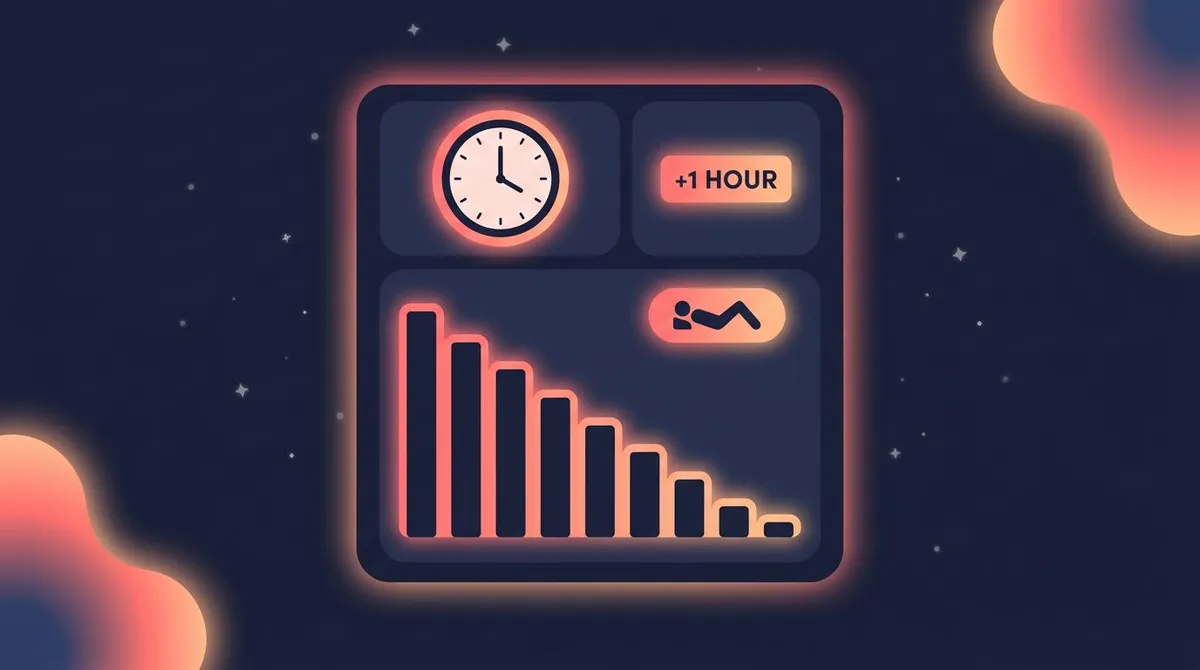
Repayment works best when it's boring and repeatable. You're not looking for one heroic night of sleep — you're looking for a slightly earlier, more consistent bedtime that holds for weeks.
Napping without sabotaging your night
Naps are a legitimate repayment tool when used well and a debt-deepener when used badly. The difference is length and timing.
A power nap of 10 to 20 minutes in the early-to-mid afternoon restores alertness without dropping you into deep sleep, so you wake refreshed rather than groggy. This is the safe default for most people repaying a modest deficit. A full-cycle nap of about 90 minutes lets you complete one sleep cycle and can help after a significant loss, but it needs to happen early enough not to steal from your nighttime sleep. Our nap calculator gives you the exact wake-up time for either length.
The trap is the 30-to-60-minute nap, which often wakes you mid-deep-sleep into "sleep inertia" — that heavy, disoriented feeling that can last longer than the nap saved you. Avoid it. And keep all naps before about 3 p.m.; a late nap bleeds off the sleep pressure you need to fall asleep at bedtime, which is how a well-meant nap turns into tomorrow's debt.
If you routinely need a nap to get through the day, treat that as a signal of underlying debt to repay at night, not a permanent feature to build your schedule around.
A sample two-week repayment plan
Say you've calculated a debt of around 8 hours and your need is 8 hours a night. Here's a realistic, gentle plan that repays it without disrupting your body clock.
Week 1 — add a consistent hour. Keep your wake time fixed. Move your bedtime 60 minutes earlier and hold it every night, weekends included. That extra hour a night puts roughly 7 hours of sleep back over the week — most of your debt — while your body adjusts to an earlier lights-out. Expect the first two or three nights to feel unnatural; your clock catches up.
Week 2 — settle at your true need. Once the acute debt is cleared, ease bedtime back so you're consistently getting your full 8 hours — no more, no less — at the same time every night. The goal now shifts from repayment to maintenance: a stable window you can hold indefinitely.
Notice what this plan is not: it's not an 11-hour Saturday, not a heroic single night, not a dramatic overhaul. It's one modest, repeatable change held long enough to work. That's what repayment actually looks like, and it's why the boring version wins.
How to prevent sleep debt going forward
The cheapest debt to repay is the one you never take on. Prevention comes down to protecting a consistent sleep window and treating it as a non-negotiable daily habit rather than the first thing you sacrifice when life gets busy.
Consistency is where a habit tracker earns its place. When you commit to a fixed bedtime and wake time and check them off daily, two things happen: you get the honest data to spot the nights you're slipping, and the streak itself becomes a small motivator to protect the window. A simple tracker like HabitBox lets you log a "lights out by 10:30" habit and see, on a calendar heatmap, exactly how often you actually hit it — which is usually a humbling and useful reality check.
Pair that with a wind-down routine and an honest sleep target, and the deficit stops re-accumulating. You stop needing to repay a debt you never let build. If you struggle with mornings even after fixing your sleep, a consistent morning routine reinforces the same rhythm from the other end of the day.
Build a "sleep window" habit, not a bedtime rule
A rigid "in bed by 10:00 sharp" rule tends to fail because life is variable. A more durable approach is a sleep window — a 30-minute target range, say 10:00 to 10:30, that you aim to be in bed and lights-out within. The window is forgiving enough to survive a slightly late dinner but tight enough to protect your total hours.
Anchor the window to a fixed wake time working backward. If you need 8 hours and must be up at 6:30, your window closes at 10:30. Set a gentle "start winding down" alarm 45 minutes before — this cue matters more than the bedtime itself, because the wind-down is what actually gets you into bed on time.
Track leading indicators, not just the outcome
Sleep quality is a lagging indicator — you only find out how you slept the next morning. To prevent debt, track the leading indicators you control: the time you started your wind-down, whether you kept your caffeine cutoff, and whether you hit your sleep window. When you log these as daily habits and watch the streak, you get an early-warning system. Three missed wind-downs in a week is your cue to protect the next few nights before a small deficit becomes a large one.
This is exactly the kind of consistency work a habit tracker is built for. Log two or three sleep-protecting habits, check them off nightly, and let the calendar heatmap show you the pattern. The goal isn't a perfect record — it's catching the drift early, while the debt is still cheap to repay.
Common sleep debt myths
A few persistent myths keep people stuck in the debt cycle. Clearing them up makes the whole picture easier to act on.
"I can train myself to need less sleep." You can train yourself to tolerate less sleep — meaning you stop noticing the sleepiness — but your underlying need and the performance cost don't change. The research is blunt on this: subjective adaptation happens while objective impairment continues. Feeling fine on six hours is not the same as functioning fine on six hours.
"I'll catch up when I retire / on vacation / next weekend." Sleep isn't a resource you can defer indefinitely and reclaim in bulk. Recent debt is repayable; a years-long backlog largely isn't a meaningful number, and the daily impairment while you're accumulating it is what matters.
"More sleep is always better." For debt repayment, extra sleep helps — but consistently sleeping far beyond your need (regularly 10-plus hours when your need is 8) can itself be a sign of an underlying issue and is linked in some studies to worse health outcomes. The goal is enough and consistent, not maximal.
"Weekends fix everything." As covered above, weekend catch-up helps recent debt a little but leaves metabolic effects unaddressed and creates social jet lag. It's a patch, not a cure.
Managing sleep debt in hard situations
Not everyone gets to choose their schedule. If your sleep loss is structural, the goal shifts from prevention to smart damage control.
Shift workers. Rotating and night shifts fight your circadian rhythm directly, so perfect sleep isn't on the table. Focus on anchoring a consistent sleep block even on days off, using blackout curtains and cool temperatures to sleep during daylight, and taking strategic pre-shift naps. Protect the sleep block as fiercely as you'd protect a meeting.
New parents. Fragmented sleep is unavoidable in the early months, and total hours will drop no matter what you do. The realistic play is to bank sleep opportunistically — sleep when the baby sleeps is a cliché because it works — and to split night duty with a partner so each person gets at least one longer unbroken stretch, which matters more for recovery than the total.
Students. Exam-season all-nighters are the worst trade in the deck: the sleep you sacrifice degrades exactly the memory consolidation and recall you're studying for. Consistent 7-to-8-hour nights across the term beat cramming. If you must trim sleep before a deadline, trim it once and repay it immediately rather than stacking short nights.
In every case, the principle is the same: you can't always prevent the debt, but you can be deliberate about when you take it on and how quickly you repay it.
When sleep debt might be something more
Most sleep debt is behavioral — a scheduling and habits problem you can fix with the steps above. But sometimes the shortfall isn't voluntary, and no amount of "going to bed earlier" helps because the sleep itself is broken.
Consider talking to a doctor if you consistently spend enough time in bed but still wake unrefreshed, if you snore loudly and wake gasping (a possible sign of sleep apnea), if it regularly takes you more than 30 minutes to fall asleep or you wake for long stretches (possible insomnia), or if daytime sleepiness is severe enough to affect your safety or work. These are treatable conditions, and chasing them with willpower alone won't work. A sleep debt you can't repay despite adequate time in bed is a medical question, not a discipline one.
FAQ
What is sleep debt?
How do I calculate my sleep debt?
Can you catch up on lost sleep?
How long does it take to recover from sleep debt?
How much sleep do I need?

Mira Hartwell
Editor, HabitBoxEditor at HabitBox. Writes about habit science and productivity, grounding every post in named research (Lally, Wood, Walker, Huberman) instead of recycled advice. Read full bio →