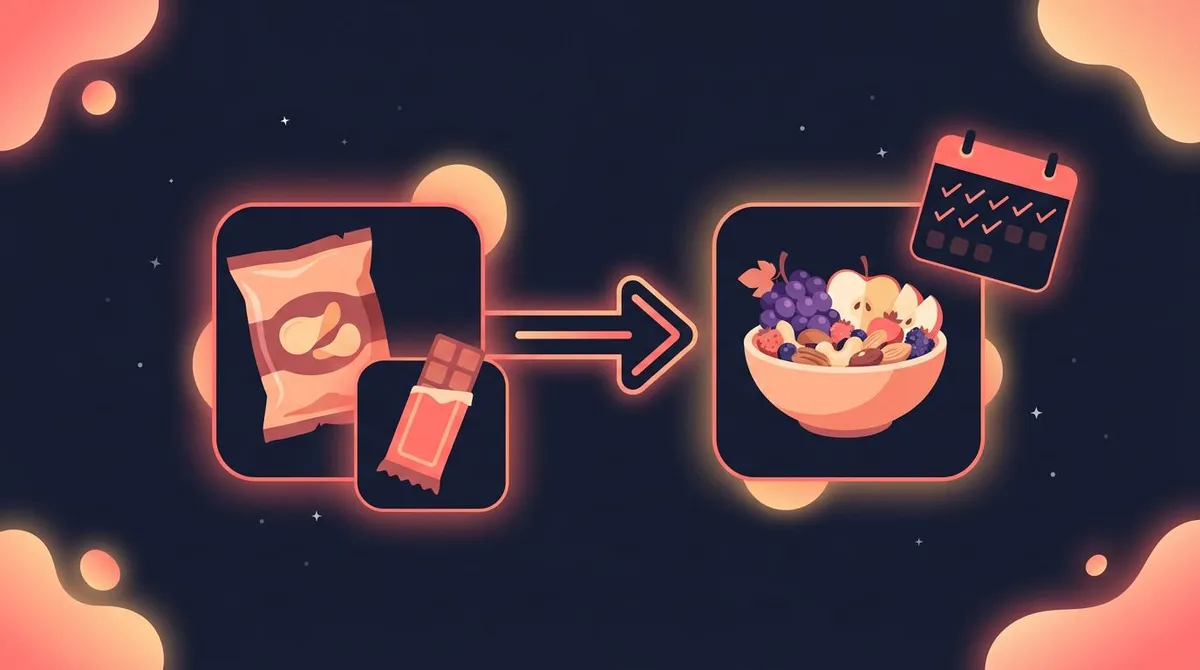
How to Eat More Vegetables: 12 Easy Habits (2026)
TL;DR. Most US adults eat only about 1.5 cups of vegetables a day — and just 1 in 10 hit the recommended amount, per the CDC. The fix to eat more vegetables isn't a diet or more willpower. It's a handful of low-effort habit swaps plus one trackable daily target: 5 servings, ticked off one at a time. Pick three swaps below, track them for two weeks, and let the count do the work.
You already know vegetables are good for you. That was never the problem. The problem is the bag of spinach turning to slime in the crisper drawer while you order takeout for the third night running.
Knowing and doing are two different systems. This guide skips the lecture and treats eating more vegetables as what it actually is — a daily habit you can make easier and then track, not a moral test you keep failing.
No clean-eating rules. No foods you have to give up. Just small swaps that stack into real servings.
How many servings of vegetables do you actually need?
Here's what the research says. The American Heart Association recommends 2.5 cups of vegetables and 2 cups of fruit per day — roughly five servings of veg once you count a serving as about half a cup cooked or one cup raw. The U.S. Dietary Guidelines land in the same place: around 2.5 cups of vegetables a day for a 2,000-calorie diet.
The gap between that target and reality is wide. The CDC reports that only about 1 in 10 US adults eat enough vegetables, with a median intake near 1.7 times per day. So if your veggie game feels weak, you're normal — not broken.
The good news is that closing the gap doesn't require doubling anything at once. Going from 1.5 to 3 or 4 servings a day is a meaningful jump, and every extra serving counts.
Vegetable serving sizes at a glance
Servings sound abstract until you can picture them. Here's what one serving actually looks like across common forms.
| Vegetable form | One serving | Everyday picture |
|---|---|---|
| Raw leafy greens (spinach, lettuce, kale) | 1 cup | Two big handfuls |
| Cooked or chopped vegetables | 1/2 cup | Half a small bowl |
| Frozen vegetables (cooked) | 1/2 cup | A microwaved steam pack, split |
| Vegetable juice (100%) | 1/2 cup | A small glass |
| Cherry tomatoes / baby carrots | About 1/2 cup | 6–8 pieces |
A helpful mental shortcut from the AHA: fill half your plate with vegetables and fruit at your two biggest meals, and you're most of the way to five servings without counting anything.
Why the number is worth chasing
You don't need to memorize the biochemistry, but a little "why" makes the habit easier to keep. Harvard's Nutrition Source notes that eating more than five servings of fruits and vegetables a day is linked to roughly a 20% lower risk of heart disease and stroke, with benefits continuing to rise at higher intakes. Vegetables deliver fiber, potassium, folate, and a range of protective plant compounds that supplements can't fully replicate.
Variety matters as much as volume. Different colors carry different nutrients, so a plate that mixes dark leafy greens, orange and red vegetables, and legumes covers more bases than five servings of the same thing. Think of the daily count as the floor and color variety as the upgrade — hit the number first, then widen the range.
Why eating more vegetables is harder than it should be
If willpower were the issue, nobody who buys spinach with good intentions would let it rot. The real obstacles are practical, and naming them makes them easier to beat.
Convenience friction. Vegetables usually need washing, chopping, and cooking. Chips need a bag opening. Whichever option takes fewer steps at 7 p.m. tends to win. As habit researcher Wendy Wood has shown, roughly 43% of daily behavior runs on autopilot cued by our environment — so the easier default usually wins by default.
No built-in cue. You have a reliable trigger for brushing your teeth (waking up, going to bed). Most people have no trigger that says "eat a vegetable now." Without a cue, the behavior never starts.
All-or-nothing thinking. Plenty of people decide that if they can't overhaul their whole diet, there's no point adding one serving. That framing guarantees zero progress. Adding beats overhauling every time.
The takeaway: don't try to want vegetables more. Make them the easy, cued, add-on option — and let the habit run itself. That's the same principle behind being consistent with any habit: reduce friction, attach a cue, and lower the bar for a win.
12 painless habits to eat more vegetables
These are add-don't-subtract swaps. You're not removing foods you love — you're bolting vegetables onto meals you already eat. They're grouped by meal so you can find the easiest place to start.
At breakfast
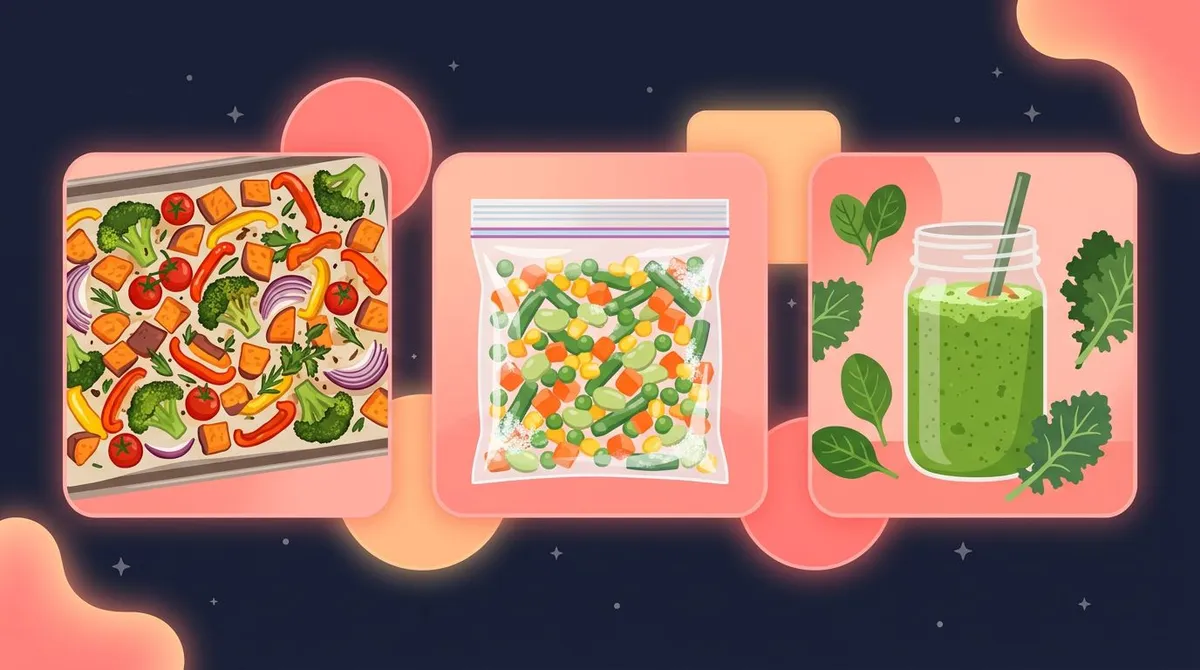
- Blend greens into a smoothie. A big handful of spinach disappears into fruit and yogurt — no taste, one serving banked before 8 a.m.
- Add vegetables to eggs. Toss frozen peppers, spinach, or leftover roasted veg into scrambled eggs or an omelet. Same cooking time, one extra serving.
- Top toast or oats with something green. Avocado and tomato on toast, or grated carrot stirred into savory oats, front-loads a serving early.
At lunch
- Make salad the base, not the side. Build your lunch on a bed of greens instead of adding lettuce as an afterthought. Two handfuls is a full serving.
- Practice veggie-first eating. Eat the vegetables on your plate before the rest. You arrive at the pasta already one serving up, and often eat a bit less of the heavier stuff.
- Bulk up soups and sandwiches. Stir a handful of frozen mixed veg into canned soup, or stack cucumber, spinach, and peppers into any sandwich or wrap.
At dinner
- Default to a vegetable side, always. Decide once that every dinner comes with a vegetable, so it's not a nightly negotiation. Frozen counts — see below.
- Hide vegetables in sauces. Blend carrots, zucchini, or cauliflower into pasta sauce, chili, or curry. Kids and picky adults never notice.
- Roast a tray on Sunday. Batch-roast a sheet pan of mixed vegetables for the week. Reheated roasted veg is a two-minute side any night. This is habit stacking applied to food prep.
Snacks and defaults
- Keep cut veg at eye level. Wash and chop carrots, peppers, and cucumber when you get home, and store them front-and-center in the fridge. Convenience decides snacks.
- Pair veg with a dip you like. Hummus, guacamole, or Greek-yogurt ranch makes raw vegetables genuinely appealing. The dip is the point.
- Lean on frozen — it's not cheating. Frozen vegetables are picked and flash-frozen at peak ripeness, so they're just as nutritious as fresh and last for months. A steam pack in the microwave is a full serving with zero prep.
Notice that none of these ask you to like vegetables more than you do. They lower the effort and raise the frequency — which is how habits actually form.
Turn it into a trackable daily target
Here's the key insight most vegetable advice misses: a tip list gives you ideas, but no way to know whether you're actually doing better. A number does.
Set one simple target — 5 servings a day — and treat it as a count-based habit, not a yes/no checkbox. Every time you eat a serving, you tick it off. The goal isn't perfection; it's watching the daily count climb from your usual 1 or 2 toward 5.
Counting works because it makes an invisible behavior visible. You stop guessing and start seeing patterns: maybe you nail breakfast and lunch but dinner drags you down. That's exactly the kind of insight a running total surfaces.
This is where a tracker earns its keep. In a count-based habit app like HabitBox, you set the veggie habit to a daily target of 5 and tap once per serving, so the tally rises through the day and you can see at a glance whether you're on pace. A visible streak of days-hitting-5 is far more motivating than a vague resolution to "eat healthier." If you've tracked water before, it's the same mechanic — see how to start drinking more water for the count-and-cue approach applied to hydration.
Pair the target with the same friction-reduction that powers any keystone habit: make the good option easy and the count does the rest.
One more reason counting beats a plain resolution: it turns a fuzzy goal into daily feedback. A vague "eat healthier" gives you no signal on a Tuesday afternoon, so it quietly fades. A tally that reads "2 of 5" at 3 p.m. tells you exactly what to do next — grab the cut veg from the fridge. Small, specific, and immediate beats big and abstract almost every time.
Common mistakes that stall progress
A few predictable traps trip people up. Knowing them in advance saves weeks of frustration.
Starting at five. Jumping from 1.5 servings straight to a strict 5-a-day is a setup for burnout. Start at 3, get a week of wins, then raise the bar. The count should feel achievable most days, not punishing.
Treating one miss as failure. Missing your target on a busy day doesn't undo anything. The research on habit formation is clear that a single lapse has almost no effect on whether a habit sticks — quitting after the lapse is what breaks it. Log what you got and move on.
Buying fresh you won't cook. If spinach keeps rotting, stop buying fresh spinach. Buy the frozen bag that survives a chaotic week. Match your purchases to your real energy level, not your idealized one.
Ignoring the weakest meal. Most people have one meal that consistently drags their count down. Your tracker will show you which one. Fix that single meal and your daily total often jumps by two servings on its own.
A 7-day starter plan
Don't try all 12 swaps at once. Layer them in, one small win at a time, so each new habit has room to stick.
- Day 1: Pick your target (aim for 3 servings to start, not 5). Add one green handful to breakfast — a smoothie or eggs.
- Day 2: Repeat breakfast. Add a vegetable side to dinner (frozen is fine).
- Day 3: Wash and cut a batch of snack veg. Keep it at eye level in the fridge.
- Day 4: Try veggie-first eating at one meal — vegetables before everything else on the plate.
- Day 5: Make lunch salad-based, or bulk up a soup or sandwich with extra veg.
- Day 6: Roast a sheet pan of mixed vegetables for the days ahead.
- Day 7: Review your week's counts. Notice which meal is weakest and pick one swap to shore it up next week.
By the end of week one you're not chasing motivation — you're running two or three small routines on autopilot. Nudge the target from 3 up to 5 once the early swaps feel automatic, usually after a couple of weeks. Deciding in advance which habits to log keeps the list short and doable — see what habits to track for how to choose the few that matter.
FAQ
How many servings of vegetables should I eat a day?
Do frozen or canned vegetables count?
What counts as one serving?
How can I eat more vegetables if I don't like them?
Do potatoes count as a vegetable?

Mira Hartwell
Editor, HabitBoxEditor at HabitBox. Writes about habit science and productivity, grounding every post in named research (Lally, Wood, Walker, Huberman) instead of recycled advice. Read full bio →