How to Stop Eating Junk Food: 9 Habit Swaps (2026)
The fastest way to learn how to stop eating junk food is to treat it as a cue-routine-reward habit loop and swap the routine while keeping the reward — these 9 swaps do exactly that. The hard part isn't weak willpower: ultra-processed foods are engineered to a "bliss point" that overrides your normal fullness signals, so "just eat less" fights your own biology. Target the cue instead, and the 3 p.m. vending-machine autopilot loses its grip.
You know the moment. It's 3 p.m., your energy dips, and before you've decided anything your feet are walking toward the vending machine. That's not a lack of discipline — it's a habit running on autopilot. This guide reframes junk food as a loop you can rewire, gives you nine concrete swaps, and shows you how to track the change so it actually holds.
One honest note first: this is about everyday eating habits, not disordered eating. If food feels genuinely out of control — bingeing, secrecy, distress — that's worth talking to a doctor about, and there's no shame in it. The rest of this is for the ordinary "I eat too much junk and want to cut back" situation.
Why junk food is so hard to resist
Junk food isn't just tempting by accident — it's built to be. Food scientists tune the ratio of salt, sugar, and fat to hit what the industry calls the "bliss point," the exact combination that maximizes craving without ever quite satisfying you. Journalist Michael Moss documented this in Salt Sugar Fat: products are literally engineered so one chip is never enough.
Your body doesn't stand much of a chance in that fight. Research from the University of Cambridge shows that overeating is driven by biology and environment, not just choice — the brain, as one researcher put it, is "a slave to the environment and to what's going on in the body." Ultra-processed foods are calorie-dense and fast to eat, so you consume them before your gut hormones can signal fullness.
The environment stacks the deck too. Cambridge researchers found that in some neighborhoods nearly half of all food outlets are fast food, and that simply shrinking portion sizes could cut a population's calorie intake by double digits. In other words, the default is junk, and defaults win.
The good news: you don't have to out-muscle any of this. You have to change what happens on autopilot.
The habit-loop reframe: keep the reward, swap the routine
Every junk-food habit has three parts. Charles Duhigg calls it the cue-routine-reward loop in The Power of Habit. A cue triggers the behavior (3 p.m. slump, stress, walking past the kitchen). The routine is the thing you do (grab chips). The reward is what your brain actually wants (a break, a lift, comfort, crunch).
Here's the key insight: you almost never crave the junk food itself. You crave the reward. The chips are just the routine your brain learned to get there. So the move isn't to delete the loop through willpower — it's to keep the cue and reward but swap the routine for something that delivers the same payoff with less damage.
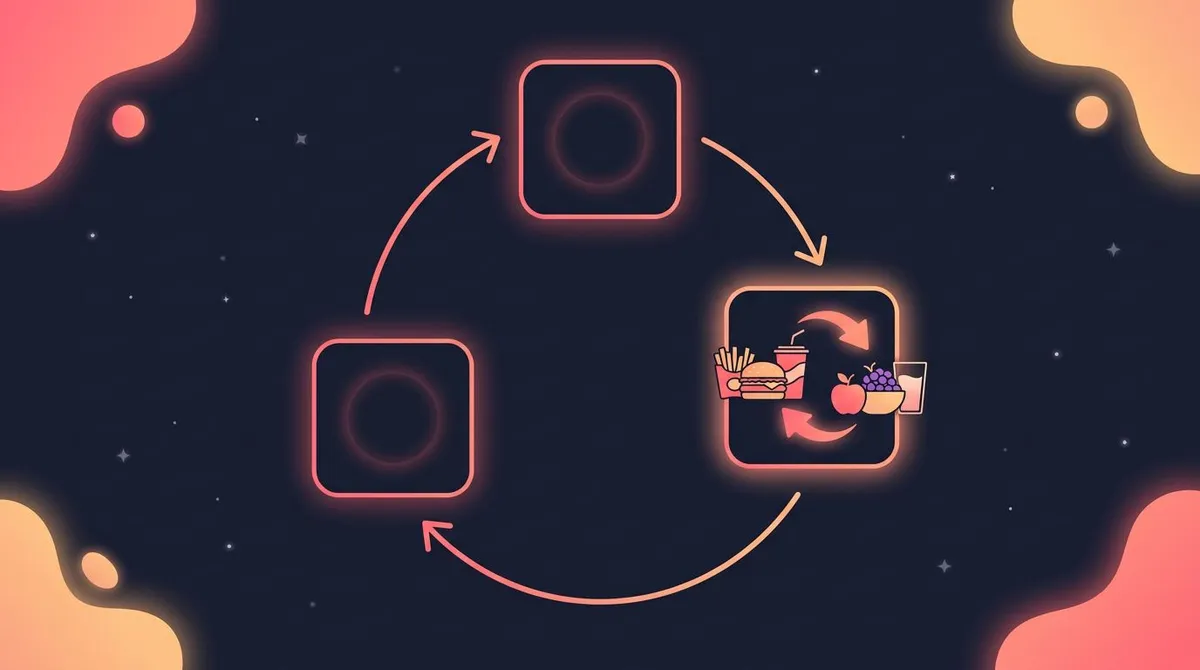
If your 3 p.m. reward is really "a mental break," a five-minute walk plus an apple can deliver it. If the reward is crunch, carrots and hummus scratch the same itch. The point is to get curious about what you're actually after, then engineer a better route to it. If you want to go deeper on the mechanics, our guide to breaking a habit walks through disrupting the loop step by step.
How to stop eating junk food: 9 habit swaps that work
These aren't willpower hacks. Each one changes the environment or the cue so the healthy choice becomes the easy one.
- Don't keep it in the house. The single highest-leverage move. You can't autopilot into a bag of chips that isn't in the cupboard. Willpower is a bad daily strategy; a bad grocery list you write once beats it.
- Use if-then plans. Decide the response before the craving hits: "If it's 3 p.m., then I make tea and eat the fruit on my desk." Psychologists call these implementation intentions, and they roughly double follow-through because the decision is already made.
- Eat protein and fiber first. Front-load meals with eggs, beans, yogurt, or vegetables. They trigger the fullness hormones that ultra-processed food skips, so you reach for junk less by default.
- Run a HALT check. Before you grab a snack, ask: am I Hungry, Angry, Lonely, or Tired? Boredom and stress masquerade as hunger constantly. If it's not real hunger, the fix isn't food.
- Fix your defaults. Keep cut fruit at eye level, chips on a high shelf. Rutgers' healthy-eating guidance recommends stocking fresh fruit and vegetable sticks with hummus so the easy snack is also the good one.
- Protect your sleep. This one surprises people. In sleep-restriction studies where people slept only four hours a night, appetite and cravings for high-fat, high-carb food shot up. Seven to eight hours is a junk-food defense. A steady sleep routine does more than any diet rule.
- Drink water first. Thirst reads as hunger, and liquid calories from soda don't register as fullness the way food does. Have a glass of water before you decide you want a snack — our drink more water plan makes this automatic.
- Add friction, don't just remove it. Delete the delivery apps, don't carry cash for the vending machine, park farther from the drive-thru. Every extra step between cue and junk gives the craving time to pass — it usually peaks and fades in a few minutes.
- Aim for progress, not perfection. One doughnut doesn't "ruin" anything. All-or-nothing thinking is what turns a slip into a spiral. Cut junk 80% of the time and you've won; being consistent, not flawless, is the whole game.
Common junk-food cue vs. better swap
Most cravings map to a handful of cues. Find yours in the left column and pre-load the swap on the right so the decision is already made when the moment comes.
| Common cue | What you actually want | Better swap |
|---|---|---|
| 3 p.m. energy slump | An energy lift and a break | Short walk + protein snack (nuts, yogurt) |
| Stress or a hard day | Comfort and a reset | 5 minutes off-screen, tea, or a quick call |
| Watching TV at night | Something to do with your hands | Popcorn, cut veg, or sparkling water |
| Walking past the kitchen | Nothing — pure autopilot | Keep counters clear; fruit bowl in view |
| Sugary drink with lunch | A hit of sweetness | Water or unsweetened sparkling water |
| Boredom mid-afternoon | Stimulation, not calories | Stand up, stretch, change tasks |
Track it: cravings, give-ins, and a junk-free streak
You can't change what you don't measure. For two weeks, keep a dead-simple log: each time a craving hits, jot the cue (where, when, what you were feeling) and whether you gave in. Patterns jump out fast — you'll usually find two or three cues drive most of it, and those are the ones worth engineering around.
Then flip to the positive. Count "no junk" days and build them into a streak. Streaks work because of loss aversion — once you've stacked up nine junk-free days, you don't want to break the chain. A tracker like HabitBox makes this one tap a day, so you see the streak grow and stay motivated without any spreadsheet fuss.
Two rules keep the streak honest. First, define "junk-free" for yourself up front (no chips, soda, or fast food, say) so there's no daily debate. Second, if you slip, log it and move on — the next day's box is still there to check. Progress compounds; perfection just sets you up to quit. The same loop-and-streak approach is exactly how tracking habits turns a vague intention into visible momentum.
FAQ
Why can't I stop eating junk food?
How do I stop craving junk food?
How long does it take to break a junk food habit?
What should I eat instead of junk food?
Is junk food actually addictive?

Mira Hartwell
Editor, HabitBoxEditor at HabitBox. Writes about habit science and productivity, grounding every post in named research (Lally, Wood, Walker, Huberman) instead of recycled advice. Read full bio →