How to Start Drinking More Water: 14-Day Plan (2026)
If you want to start drinking more water, the fix is rarely willpower — it's cues. Most people forget because nothing in their day says "drink now." This 14-day plan attaches four water moments to routines you already do and gives you a tracker you can finish. By day 14, the wakeup glass runs on autopilot — no smart bottle, no app pile-up.
What this plan is (and isn't)
A 14-day starter plan for adults who want to drink more water without overhauling their day. No milliliter counting, no 2-liter bottle. You'll attach a glass to four moments that already happen — wakeup, work start, lunch, and evening — and let the cue do the remembering.
It isn't medical advice. Hydration needs vary by body, activity, climate, and health. For intake guidance, see the NHS hydration page or the CDC water and healthy drinks guide. This article covers the habit mechanics.
Why "drink more water" usually fails
"Drink more water" is a goal, not a habit. A goal describes an outcome. A habit describes a behavior tied to a moment. Without the moment, your brain has nothing to attach the action to.
Wendy Wood, a USC behavioral scientist who has studied habit formation for decades, found that roughly 43% of daily behavior is repeated in the same context — same place, same time, same trigger. Behavior follows cues, not intentions.
A 2010 University College London study by Phillippa Lally and colleagues tracked 96 people forming new daily habits. Automaticity plateaued after a median of 66 days, and consistency of context was the strongest predictor of success (Lally et al., 2010). "Glass of water after I brush my teeth" sticks because the cue is already there.
James Clear calls this habit stacking in Atomic Habits (2018): "After [existing habit], I will [new habit]." For water: "After I pour my coffee, I will drink one glass of water."
The 14-day water habit ramp
You don't add four anchors on day one. You add one at a time so each cue locks in before the next layer goes on. This staging mirrors BJ Fogg's Tiny Habits research at Stanford — start so small the habit is hard to skip, then expand.
| Phase | Days | Anchor cues active | Daily target |
|---|---|---|---|
| Foundation | 1–4 | Wakeup glass | 1 glass before anything else |
| Build | 5–8 | + Mid-morning glass | 2 glasses by noon |
| Stack | 9–12 | + Lunch glass | 3 glasses by mid-afternoon |
| Full plan | 13–14 | + Evening glass | 4 glasses by dinner |
A "glass" means roughly 8 oz (about 240 ml). Four glasses is intentional water on top of what you already get from coffee, tea, and food — within the Harvard Health hydration guidance for most adults.
How to actually build the habit
1. Put the glass where the cue happens
Environment design beats willpower. If your wakeup glass lives in the kitchen but your alarm goes off in the bedroom, you'll forget. Fill a glass tonight and leave it by your toothbrush. For mid-morning and lunch, a refillable bottle on your desk beats a glass elsewhere. Wood's research shows friction — extra steps, extra distance — predicts habit-holding more than motivation does.
2. Anchor each glass to a cue you can't skip
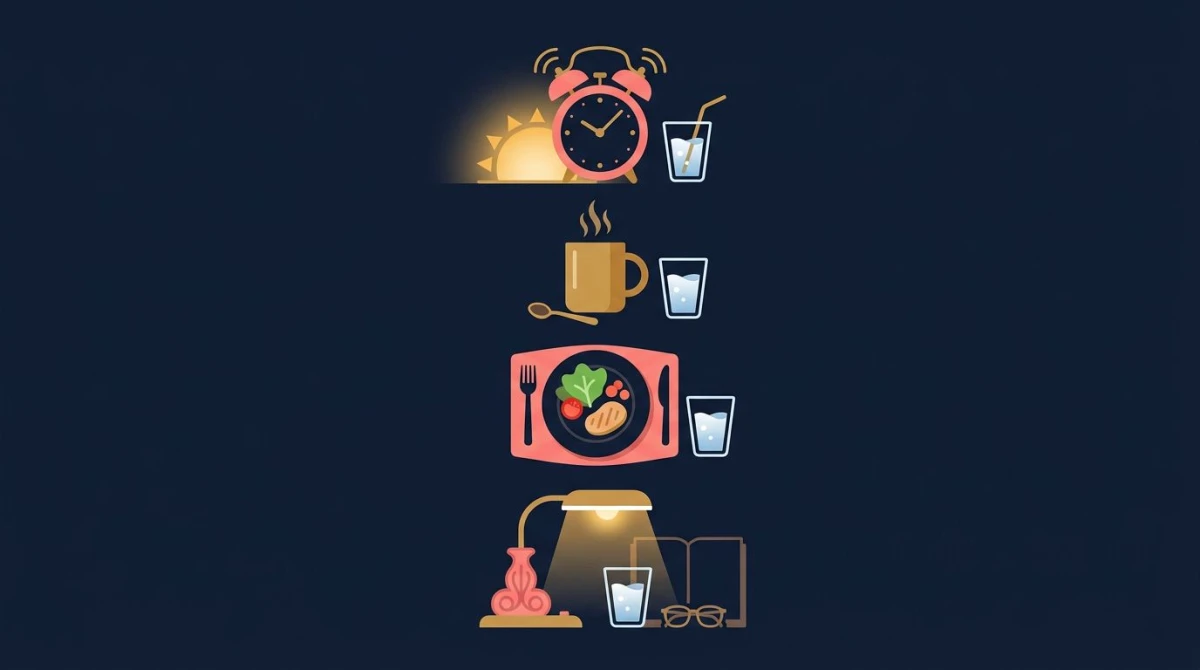
Don't anchor water to "when I remember." Anchor it to something that already happens every day:
- Wakeup: After I get out of bed (before phone, before coffee)
- Mid-morning: After I sit down at my desk
- Lunch: When I sit down to eat
- Evening: After I clear dinner plates
The anchor matters more than which one you pick.
3. Make the first action small
On day 1, the only goal is the wakeup glass — drink it before you check your phone. Fogg's research shows tiny, easy wins build the neural pathway faster than ambitious targets.
4. Track each anchor as yes/no, not volume
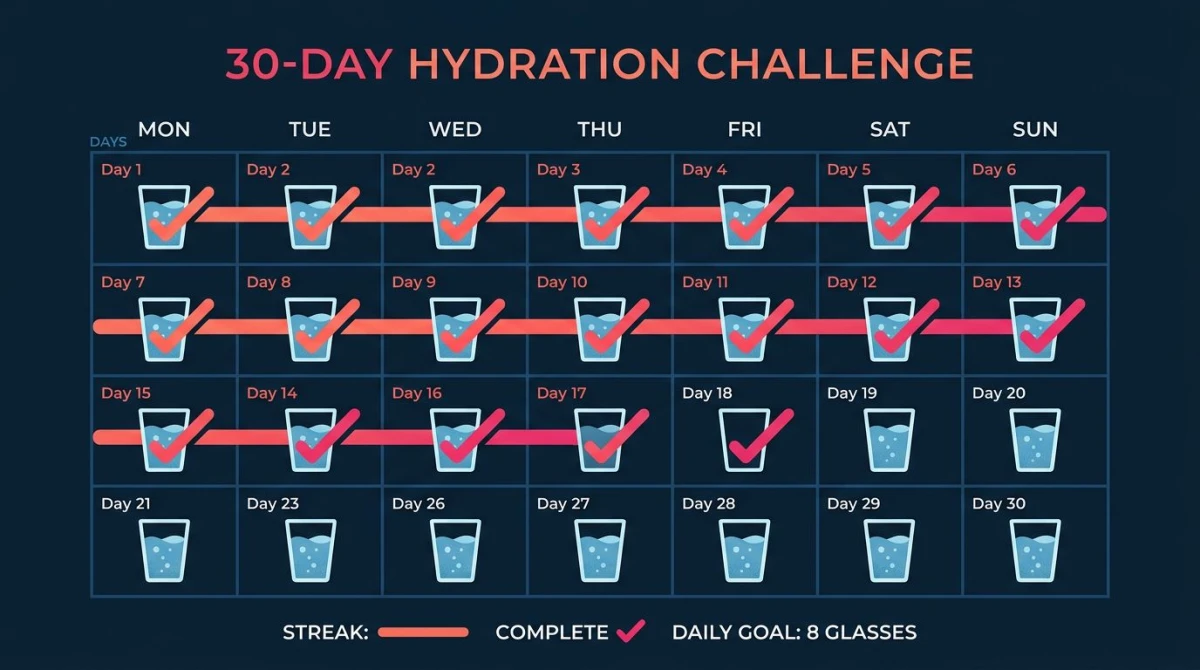
Tracking "ounces today" turns hydration into homework. Track each anchor as a tick-box — did I do the wakeup glass? Yes or no.
A tracker like HabitBox lets you set each glass as its own daily check-in with its own streak. If you nail wakeup for ten days but miss lunch twice, you keep the wakeup streak. That's habit stacking applied to one umbrella behavior.
5. Plan the missed-day rule
You'll miss a day. The rule that protects the habit: never miss twice in a row. One miss is noise. Two misses starts a new pattern. Clear writes about this in Atomic Habits — the second skipped day is when habits quietly die.
Day-by-day starter plan
- Days 1–4 (Foundation): Wakeup glass only. Glass on bathroom counter the night before. If it doesn't feel automatic by day 4, hold two more days.
- Days 5–8 (Build): Add mid-morning glass. Bottle on desk before you sit down.
- Days 9–12 (Stack): Add lunch glass. Place it next to your fork before you eat.
- Days 13–14 (Full plan): Add evening glass. After dinner, before couch.
After day 14, you keep going. Lally's UCL data suggests automaticity continues building for weeks past the initial run.
When it stops working
"I keep forgetting the mid-morning glass." Your anchor is too vague. Re-anchor to a specific action: "After I open my laptop."
"I drink the water but feel bloated." Slow down. Sip over five minutes instead of chugging.
"I forget on weekends." Different schedule, missing cues. Re-anchor to weekend cues — "after I make breakfast," "before I leave the house."
"I keep peeing constantly." Most people level out by day 5. If it doesn't, talk to your doctor.
A simple way to track each glass
You don't need a smart bottle — you need a way to not forget the cue. A daily check-in tracker works because the streak number is itself a cue. If wakeup hits a 12-day streak, missing it feels expensive. More on the setup in our water tracker app guide and the broader system in tracking habits the simple way. Paper works too — a 14-day grid on the fridge.
FAQ
How do I remember to drink water if I'm always busy?
What's the best water bottle for the habit?
How much water do I actually need?
Do I need a water tracker app?
Why do I forget to drink water at work?
Can I count coffee and tea toward my water?
Closing thought
Most people fail at drinking more water because they treat it as a number to hit, not a moment to attach. Pick four moments. Anchor a glass to each. Track the moments, not the milliliters. By day 14, the wakeup glass will run itself — and a tracker like HabitBox makes it easy to keep four small streaks visible at a glance.

Mira Hartwell
Editor, HabitBoxEditor at HabitBox. Writes about habit science and productivity, grounding every post in named research (Lally, Wood, Walker, Huberman) instead of recycled advice. Read full bio →