Alcohol-Free Days: How Many a Week and How to Track Them
TL;DR: Most official guidance sets no exact number of alcohol-free days. New Zealand is an exception: at least 2 a week. The UK Chief Medical Officers say to keep to 14 units a week, spread over 3 or more days, and to have "several drink-free days each week" if you want to cut down. Canada's 2023 guidance puts low risk at 2 drinks or fewer a week. Read together, they point to more dry days than drinking days, so 4 or more a week. Build up to it from where you are now, pick the days in advance, and track the week as a goal instead of a daily chain.
How many alcohol-free days a week? What official guidance says
Health bodies agree on the direction: less is better. They don't agree on a day count. Here is what five of them say, read from each primary source in November 2026.
Official drinking guidance, checked November 2026
| Guidance | Weekly limit | Per-day limit | What it says about drink-free days | Source |
|---|---|---|---|---|
| UK Chief Medical Officers, 2016 | 14 units, spread over 3 or more days. | No set number. Limit how much you drink on any one occasion. | "Several drink-free days each week" if you want to cut down. | UK CMOs' guidelines (PDF, p. 4) |
| Australia, NHMRC, 2020 | 10 standard drinks. | 4 standard drinks. | No rule. The weekly cap was modelled on drinking 3 days a week. | NHMRC and MJA 2021 |
| Canada, CCSA, 2023 | 2 or fewer is low risk. 3 to 6 is moderate. 7 or more is increasingly high. | No more than 2 on any day. | No day count. Its tips include alcohol-free weeks. | CCSA |
| US Dietary Guidelines 2025–2030, January 2026 | No number. | No number. | None. "Consume less alcohol for better overall health." | Dietary Guidelines (PDF, p. 5) |
| WHO Europe, January 2023 | No safe level. | No safe level. | None. The less you drink, the safer it is. | WHO Europe |
A "drink" isn't the same size everywhere. A UK unit is 8 g of pure alcohol (NHS), an Australian standard drink is 10 g (NHMRC), and a US standard drink is about 14 g (NIAAA). So compare advice within one country, not across them.
What the table adds up to
Of these five, only the UK writes drink-free days into its official advice, and it says "several" rather than a number. Health New Zealand, which isn't in the table, is more exact: at least 2 alcohol-free days each week.
The other figures still point the same way. Australia's 10-drink cap was modelled on drinking 3 days a week, the most common pattern there, which leaves 4 dry days.
Canada's low-risk band is 2 drinks or fewer a week, with no more than 2 on any day. Stay in that band and you have at least 5 dry days.
The US now gives no number at all. The 2025–2030 guidelines dropped the old limits of 2 drinks a day for men and 1 for women. You may still see those limits on the CDC's moderate drinking page, dated January 2025, which cites the 2020–2025 edition.
Our reading of the table, not an official guideline: aim for more alcohol-free days than drinking days. That means 4 or more a week. If 4 feels far off, the starting table further down shows how to build up to it.
The catch: dry days are not savings
Drink-free days only help if your weekly total goes down too. The UK CMOs warn that one or two heavy drinking episodes a week raise your risk of death from long-term illness and from accidents. The MJA paper makes the same point: 14 standard drinks on a single day raises the risk of acute harms, such as injury, far more than 2 drinks a day across a week.
So four dry days followed by a huge Saturday is not a win. Keep each drinking day the same size or smaller as you add dry days.
What drink-free days do, and what they don't
The UK CMOs' report says there is evidence that some alcohol-free days each week help people who want to drink less. That is the main job of a dry day: it cuts the total. The same report chose a weekly limit over a daily one because most people don't drink every day.
Drinkaware lists what you gain from drinking less across the week. A glass of wine has about the calories of a small bar of chocolate, and three pints of 4% lager about the same as two cheeseburgers. It adds that several drink-free days a week reduce the risk of liver disease, and that cutting back helps lower high blood pressure.
Sleep is another reason to try. Our sleep hygiene checklist explains how alcohol breaks up REM sleep and causes wake-ups later in the night. A dry evening gives you a cleaner night to compare against.

Be wary of bigger promises. A dry day is not a liver "detox", and it doesn't cancel out a heavy night.
The UK CMOs note that cancer risks start from any level of regular drinking and rise with the amount. Dry days help because they lower that amount, not because they reset anything.
Pick your number: a starting target from your current week
Start from what you do now, not from the ideal. Count the nights you had a drink last week, then find your row. This is a habit plan, not medical advice.
| Nights you drink now | Dry days now | Starting target | Next step |
|---|---|---|---|
| 7 | 0 | 2 dry days. | 3, then 4. |
| 5 or 6 | 1 or 2 | 3 dry days. | 4. |
| 4 | 3 | 4 dry days. | Hold 4 and trim the amount on drinking days. |
| 3 or fewer | 4 or more | Keep what you have. | Watch how much you drink on the other days. |
Add one more dry day only after you hit your target two weeks in a row. Keep going until your weekly total sits inside your country's guidance. Every dry day past that point lowers your risk a little more.
Worked example: a glass or two most nights
Say you drink two 175 ml glasses of 13% wine on 6 nights a week. The NHS unit formula is ABV × volume in ml ÷ 1,000. So one glass is 13 × 175 ÷ 1,000 = 2.275 units, and two glasses come to 4.55 units a night.
| Drinking nights | Dry days | Weekly units | Meets the UK guideline? |
|---|---|---|---|
| 6 | 1 | 6 × 4.55 = 27.3 | No. Almost double 14. |
| 4 | 3 | 4 × 4.55 = 18.2 | No. Still over 14. |
| 3 | 4 | 3 × 4.55 = 13.65 | Yes. Under 14, spread over 3 days. |
Four dry days take this drinker from about 27 units to about 13.7 without changing what they pour on the other nights. That only works because each drinking night stays at two glasses.
Choose which days, not only how many
The number is half the plan. Which days you pick decides whether it holds.
Map routine nights and social nights
Look at last week and sort your drinking nights into two kinds. Routine nights run on autopilot: a glass with Tuesday dinner, a beer while you cook. Social nights are Friday drinks, a birthday or a work event.
Make your first dry days routine nights. Nobody else is involved, so they are the easiest to win. Once those hold, protect one harder night too.
Decide before the day, not on the evening
Writing the days down in advance takes the nightly debate off the table. Psychology academics Megan Lee and Emily Roberts of Bond University suggest choosing which days will be alcohol-free, marking them on a calendar and setting phone reminders. The NHS says the same in fewer words: have at least a few drink-free days every week, and choose yours.
Keep the ritual, swap the drink
The evening drink is often about the moment more than the alcohol: the glass, the sofa, the end of the workday. Keep the moment and change what's in the glass. Sparkling water with lime in your usual wine glass is an easy first swap, and our guide to cutting out soda has more ideas that keep the fizz.
If the drink is tied to a strong cue, such as walking in the door after work, use the cue-and-routine method for breaking a habit. It helps you put a new routine in that exact slot.

Move a dry day, don't drop it
Plans change. If a party lands on a planned dry day, go to the party and move the dry day to another night that week. Lee and Roberts also advise forgiving yourself if you drink on a planned alcohol-free day, then carrying on.
The 75 Soft challenge works the same idea from the other side: alcohol only on real social occasions. Either way, the rule only bends without breaking when the goal is weekly.
Track the week, not a daily chain
A daily streak suits habits you do every day. For alcohol-free days it backfires, because every planned drinking night shows up as a broken chain, even when you stuck to the plan.
A weekly target counts what you planned: a Friday glass of wine is fine as long as you still reach 4 dry days by the end of the week. And as our guide to staying consistent explains, one off day doesn't erase your progress.
Set it up as a weekly goal
HabitBox has a weekly goal that fits this method. Here's the setup:
- Add a habit and name it "Alcohol-free day".
- Under Schedule, choose Weekly goal instead of Active Days.
- Set Days per week to your starting target. You can pick any number from 1 to 7.
- Check in each evening you don't drink. The card shows progress such as "2/4 this week" and adds "Goal met" once you reach your number.
- Add a reminder for the time your first drink of the evening tends to happen.
The streak counts weeks, not days. The setting says it plainly: "Rest days do not break your streak."
The week you're in can't break it either. Only a finished week that falls short resets it.
The habit's detail screen shows "Weekly goals met" as a count of finished weeks, such as 6 of 8. You can choose whether weeks start on Sunday or Monday in Settings.
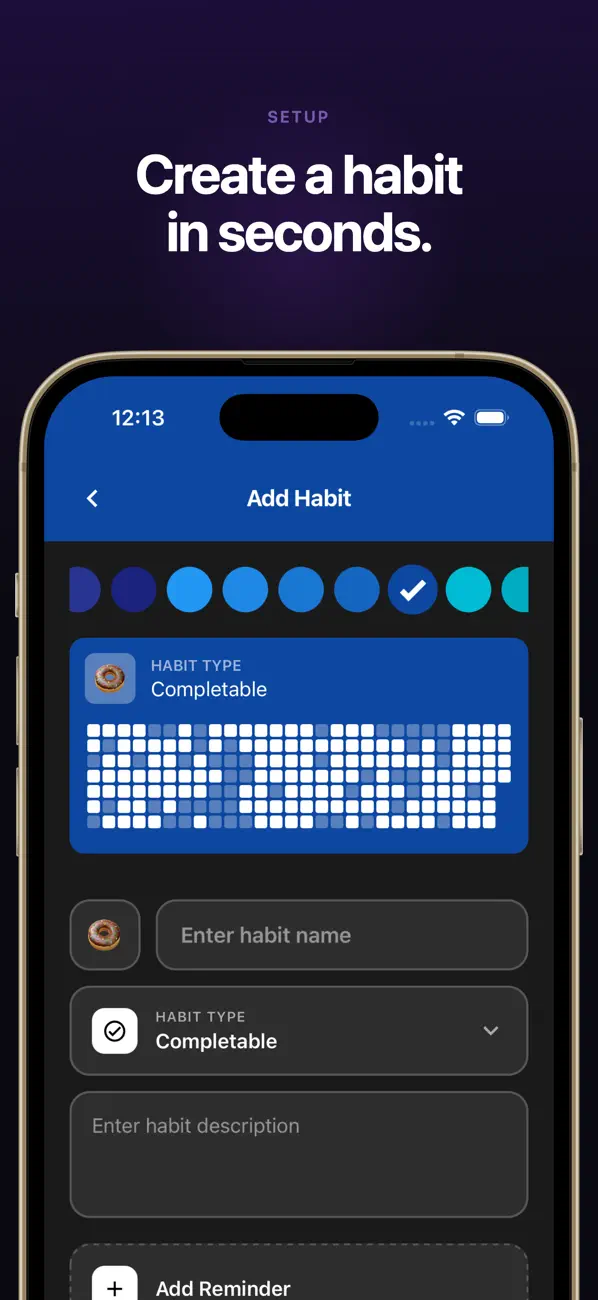
Weekly goals work on the free plan, which includes up to 2 active habits and 1 reminder per habit. Plus adds more active habits and multiple reminders per habit.
Prefer paper? Our printable habit tracker has a Weekly layout with Monday to Sunday columns. Add "Alcohol-free day" as a row, tick each dry night, and keep the sheet where the glasses live.
Other apps do this too. In the UK, the NHS's free Drink Free Days app (also on Google Play) lets you pledge a number of drink-free days each week. Try Dry, from the charity Alcohol Change UK, tracks your dry days plus units, calories and money saved.
If you'd rather stop drinking and count days since your last drink, our sober tracker roundup covers apps built for that.
When a drink-free day is hard to keep
A tracker helps with a habit. It isn't treatment. If a planned dry day keeps feeling impossible, talk to your doctor: the UK CMOs say people who find it hard to cut down can ask their doctor about local support.
Get medical advice before you stop if you have physical withdrawal symptoms, like shaking, sweating or feeling anxious until your first drink of the day. The NHS warns that stopping too quickly without proper help can be dangerous.
In the UK, the NHS alcohol support page lists local services, and Drinkline is free on 0300 123 1110. In the US, SAMHSA's National Helpline is free, confidential and open 24/7 on 1-800-662-4357.
FAQ
How many alcohol-free days a week should I have?
Is it better to drink a little every day or more on fewer days?
Do alcohol-free days help if my weekly total stays the same?
What counts as an alcohol-free day?
What if I drink on a planned alcohol-free day?
Is there an app to track alcohol-free days?

Mira Hartwell
Editor, HabitBoxEditor at HabitBox. Writes about habit science and productivity, grounding every post in named research (Lally, Wood, Walker, Huberman) instead of recycled advice. Read full bio →