Goal Gradient Effect: Why Streaks Motivate (2026)
TL;DR: The goal gradient effect means your motivation rises as you get closer to a goal. In the landmark coffee-card study by Kivetz, Urminsky, and Zheng (2006), café customers bought coffee 20% faster as they neared a free drink — the exact force that makes streaks, progress bars, and "don't break the chain" work. Make your remaining distance visible and you can borrow that final-stretch push for any habit.
You have felt this. The last mile of a run somehow has more in it than the third. The final chapter of a book gets read in one sitting. The loyalty card with one stamp left burns a hole in your wallet. That surge near the end has a name, and it explains a surprising amount about why some habit systems keep you going while others quietly fall apart.
The good news is that this pull toward the finish line is not willpower you either have or don't. It is a predictable feature of how motivation works — and once you can see it, you can build it into your habits on purpose.
What is the goal gradient effect?
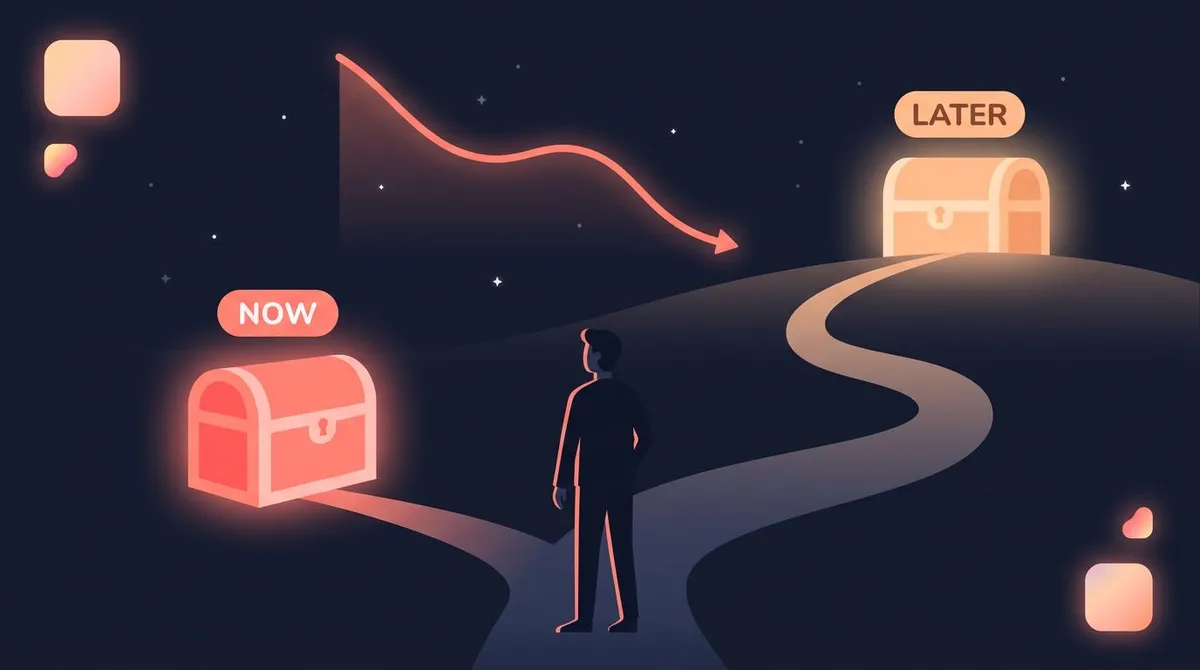
The goal gradient effect is the tendency to increase effort as you get closer to a goal. The nearer the finish line feels, the harder you push. Distance from the reward, not the reward itself, is what modulates your drive.
The idea comes from behaviorist Clark Hull, who proposed the goal-gradient hypothesis in 1932. In his 1934 experiment, Hull built a straight runway and measured how fast rats ran toward food. The rats ran progressively faster the closer they got to the food box — a clean, measurable acceleration toward the reward.
For decades this stayed mostly an animal-behavior finding. The question was whether people, with all our complicated reasoning, would show the same reflex. In 2006, a team of consumer researchers answered it.
The coffee-card study that proved it in humans
Ran Kivetz, Oleg Urminsky, and Yuhuang Zheng published "The Goal-Gradient Hypothesis Resurrected" in the Journal of Marketing Research (Vol. 43, February 2006). They tracked real customers in a café reward program of the "buy ten coffees, get one free" variety.
The result was strikingly Hull-like. Members purchased coffee more frequently the closer they got to the free drink. On average, the time between purchases dropped by roughly 20% as customers approached the reward. People accelerated toward the goal exactly the way the rats did — just with lattes instead of a food box.
One more detail matters for habits. After earning the free coffee, purchase rates reset to a lower level, then accelerated again toward the next reward. Progress is not a permanent boost. It is a renewable one, tied to how near the current milestone feels.
The researchers also ruled out the boring explanations. The acceleration held up after accounting for weekly sales patterns and individual differences between customers — it wasn't just heavy buyers skewing the average. A genuine majority of customers accelerated as the reward drew near, which is what makes the finding robust enough to build habits on rather than a statistical quirk.
The endowed progress effect: the head-start trick
The same 2006 paper uncovered a twist that is arguably more useful than the main finding. It is usually called the endowed progress effect, a name coined in a separate 2006 study by Joseph Nunes and Xavier Drèze that found the same pattern.
The researchers gave one group a loyalty card requiring 10 purchases with no stamps filled in. They gave a second group a card requiring 12 purchases — but with 2 stamps already filled as a "bonus." Both cards required the same 10 real purchases. The only difference was framing: the second group was told they had already started.
The group with the artificial head start completed the card faster — in 12.7 days on average versus 15.6. Nunes and Drèze saw the same effect: a head start made people both more likely to finish and quicker to do it. Being handed progress you didn't earn still triggers the goal gradient. When people feel they have already begun, the goal feels closer, and closeness drives effort.

The practical takeaway: how far along you feel matters as much as how far along you actually are. That gap is something you can design around.
Goal gradient mechanisms and where you see them
The effect shows up anywhere a system makes remaining distance visible. Here is how the underlying mechanism maps to products you already use — and to habits.
| Goal-gradient mechanism | Product example | Habit example |
|---|---|---|
| Shrinking distance to a reward | Coffee loyalty card near the free drink | A 30-day challenge on day 26 |
| Visible progress bar | LinkedIn "profile 80% complete" nudge | A reading log filling toward a page goal |
| Endowed head start | "2 of 12 stamps pre-filled" bonus | Counting habit prep as day one |
| Milestone reset and re-acceleration | Frequent-flyer tiers that renew yearly | A streak that restarts after a miss |
| Fear of losing accrued progress | "You're 3 modules from your certificate" | A 40-day streak you won't break |
Notice how many of these are just streaks and progress bars wearing different clothes. That is not a coincidence.
Why streaks and progress bars exploit the goal gradient
A streak is a running count of consecutive successful days. A progress bar is a visual estimate of how much is left. Both do the same psychological job: they convert an abstract, open-ended goal into a concrete, shrinking distance you can watch close in real time.
Every check-in shortens the perceived gap to the next milestone. Day 3 of a 7-day streak feels ordinary; day 6 feels urgent. The behavior didn't change — the distance did, and the goal gradient did the rest. This is the engine underneath "don't break the chain," the idea often attributed to comedian Jerry Seinfeld's advice to mark an X on the calendar for every day of practice and simply not break the chain.
There is a second force stacked on top once the streak grows. A long streak becomes something you can lose, and we feel losses more sharply than equivalent gains — the well-documented pattern known as loss aversion. A 40-day streak isn't just progress toward a goal; it is 40 days of accrued value you don't want to forfeit. Goal gradient pulls you toward the next milestone while loss aversion pushes you away from breaking what you've built. That combination is why tracking your habits so reliably outperforms tracking nothing.
You can watch both forces operate in a single week. Early in a streak, neither is strong — there's little distance closed and little to lose, so a missed Tuesday feels cheap. By day 6 the goal gradient has your attention because the milestone is one day away, and loss aversion has it too because six days is now worth protecting. That is the sweet spot where habits feel almost self-sustaining, and it is entirely a product of design, not discipline.
The catch is the reset. Because motivation is tied to proximity, breaking a long streak can drop you back to that low, just-started level — which is exactly why an all-or-nothing streak can backfire. The fix is to design milestones you re-approach quickly, not one distant finish line.
How to use the goal gradient effect in your habits
You don't need a café or an app to borrow this force. You need to make remaining distance visible and keep the next milestone close. Here is how.
Set visible sub-goals instead of one distant target
"Meditate every day this year" has no near edge — the goal gradient never kicks in. "Meditate 7 days in a row" does. Break big goals into short, repeatable segments so there is always a finish line within sight. Weekly and monthly targets work better than annual ones for this reason.
A useful rule of thumb: your active milestone should be close enough that you can picture completing it. If you can't feel the finish line from where you stand today, the segment is too long. Shrink it until the next reward is a few days out, not a few months. You can always chain finished segments end to end — that is what a streak already is.
Use a progress bar or streak counter
The point is to externalize your distance so you're not guessing. A calendar you mark, a chain of Xs, a streak number, a bar that fills — any of these turns "somewhere along the way" into "6 of 7." Pairing the goal gradient with clear tracking is what makes keystone habits cascade: visible early wins pull the next behavior along.
Celebrate near-milestone moments
Motivation peaks before the finish, not after. Notice day 6 of 7, not just day 7. A small acknowledgment at the near-goal moment reinforces the acceleration when it's strongest. This is also when you're most vulnerable to overreaching, so protect the streak rather than doubling the goal.
Give yourself an honest head start
Use the endowed progress effect on yourself. Count your planning day, your setup, or your first tentative attempt as progress on the board. Starting a habit card at "day 1 done" instead of a blank slate makes the goal feel measurably closer — and closeness is the whole game. If you're choosing where to begin, our guide on what habits to track can help you pick a starting line worth accelerating toward.
This is where a dedicated tracker earns its place. In HabitBox, the streak counter and calendar heatmap keep your progress-to-next-milestone visible at a glance — which is exactly the "shrinking distance" the goal gradient effect rewards. Seeing a nearly-complete week makes finishing it feel almost automatic.
Where the goal gradient effect has limits
It is not magic, and pretending otherwise sets you up to quit. Three honest caveats.
First, distance has to feel achievable. If the finish line looks impossibly far, the gradient flattens and motivation drops — this is why marathon-sized daily goals so often stall. Keep milestones small enough that the next one always feels within reach.
Second, the reset is real. After a miss or a completed milestone, motivation dips before it rebuilds. Missing a day doesn't erase what you've learned — it just resets the counter. Plan for the dip: make the next milestone short so you re-enter the accelerating zone fast, rather than staring down a distant restart.
Third, the effect rewards visible progress, not busywork. Padding a card with meaningless tasks so the bar fills faster produces a hollow version of the pull — you feel the acceleration but toward a goal that doesn't matter. Point the gradient at behaviors you actually want to keep, and the momentum works for you instead of against your attention.
FAQ
What is the goal gradient effect?
Who discovered the goal gradient effect?
What is the endowed progress effect?
Why do streaks and progress bars work?
How do you use the goal gradient effect to build habits?

Mira Hartwell
Editor, HabitBoxEditor at HabitBox. Writes about habit science and productivity, grounding every post in named research (Lally, Wood, Walker, Huberman) instead of recycled advice. Read full bio →