Temptation Bundling: Make Hard Habits Stick (2026)
Temptation bundling means you only let yourself enjoy a guilty pleasure while doing a habit you avoid. Coined by Wharton professor Katherine Milkman, the trick pairs a want-to-do (a page-turner audiobook) with a should-do (the gym). In her field experiment, bundling raised gym visits by as much as 51%. The one-line how-to: list your favorite temptations, list the chores you dodge, then make each pleasure available only during its paired task.
Most habit advice tells you to push harder. Temptation bundling does the opposite. It makes the hard habit ride along with something you already want, so willpower stops being the bottleneck. Below is what the concept actually is, the real Wharton study behind it, how it differs from habit stacking, and copy-paste bundles you can start this week.
What temptation bundling is
Temptation bundling is a self-control trick. You let yourself enjoy a tempting activity only while doing a task you tend to put off. The pleasure becomes the carrot, and you can only reach it through the chore.
Katherine Milkman, a scientist at the Wharton School, coined the term in 2014. Her insight was simple. Most of us have things we crave but feel a bit guilty about, like binge-listening to a thriller. We also have things we know are good for us but skip. Glue the two together and each one fixes the other's flaw.
The guilty pleasure stops feeling like wasted time, because it now powers a habit. The dreaded chore stops feeling like a slog, because it comes with an instant reward. James Clear later made the idea popular in Atomic Habits (2018). He folded it into his second law: make it attractive.
The key insight is that you do not rely on motivation in the moment. You set up a situation where the thing you want and the thing you should do can only happen at once.
The research: the Wharton gym and audiobook study
The evidence for temptation bundling comes from a randomized controlled trial by Milkman, Julia Minson, and Kevin Volpp, published in Management Science in 2014. It is one of the rare habit hacks with a peer-reviewed effect size behind it.
The researchers recruited 226 participants and split them into three groups. The full-treatment group got iPods loaded with tempting audiobooks (think The Hunger Games) that were locked in the gym and could only be accessed during workouts. The intermediate group got the audiobooks on their own devices with encouragement to listen only at the gym. The control group received a $25 gift card.
Here is what the research says about the results over the first seven weeks. Gym visits rose 51% in the full-treatment group and 29% in the intermediate group, both measured against the control baseline. The effect faded after Thanksgiving break, when the university gym closed and the routine broke.

The most telling result came at the end. When the study wrapped, 61% of people chose to pay (about $6.91 on average) to keep access to the gym-locked audiobooks. They did not just tolerate the rule. They spent money to keep it in place. That suggests bundling solved a real self-control problem they wanted solved.
You can read the full paper on PubMed Central if you want the raw numbers and methodology.
Temptation bundling vs habit stacking
People mix these two up all the time, but they work in different ways. Habit stacking chains a new habit to one you already do, using a cue ("after I pour my coffee, I meditate"). Temptation bundling links a want-to-do with a have-to-do, so the reward only happens during the chore.
The difference is what you pair. Stacking pairs one habit with another, using the first as the trigger for the next. Bundling pairs desire with duty, using a craving as the fuel for a task you avoid.
| Temptation bundling | Habit stacking | |
|---|---|---|
| What you pair | A want-to-do with a have-to-do | A new habit with an existing habit |
| The mechanism | Reward gating (Premack's principle) | Cue chaining (existing routine triggers new one) |
| The cue | The chore itself unlocks the pleasure | The completed habit before it |
| Example | Only watch Netflix while folding laundry | After I brush my teeth, I floss |
| Best for | Habits you dread but rarely start | Habits you forget or never get around to |
Both rely on Premack's principle. That is the finding that a behavior you love can reinforce one you avoid. The two strategies pair well together, and many people layer them. For the full mechanics of chaining, see our guide to habit stacking and its habit stacking examples.
8 temptation-bundling examples you can copy
The fastest way to understand bundling is to see it applied. Each pairing below gates a small pleasure behind a task most people put off. Pick one that matches a temptation you already reach for.
| Habit you avoid | Reward you only allow during it |
|---|---|
| Cardio at the gym | A binge-worthy audiobook or podcast |
| Folding laundry | Your favorite reality show |
| Meal prepping for the week | A guilty-pleasure playlist or podcast |
| Processing your inbox | A fancy coffee from the good cafe |
| Doing the dishes | A funny podcast or comedy special |
| Walking on the treadmill | The next episode of a binge series |
| Cleaning the bathroom | A loud throwback music playlist |
| Reviewing finances or bills | A glass of wine and a scented candle |
The rule that makes these work: the reward is off-limits at every other time. If you watch the show on the couch anyway, the laundry loses its pull. Scarcity is what turns the pleasure into a real incentive.
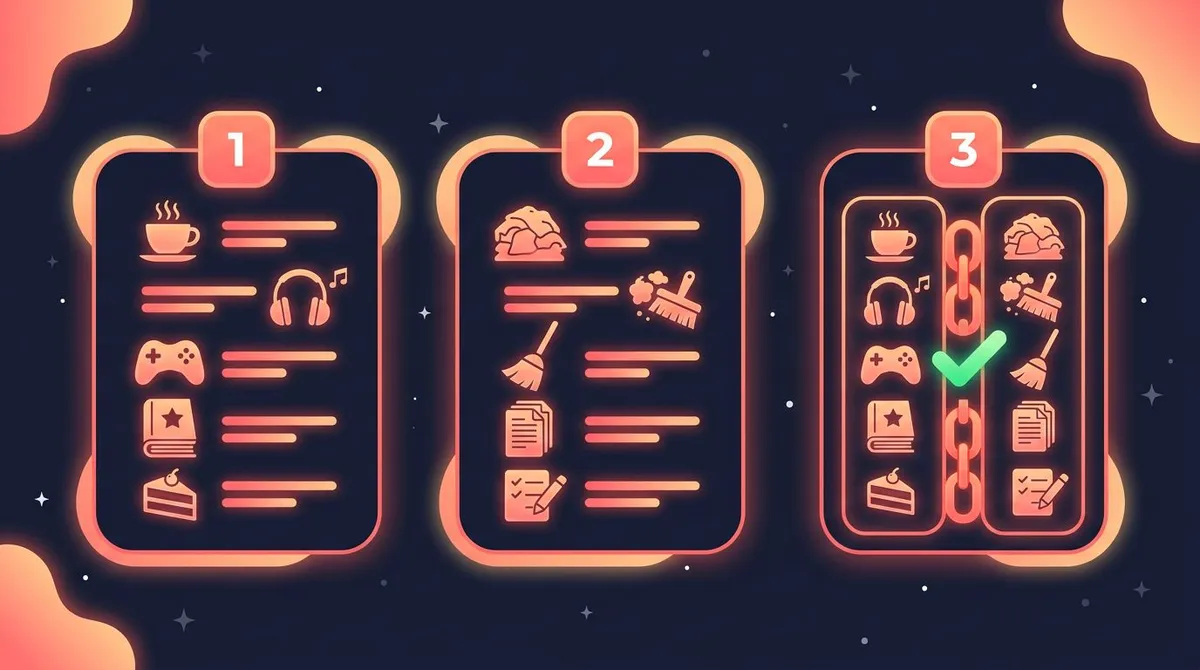
How to set up your own bundle in 3 steps
Building a bundle takes about ten minutes. The goal is to find a pairing strong enough that you start the chore just to unlock the reward.
Step 1: List your temptations
Write down the activities you genuinely look forward to but feel slightly guilty about. Streaming shows, audiobooks, social media, podcasts, a specific snack or drink. These are your reward candidates.
Step 2: List the habits you dodge
In a second column, write the tasks you know matter but keep avoiding. Exercise, chores, admin work, studying. James Clear calls this the two-column method, and it surfaces pairings you would never spot otherwise.
Step 3: Pair one and enforce the gate
Match a temptation to a chore and commit to a single rule: the pleasure only happens during the task. Make it concrete and binding. The Wharton study worked partly because the audiobooks were physically locked in the gym, so removing the temptation from its usual context is the move that protects the bundle.
Start with one bundle, not five. Once it runs on autopilot for a couple of weeks, add the next.
Where temptation bundling backfires
Temptation bundling is not foolproof. Being honest about its limits keeps you from picking a pairing that quietly fails. The main failure mode is when the reward works against the habit itself.
A wine-and-treadmill bundle is a bad idea, because the reward fights the health goal. The same goes for snacking through a workout. Pick a pleasure that does not cancel out the habit's purpose.
The second trap is leakage. If you keep enjoying the temptation outside the bundle, the chore loses its only payoff. The whole system depends on the reward staying scarce, which takes some discipline up front.
Bundling also struggles with deep-focus work. You cannot bundle a podcast with writing a report, because the audio fights for the same attention. It shines for simple, repeat tasks like cardio, chores, and errands. It falls flat for work that needs your full head. For those, lean on cue-based systems and identity-based habits instead. Bundling is one tool in the kit, not the whole kit. It maps onto the "make it attractive" stage of the 4 laws of behavior change, so it works best alongside the other three.
Track which bundles actually stick
A bundle that feels great in week one can quietly fade by week three, exactly like the Wharton effect did after the gym closed. The only way to know which pairings hold is to watch the data over time.
That is where a habit tracker earns its place. Logging each bundled habit and watching the streak build tells you in plain numbers whether "audiobook only at the gym" still pulls you in, or whether the reward has gone stale. If you run a few bundles at once, a simple tracker like HabitBox keeps every streak and completion rate in one calendar view. That way you can spot the pairing that stopped working before it drags the habit down with it.
The bundles that survive are the ones you can see working. Make the reward scarce, gate it behind the chore, and keep an eye on the streak.
Temptation Bundling FAQ
What is temptation bundling?
Does temptation bundling actually work?
Is temptation bundling the same as habit stacking?
What are examples of temptation bundling?
Who invented temptation bundling?

Mira Hartwell
Editor, HabitBoxEditor at HabitBox. Writes about habit science and productivity, grounding every post in named research (Lally, Wood, Walker, Huberman) instead of recycled advice. Read full bio →