The Habit Loop: Cue, Routine, Reward Explained (2026)
The habit loop is the three-part pattern your brain uses to automate behavior: a cue triggers a routine, which delivers a reward. Once the brain sees this loop repeat enough, it stores the whole sequence in the basal ganglia and starts running it without conscious thought. That's why you reach for your phone the second you sit down — and why understanding the loop is the first step to changing any habit.
TL;DR — the habit loop in 30 seconds
The habit loop has three core parts:
- Cue — what triggers the behavior (time, place, emotion, person, preceding action).
- Routine — the behavior itself.
- Reward — what your brain gets out of it.
In his follow-up work, journalist Charles Duhigg added a fourth element: craving — the anticipation of the reward that pulls you through the loop. So the full model is cue → craving → routine → reward.
Want to change a habit? You can't just stop the routine. You have to keep the cue and the reward, and swap the routine for something better. For the full step-by-step version, see how to break a habit. Duhigg's 4-step rewrite, the underlying neuroscience, and a worksheet are below.
Where the habit loop came from
The phrase "habit loop" was popularized by journalist Charles Duhigg in The Power of Habit (2012). But the neuroscience predates the book by decades.
At MIT, neuroscientist Ann Graybiel ran a series of experiments — most famously with rats running a T-shaped maze for chocolate — showing that as a behavior becomes habitual, brain activity shifts. Early in learning, the prefrontal cortex (the deliberative part of the brain) is highly active. After the behavior is repeated enough, activity concentrates in the basal ganglia, a deeper structure that stores routines. The behavior fires automatically at the start and end, with the brain quiet in between. (MIT News on Graybiel's research, 2012.)
Duhigg packaged the science into the three-part model now used by Healthline, Stanford, Peloton, and every "what is the habit loop?" article on the internet. Most of them stop at the three parts. Duhigg's later work — and James Clear's Atomic Habits (2018), which builds directly on the loop — adds a fourth element: craving.
The full 4-part model
Here is the loop as Duhigg later described it, with the craving step added:
| Step | What it is | Example |
|---|---|---|
| 1. Cue | The trigger | Phone buzzes |
| 2. Craving | Anticipation of the reward | "I want to know what it is" |
| 3. Routine | The behavior | Pick up phone, unlock, check |
| 4. Reward | What you get | Social hit, novelty, relief from boredom |
Without the craving, the cue is just information. Your phone buzzes for a building fire alarm test and you don't feel pulled to check — there's no craving attached. But your phone buzzes with a notification, and you feel the pull instantly. The craving is the engine.
Clear's Atomic Habits uses the same four steps under slightly different labels: cue, craving, response, reward. Same loop, same components.
The 5 types of cues
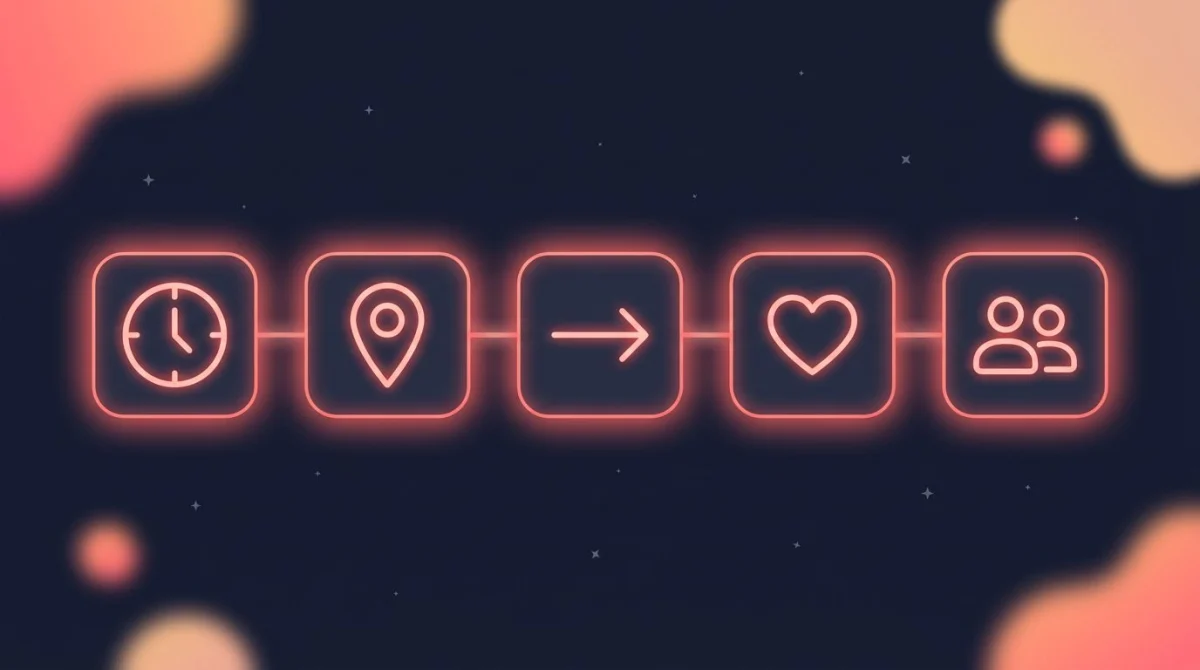
Most cues fall into one of five categories. Duhigg names these directly:
- Time — "It's 10 a.m." (coffee break, snack, scroll)
- Location — "I'm in the kitchen." (open the fridge)
- Emotional state — "I feel anxious." (bite nails, scroll, eat)
- Other people — "My partner just sighed." (defensive response)
- Immediately preceding action — "I just brushed my teeth." (floss — or check phone)
That last one — preceding action — is the most useful for building good habits. It's the cue lever behind habit stacking: you pair a new behavior with an action you already do reliably, and the existing action becomes the cue.
The other four are more often the cue lever behind bad habits. The first move in changing a bad habit is figuring out which type of cue is firing it.
What "reward" really means
Reward gets misunderstood. It's not a treat. It's not external. It's the thing your brain is actually after — and often it's not what you'd say if asked.
Duhigg's example: he had a habit of leaving his desk every afternoon to buy a cookie from the cafeteria. He assumed the reward was the cookie. When he experimented, he realized the reward was actually socializing — the chat with coworkers while waiting in line. He swapped the cookie run for a 10-minute chat with a colleague at his desk. The habit dissolved.
That's the work: figuring out what your brain is actually getting from the routine. Common hidden rewards:
| Surface routine | Likely real reward |
|---|---|
| Snacking at 3 p.m. | Break from work, distraction |
| Checking phone every 5 min | Novelty, mental shift, avoidance |
| Pouring a drink at 7 p.m. | Transition from work to home |
| Scrolling at bedtime | Decompression, escape from tomorrow |
| Opening the fridge bored | Stimulation, something to do |
Notice none of these are about the food, the phone, the drink, or the fridge. Those are the routines. The reward is mental — and that's why willpower-based interventions usually fail. You can white-knuckle past the cookie, but the brain still wants the chat.
The neuroscience in one paragraph
Once a behavior is repeated enough times, the basal ganglia store the whole sequence as a chunk. The prefrontal cortex — the part responsible for conscious decision-making — disengages during the routine, then re-engages at the reward. Ann Graybiel and colleagues at MIT showed this in rats and confirmed it in humans: habits live in older, deeper brain structures, not in your conscious will. This is why "just try harder" is a poor strategy for habit change. You're trying to override hardware with software, and the hardware always wins eventually.
How to hack your habit loop — Duhigg's 4-step rewrite
This is the practical part. Duhigg's framework, lightly streamlined.
Step 1 — identify the routine
Write down the habit you want to change. Be specific. Not "I eat too much," but "every afternoon around 3 p.m. I go to the cafeteria and buy a cookie."
Step 2 — experiment with rewards
On different days, change what you do during the cue window and observe how you feel 15 minutes later.
- Day 1: get a cookie, eat at your desk (skip the social).
- Day 2: take a 10-minute walk outside (movement + novelty).
- Day 3: chat with a coworker for 10 minutes (social only).
- Day 4: get a piece of fruit from the cafeteria (different food, same trip).
After each experiment, write three words for what you're feeling. Then ask yourself if the craving is still there. The day the craving disappears is the day you've isolated the real reward.
Step 3 — isolate the cue
The same Duhigg framework: when the urge hits, write down five things — location, time, emotional state, other people present, immediately preceding action. Do this for a week. The pattern almost always becomes obvious. Most people discover their cue is one specific feeling at one specific time.
Step 4 — have a plan
Once you know the cue and the real reward, design a replacement routine:
When [cue] happens, instead of [old routine], I will [new routine] to get [same reward].
Example: "When 3 p.m. hits and I feel restless, instead of buying a cookie, I will walk to my colleague's desk and ask about her weekend, to get a 10-minute social break."
Write it down. Read it before the cue window. The first 2–3 weeks require deliberate practice; after that, the new routine starts taking over.
Why "just stop the routine" never works
The loop has a structural property: you can break the routine, but the cue still fires and the craving still rises. If you don't redirect to a new routine, the brain finds one on its own — often a worse one.
Classic example: quitting smoking by sheer willpower. The cue (stress, after-meal, with coffee) still happens. The craving (nicotine, oral fixation, the social ritual) still rises. Without a planned new routine, people commonly substitute snacking, drinking, or scrolling — three new habits trying to fill the same loop.
The lesson from Duhigg, Clear, and Graybiel is the same: keep the cue, keep the reward, swap the routine. Subtraction alone usually fails.
Habit loops in apps (the streaks angle)
Habit-tracking apps don't claim to rewire your brain, but they do build artificial reward systems on top of your habit loops.
- Streak counters create an external reward your brain notices (visible progress, loss aversion when you might break the chain).
- Calendar heatmaps turn weeks of small actions into a single visible pattern — a long-form reward.
- Daily check-ins give you a one-tap completion signal, which is itself a small reward (the satisfying mark of "done").
The mechanism is honest: the app isn't doing the habit for you, it's giving the routine a clear reward signal so the loop closes more cleanly. HabitBox uses exactly these — streaks, calendar heatmaps, and one-tap check-ins — without an account, ads, or AI coach. It's free to start on iOS and Android, with optional Plus. The reason it works for some people is the same reason a paper checkmark works for others: visible progress is a reward your brain likes.
This is also why streaks can backfire if a tracker is too aggressive. If breaking the streak feels punishing rather than informative, the loop trains avoidance instead of action. The fix is a tracker that doesn't shame you for missing — just shows where the gap was. Habitica is the extreme case — it turns the whole loop into an RPG where missed habits damage your character. If that reward layer sounds like too much, our roundup of simple habit tracker apps like Habitica alternatives covers gentler options.
Habit loop examples (good and bad)
Five short examples showing the full loop.
| Habit | Cue | Craving | Routine | Reward |
|---|---|---|---|---|
| Morning coffee | Alarm, kitchen | Wake-up boost | Make + drink coffee | Caffeine + ritual comfort |
| Phone-check on bed | Phone visible at bedside | Curiosity | Pick up, scroll | Novelty + escape from quiet |
| 4 p.m. snack | Energy dip + clock | Stimulation | Walk to cafeteria | Break + sugar boost |
| Evening run | Changing out of work clothes | Stress relief anticipated | Lace up, run 3 km | Endorphins + sense of done-for-day |
| Late-night scroll | In bed, alone, mind active | Escape from tomorrow | Open Instagram | Distraction + delayed sleep |
Notice the structure is identical across "good" and "bad" habits. The loop is morally neutral. What changes is whether the long-term effect is one you want.
How long does a new habit loop take to form?
Most articles repeat the 21-day myth. The actual research is from Phillippa Lally and colleagues at University College London (2009, European Journal of Social Psychology): the median time for a new habit to become automatic was 66 days, with a wide range (18–254 days). Habit-forming time depends on difficulty and consistency.
Two practical implications:
- Plan for at least 8–10 weeks of conscious practice before a new habit feels automatic.
- One missed day does not break the habit. Lally's data showed missing one day had no measurable effect on automaticity — as long as the person came back the next day.
For the longer version of the science, see our guide to habit formation.
FAQ
What is the habit loop?
Who created the habit loop?
What's the 4th step in the habit loop?
How do you change a habit loop?
What are some examples of habit loops?
Where to start
If you want to actually use this:
- Pick one habit you want to change. Write down the routine first.
- For one week, log the cue every time you do it (time, place, emotion, who's around, what you just did).
- The next week, experiment with different actions in the same cue window to find the real reward.
- Design a replacement routine that keeps the cue and reward, swaps the action. Write it down.
Two to three weeks of deliberate practice is usually enough to start replacing the old loop, but expect it to take 8–12 weeks before the new version feels automatic. That's the identity-based habits shift Clear talks about — you're not just changing what you do, you're casting small votes for who you become.
The loop is the wiring. The rewrite is the work.

Mira Hartwell
Editor, HabitBoxEditor at HabitBox. Writes about habit science and productivity, grounding every post in named research (Lally, Wood, Walker, Huberman) instead of recycled advice. Read full bio →