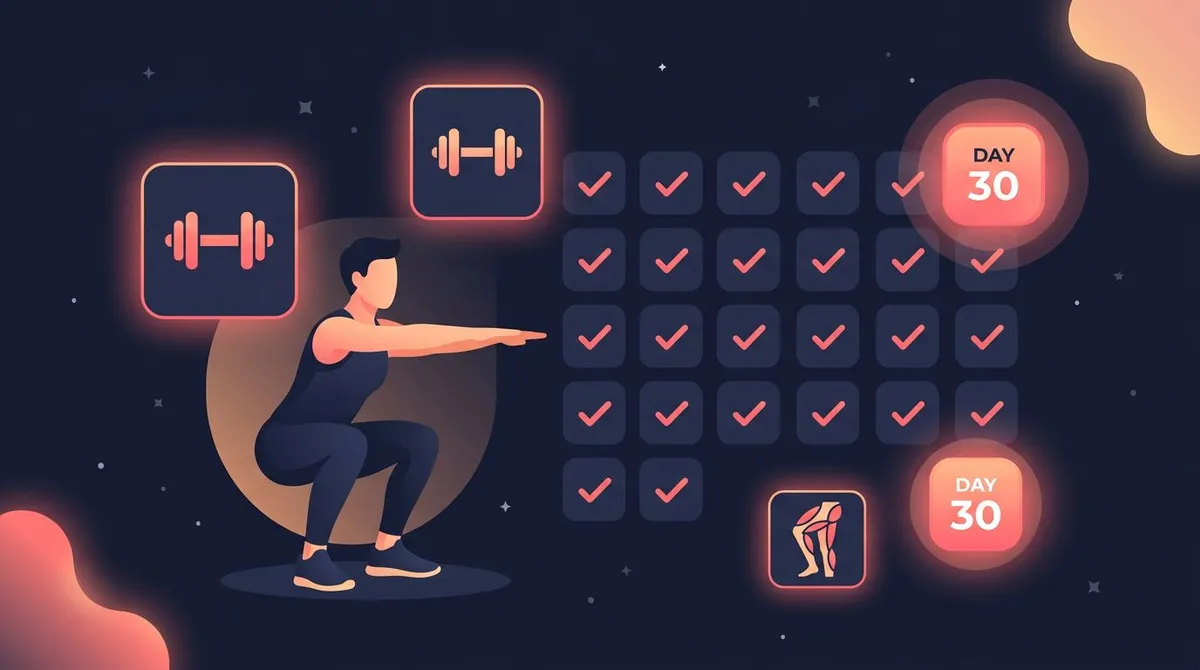
How to Start Working Out: A 4-Week Beginner Plan
TL;DR. How to start working out as a beginner: train 3 days a week for 20-30 minutes with full-body bodyweight movements and a rest day between sessions. U.S. guidelines recommend 150 minutes of moderate activity plus 2 strength sessions per week, but starting smaller and building the habit beats going all-in and burning out in the first weeks. Below: how to pick your days and start time, a week-by-week 4-week plan, how hard it should feel, the five movements to learn, and the habit layer that keeps you going.
You know the pattern. Monday you're motivated, so you go hard — a long session, sore muscles, a promise to yourself. By Thursday you can barely walk down the stairs, the second workout gets skipped, and by the following week the whole thing is quietly dead.
That is not a discipline problem. It is a starting-line problem. Starting too hard is a common reason beginners stop, and laziness has little to do with it. The fix is to begin at a level that feels almost too easy, then let consistency do the heavy lifting.
Here's a plan for starting from zero.
How many days a week should a beginner work out?
Start with 3 days a week, 20-30 minutes per session, with a rest day in between. That is enough to build strength, protect you from doing too much too soon, and — most importantly — leave you wanting to come back.
The U.S. Physical Activity Guidelines for Americans, summarized by the CDC, recommend adults get 150 minutes of moderate-intensity activity per week plus muscle-strengthening work on 2 or more days. That's the destination, not the starting line.
If you did 150 minutes on day one, you'd be sore, discouraged, and done. The NIDDK's guidance on starting physical activity says the same thing in plain terms: start slowly and build up from there. The plan below begins with three 20-minute sessions and two 15-minute walks, then ramps up week by week.
The reason to under-start is behavioral, not physical. A session you finish and feel good about is a session you'll repeat. A session that wrecks you for three days breaks the chain before it forms.
Pro tip: pick your 3 days now and write them down — for example, Monday, Wednesday, Saturday. A vague "3 times a week" is easy to push to next week.
How to pick a start time you'll keep
The best time to work out is the one you can repeat on all three of your training days. Morning, lunch and evening all work; what matters is that the slot is predictable. Three questions narrow it down:
- When were you free? Look back at your calendar for the last two weeks and find a 30-minute window that was open on at least three days.
- What happens right before it? Pick an event that already happens just before that window, such as pouring your coffee, the school drop-off or closing your laptop. That event becomes your cue: "After I close my laptop, I change into workout clothes."
- Does it cost you sleep? If a 6 a.m. session means sleeping less than the 7 or more hours the CDC recommends for adults aged 18 to 60, choose a later slot (CDC).
| If your days look like this | Try this slot | Cue to anchor it to |
|---|---|---|
| Predictable office or remote hours | Before work, or as soon as you get home | Pouring your first coffee; dropping your bag by the door |
| Mornings taken up by kids | Right after the school drop-off, or after the kids' bedtime | Closing the front door; switching off their light |
| Unpredictable evenings | Lunch break | Closing your laptop for lunch |
| Shift work or rotating hours | The first hour after you wake, whatever the clock says | Your first glass of water |
Keep the same slot for all four weeks. If it fails two sessions in a row, move it instead of leaning on willpower: the slot was wrong, not you.
How to start working out: a simple 4-week beginner plan
Here's a progression you can run at home with no equipment. Each session is full-body, and the volume climbs slowly so week 4 feels like a natural step up rather than a wall.
Walking counts. On non-lifting days, a brisk 15-30 minute walk keeps you active without adding recovery load, and it moves you toward that 150-minute weekly number.
| Week | Strength sessions | What each session looks like | Walks | Focus |
|---|---|---|---|---|
| Week 1 | 3 × 20 min | 5-minute easy walk to warm up, then 2 sets of 8 squats, 8 incline push-ups and a 15-second plank | 2 × 15 min | Learn form; end every set with 2-3 reps left in the tank |
| Week 2 | 3 × 25 min | Same warm-up, then 3 sets of week 1's moves, plus 2 sets of 10 glute bridges | 2 × 20 min | Your first added set |
| Week 3 | 3 × 25 min | Repeat week 2. Nothing new | 3 × 20 min | Hold the volume; walk a little more |
| Week 4 | 3 × 30 min | Warm-up, then a circuit, 3 rounds: 10 squats, 10 incline push-ups, 12 glute bridges, 20-30-second plank | 3 × 25 min | Optional 4th session: a longer brisk walk |
Rest about a minute between sets. By week 4 your walks add up to 75 minutes, half of the 150-minute aerobic target; the NIDDK suggests adding 5 to 10 minutes every few weeks from there.
Notice week 3 adds nothing new. That's deliberate: many beginners find the third week the hardest, once the novelty has worn off, so the plan asks you to keep showing up rather than push harder. Repeat week 4 as many times as you like, then start adding reps, sets, or resistance. To run the week-4 circuit on the clock, a free HIIT timer handles the work and rest intervals so you're not watching a clock between rounds.
How hard should it feel?
For the strength moves, finish each set with two or three reps you could still do. For walks, aim for moderate intensity. The CDC's talk test is the simplest check: during moderate-intensity activity you can talk, but not sing (CDC).
If you wear a heart rate monitor and want numbers, enter your age and resting heart rate in our heart rate zone calculator. For example, a 40-year-old with a resting heart rate of 70 gets an estimated maximum of 180 bpm (220 minus age). The calculator's two easiest zones, which it describes as "very easy, full conversation" and "easy, base building, long sentences," come out at 90-126 bpm with the simple percentage-of-max method, or 125-147 bpm with the Karvonen method, which factors in resting heart rate. The methods disagree, so treat the numbers as a rough guide and let the talk test have the final say.
A smartwatch or chest strap can log your heart rate and walking minutes for you; our fitness tracker app comparison covers which apps read that data on iPhone and Android.
Form beats intensity every session. Slow, controlled reps with good technique build more than sloppy fast ones — and they keep you off the injury list that ends so many beginner runs.
The five movements to learn first
You don't need a gym or equipment to start. Five bodyweight movements cover the major patterns your body uses every day.

- Bodyweight squat — feet shoulder-width, sit back like lowering into a chair, knees tracking over toes. Trains legs and glutes.
- Incline push-up — hands on a counter or sturdy table, body straight, lower your chest to the edge. Easier than a floor push-up and lets you build real pressing strength.
- Plank — forearms down, body in one line from head to heels, core tight. Start with 15-20 seconds and add time weekly.
- Glute bridge — lie on your back, feet flat, drive your hips up and squeeze. Wakes up muscles that sitting all day switches off.
- Brisk walk — the most underrated exercise there is. It's low-risk, requires nothing, and adds up fast.
Do 2-3 sets of 8-12 reps for the strength moves, resting a minute between sets. If a movement hurts a joint (not just "works the muscle"), stop and scale it back. When in doubt, film one set and check that your back stays neutral and your knees stay stable.
The habit layer: how to not quit by week three
The plan is the easy part. Doing it on the day you don't feel like it is the whole game. Four small moves make the difference.
Schedule it, don't decide it. Attach your workout to something you already do daily — right after your morning coffee, or the moment you get home. In Atomic Habits, James Clear calls this habit stacking: the existing routine becomes the cue for the new one, so you're not relying on remembering or feeling motivated.
Start absurdly small. On low-energy days, commit to putting on your workout clothes and doing one set. That's it. This is BJ Fogg's Tiny Habits idea: make the behavior small enough that a low-motivation day can't talk you out of it. Once you've started, you'll often keep going.
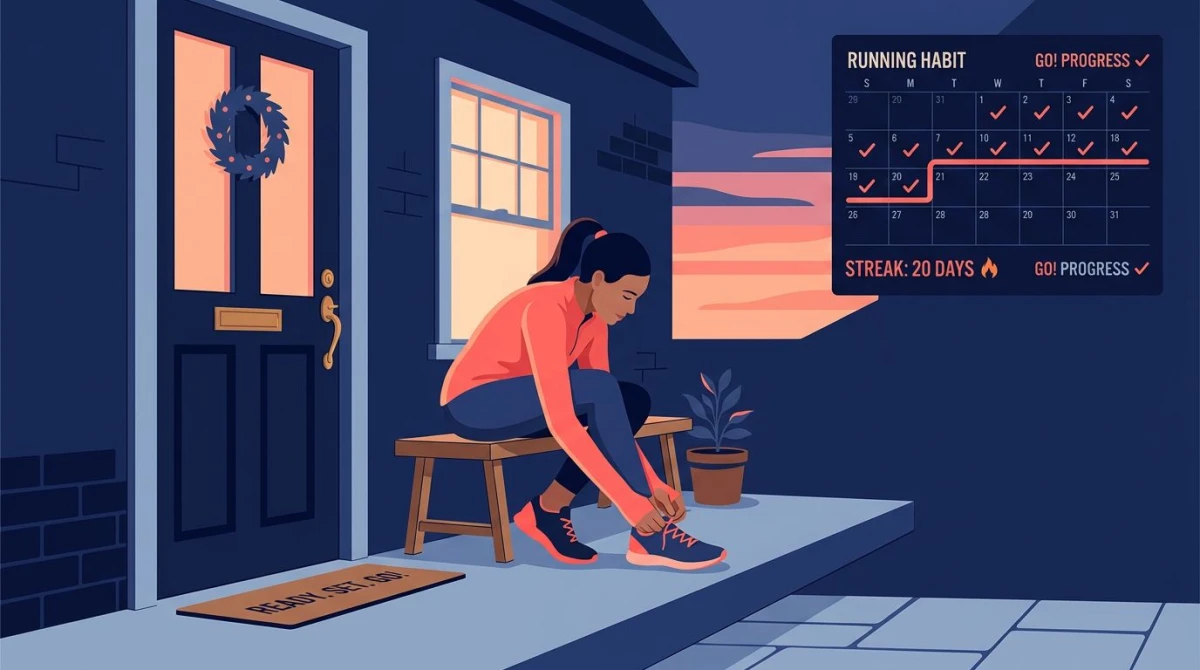
Streak it. Marking each session done taps into loss aversion: after five checkmarks in a row, you don't want to break the chain. A dedicated tracker like HabitBox (our own app) shows your workout streak as a growing calendar, which turns "should I today?" into "I'm not breaking this." Research from University College London (Lally et al., 2010) found new habits took a median of 66 days to become automatic — so a visible streak carries you through the long middle stretch where motivation has already faded.
Expect the early dip. For many beginners, motivation sags around the third week, once the novelty wears off. Knowing it's coming takes away some of its power. When it hits, don't quit — shrink the workout. A 10-minute session keeps the streak alive and beats a zero every time.
For the deeper consistency playbook once you're past the beginner stage, see our guide on how to make exercise a habit — it goes far past the first month. If mornings are your window, the morning workout routine pairs a 20-minute plan with a fixed cue. And if consistency in general is your struggle, how to be consistent covers the mechanics that apply well beyond the gym.
Common beginner mistakes to avoid
A few predictable errors end a lot of beginner runs. Sidestep these and you're most of the way there.
- Going too hard on day one. An all-out first session can leave you too sore to want a second one. Leave a little in the tank.
- Skipping rest days. Your body adapts between sessions, so recovery is part of the plan. Hard full-body sessions on back-to-back days leave little room for it.
- Chasing intensity over form. Ten clean reps build more than twenty sloppy ones — and they don't put you on the couch for a week.
- Measuring by the scale in week one. Early wins are sessions completed and cleaner form, not the number on the scale. Judge the first month by whether you showed up.
- Treating one missed day as failure. Missing a workout doesn't undo anything. In Lally and colleagues' habit-formation study, missing one opportunity did not materially affect the habit-forming process. Get back to the plan at your next session.
If you'd rather ease in with cardio, our guide to running for beginners uses the same start-small logic, and our free stretching timer runs a five-minute beginner routine, a gentle way to build the daily movement habit before you add load.
A quick health note: if you have a heart condition, a chronic injury, are pregnant, or have been inactive for a long time, check with a doctor before starting. For most healthy adults, starting gradually is safe — but form and honesty about pain always come before intensity.
FAQ
How do I start working out as a beginner?
How many days a week should a beginner work out?
Should I do cardio or weights first?
How long before I see results?
What should I do on rest days?
Ready to make it stick? Building the streak is what separates a good first week from a lasting habit. HabitBox lets you track your workout streak with a simple calendar view, so showing up becomes the thing you don't want to break — try it free.

Mira Hartwell
Editor, HabitBoxEditor at HabitBox. Writes about habit science and productivity, grounding every post in named research (Lally, Wood, Walker, Huberman) instead of recycled advice. Read full bio →