How to Stop Being Lazy: 9 Fixes That Work
Here's the short version of how to stop being lazy: laziness is rarely a character flaw — it's usually a motivation, friction, or energy problem. BJ Fogg's Behavior Model (B=MAP) shows that behavior only happens when motivation, ability, and a prompt converge. Find the weakest of those three, fix it, and the "lazy" feeling lifts. Below are 9 research-backed habit fixes, each starting with a single concrete action you can take in the next two minutes.
If you've called yourself lazy lately, you're being too hard on yourself. The good news is that "lazy" is almost never the real diagnosis — and once you find the actual cause, the fix is usually small and specific.
Laziness isn't a character flaw — it's usually one of three things
When you can't make yourself start something, it feels like a personality defect. It isn't. Behavior scientist BJ Fogg, who runs the Behavior Design Lab at Stanford, sums up every action with one tidy formula in his 2019 book Tiny Habits: B = MAP. Behavior happens when Motivation, Ability, and a Prompt all show up at the same moment.
That means a stalled task is never about being lazy. It's about one of those three things being too weak:
- Low motivation — the task feels boring, far away, or pointless right now.
- Low ability (high friction) — it's too hard, too many steps, or your gym bag is buried in a closet.
- No prompt — nothing reminds or cues you, so the moment passes.
The trick is to stop attacking all three at once. Find the weakest link and fix only that. If a workout never happens because your shoes are in the garage, no amount of motivational self-talk will help — you have a friction problem, not a willpower problem.
Most generic advice fails here because it always reaches for the same lever: motivation. "Want it more." "Set a bigger goal." "Visualize success." But motivation is the least reliable of the three. It rises and falls with your mood, your sleep, and the weather. Fogg's insight is that you should design behavior so it works on low-motivation days — because those are the days that decide whether a habit survives. The most durable habits lean on ability (make it easy) and prompts (make it automatic), not on a daily surge of willpower you can't guarantee.
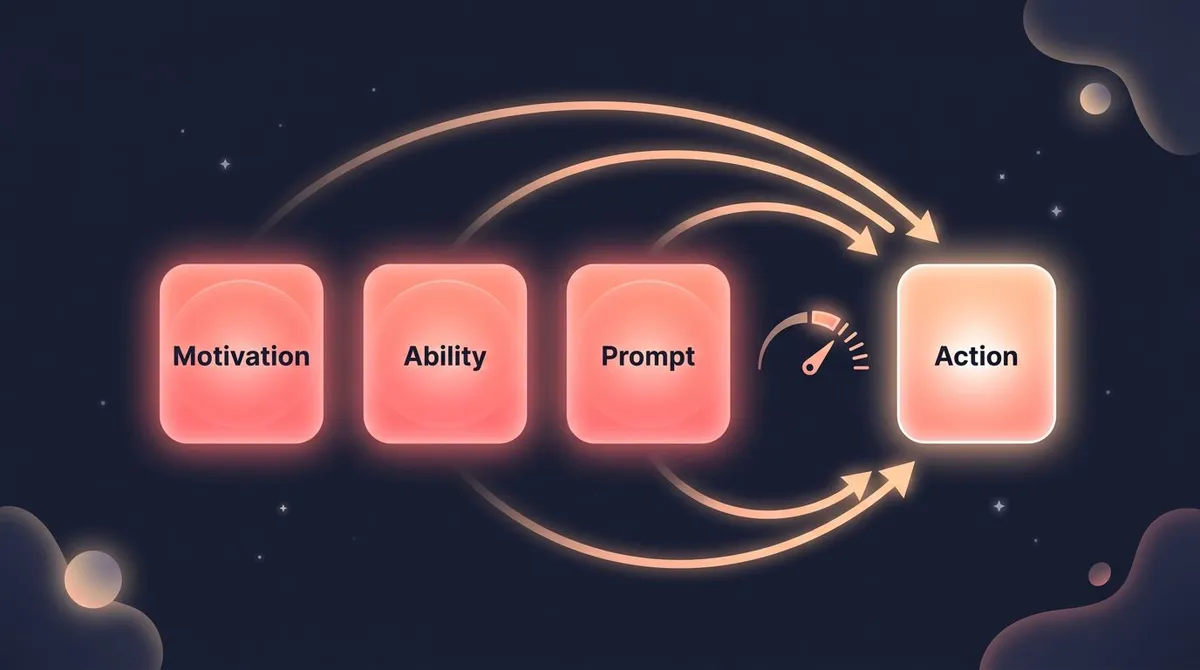
This reframe matters because it's testable. Instead of asking "Why am I so lazy?" you ask "Which of the three is missing right now?" — a question you can actually answer and act on.
Diagnose your kind of lazy
Before you reach for a fix, name the cause. Most "lazy" moments map cleanly to one of a few patterns. Find the row that sounds like you, then jump to the matching fix below.
| What it feels like | Likely cause | The fix |
|---|---|---|
| I keep putting off one specific task | The task is too big or vague (low ability) | Shrink it to two minutes (Fix 1) |
| I want to but never quite start | Too much friction between you and step one | Lower the friction (Fix 2) |
| I forget or "never got around to it" | No prompt — nothing cues the action | Add a starting ritual (Fix 3) |
| I do it for a week, then drop off | Motivation faded and nothing replaced it | Track a streak (Fix 5) |
| I'm tired and foggy all day, every day | Energy leak — sleep, light, or movement | Fix the energy leak (Fix 7) |
| I dread the task itself | The activity is genuinely unpleasant | Pair it with something you enjoy (Fix 6) |
Notice that none of these rows say "you're a lazy person." They name a mechanical cause with a mechanical fix. That's the whole reframe.
The 9 fixes to stop being lazy
Each fix below starts with one concrete first action. You don't need all nine — pick the one that matches your diagnosis and start there.
1. Shrink the task to two minutes
First action: rewrite your task so it takes less than two minutes to start. "Write the report" becomes "open the document and type one sentence." "Go for a run" becomes "put on my running shoes."
James Clear popularized the 2-minute rule in Atomic Habits (2018): when a habit feels too big, scale the starting version down until it takes two minutes or less. The point isn't to do only two minutes — it's that starting is the hard part, and a two-minute version removes the excuse to not begin. Once you're moving, momentum usually carries you further. (We break this down in our guide to the 2-minute rule.)
In B=MAP terms, you're raising ability: a two-minute task is so easy that even your worst day clears the bar. There's also a psychological trick at work. Our brains exaggerate how unpleasant a task will be before we start — the dread is almost always worse than the doing. By committing to just two minutes, you bypass the dread and discover the task wasn't so bad. Most people report that once they've written the first sentence or done the first squat, stopping at two minutes feels harder than continuing.
2. Lower the friction
First action: remove one physical step between you and the task. Lay out your gym clothes the night before. Put the book on your pillow. Leave the guitar out of its case.
Research psychologist Wendy Wood, author of Good Habits, Bad Habits (2019), spent decades studying why we repeat behaviors. Her core finding: context and friction drive habits far more than willpower does. Adding even a small amount of friction to a bad habit, or removing it from a good one, changes behavior reliably. If something never gets done, ask what's in the way — then take that thing out of the way.
The principle cuts both ways, which makes it powerful. To do more of something good, cut steps out: keep the water bottle on your desk, set the running app on your home screen, prep tomorrow's lunch tonight. To do less of something bad, add steps back: log out of the app after each use, leave the phone charging in another room, delete the game so reinstalling becomes the barrier. In one of Wood's diary studies, about 43% of everyday behaviors were habits, repeated almost daily in the same setting while people's minds were often elsewhere — which means redesigning your environment quietly redesigns your behavior. You're not fighting yourself; you're removing the fight.
3. Use a starting ritual
First action: write one sentence in the form "After I [existing habit], I will [tiny new action]." For example: "After I pour my morning coffee, I will open my to-do list."
This is an implementation intention — a specific if-then plan that ties a new action to an existing cue. Decades of research by psychologist Peter Gollwitzer show people who write these plans follow through far more often than those who just intend to "do it sometime." The existing habit becomes the prompt, so you don't have to remember or rely on motivation. (More on building these in our piece on implementation intentions.)
The reason it works: a vague intention ("I'll exercise more") leaves the when and where undecided, so every day you have to re-decide — and on a low-energy day, you decide no. An if-then plan pre-loads the decision and hands the trigger to something that already happens reliably. Your coffee gets poured every morning whether you feel motivated or not, so stapling the new habit to it borrows that reliability. Pick a stable, daily anchor you never skip — brushing your teeth, sitting down at your desk, closing your laptop at the end of work — and chain the new behavior right behind it.
4. Make the first rep stupidly small
First action: cut your goal down to something that feels almost embarrassingly easy. One push-up. One page. One line of code.
This is the heart of Fogg's Tiny Habits method. He argues you should design the behavior to be so small that motivation barely matters — because high ability (an easy task) compensates for low motivation. Floss one tooth. Meditate for one breath. The size grows naturally once the habit exists; what you're protecting is the daily start.
People resist this fix because it feels like cheating — one push-up obviously won't get you fit. But you're not training fitness yet; you're training the identity of someone who shows up. Fogg also recommends celebrating the tiny win immediately, even just a quiet "nice" or a fist pump. In Fogg's view, that hit of positive emotion is what wires the behavior in, faster than repetition alone. Do the smallest version, feel good about it, and let the habit anchor before you scale.
5. Track a streak so the chain becomes the motivator
First action: mark today done, then try not to break the chain. A visible run of completed days becomes its own reward.
Streaks work because of loss aversion — once you've built a 12-day chain, skipping feels like losing something, and we're wired to avoid loss more than we chase gains. A dedicated tracker like HabitBox shows your current and longest streaks as a calendar heatmap, so the unbroken chain is right in front of you when motivation dips. The chain, not your willpower, starts doing the heavy lifting.

If consistency is your sticking point specifically, our guide on how to be consistent digs into the friction-and-streak combination in more depth.
6. Pair the chore with something you enjoy
First action: attach a task you avoid to something you already love. Only listen to your favorite podcast while doing dishes. Only watch your show while on the treadmill.
This is temptation bundling, a tactic studied by behavioral economist Katherine Milkman at Wharton. By linking a "should" to a "want," you give the boring task a borrowed dose of motivation. The dishes don't get more fun — but the podcast makes the moment worth starting, which is all you need.
In Milkman's research, gym-goers who could only listen to addictive audiobooks at the gym went more often than those without the bundle, although the boost faded over time. The mechanism is simple: you make the indulgence conditional on the chore. The cliffhanger you want to hear next is only available while you fold laundry, so part of you actually looks forward to folding. Pick a temptation strong enough to pull you in — a specific show, a treat coffee, a playlist — and ration it to the task you keep avoiding.
7. Fix the energy leak before blaming willpower
First action: protect your sleep window tonight — same bedtime, screens off 30 minutes earlier. Then notice whether the "laziness" eases over a week.
Often what reads as laziness is just low energy. Poor sleep, no daylight, and no movement all flatten the motivation you'd otherwise have. Healthline's medically reviewed guide to laziness points to the same basics: diet, hydration, seven to nine hours of sleep, and regular exercise all affect how much get-up-and-go you feel. Before you label yourself unmotivated, rule out the boring physical causes — they're easier to fix than your character.
Three energy leaks account for most of the "I'm just lazy" feeling. First, sleep debt: even one bad night drops your willpower and focus the next day, and most people are running a chronic deficit without noticing. Second, lack of morning light: bright daylight within an hour of waking helps set your body clock and lift daytime alertness, while dim indoor mornings leave you groggy. Third, sedentary stretches: paradoxically, a 10-minute walk creates energy rather than spending it. Fix these first, give it a week, and see how much of the "laziness" was really fatigue wearing a costume.
8. Remove the choice — schedule it, don't decide it
First action: put the task on your calendar at a fixed time, so showing up isn't a daily decision.
Every time you decide whether to do something, you spend willpower — and decisions pile up into decision fatigue as the day goes on. The fix is to decide once. When the gym is simply "what happens at 7 a.m.," there's no negotiation, no talking yourself out of it. Scheduling converts a draining choice into a default. This is also a core discipline tactic — see how to be more disciplined for the environment-design version.
Notice how often "lazy" is really decision paralysis. You sit down to work and burn twenty minutes deciding what to work on, get tired from the deciding, and end up scrolling instead. A fixed schedule kills that loop because the choice was made yesterday, by a rested version of you, on paper. Time-block the important task for a specific window and treat it like a meeting you can't move. The point isn't rigidity for its own sake — it's removing the moment where laziness gets a vote.
9. Forgive the off day and restart same-day
First action: if you miss, do the two-minute version today — don't wait for Monday.
“Never miss twice” can be a useful reminder to return, but a second missed day does not automatically create a new bad habit. Choose a small next action and change the plan if it repeatedly does not fit your circumstances. Self-criticism is not a prerequisite for restarting.
For a fuller take on reclaiming lost time once these fixes click, our guide on how to stop wasting time is a natural next read — and a good companion to fixing the start.
When "lazy" is actually burnout, depression, or ADHD
Sometimes the fixes above don't touch the problem — and that's important information, not a failure of effort.
If you've lost interest in things you used to enjoy, feel exhausted no matter how much you rest, or can't focus on anything for weeks at a stretch, that's not laziness. Healthline's guide lists mental health conditions such as depression and anxiety, and medical ones such as anemia and thyroid disorders, among the causes that can look like laziness. Its guidance is direct: if you've lost interest and don't have the energy or focus to get things done, talk to a doctor.
Burnout can look similar. The World Health Organization describes it as unmanaged chronic work stress marked by exhaustion, mental distance from your job and reduced effectiveness. So can ADHD, which NIMH notes involves frequent trouble paying attention, keeping on task or staying organized.
A few honest signals it might be more than friction:
- The low energy is constant and lasts more than two weeks.
- It comes with sleep changes, appetite changes, or a flat, hopeless mood.
- You want to do things but feel physically unable to start, repeatedly.
None of this is something a blog post can diagnose, and you shouldn't try to fix a medical issue with a streak tracker. If any of that sounds familiar, talking to a doctor or therapist is the strong, sensible move — the same way you'd see a doctor for a fever that won't break.
Most of the time, though, "lazy" really is a motivation, friction, or energy problem in disguise. The reframe matters: it's the difference between "what's wrong with me?" and "the gap between motivation and discipline" — which we untangle in motivation vs discipline.
How to stop being lazy, starting today
You don't beat laziness with a pep talk. You beat it by finding the weakest link — motivation, ability, or prompt — and fixing that one thing. Shrink the task, lower the friction, add a cue, and let a visible streak carry the motivation you don't have on tough days.
If you want the streak part to do its job, HabitBox keeps your check-ins and your longest streaks visible in one simple view — so the chain stays in front of you when you'd otherwise drift. You can try it free and start with a single two-minute habit today.
How to stop being lazy FAQ
Why am I so lazy all of a sudden?
Is laziness a sign of depression?
How do I stop being lazy and unmotivated?
What is the 2-minute rule for laziness?
Can a habit tracker help with laziness?

Mira Hartwell
Editor, HabitBoxEditor at HabitBox. Writes about habit science and productivity, grounding every post in named research (Lally, Wood, Walker, Huberman) instead of recycled advice. Read full bio →