How to Take Cold Showers: A 4-Week Beginner Plan (2026)
TL;DR: Learning how to take cold showers is easier when you build it gradually instead of bracing for an ice bath on day one. Start with just 30 seconds of cool water at the end of your normal warm shower, exhale slowly as it hits, and drop the temperature a little each week. Over four weeks you ramp from "cool" to genuinely cold — and a 2016 trial found even a 30-second cold finish was enough to cut sick-day absences by 29%. Track it like any other habit and the discomfort fades faster than the willpower would.
Most cold-shower advice falls into two camps: a list of supposed benefits, or a tough-guy challenge that tells you to crank the dial to freezing and "just endure it." Neither actually teaches you how to start without dreading every shower.
The better frame is this: a cold shower is a habit you build, not an ordeal you survive. Treat it like learning to run — you start short, you add a little each week, and you let repetition do the work that motivation can't.
Why cold showers are easier as a habit than a one-off challenge
A 30-day "cold shower challenge" relies on willpower, and willpower is a finite resource that drains as the day goes on. That is exactly why most challenges fizzle around day three, the moment the novelty wears off and the cold still feels awful.
A habit works differently. Once a behavior is anchored to a reliable cue and repeated daily, it stops drawing on willpower and starts running closer to automatic. Wendy Wood's research suggests roughly 43% of daily behavior runs on autopilot rather than active decisions — and a cold finish at the end of your shower is a perfect candidate for that autopilot list.
The other advantage of the habit frame is the gradual ramp. You are not asking your nervous system to tolerate freezing water tomorrow. You are asking it to tolerate slightly cooler water than yesterday, which is a request it can actually meet. By the time you reach genuinely cold water in week four, your body has already adapted in small, survivable steps.
If you have struggled to stick with routines before, it helps to understand the mechanics first. Our guide on how to be consistent breaks down why friction — not desire — usually decides whether a habit survives.
The breathing trick that stops the gasp
The worst part of a cold shower is not the cold itself. It is the involuntary gasp — that sharp inhale and shoulder-clench your body does the instant cold water hits your skin. It feels like panic, and it makes the whole thing seem unbearable.
The fix is to control the exhale. As the cold water lands, breathe out slowly and steadily through your mouth instead of sucking air in. A long, calm exhale tells your nervous system you are safe and keeps the shock response from spiraling. The Wim Hof Method describes this same principle — when the cold hits, you "try to control your breathing" rather than fight it.
One important safety note: do not do intense, rapid Wim Hof–style power breathing while standing in the shower. The Wim Hof Method explicitly warns against it, because forceful hyperventilation can make you light-headed enough to pass out — a genuine hazard on a wet, hard surface. Keep it simple: slow exhale on contact, normal breaths after.
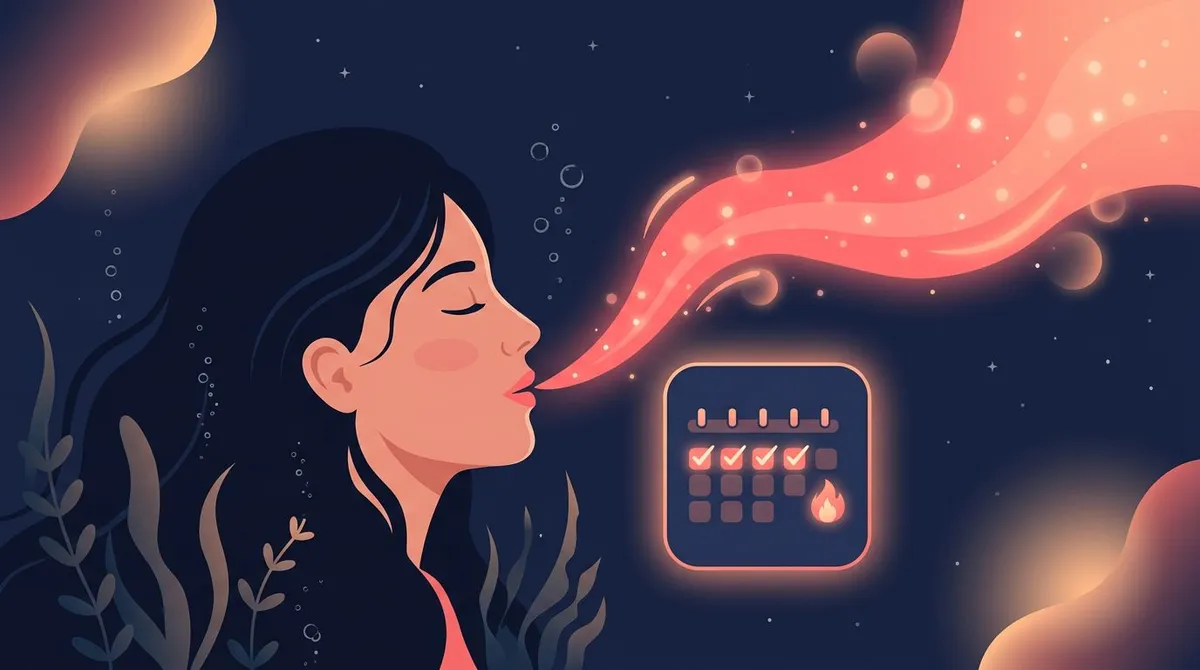
In practice, it looks like this. Before you turn the water cold, take one slow breath in. As you flip to cold, push a long exhale out — count it to four or five seconds. Then let your breathing settle into a slow, deliberate rhythm. The Wim Hof Method notes the first 15 seconds or so are always the hardest; ride out that window with controlled exhales and the panic passes.
The 4-week cold-shower ramp plan
Here is the part no benefits-listicle gives you: an actual week-by-week plan. The idea is to lower the temperature and extend the time in small, repeatable steps so your body adapts without ever facing a miserable jump.
You do not need a thermometer. "Cool" means noticeably colder than comfortable but still tolerable; "cold" means the coldest your tap runs. For reference, research-backed cold-exposure guidance tends to land around 50–59°F (10–15°C), and the Wim Hof Method cites roughly 14°C as a minimum for measurable benefit — but you reach that by feel, not by reading a gauge.
| Week | Water temperature | Duration at the end of your shower |
|---|---|---|
| Week 1 | Cool — a small step down from your normal warm | 30 seconds |
| Week 2 | Cooler — clearly chilly, not yet cold | 45–60 seconds |
| Week 3 | Cold — close to full cold tap | 60–90 seconds |
| Week 4 | Full cold | 90–120 seconds |
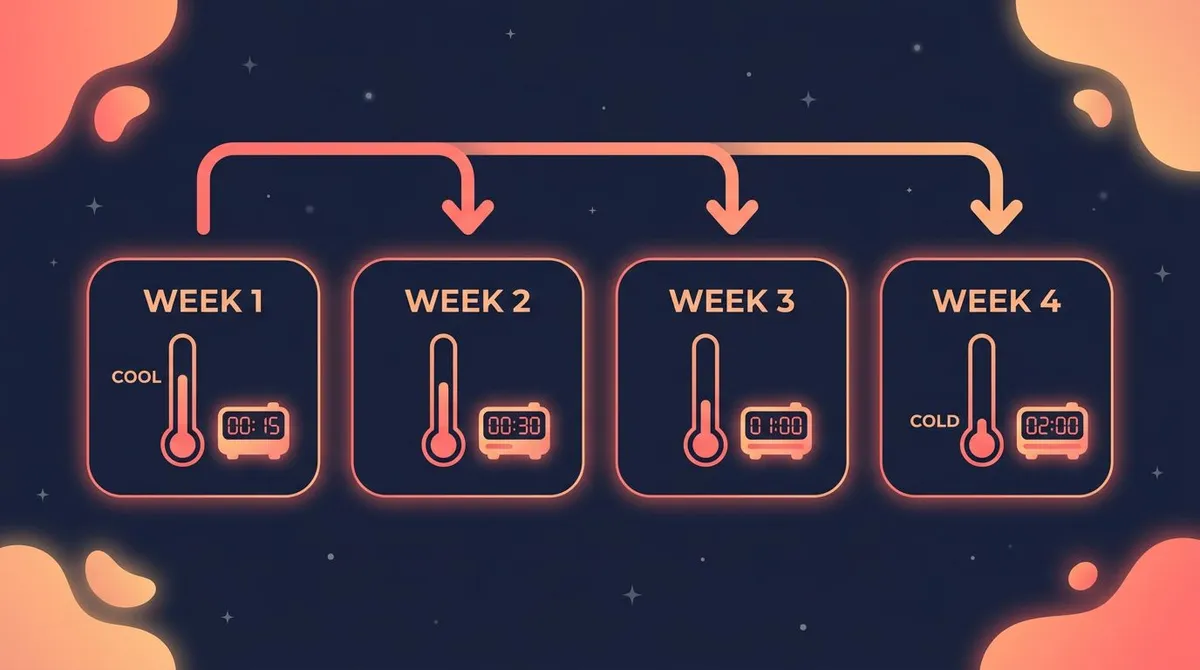
Two rules make this stick. First, only the end of your shower is cold — wash warm, then finish cold. This matches Healthline's beginner advice to "start by slowly lowering the temperature at the end of a usual shower," then increase coldness and duration after seven to ten sessions. Second, if a week feels too hard, repeat it before advancing. There is no prize for rushing the ramp, and a week you can actually complete beats a week you skip.
By week four you are taking a one-to-two-minute cold finish — and notably, the 2016 PLoS One trial found that 30, 60, and 90-second cold groups all saw similar benefits. The takeaway: consistency matters more than duration. A short cold finish you do every day beats a long one you do twice.
Make it stick: anchor it to your existing shower
The reason a cold finish is such a good habit candidate is that you already have the perfect cue built in — you already shower. You are not adding a new event to your day; you are appending a small action to an existing one.
This is habit stacking, a technique James Clear popularized in Atomic Habits. The formula is "after I do [current habit], I will do [new habit]." Here it becomes: "After I finish washing, I turn the water cold for 30 seconds." The existing routine carries the new behavior, so you never have to remember it on its own.
Because the cue is rock-solid, the cold finish tends to install faster than free-floating habits like "meditate more" or "drink more water." The shower happens at the same time, in the same place, every day. That reliability is exactly what your autopilot needs. If you want to go deeper on building durable routines this way, our piece on the 2-minute rule shows how shrinking the starting action makes almost any habit easier to begin.
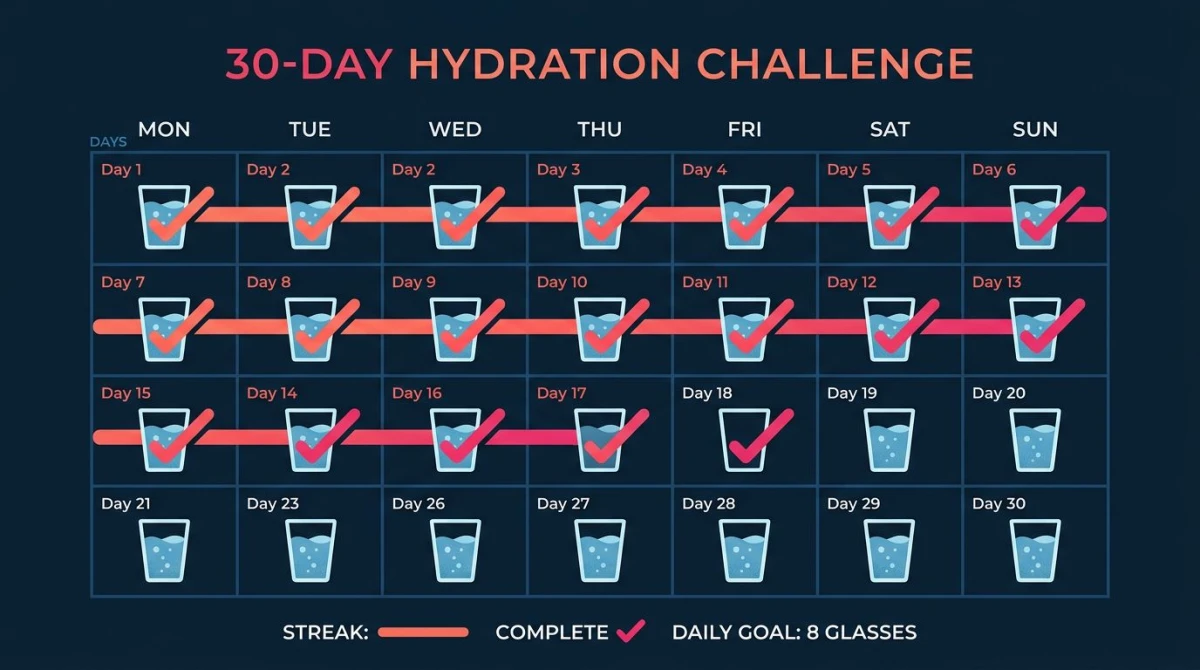
Track the streak so you don't quit on day 3
Day three is where cold showers go to die. The novelty is gone, the water still feels awful, and there is no visible payoff yet. This is precisely where a streak earns its keep.
A streak works because of loss aversion — once you have a chain of completed days, breaking it feels like losing something, and that pull is often stronger than the urge to skip. Seeing a row of check marks turns an abstract goal into a tangible thing you do not want to wreck.
A dedicated tracker like HabitBox makes this easy: log the cold finish with one tap, watch the calendar heatmap fill in, and let the four-week ramp ride on top of your current and longest-streak counters. The same loss-aversion mechanic that keeps a running streak alive works just as well for a daily cold shower.
One honest caveat: a single missed day does not break the habit — it only breaks the number. If you skip a day, restart the next morning without drama. The research on habit formation is clear that the occasional gap has little effect on long-term consistency, so don't let one slip become a quit. The same mindset applies to bigger routines, like the ones in our morning workout routine guide.
Who should skip cold showers (an honest safety note)
Cold showers are not a magic cure-all, and they are not for everyone. The cold triggers a sharp cardiovascular response — a spike in heart rate and blood pressure — that most healthy people handle fine but that can be risky for some.
Texas Health Resources advises consulting your healthcare provider before trying cold-water therapy, "especially if you have a history of heart issues and/or circulation issues." Healthline adds caution for people who are currently sick, recently hospitalized, immune-compromised, or taking medication for mental-health conditions — and warns against stopping any such medication abruptly. If you are pregnant or managing a chronic condition, check with your doctor first rather than guessing.
A few practical safety habits help too. Don't pair a cold shower with intense breath-holding or power breathing. Warm up gradually afterward instead of jumping straight into a hot shower, which Texas Health notes can cause a sudden blood-flow change that makes some people feel faint. And keep the benefits in perspective: the evidence is promising but modest, so treat a cold shower as a small wellness habit, not a treatment.
If your goal is simply to build a tougher, more consistent routine, the cold shower is one small brick. Pairing it with a steady exercise habit compounds the effect — our guide on how to make exercise a habit covers the same gradual-ramp approach for movement.
FAQ
How do I start taking cold showers?
How long should a beginner take a cold shower?
How cold should the water be?
Are cold showers safe every day?
How long until cold showers feel easy?

Mira Hartwell
Editor, HabitBoxEditor at HabitBox. Writes about habit science and productivity, grounding every post in named research (Lally, Wood, Walker, Huberman) instead of recycled advice. Read full bio →