How to Wake Up Energized: 9 Morning Habits
Learning how to wake up energized is less about the alarm and more about the 24 hours before it. A 2022 UC Berkeley study of 833 people found that getting enough sleep, exercising the day before, and eating a higher-carb breakfast were the strongest predictors of morning alertness — and genetics explained only about 25% of the difference. In other words, 9 simple habits, built mostly the night before, do most of the work.
If you sleep a full eight hours and still feel like you've been hit by a truck, you're not broken and you're not lazy. You're experiencing a normal biological state — and the same research that explains it also points to the fixes. Let's start with why the grogginess happens.
Why you wake up groggy
That heavy, foggy feeling in the first minutes after waking has a name: sleep inertia. It's the transition period where your brain is still partly in sleep mode, reaction time is slow, and decision-making is impaired. For most people, sleep inertia lasts 15 to 60 minutes, though it can linger longer after a bad night.
Two things make it worse. The first is waking up mid-cycle, especially out of deep sleep — your brain hasn't finished its overnight housekeeping and needs more time to come online. The second is an inconsistent schedule. When you go to bed and wake at different times each day, your internal clock never settles, so your body is often trying to wake you during a low point in your circadian rhythm.
There's also a chemistry side to it. While you sleep, your brain clears out adenosine, the molecule that builds up during the day and makes you feel sleepy. If you cut sleep short, you wake with leftover adenosine still circulating — which feels exactly like the grogginess you're trying to escape. This is why "I slept eight hours but feel terrible" usually traces back to when and how you slept, not just the headline number.
The good news is that sleep inertia is temporary by design. The habits below either prevent it from being severe or speed up how fast you shake it off. Most of them work by sending your brain the same message from different angles: the day has started, it's safe to wake up fully.
What the science says predicts morning alertness
Most "wake up refreshed" advice is a pile of isolated tips. The most useful research actually ranks what matters. In November 2022, UC Berkeley scientists Raphael Vallat and Matthew Walker published a study in Nature Communications tracking 833 people over two weeks, measuring what predicted how alert they felt each morning.
Three behavioral factors stood out:
- Sleep duration and timing. Sleeping longer, or slightly later than usual, sharply increased morning alertness. Extra sleep clears more of the adenosine that builds up during the day, and waking later aligns you with your circadian upswing.
- Physical activity the day before. People who were more active the previous day woke up more alert the next morning. The effect came from daytime movement, not a frantic dawn workout.
- A higher-carbohydrate breakfast. A breakfast richer in complex carbohydrates — with limited sugar — was linked to better alertness. As the researchers noted, carbs can raise alertness "so long as your body is healthy and capable of efficiently disposing of the glucose."
The headline finding: genetics explained only about 25% of the variation in morning alertness. The rest came down to behavior and environment — things you control. That's the whole premise of this guide. If you've ever assumed you're "just not a morning person," the data says your habits are doing far more of the talking than your DNA.
It also reframes the whole problem. Three of the strongest levers — sleep, prior-day exercise, and breakfast — are decided before you ever open your eyes or at most within the first hour of waking. Trying to fix mornings purely with a louder alarm or more coffee is working on the smallest part of the system. The sections below are ordered roughly by impact, starting with the one habit that moves the needle most.
How to wake up energized: the 9 habits
These nine habits split into two groups: a few you set up the night before, and a short morning sequence that beats sleep inertia fast. None of them require willpower at 6 a.m. — that's the point.
1. Keep a consistent wake time
This is the single highest-leverage habit, and the Berkeley data backs it up. Waking at the same time every day — including weekends — trains your circadian clock to align your natural waking with the moment your alarm goes off, which means far less inertia.
Pick a wake time you can hold seven days a week, not just an ambitious weekday number you'll abandon on Saturday. Consistency beats earliness. A regular 7 a.m. will leave you fresher than a heroic 5 a.m. you only manage on weekdays, because the weekend lie-in resets your clock and you spend Monday paying for it — a pattern sleep researchers call social jet lag. If you want help with the timing math, our guide on how to wake up at 5am walks through the bedtime calculation.
2. Get bright light within minutes of waking
Light is the master signal for your body clock. Getting bright light — ideally sunlight — into your eyes soon after waking suppresses melatonin and tells your brain the day has started, which shortens sleep inertia.
Open the blinds before you do anything else. If you wake before sunrise or live somewhere dark in winter, a bright lamp or a sunrise alarm helps. Aim to be in real outdoor light within the first 30 minutes if you can — outdoor light is many times brighter than indoor lighting even on an overcast day, so a short walk or a few minutes on the porch does far more than a ceiling bulb. Pair this with your coffee or breakfast later and you get a double cue that the day has begun.
3. Hydrate before you do anything else
You lose water all night through breathing and sweating, so you wake up mildly dehydrated — and even mild dehydration causes fatigue and fuzzy thinking. Harvard Health lists water among the nutrients shown to enhance performance, and dehydration among the quiet drains on energy.
Keep a glass or bottle by the bed and drink it before you reach for your phone. If hydration is a weak spot for you generally, our walkthrough on how to start drinking more water makes it stick.
4. Move your body, even for five minutes
You don't need a full workout to wake up. A few minutes of movement — stretching, a short walk, light bodyweight exercises — raises your heart rate, increases circulation, and pushes you out of the inertia zone faster.
The Berkeley study found the bigger alertness payoff came from being active the previous day, so think of morning movement as the quick fix and daytime activity as the deeper investment. A short morning workout routine covers both if you want to build the habit properly.
5. Skip the snooze button
Hitting snooze feels merciful, but it's a trap. Those extra 9-minute fragments are too short for restorative sleep and often drop you back into a sleep stage you then get yanked out of — restarting sleep inertia from scratch.
Put your alarm across the room so you have to stand up to turn it off. Once you're vertical and in the light, the urge to crawl back fades fast. One firm wake beats five soft ones. If snoozing is your hardest habit to break, the trick is to remove the choice entirely: standing up and opening the blinds in one motion gives your brain light and movement before it can negotiate for "five more minutes."
6. Splash cold water on your face
A few splashes of cold water — or a cold finish to your shower — triggers a quick jolt of alertness through the cold-shock response. It raises heart rate and breathing and snaps you out of the half-asleep state.
It's not a substitute for sleep, but as a fast on-switch in the first few minutes, it works. Keep it brief; the goal is a wake-up cue, not endurance training.
7. Eat a protein-forward, complex-carb breakfast
Pair the Berkeley carbohydrate finding with protein for steady energy. Choose complex carbs with a low glycemic index — oats, whole grains, fruit — over sugary cereals or pastries that spike then crash you. Harvard recommends low-glycemic foods "whose sugars are absorbed slowly" for sustained energy.
Add a protein source — eggs, Greek yogurt, nut butter — to blunt the glucose curve and keep you full. A high-sugar breakfast does the opposite of what you want: it deepens the mid-morning slump.
8. Time your caffeine — wait 60 to 90 minutes
Coffee the second you wake up is a common mistake. Early in the morning your cortisol is already elevated and naturally alerting, so caffeine adds little. Worse, drinking it too early can blunt that natural rhythm and set up a harder crash later.
Wait 60 to 90 minutes after waking, then have your coffee — you'll feel the lift more and avoid the afternoon dip. And keep it before early afternoon: Harvard advises caffeine before 2 p.m. to protect tonight's sleep, which protects tomorrow's energy.
9. Fix your wind-down the night before
Every habit above is undermined by a bad night. Since sleep duration and timing were the top predictors of morning alertness, your evening is where energy is really earned. A consistent pre-bed routine, a dark cool room, and no screens in the last hour all raise sleep quality. If you're not sure how many hours you're actually aiming for, our free sleep need calculator shows your target sleep by age, plus deep and REM stage goals.
A structured evening routine and a solid sleep hygiene checklist do more for your mornings than any sunrise hack. Tonight's wind-down is tomorrow's energy.
Build it as a morning energy stack
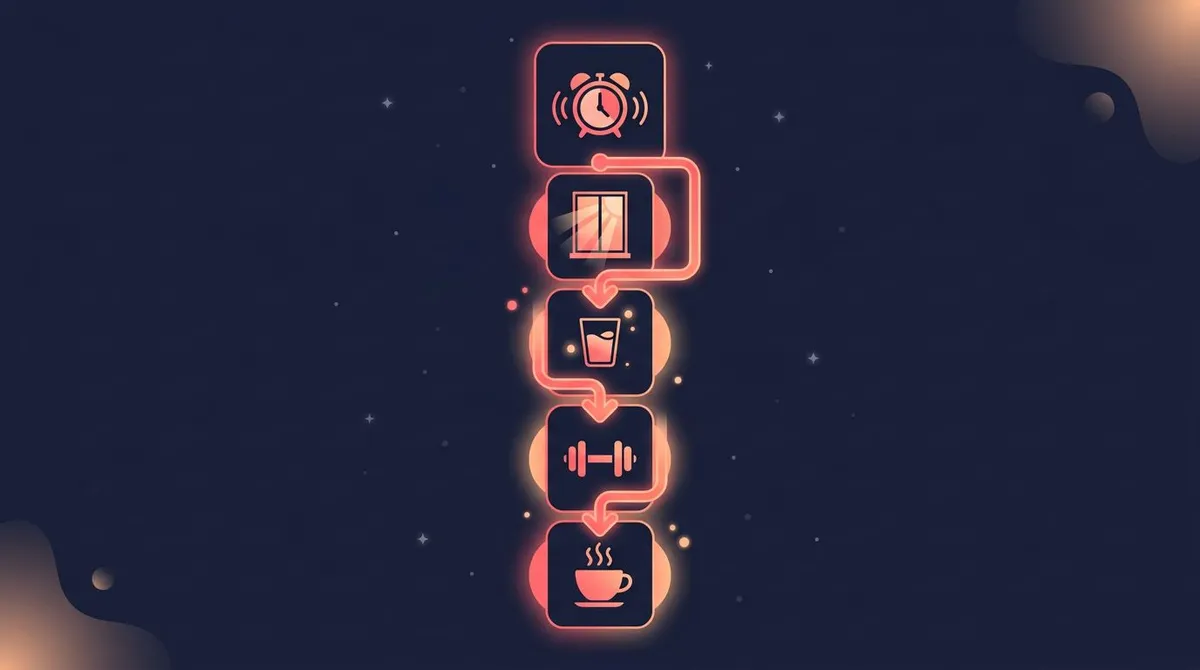
Individual tips are forgettable. A sequence is not. Stacking these habits in order — each one cueing the next — turns them into a routine you run on autopilot. Here's a simple stack for the first 90 minutes after your alarm.
| Sequence | Habit | Why it works |
|---|---|---|
| 1 | Same wake time, alarm across the room | Aligns your circadian clock so you wake near your natural upswing |
| 2 | Stand up, open the blinds | Bright light suppresses melatonin and shortens sleep inertia |
| 3 | Drink a full glass of water | Reverses overnight dehydration that causes morning fatigue |
| 4 | Splash cold water on your face | Cold-shock response gives a fast alertness jolt |
| 5 | Move for 5 minutes | Raises heart rate and circulation, clearing the fog faster |
| 6 | Eat a protein + complex-carb breakfast | Steady glucose supports the alertness the Berkeley study linked to carbs |
| 7 | Coffee after 60-90 minutes | Works with your cortisol rhythm instead of against it |
You don't have to adopt all seven at once. Pick the two that feel easiest — usually light and water — run them for a week, then add the next. A stack you actually do beats a perfect one you abandon by Wednesday.
The reason a stack works better than a checklist is that each habit becomes the trigger for the next one. Standing up cues opening the blinds; the light cues reaching for the water glass; finishing the water cues the cold splash. You're not relying on remembering nine separate things at 6 a.m. — you're running a single chain where one action pulls the next along. Behavior researchers call this habit stacking, and it's one of the most reliable ways to make a new routine stick without leaning on motivation.
Track your morning routine so it sticks
Knowing the habits is the easy part. Doing them every day for the weeks it takes to make them automatic is where most people drift. This is where a simple tracker earns its place: checking off "morning light," "water," and "consistent wake time" each day turns vague intentions into a visible streak you don't want to break.
A dedicated habit tracker like HabitBox lets you log a small morning stack and watch your consistency build on a calendar heatmap — which is exactly the kind of feedback that keeps an early-morning routine alive past the first hard week. Seeing the chain grow is more motivating than any single tip.
Don't chase a perfect morning. Chase a repeatable one. Consistency is what rewires the clock.
FAQ
Why do I wake up so tired even after enough sleep?
How can I wake up with more energy?
Does drinking water in the morning help?
When should I have coffee after waking up?
How long does morning grogginess last?

Mira Hartwell
Editor, HabitBoxEditor at HabitBox. Writes about habit science and productivity, grounding every post in named research (Lally, Wood, Walker, Huberman) instead of recycled advice. Read full bio →