Evening Routine: 60-Min Wind-Down That Works (2026)
A good evening routine is not a long list of self-care. It is a 60-minute architecture that closes the workday, signals sleep to your body, and pre-loads the morning. Done well, it cuts the time you spend falling asleep, raises sleep quality, and removes most of tomorrow's "where do I start" friction. This is the 3-phase, 8-habit version of an evening routine that actually fits a working adult's life.
TL;DR
A solid evening routine has three phases and runs about 60 minutes total. Phase 1 (shutdown, 20 min) closes the workday. Phase 2 (wind-down, 30 min) signals sleep to your nervous system. Phase 3 (sleep window, 10 min) protects a consistent bedtime in a dark, cool room. Track 8 small habits across those phases and most people fall asleep faster and wake up clearer within two weeks.
Quick answer: Start an evening routine 60 minutes before bed. First 20 minutes: close work (last email, write tomorrow's top 3, say "shutdown complete"). Next 30 minutes: dim the lights, no screens, low-stimulation activity like reading or stretching. Final 10 minutes: phone out of room, room cool (65 to 68°F), same bedtime within a 30-minute window. The structure does the work — you don't need willpower at 10pm.
Why most evening routines fail
The standard advice ("no screens before bed, drink chamomile tea, journal for 20 minutes, meditate, take a hot bath") fails because it is a long list with no structure. You hit minute 35 of a 90-minute wind-down, give up, and grab the phone. The next night you do not bother starting.
The fix is structure, not content. Three phases, each with a clear job. Each phase shorter than the last. The routine has a clean start trigger (work close) and a clean end trigger (lights out). What happens inside is flexible.
The science underneath: your body runs on a circadian rhythm that needs consistent input to do its job. Matthew Walker's Why We Sleep (2017) makes the case clearly — bedtime regularity matters more than sleep length for cognitive function, and a wind-down hour is how you give the body the consistent input it needs. The CDC's sleep guidance puts adults at 7+ hours and emphasizes consistent timing.
The 3-phase framework
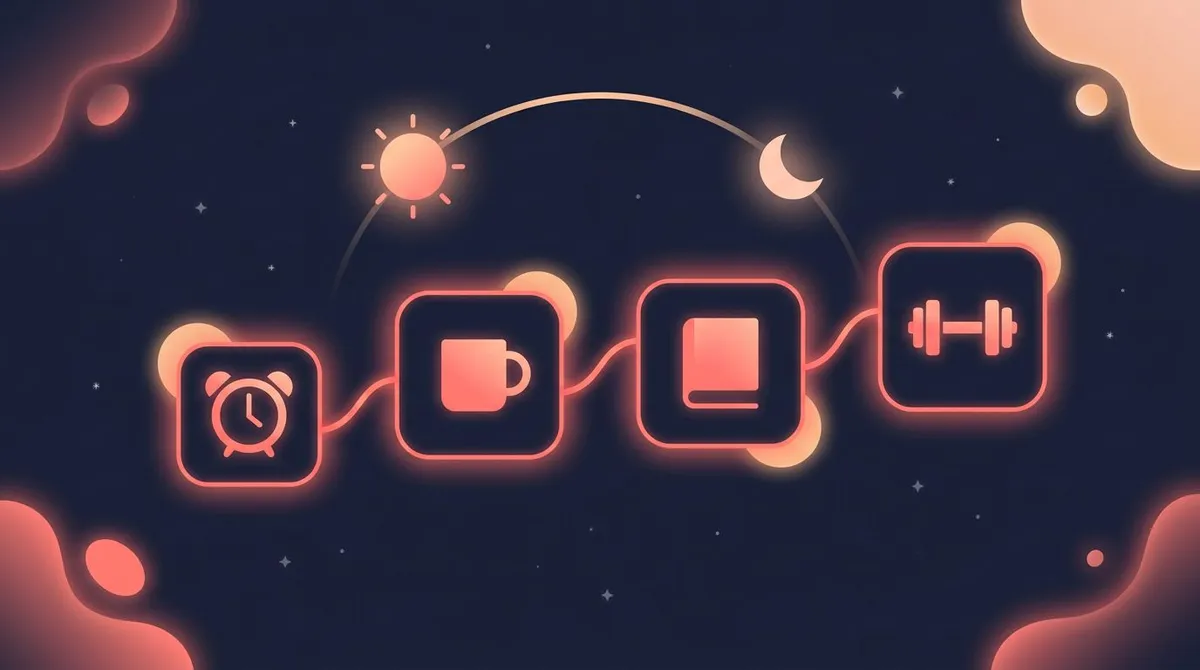
The architecture: 20 minutes to close, 30 minutes to wind down, 10 minutes to protect the bedtime.
| Phase | Time | Job | Anchor |
|---|---|---|---|
| 1. Shutdown | 7:00–7:20pm (or 60 min before bed start) | Close the workday | Newport's shutdown ritual |
| 2. Wind-down | 9:00–9:30pm | Signal sleep to nervous system | Dim light + no screens |
| 3. Sleep window | 9:30–9:40pm | Protect bedtime + sleep environment | Cool, dark, phone out |
Each phase is a habit chain. The end of one phase triggers the start of the next. Habit stacking, in other words. If you've read about habit stacking, this routine is one stack across the evening.
Adjust the times to your schedule. If you sleep at midnight, run the routine 11–12. If you sleep at 9:30 (some people genuinely do), run it 8:30–9:30. The clock matters less than the structure.
Phase 1 — Shutdown (20 minutes)
This is the most-skipped phase and the highest-leverage one. Most people drag work into the evening — answering one more email at 9pm, refreshing Slack at 10. The work follows you into bed. The shutdown phase ends the workday cleanly so evening actually feels like evening, not "work paused."
The best-evidenced technique here is Cal Newport's shutdown ritual from Deep Work: a short scripted sequence (review open tasks → write tomorrow's top 3 → close every work surface → verbalize that the workday is over) that closes off the cognitive open loops your brain keeps replaying after hours. The full 4-step script, the Zeigarnik-effect mechanism behind it, and three work-style variants live in our dedicated shutdown ritual guide — that's the deep dive for this phase. For the purposes of an evening routine, what you need is: spend 15 minutes between work-end and dinner running your shutdown of choice, and then treat the workday as actually over.
The benefit is not just "less work spillover." Without a shutdown, your brain runs the workday in the background until you fall asleep. With one, you actually feel evening as evening — most people report a noticeable mental shift within the first week, and tracking the shutdown as a single daily checkbox makes it stick faster than relying on memory.
Phase 2 — Wind-down (30 minutes)
Once work is closed, the body needs 30 minutes to drop into a parasympathetic state. The wind-down is what gets you there. Three rules govern this phase:
Dim the lights
The retina has special cells that read ambient light and tell the brain whether it is day or night. Bright overhead light at 9pm tells the brain it is still day, which delays the natural melatonin release. The fix is small: turn off overhead lights, use a warm lamp at low brightness, kill the kitchen pot lights. Aim for warm light below 2700K.
If you have smart bulbs, set them to dim automatically at the start of the wind-down. The Sleep Foundation's bedtime routine guide covers light environment in more detail.
No work emails and no scrolling
The phone is the single biggest wreck for sleep. Bright screen + dopamine-loaded content + adrenaline from work updates equals a body that thinks it is daytime and alert. Two options:
- Soft rule: Phone on Do Not Disturb, no work apps, no social. Allow audiobooks, music, e-book reader apps with warm screen.
- Hard rule: Phone goes in another room at the start of the wind-down. You don't pick it up again until morning.
The hard rule produces noticeably better results. Most people resist it for a week and then quietly love it.
Low-stimulation activity
Pick an activity that lowers heart rate and gives the mind something to settle on. Options:
- Reading a paper book. Fiction is best — it pulls you out of the day. Non-fiction works if it is not work-adjacent.
- Light stretching. 10–15 minutes of slow yoga or mobility. Not a workout.
- Journaling. Three lines about the day, three about tomorrow, three about anything else. See our piece on how to start journaling if you want a structure, or use a gratitude journal app if guided prompts make it easier to start.
- Warm shower. The post-shower drop in body temperature mimics the body's natural pre-sleep temperature drop. Walker's research notes this effect helps sleep onset by 10 to 15 minutes for many people.
- Conversation with a partner. Counts. Low-stimulation, parasympathetic-friendly, and an actual relationship.
Pick one or two. Not all five. The wind-down is a single thread of low-stimulation activity, not a self-care sampler platter. One 30-second addition that pairs with any of them: log your mood in a tracking app before lights out — after a few weeks the trend shows which wind-down activities actually work for you.

Phase 3 — Sleep window (10 minutes)
The last 10 minutes lock in the bedtime and the sleep environment. Four moves.
Phone out of the bedroom
If the phone is in the room, you will check it. Charge it in the kitchen, hallway, or living room. Use a $15 alarm clock for the morning. This single change is the most reported "couldn't believe how much it helped" habit in sleep research surveys.
Cool the room
The body needs to drop about 1 to 2°F internal temperature to fall asleep. A cool room helps. The Sleep Foundation puts the ideal range at 65 to 68°F (18 to 20°C). Cooler is generally better than warmer. If you share a bed with someone who prefers warmer, the dual-zone mattress topper or extra blanket trick works.
Dark room
Light leak ruins sleep quality even with eyes closed. Black-out curtains if streetlights or sunrise are issues. Eye mask works at near-zero cost. Cover any LED indicators (router, TV, smoke detector) with a tiny piece of black tape.
Same bedtime, every night
Within a 30-minute window. Including weekends. Weekend sleep-in is the biggest single contributor to "Sunday night insomnia" and Monday morning misery. Pick a bedtime that gives you 7.5 to 9 hours before your fixed wake time. Hold it.
This sounds joyless. In practice, after two weeks of holding the window, you start to feel sleepy at the same time naturally. The body cooperates when you give it consistent input.
For more on the sleep side, see our sleep hygiene checklist.
The 8 habits to track
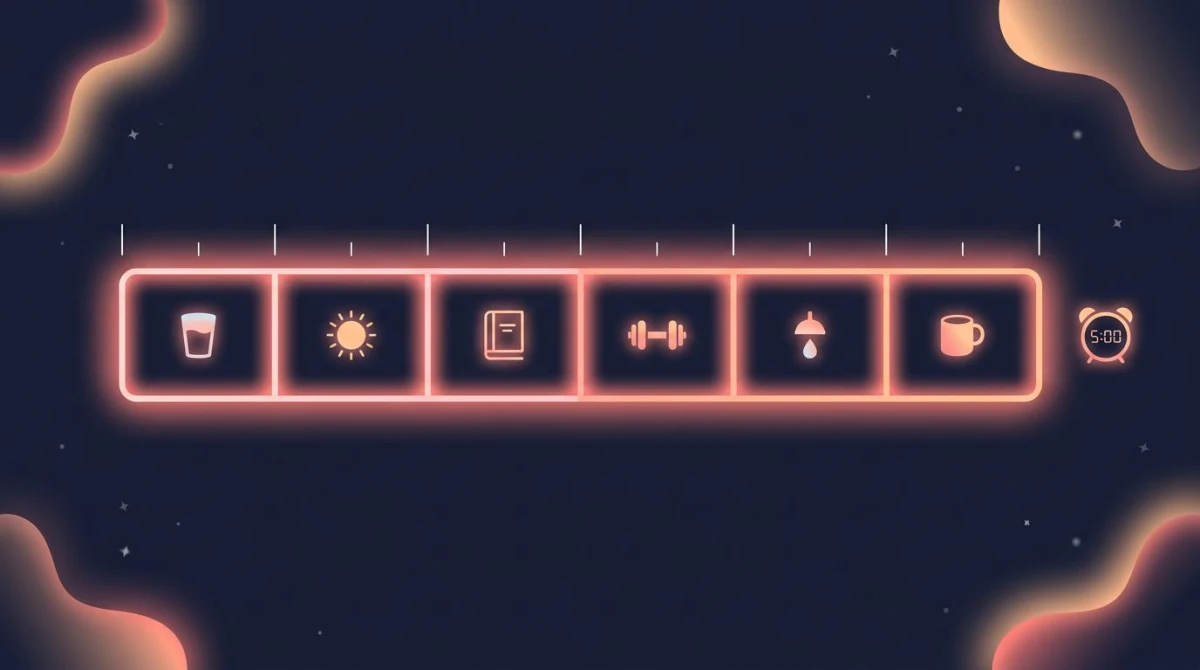
A clean trackable version of the routine. Pick the ones that fit your life. Most people start with 4 to 5 and add the rest over the first month.
| # | Habit | Phase | Time cost |
|---|---|---|---|
| 1 | Closed laptop / Slack quit by [fixed time] | Shutdown | 1 min |
| 2 | Wrote tomorrow's top 3 | Shutdown | 3 min |
| 3 | Dimmed lights at wind-down start | Wind-down | 30 sec |
| 4 | No phone scrolling after wind-down start | Wind-down | Boundary |
| 5 | 30 min of low-stim activity (reading, stretching, journaling) | Wind-down | 30 min |
| 6 | Phone in another room | Sleep window | 30 sec |
| 7 | Room cool (65–68°F) and dark | Sleep window | Setup once |
| 8 | Hit bedtime within 30-min window | Sleep window | Discipline |
Habit 8 is the keystone. If you only do one, do that. The rest pull along when bedtime is consistent.
If you want the streak visible, HabitBox shows each habit as a calendar heatmap on iOS and Android — pick 4 or 5 of these and you have a clean evening checklist. No account, data on your device, just the rep. The streak visibility matters because the evening routine is the easiest one to skip on a tired Tuesday.
Bad evening habits that wreck sleep
A short list of common evening behaviors that consistently degrade sleep. Most people do at least three.
- Caffeine after 2pm. Caffeine has a half-life of 5 to 6 hours. A 3pm coffee is still ~25% active at midnight. If you sleep poorly and drink afternoon caffeine, cut the caffeine first and watch what happens.
- Late workouts. A hard workout within 2 hours of bed raises core body temperature and adrenaline. Move workouts to morning or early evening if sleep is a problem.
- Late meals. Eating within 2 hours of bed disrupts both sleep onset and quality. Late dinners are fine occasionally. Every night is a problem.
- Doom-scrolling. News, social, work email after dark. Two effects: blue light delays melatonin, content keeps the brain alert. Combined: a wrecked sleep onset.
- Alcohol. Falls asleep faster, sleeps worse. Alcohol fragments REM and reduces deep sleep. One drink is fine. Three drinks ruin the night.
- Sleeping in on weekends. A 3-hour weekend delta on bedtime is equivalent to mild jet lag every Monday.
- Working in bed. The bed should mean sleep, not work. The brain learns the association. If you work in bed, you sleep worse in it.
Modifiers for real life
The 60-minute version assumes you control your evenings. Many people don't. Three common modifiers:
Parents of young kids
Cut to a 30-minute version. Phase 1 (10 min): shutdown after kids' bedtime. Phase 2 (15 min): dim lights, one low-stim activity. Phase 3 (5 min): phone out, bedtime within window. The kids are the routine — accept that and protect the 30 minutes you have left.
Shift workers
The 60-minute structure still works, the clock just rotates. The bigger issue is light. After a night shift, wear sunglasses on the commute home and black out the bedroom. Your "evening" is whenever your sleep window starts. The phases are the same; the time is shifted.
Insomniacs
The routine helps but does not replace clinical care. If you cannot fall asleep within 20 minutes most nights, the gold standard is CBT-I (cognitive behavioral therapy for insomnia), often delivered through apps or sleep clinics. The routine is the floor. CBT-I is the structured intervention if the floor isn't enough.
Evening people (chronotype night owls)
Roughly 25% of adults are biologically late chronotypes. If you are genuinely better at 11pm than at 7am, do not force a 6am wake time. Build the routine around your real bedtime — say, midnight — and let the rest follow. The structure is what matters; the clock is yours.
Pairing with the morning
The evening routine pre-loads the morning. Tomorrow's top 3 is already written, the laptop is closed in a clean state, the phone is out of the bedroom so you wake up to a quiet morning instead of to email. If you have read about morning routines (see our pieces on self-care morning routines and anxiety morning routines), the evening is half of the equation. A good morning depends on a clean evening more than on a heroic alarm.
The flip is also true. A good evening depends on a structured day. If your day has no shutdown point because you "work whenever," the evening cannot start. The shutdown ritual is what creates the boundary.
When the routine breaks
Real talk: you will skip nights. Travel, social events, sick kids, big work weeks. The recovery rule is the same as for any habit: never miss twice. After a skipped night, run the bare-minimum version the next night (phone out of room, hit the bedtime window, lights out). Add the rest back over the next few nights.
Two nights off in a row is when the routine starts to slide. Three or four in a row and you are back to square one. The cost of skipping a single night is tiny. The cost of skipping two is the start of a new pattern.
FAQ
What should an evening routine include?
A good 60-minute evening routine includes three phases: a 20-minute shutdown to close the workday (write tomorrow's top 3, quit work apps, end-of-day review), a 30-minute wind-down with dim lights and low-stimulation activity (reading, stretching, journaling), and a 10-minute sleep window with the phone in another room, a cool dark bedroom, and a consistent bedtime. Most people see better sleep within two weeks.
What is the best evening routine for better sleep?
The single biggest move is a consistent bedtime within a 30-minute window every night, including weekends. Add a 30-minute wind-down with dim lights and no screens, and put the phone in another room. The Sleep Foundation and CDC both emphasize bedtime regularity and a dark cool bedroom as the highest-leverage interventions for adult sleep quality.
How long should my evening routine be?
60 minutes is the sweet spot for most working adults — 20 minutes to close work, 30 to wind down, 10 to lock in the bedtime. If your schedule is tighter, a 30-minute version still works (10/15/5 split). Going longer than 90 minutes usually backfires because the routine becomes too much to start on a tired night.
Evening routine vs morning routine — which matters more?
The evening routine has higher leverage. A clean evening sets up the morning — tomorrow's top 3 is written, the laptop is closed, the phone is out of the bedroom. A morning routine without a structured evening is fighting a hangover from yesterday. Build the evening first, then the morning.
Can I do an evening routine without my phone?
Yes, and most sleep researchers recommend it. Charge the phone in another room and use a $15 alarm clock for the morning. The phone-out-of-bedroom rule is one of the highest-reported "this changed my sleep" habits across studies. Audiobooks and meditation tracks can be played on a small Bluetooth speaker if you want sound without the phone.
The bottom line
An evening routine is not self-care theater. It is 60 minutes of structure that closes the day, signals sleep, and protects tomorrow. Three phases, eight habits, and a habit tracker to hold the streak. Start with bedtime regularity and a 5-minute shutdown ritual. Add the rest as the first two stabilize.
If you want the routine tracked as a single calendar heatmap, HabitBox is free to download on iOS and Android, with a Plus upgrade for more. Pick a few of the habits above, run them for 30 days, and watch the bedtime hold itself.

Mira Hartwell
Editor, HabitBoxEditor at HabitBox. Writes about habit science and productivity, grounding every post in named research (Lally, Wood, Walker, Huberman) instead of recycled advice. Read full bio →