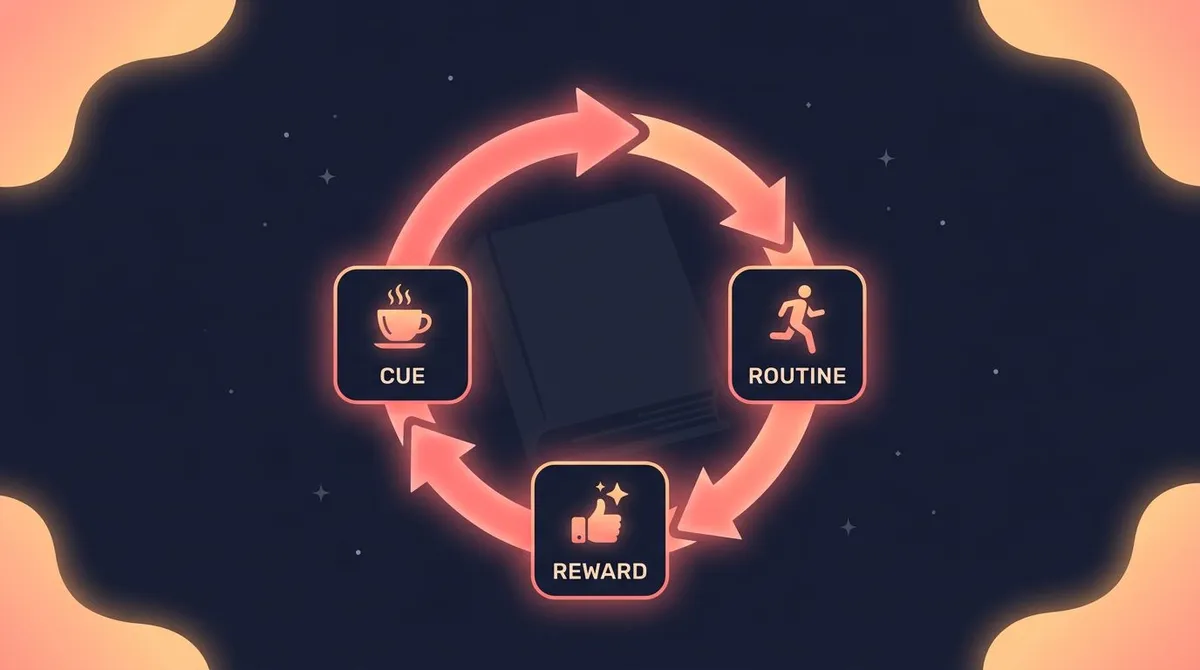
Make Your Bed Summary (2026): All 10 Lessons
TL;DR
This make your bed summary covers all 10 lessons from Admiral William H. McRaven's 2017 book, drawn from his 2014 University of Texas commencement speech. The central idea: complete one small task — make your bed — and you start the day with an early win that compounds. Below you'll find each lesson, the Navy SEAL training story behind it, the everyday habit it maps to, and a starter plan for tracking the one that matters most.
What Make Your Bed is about
Make Your Bed: Little Things That Can Change Your Life... And Maybe the World is a short 2017 book by retired Admiral William H. McRaven, a Navy SEAL of 37 years who commanded the raid that found Osama bin Laden.
The book expands his commencement address at the University of Texas at Austin, delivered on May 17, 2014. The speech went viral — the video has tens of millions of views — because it took ten brutal lessons from SEAL training and turned them into advice anyone can use.
Each chapter pairs a story from Basic Underwater Demolition/SEAL training (known as BUD/S) with a single, portable principle. The book is honest about how hard life gets. It does not promise that effort guarantees fairness. It argues instead that small, repeated actions and refusal to quit are what carry you through.
Why the first task of the day matters
McRaven's first instructor lesson is the one people remember: if you want to change the world, start by making your bed.
In SEAL training, recruits made their beds to a rigid standard every morning. McRaven's point is not about hospital corners. It's that finishing one small task gives you a sense of pride and the momentum to tackle the next one. By the end of a hard day, that one completed task reminds you that small things matter — and that if you can't do the little things right, you'll never do the big things right.
That is a textbook description of a keystone habit: one routine that triggers a chain of better behaviors. The behavior-science writer Charles Duhigg popularized the term in The Power of Habit, describing how a single small win can cascade into other positive changes. Making your bed is cheap, takes under a minute, and resets your environment — exactly the kind of anchor a good morning is built on.
The 10 lessons from Make Your Bed
Here are all ten lessons, each tied to its SEAL-training origin and the ordinary habit it points to. McRaven frames every one as a way to "change the world," but each works just as well at the scale of a single day.
| # | Lesson | SEAL-training origin | The everyday habit it maps to |
|---|---|---|---|
| 1 | Start your day with a task completed | Making your bed to standard every morning at BUD/S | Do one tiny, finishable thing first — make your bed |
| 2 | You can't go it alone | Seven-person boat crews paddling together through the surf | Build and lean on a support network |
| 3 | Only the size of your heart matters | The smallest, least-likely recruits often outlasted the big ones | Judge effort and character over appearances |
| 4 | Life's not fair — drive on | The "sugar cookie" punishment: rolled in wet sand for no fair reason | Stop waiting for fairness; keep moving anyway |
| 5 | Failure can make you stronger | "The Circus" — extra brutal exercise for those who fell short | Treat setbacks as training, not verdicts |
| 6 | You must dare greatly | Sliding down the "Slide for Life" obstacle head-first | Take the bolder approach when it counts |
| 7 | Stand up to the bullies | Night swims in shark-filled waters; you don't back down | Confront fear directly instead of retreating |
| 8 | Rise to the occasion | Planting a mine under a ship in pitch-black, freezing water | Bring your best in the darkest moment |
| 9 | Give people hope | Singing together while neck-deep in mud during Hell Week | Offer hope; it sustains people through misery |
| 10 | Never, ever quit | The brass bell — ring it three times and you're out | Don't ring the bell, no matter how hard it gets |
A few of these deserve a closer look.
Lesson 4 — the sugar cookie. Recruits who failed a uniform inspection were ordered to jump in the surf and roll in sand, then spend the day cold, wet, and gritty. The lesson is blunt: sometimes you do everything right and still get the sugar cookie. Fairness isn't owed to you. The people who thrive accept that and drive on.
Lesson 5 — the circus. Underperformers earned "The Circus," two extra hours of grinding exercise designed to wear them down. McRaven's surprise: those who kept getting the circus grew stronger over time, and many outlasted recruits who never struggled early. Failure, repeated and survived, builds the capacity that easy success never does.
Lesson 2 — find someone to help you paddle. At BUD/S, recruits operated in seven-person boat crews, paddling small rubber boats through pounding surf. No one finished training alone. McRaven uses it to make a point people forget when they idolize self-reliance: meaningful goals need other people. Knowing whose help to ask for is a skill, not a weakness.
Lesson 8 — rise to the occasion. One exercise had recruits swim under an enemy ship in pitch-black, freezing water to plant a practice mine — the darkest, most disorienting point of the swim, right at the keel, was exactly where the job had to be done. The lesson maps cleanly onto ordinary life: your character is defined by what you do in the hardest moment, not the easy ones.
Lesson 10 — the bell. A brass bell hung in the training compound. Quit, and all you had to do was ring it three times — and the misery would stop. No more cold, no more sand, no more exhaustion. McRaven's closing charge is simple: if you want to change the world, don't ever ring the bell. The people who made it weren't the strongest. They were the ones who refused the easy way out, one day at a time.

Why making your bed is a keystone habit
The reason the title lesson resonates isn't discipline for its own sake. It's the psychology of small wins.
A completed task — even a trivial one — produces a small hit of progress that makes the next task feel more doable. James Clear describes keystone habits as routines that create a chain reaction, shifting your identity toward "the kind of person who follows through." Make your bed, and you've cast a tiny vote for that identity before 7 a.m.
It also works because it's nearly frictionless. It takes under a minute, needs no equipment, and the cue (getting out of bed) is already built into your morning. That's why it's a far better starting habit than something ambitious and fragile. The win is guaranteed, and guaranteed wins are what build momentum.
There's an environmental effect too. A made bed changes the room you wake up to and come home to. A tidy space is a small, repeated signal that you keep your commitments — and it makes the next tidy choice slightly easier. That's the cascade in action: the bed isn't the goal, it's the trigger. The point is never the bed itself. It's the proof, banked before the day has a chance to derail, that you do what you say you'll do.
If you want a structure for the rest of the morning around it, our self-care morning routine and evening routine guides stack additional small habits onto that first anchor.
How to apply Make Your Bed: a starter plan
You don't need all ten lessons at once. Pick one or two, turn each into a tiny daily action, and track whether you actually do it.
- Pick your keystone. Make your bed is the obvious starting point — it's the one McRaven built the whole book around, and it's the easiest to win at.
- Define the tiny version. "Pull the duvet straight and square the pillows" is enough. Don't gold-plate it. A 30-second standard you'll hit every day beats a perfect one you'll skip.
- Attach it to an existing cue. Right after your feet hit the floor, before you check your phone. Anchoring a new habit to one you already do is the most reliable way to make it stick.
- Track the streak. This is where most people drift. Checking the habit off each morning gives you the same small-win feedback McRaven describes — visible proof you followed through.
This is exactly the kind of single, checkable behavior a habit tracker is built for. In HabitBox, you can add "make your bed" as a simple daily habit, tap once each morning, and watch the streak grow on the calendar heatmap — turning McRaven's first lesson into visible momentum. If you want to add more discipline over time, our guide on how to be more disciplined and how to wake up at 5 a.m. build naturally on the same foundation.
Once the bed is automatic — usually a few weeks — add a second lesson-based habit. Lesson 2 might become "text one friend I've been meaning to reach." Lesson 5 might become a two-minute review of what went wrong that day, treated as data instead of defeat. Keep each one tiny and checkable. The mistake is trying to live all 10 lessons at once; the book works as a slow stack, not a single heroic push.
The honest part McRaven would appreciate: some mornings you won't feel like it, and you'll miss a day. Missing once doesn't undo the habit. Make the bed the next morning and the chain continues. What breaks a habit isn't one missed day — it's deciding that one missed day means you've failed and quietly ringing your own bell.
Who should read Make Your Bed
This is a short book — you can finish it in an afternoon — so the bar for "worth it" is low.
Read it if you saw the viral speech and want the full set of lessons, if you respond to plain-spoken, no-nonsense motivation, or if you're rebuilding routine after a hard stretch and need a small, concrete place to start. It's also a good gift for graduates, given its origin.
It's less useful if you want a detailed, research-heavy framework for behavior change. For that, pair it with a habit-science book — McRaven gives you the why and the grit; the mechanics of cues, cravings, and rewards come from elsewhere.
FAQ
What is Make Your Bed about?
What are the 10 lessons in Make Your Bed?
Why does making your bed matter?
Is making your bed a keystone habit?
What habit should I start with after reading it?

Mira Hartwell
Editor, HabitBoxEditor at HabitBox. Writes about habit science and productivity, grounding every post in named research (Lally, Wood, Walker, Huberman) instead of recycled advice. Read full bio →