Morning Routine: A 5, 20 or 45-Minute Plan You'll Keep
A morning routine is a short run of the same few habits, done in the same order soon after you wake up, where finishing one step is the cue for the next. A good first version takes five minutes: a glass of water, a few slow breaths, some movement in daylight, one line about the day and a check mark. You can make it longer later. Keep the order.
Most routines break because they were written for an ideal morning, the one with a full night's sleep and nowhere to be. The plan below is built for the other mornings too. It is one five-step stack that runs at three lengths (5, 20 or 45 minutes), a menu of extra habits sorted by how long they take, a worked example you can copy, and a rule for the mornings that go wrong.
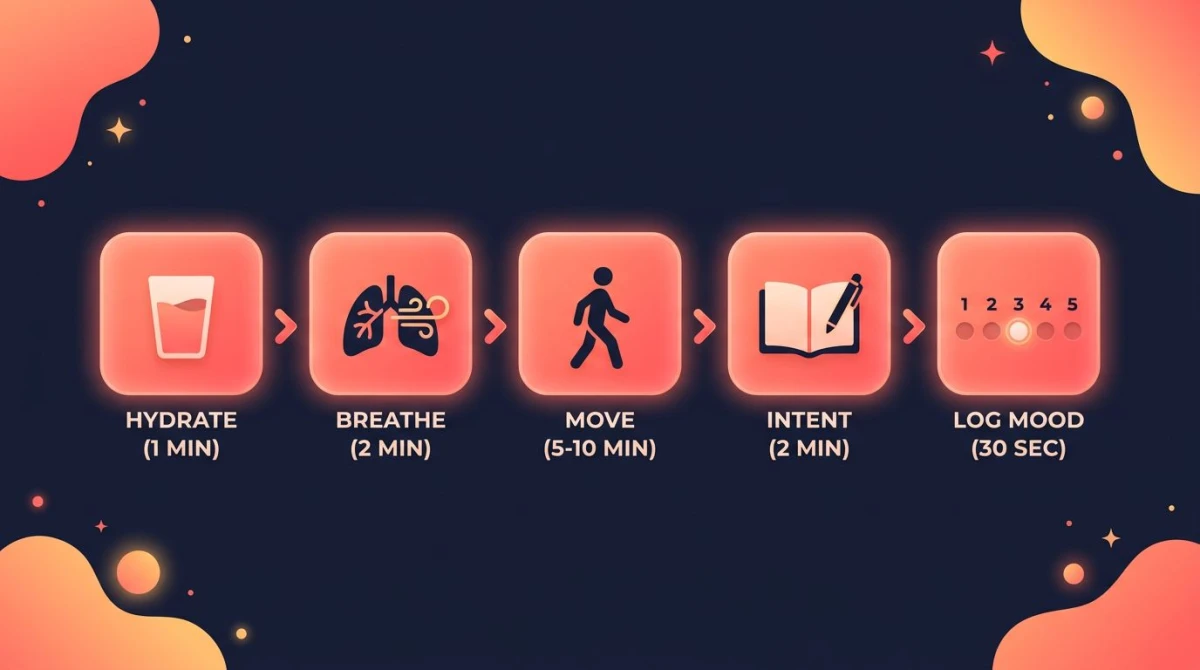
The five-step morning routine, step by step
Here is the default 20-minute version. Each step's cue is the end of the step before it, so only the first step needs a trigger from outside the routine.
| Step | Habit | Cue | Time |
|---|---|---|---|
| 1 | Drink a full glass of water | Feet hit the floor | 1 min |
| 2 | Take six slow breaths, or two minutes of box breathing | Last sip of water | 2 min |
| 3 | Move, outdoors or by an open window | Last breath | 5–10 min |
| 4 | Write one sentence about the day | Back inside, shoes off | 2 min |
| 5 | Tick the routine off and rate your mood from 1 to 5 | Notebook closed | 30 sec |
The rest of the 20 minutes is buffer: the kettle, the blinds, finding your shoes. Real mornings take time, so the plan leaves room for it instead of pretending it isn't there.
1. Water (1 minute)
Pour the glass the night before and leave it on your nightstand or by the kettle. On a tired morning you won't decide to drink water. The glass that is already there decides for you, so finish it before you look at your phone.
2. Breathe (2 minutes)
Sit down and take six slow breaths, with the out-breath longer than the in-breath: in for 4, out for 6. If you like a pattern, box breathing is in for 4, hold for 4, out for 4, hold for 4. Harvard Health lists this kind of slow breath focus among six techniques for calling up the body's relaxation response.
If counting feels like too much at 6 a.m., our free breathing timer paces it for you.
3. Move, in daylight if you can (5 to 10 minutes)
This is the step that flexes the most. A walk to the end of the street, a few sun salutations or a stretch by an open window all count. Doing it outside adds daylight, which matters for tonight's sleep: a 2019 review of light and the body clock sums up the effect as morning light moving your internal clock earlier and evening light pushing it later.
Pick one form and keep it for a week before you swap. If you want a real workout in this slot, our morning workout routine is a 20-minute plan that fits here.
4. Set an intention (2 minutes)
Write one sentence in a notebook or notes app. Two prompts work well: one thing you want to feel today, and one thing you'll do to support it. "Calm. I'll walk after lunch." is enough.
Don't polish the wording, because the writing is the work. If you'd like this step to grow into a journal, our guide to starting a journaling habit keeps the floor at two minutes.
5. Check in (30 seconds)
Mark the routine as done and give your mood a number from 1 to 5. It's one data point, not a therapy session. After a few weeks, you'll see which mornings went well and what they had in common.
One rule runs through all five steps: the phone stays face-down until step 5. Notifications can wait 20 minutes, and the routine is easier to finish when nothing has pulled you into the day yet.
Three lengths, same order
You won't always have 20 minutes. Set up all three versions now, so a short morning has a plan instead of a gap.
| Version | Time | What's in it | Use it when |
|---|---|---|---|
| Lean | 5 min | Water, six breaths, a one-line intention, the check-in | Bad sleep, travel, sick days, kids up early |
| Default | 20 min | All five steps | Most weekdays |
| Slow | 45 min | All five steps, with a 20–30 minute walk or workout and 5 minutes of journaling | Weekends and slow mornings |
The lean version is not a failure. It is the same routine, in the same order, at a smaller size, and that repetition is what turns a sequence into a habit. Skipping a step is fine. Skipping the whole structure is what breaks the chain.
Extra habits worth adding, sorted by time
Once the five steps run without thinking, you can add one habit at a time. Here is a menu, cheapest first. On a rough week, keep the ones near the top and let the rest go.
| Habit | Time | Why it earns a slot |
|---|---|---|
| Phone face-down for the first 20 minutes | 0 min | Protects every other step from a scroll |
| Open the blinds as soon as you're up | 10 sec | Daylight starts before you leave the bedroom |
| Make the bed | 1 min | One finished task before the day starts |
| Read one page of a book | 2 min | Takes the place of the first scroll |
| Lay out tonight's glass and tomorrow's clothes | 2 min | Tomorrow's routine starts with no decisions |
| Skincare and sunscreen | 3 min | Easy to stack onto brushing your teeth |
| Protein-forward breakfast | 5 min | Eggs, yogurt or a smoothie all count |
| Five minutes of meditation | 5 min | Grows out of the breathing step |
| A 10-minute walk outside | 10 min | Movement and daylight in one, and it can double as your commute |
Add one, run it for a week or two, then decide whether it stays. The rule is the same as for the core stack: one new habit at a time, attached to a step you already do. Brushing your teeth is a better anchor for sunscreen than "sometime before work."

Worked example: the routine as a habit stack
Writing each step as a sentence makes the cues explicit. Our free habit stacking builder uses the formula James Clear popularized in Atomic Habits: "After [current habit], I will [new habit]." Clear credits the method to BJ Fogg's Tiny Habits program.
Here are the inputs we gave it: five rows, each set to "Custom anchor…".
| Row | After I… (anchor) | I will… (new tiny habit) |
|---|---|---|
| 1 | switch off my alarm | drink the glass of water on my nightstand |
| 2 | put the empty glass down | take six slow breaths by the window |
| 3 | finish the sixth breath | put on my shoes and walk to the end of the street |
| 4 | take my shoes off | write one sentence about what today needs |
| 5 | close the notebook | tick off my morning routine |
The builder returned this stack:
- After I switch off my alarm, I will drink the glass of water on my nightstand.
- After I put the empty glass down, I will take six slow breaths by the window.
- After I finish the sixth breath, I will put on my shoes and walk to the end of the street.
- After I take my shoes off, I will write one sentence about what today needs.
- After I close the notebook, I will tick off my morning routine.
Here's what the output tells you:
- Only line 1 depends on something outside the routine. Lines 2 to 5 are cued by the step before, so once the alarm goes off, the chain carries itself.
- Test each anchor against your worst morning. If you don't set an alarm at weekends, line 1 has no cue on Saturday. Change it to "After I put my feet on the floor" and the stack works seven days a week.
- Line 3 is the one that grows and shrinks. For the lean version, change it to "stretch for one minute by the window" and keep the other four lines as they are.
- Start smaller than the full stack. The builder's own advice is to introduce new habits one at a time. If the lean version still feels like a lot, run lines 1 and 2 for a week before adding the rest.
Copy the stack onto a sticky note on the bathroom mirror or into your notes app. Reading it once the night before makes tomorrow's first step obvious.
How to start: the first two weeks
- Pick the anchor for step 1. For most mornings that's the alarm or your feet on the floor. Write it down.
- Set up the night before. Glass of water by the bed, notebook on the counter, shoes by the door. Setting up in the evening removes more morning friction than any amount of motivation.
- Run the lean version for the first seven days. Five minutes, no upgrades. You're building the cue, not the routine.
- Add one step every two or three days. Once the lean version runs on its own, lengthen the movement step, then add the rest. At that pace you reach the 20-minute version in two to three weeks.
- Track one thing: did it happen? Yes or no. You need a streak, not a spreadsheet.
- Keep the same time window. A routine that runs at 6:00 one day and 8:30 the next is two different routines. Pick a 30-minute window and protect it.
Expect it to take a while before it feels automatic. In a well-known study of everyday habits, the time participants took to reach their peak automaticity ranged from 18 to 254 days, with a median of 66 (Lally et al., 2010). Plan for weeks, not days, and don't read a hard second week as proof that it isn't working.
If you'd rather listen than read, Cal Newport walks through the principles behind morning routines that work in this 12-minute clip from his Deep Questions podcast:
When sleep or energy changes from week to week
A routine designed for your average week will meet weeks that aren't average. Plan the adjustments in advance, so a hard stretch shrinks the routine instead of ending it.

Broken nights. With a new baby, a sick child or someone you care for at night, sleep comes first. Drop to three habits and about five minutes: water, a minute of daylight at the nearest window, one slow breath. Mark it as a kept day, because a short routine you keep beats a long one you trade sleep for.
The days around your period. Energy and sleep can shift across the menstrual cycle. A review of sleep and the menstrual cycle found that self-rated sleep quality tends to be lowest around menstruation. Running the lean version on those days keeps the chain going without asking for energy you don't have.
Perimenopause. The National Institute on Aging notes that hot flashes and night sweats can contribute to poor sleep during the menopausal transition, and its first tip is a regular schedule: up at the same time each day. Keep the wake time steady and the daylight step in, and talk to your doctor if sleep problems persist.
Shifting schedules. If your wake time moves with your shifts, tie the routine to waking up, not to a clock time. The order stays the same whether you're up at 5 a.m. or 1 p.m.
When a morning goes wrong
Every routine breaks sometimes. What matters is the next morning.
Never miss twice. One missed morning doesn't undo the habit: in the Lally study, missing one opportunity did not materially affect how the habit formed. The risk is letting one miss turn into a run of them, so the morning after a miss, run the lean version even if it's late and messy.

Cut, don't quit. On a bad morning, shrink every step instead of skipping the routine. One sip, one breath and one sentence still count.
Three common snags, and what to do about each:
- You woke up late. Run the lean version. Shrink everything, skip nothing.
- You feel anxious or low. Keep the water, the breathing and a kind one-line intention ("Today is hard. I'll go gently."). Drop the movement step if you need to. If anxiety shapes most of your mornings, our anxiety morning routine is built around it.
- The novelty wore off in week two. That's the boring middle, where the habit is still forming. Don't add steps or change the order; stay on the version you have for a few more days.
If low mood lasts more than two weeks, gets worse or gets in the way of daily life, it is beyond what a morning routine can fix. Talk to a doctor or therapist; the APA's stress guidance is a reasonable place to start.
Mistakes that sink a new routine
- Phone first. Reaching for the phone in bed is the fastest way to lose the routine. Charge it outside the bedroom, or keep it face-down until step 5.
- Designing for your best morning. An hour-long routine for a 30-minute morning fails by Wednesday. Design for a tired Tuesday in February.
- Starting five new habits at once. Start with the lean version and add one step at a time.
- Copying someone else's timestamps. A 5 a.m. routine from a podcast guest runs on their life, not yours. Copy the principles instead: same order, same cues, small steps. If an earlier start is your goal, our guide to waking up at 5 a.m. covers the bedtime math first.
Tracking the routine without making it a chore
Track one thing: did the routine happen today? A yes or no is enough. A paper calendar on the fridge works, and so does a habit tracker. What matters is that you can see the run of kept mornings, because a visible chain is easier to protect.
HabitBox, our own app, can hold the whole routine as a single daily habit: one tap after step 5, and the calendar heatmap shows kept and missed mornings at a glance. The free plan covers up to 2 active habits, so the routine and one other habit fit without upgrading. For more on keeping any tracker light, see our guide to tracking habits.
If you'd prefer an app that times each step and walks you through the sequence, that's a different kind of tool. Our roundup of morning routine apps compares those.
The short version
Five steps, same order, every morning: water, breath, movement in daylight, one sentence, a check mark. Start at five minutes and add a step every few days. When a morning goes wrong, shrink the routine instead of skipping it.
FAQ
How long should a morning routine be?
What should a morning routine include?
Do I need to wake up early for a morning routine to work?
How long does it take for a morning routine to become automatic?
Should I build a morning or an evening routine first?

Mira Hartwell
Editor, HabitBoxEditor at HabitBox. Writes about habit science and productivity, grounding every post in named research (Lally, Wood, Walker, Huberman) instead of recycled advice. Read full bio →