Morning Routine for Women: 4 Routines by Life Stage (2026)
TL;DR. A morning routine for women has to flex with what's actually happening in your body — not just your wake time. Energy, sleep, and bandwidth shift across the menstrual cycle, fall off a cliff postpartum, and rebuild differently through perimenopause. This guide gives you four routines tuned to where you are right now — follicular, luteal, postpartum, and perimenopause — plus the five anchor habits that hold across all four. Most women feel the routine becoming automatic by the third week (Lally et al., 2009 — UCL habit formation study). If you don't need life-stage-aware adjustments, the general-audience self-care morning routine covers a flexible 5/20/45-minute template approach.
This is a lifestyle and habit-formation guide. It is not medical advice. If a symptom is severe, persistent, or new — talk to your clinician. Pregnancy, perimenopause, thyroid issues, and many medications change what your morning needs to look like.
Most "morning routine for women" articles are celebrity dossiers. Mel Robbins gets up at 5 a.m. Jennifer Aniston meditates before sunrise. Those routines are real, but they are not blueprints — the habits behind them took years to stack onto private cues you cannot see from the outside.
This guide takes a different angle. Generic morning routines fail women not because women lack discipline but because female physiology genuinely changes what's possible morning-to-morning. Energy varies across the cycle. Sleep collapses postpartum. Hot flashes fragment nights through perimenopause. A rigid 5 a.m. routine ignoring that is destined to break by week two.
Below: five anchor habits that hold across every life stage, and four routines tuned to your current one — follicular phase, luteal phase, postpartum, and perimenopause. Plus a high-caregiving-load fallback for the days nothing else fits.
What a morning routine for women actually is
A morning routine is a short, repeatable sequence of behaviors you do in the same order, at roughly the same time, every morning. The point is not to be productive before sunrise — it is to give the most volatile 30 to 60 minutes of your day a familiar runway.
For women specifically, three realities shape the design:
- Hormonal variability across the cycle and across life stages. Energy, mood, and sleep shift week to week. A rigid routine that ignores this fails.
- Caregiving and household work eat morning time. Bandwidth is scarce — that has to be a design constraint, not an afterthought.
- Sleep tends to be lighter and more interrupted, particularly during pregnancy, postpartum, and perimenopause (NIH on women and sleep).
A routine that ignores any of those three collapses by week two. The templates below are designed around them.
The science: why a morning habit stack works
Three mechanisms do most of the heavy lifting.
1. Habit formation takes about 9 to 10 weeks, not 21 days. The "21-day rule" is a 1960 self-help myth. The real number, from Phillippa Lally and colleagues at University College London, is a median of 66 days to reach automaticity for a daily habit (Lally et al., 2009). The takeaway is not "this takes forever" — it is "the first three weeks feel hardest because the behavior is not yet automatic."
2. Habits are cued, not chosen. Behavioral scientist Wendy Wood has shown across decades of research that roughly 43 percent of daily behavior is habitual — performed in the same context, with the same cue, and with little conscious deliberation (Wood & Neal, 2007). A routine that depends on willpower loses to a tired brain. A routine anchored to a cue you already perform survives.
3. Habit stacking compresses the willpower cost. James Clear, building on BJ Fogg's Tiny Habits work, popularized habit stacking — the formula "after I [existing habit], I will [new habit]." Stacking a new behavior onto an anchor bypasses the decision point. You do not choose to stretch — you stretch because the kettle just clicked off, every morning.
Bright morning light is a smaller fourth effect: getting it into your eyes in the first 30 to 60 minutes of waking helps lock your circadian rhythm, which supports nighttime sleep and next-day energy (2022 review on circadian rhythm and mental health).
None of these mechanisms are dramatic alone. Stacked daily, they compound.
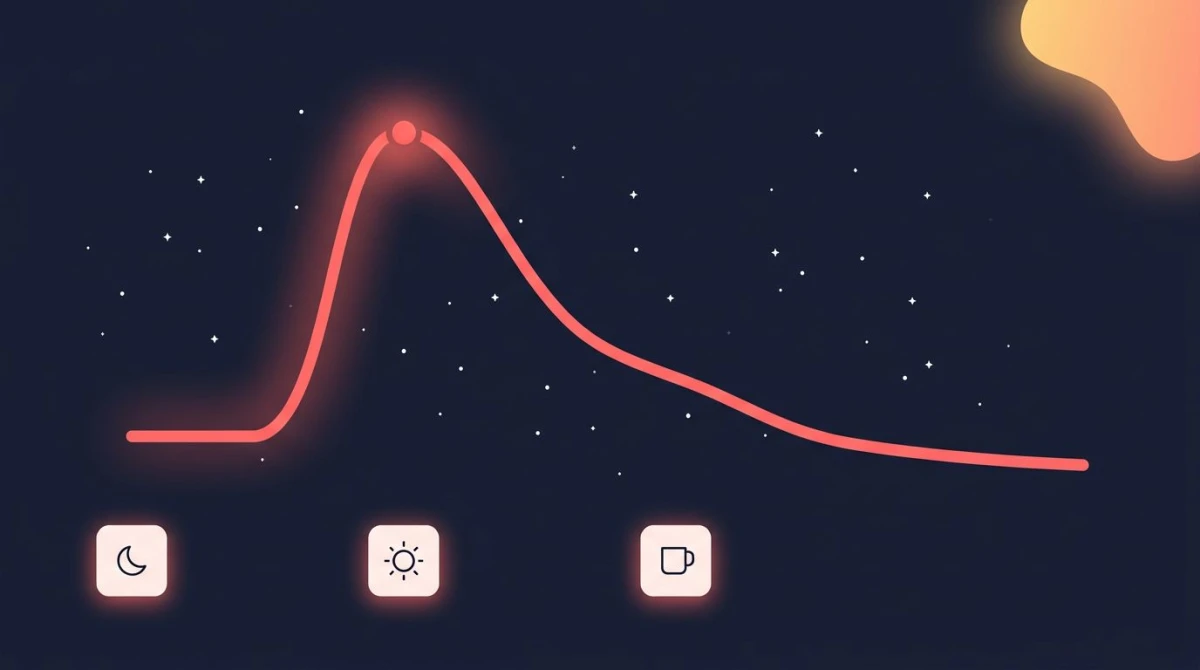
The cortisol awakening response — that sharp peak in the first 30 to 45 minutes after you open your eyes — is the window your routine is competing with. A short, anchored sequence rides the curve. A reactive scrolling-first morning gets eaten by it.
10 habits for a morning routine for women
Here are ten habits, sorted by the time they cost. Pick from the top of this list when you have a hard morning. Build down it as your routine matures.
| # | Habit | Time | Why it earns its slot |
|---|---|---|---|
| 1 | Glass of water on waking | 1 min | Counters overnight dehydration; anchors the rest of the stack (Cleveland Clinic) |
| 2 | Open the blinds (5 min of morning light) | 5 min | Anchors circadian rhythm, supports sleep–mood loop |
| 3 | Box breathing or 4-7-8 (2 min) | 2 min | Triggers parasympathetic response (Harvard Health on breath control) |
| 4 | One-line journal: "Today I will…" | 1 min | Shifts attention from threat to action |
| 5 | 5-minute mobility flow (cat-cow, hip openers) | 5 min | Decompresses spine after sleep; signals "I have a body" |
| 6 | Protein-forward breakfast | 5 min prep | Stabilizes morning blood sugar and satiety |
| 7 | 10-minute walk (outdoors if possible) | 10 min | Stacks light + movement; doubles as commute on some days |
| 8 | Skin and sunscreen (basic, not 12-step) | 3 min | A daily anti-aging baseline that fits a routine |
| 9 | 5 minutes of mindfulness or meditation | 5 min | Reduces anxious rumination (Hofmann et al., 2010 meta-analysis) |
| 10 | Phone stays face-down for the first 20 min | 0 min | The single highest-leverage habit on this list |

A few notes.
The phone habit is free, costs zero minutes, and protects every other habit from being eaten by a doomscroll. If you adopt only one item, this is it.
The breakfast slot is intentionally vague — Greek yogurt, eggs, or a smoothie all qualify. The Office on Women's Health keeps the recommendation general because consistency at breakfast beats any specific food.
A 10-minute walk is the closest thing to a free lunch here. Cleveland Clinic's review of walking covers cardiovascular, mood, and metabolic effects from a habit you can stack onto a commute or coffee run.
How to build the habit so it actually sticks
Picking habits is the easy part. Getting them to run on autopilot is the work. Three rules do most of the heavy lifting.
1. Anchor every habit to a cue you already hit. Not the alarm — the alarm is fragile, you can dismiss it. Anchor to brushing your teeth, the coffee maker, the moment you sit down on the bed. The format is "after [anchor], I will [habit]." This is the core of habit stacking and the most replicated finding in behavior design.
2. Stay below your time budget on your worst day. Design the routine for a Tuesday in February when you slept badly. If the routine fits that morning, it fits every morning.
3. Track it so you can see the chain. The streak effect — wanting to keep the chain alive — is the best-documented motivator in habit formation. A check mark on a calendar, a tap in an app, even a sticker on the fridge. The medium does not matter; visibility does. A simple habit-tracking system makes the difference between "I am trying" and "I have done this 12 mornings in a row."
Four routines by life stage
These are not "intensity levels" — they are different routines for different physiological windows. Run the one that matches where your body is right now. The five anchor habits (water, light, breath, intent, phone-down) stay constant across all four; what changes is what you stack on top.
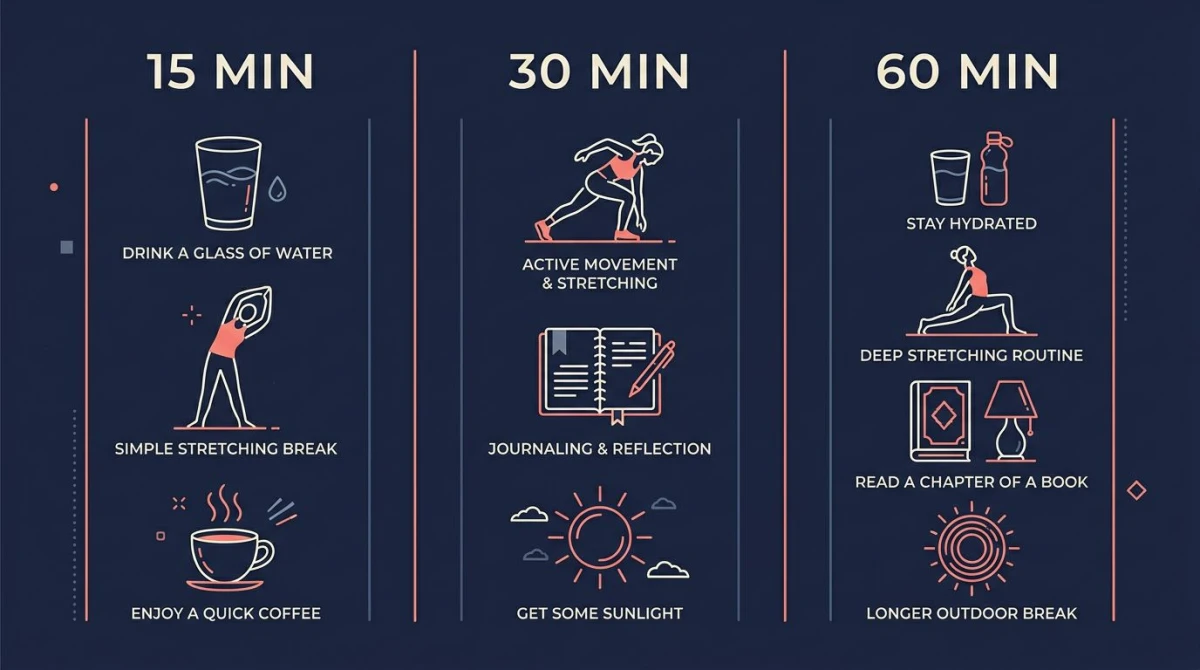
Follicular phase (roughly days 1 to 14)
The window from the start of your period through ovulation is the highest-leverage one to push your routine. Estrogen climbs, sleep quality improves, body temperature is lower, and most women report better cognitive bandwidth and exercise tolerance (Lebrun et al., 2003, athletic performance across the cycle; Knowles et al., 2023 review).
The routine: water → 5–10 minutes of outdoor light → 5-minute mobility flow → 10-minute walk or workout → breakfast → one-line intent → phone last. Roughly 30 to 45 minutes. This is the phase to install new habits — they're more likely to stick when energy is on your side.
Luteal phase (roughly days 15 to 28)
After ovulation, progesterone rises, basal body temperature goes up by about 0.3 to 0.5 °C, and sleep becomes lighter and more fragmented (Baker & Driver, 2007 on sleep and the menstrual cycle). The last 5 to 7 days of this phase — the premenstrual window — are when most women's morning energy collapses.
The routine: water → light → 4-7-8 breath (2 min) → one-line intent → phone last. About 10 to 15 minutes. Skip the workout if it's a heavy PMS day; protect sleep over morning ritual. This isn't slacking — it's design. The point is keeping the streak alive on a hard hormonal week, not maxing out a stack you'll abandon by Wednesday.
Postpartum (first 6 to 12 months)
Sleep deprivation is the dominant variable. Newborn-night cortisol, breastfeeding hormone shifts, and recovery from labor all eat into the morning routine you had before. The NIH on postpartum sleep is unambiguous: getting enough sleep, even in fragments, beats any specific morning practice during this window.
The routine: water → 5 minutes of light (window-side if going outside isn't realistic) → one slow breath cycle → phone-down whenever you can. Five minutes total. The goal is recovery, not ritual. Any "lost" minute of sleep traded for a longer routine is a worse exchange than it sounds. Treat six weeks to six months of the lean version as a win, and let the routine rebuild on its own timeline.
Perimenopause (typically 40s to early 50s)
Estrogen variability drives the signature symptoms: hot flashes, fragmented sleep, mood and cognitive shifts. NIH on menopause and sleep lists sleep disruption as one of the most common and persistent complaints. The morning routine becomes a sleep-recovery tool, not a productivity tool.
The routine: cold water on waking (helps reset core body temperature after night sweats) → 10 minutes of bright outdoor light to anchor the circadian rhythm → 4-7-8 breath → one-line intent → phone last. Roughly 20 minutes. The light step is the highest-leverage one — morning bright light is one of the best-evidenced non-hormonal tools for resetting disrupted sleep (Harvard Health on light and circadian rhythm).
High-caregiving-load days (across all stages)
Some days the kids are sick. Some days you're a primary caregiver to a parent or partner. Some days everyone gets up at 5 a.m. and you don't.
For those days, drop to three habits, five minutes total: water, 60 seconds of light by the nearest window, and one slow breath. That's it. Mark it as a kept day. The chain matters more than the volume. A 5-minute kept day prevents the missed-twice rule from kicking in and keeps the rest of the week recoverable.
A 7-day starter plan you can track
Week one is for installation, not perfection. The point is to anchor the cues, not to score points. Track each habit as a simple yes/no per day.
| Day | Add or check |
|---|---|
| Mon | Pre-pour water tonight. Tomorrow: water + light + phone-down. |
| Tue | Same three. Add 4-7-8 breathing if it fits. |
| Wed | Skip a step if you need to. Note which one. |
| Thu | Add the one-line intent. Same anchor. |
| Fri | Run the full lean stack. |
| Sat | Run a slower version of the same stack — same order. |
| Sun | Review: which step is sticky, which is friction, what to swap. |
By Sunday you will know which two habits run on autopilot and which need a different anchor. Adjust before week two. Most women find the stack feels meaningfully easier by the end of week three.
A tracker that shows the chain across a month — HabitBox, Streaks, or paper — makes the streak visible in a way a sticky note cannot. The streak is what carries you through the morning you do not feel like it.
If you would rather watch someone walk through a real, sustainable version of this than read another template, this 10-minute breakdown is a clean drop-in for week one — the "lazy girls" framing matches the anti-perfectionism design we have been making the case for:
When the routine breaks: the missed-day rule
Every morning routine collapses occasionally. The collapse is not the problem; the response is.
Never miss twice. Miss a Tuesday — fine. Miss Tuesday and Wednesday — you are starting to lose the habit. The most useful rule from James Clear and BJ Fogg is to never let a missed day become two. A tracker matters here: an unmarked day is invisible without one.
Cut, don't quit. On a hard morning, run the smallest version of the routine. One sip of water. One breath. One sentence. The point is keeping the chain alive, not hitting the full stack.
Treat hormonal weeks as terrain, not failure. The luteal phase and the deep tired days of perimenopause are simply harder mornings. Drop to the lean version on those days and resume the balanced routine when energy comes back. This is not slacking — it is design.
Postpartum, pregnancy, and acute illness reset the clock. The goal in those windows is sleep recovery, not a 60-minute ritual. Six weeks of the lean version is a win.
Common pitfalls — and how to avoid them
A few patterns sink most morning routines. Each has a cheap fix.
The phone-first morning. You reach for your phone, and the next hour is gone. Fix: phone in another room overnight, or face-down with notifications off until 8 a.m.
The aspirational hour-long routine. A 60-minute routine designed for a 30-minute morning fails by Wednesday. Fix: design for your worst morning, not your best.
Caffeine before water. Coffee is fine. But starting with caffeine instead of water leaves you drier and jitterier. Fix: water first, then coffee.
Trying to install five habits at once. Lally's data is unambiguous: people who add one habit at a time outperform people who add five. Fix: start with two anchors. Add the third only when the first two are automatic.
Comparing your routine to Mel Robbins. Her routine took her years and runs on a different life. Fix: copy the principles, not the time stamps.
How tracking changes the math
Visibility is the unsung hero of habit formation. A routine you "kind of remember" doing drifts faster than one you check off.
A simple tracker does three things: makes the streak visible (which taps loss aversion), surfaces patterns you cannot feel in the moment (oh, I miss most Mondays), and gives you a private win on the days you wonder whether any of this is working. For several morning habits at once, a dedicated tracker like HabitBox keeps them in one place — calendar heatmap, streak count per habit, no account required. Paper works too; the tracker is not the habit, the visibility is.

FAQ
Should my morning routine change with my menstrual cycle?
What's a realistic morning routine during postpartum?
How does perimenopause change a morning routine?
Do I need to wake up at 5 a.m. for a morning routine to work?
How long does it take for a morning routine to become automatic?
What if I'm not sure which life-stage routine fits me?

Mira Hartwell
Editor, HabitBoxEditor at HabitBox. Writes about habit science and productivity, grounding every post in named research (Lally, Wood, Walker, Huberman) instead of recycled advice. Read full bio →