New Year's Resolution Statistics (2026): Success Rates
How many New Year's resolutions actually survive? These New Year's resolution statistics come from named, primary sources — peer-reviewed studies, national polls, and platform data. We checked every number against the source in July 2026. The short version: about 3 in 10 Americans set one, most fade by spring, and the famous "only 8% succeed" stat doesn't hold up.
Key New Year's resolution statistics
- 31% of Americans planned to make a resolution or set a goal for 2026 (YouGov, December 2025 poll of 1,104 adults).
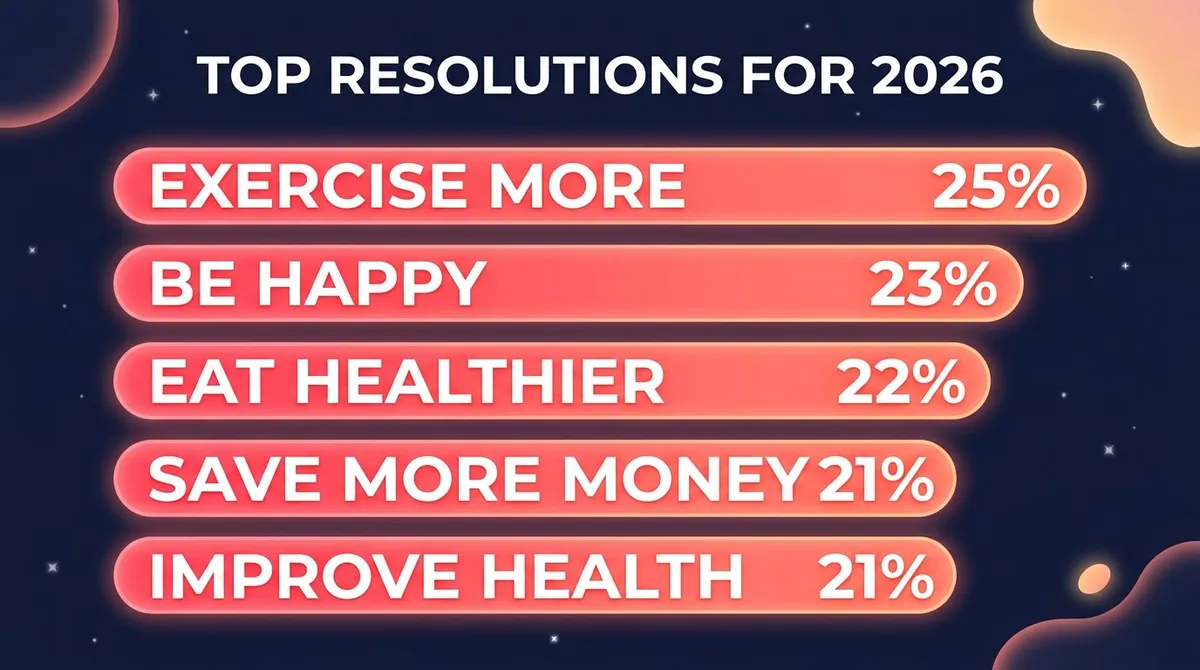
- "Exercise more" is the #1 resolution for 2026, chosen by 25% of Americans (YouGov).
- 79% of resolvers say their resolutions concern health, exercise, or diet (Pew Research Center, January 2024).
- 77% of resolvers keep their resolution for one week — but only 19% are still on track after two years (Norcross & Vangarelli, Journal of Substance Abuse).
- 46% of resolvers are continuously successful at six months, versus 4% of people with the same goals who didn't make a resolution (Norcross, Mrykalo & Blagys, Journal of Clinical Psychology).
- 23% quit by the end of the first week, and 43% quit by the end of January (Fisher College of Business, Ohio State University).
- "Quitter's Day" falls on the second Tuesday of January (Strava via TechRadar) — Strava coined the term after analyzing 822 million logged activities (endurance.biz).
- The average resolution lasts just 3.74 months (Forbes Health/OnePoll survey of 1,000 U.S. adults).
- Gym visits rise 11.6% at the start of a new year, and Google searches for "diet" spike 82.1% (Dai, Milkman & Riis, Management Science).
- New habits take a median of 66 days to become automatic — not 21 — with a range of 18 to 254 days (Lally et al., European Journal of Social Psychology).
Below, every statistic in context — plus the one famous number we left out on purpose.
How many people make New Year's resolutions?
Roughly three in ten American adults. Pew Research Center surveyed 5,140 adults in January 2024 and found 30% had made at least one. YouGov puts it at 31% heading into 2026 — flat versus its 2025 poll.
Age is the biggest divider. In Pew's data, 49% of adults aged 18 to 29 made at least one pledge — by far the largest share of any age group. YouGov found the same pattern for 2026: adults under 45 were twice as likely as older adults to plan one (43% vs. 21%).
There's also a pressure factor. In the Forbes Health/OnePoll survey, 62% of people said they felt pushed to set a New Year's resolution at all.
Resolution success rates over time
The most-cited data on how long resolutions last comes from psychologist John Norcross at the University of Scranton. He tracked real resolvers for weeks, months, and years. Here's the verified timeline, from his two landmark studies plus the best modern data:
| Checkpoint | Still on track | Source |
|---|---|---|
| 1 week | 77% | Norcross & Vangarelli, 1989 (200 resolvers tracked for 2 years) |
| End of January | ~57% (43% have quit) | Fisher College of Business, Ohio State |
| ~3.74 months | Average resolution lifespan | Forbes Health/OnePoll, 2023 survey of 1,000 U.S. adults |
| 6 months | 46% | Norcross, Mrykalo & Blagys, 2002 (159 resolvers vs. 123 nonresolvers) |
| 1 year | 12–55% depending on study | Wiseman, 2007; Oscarsson et al., 2020 |
| 2 years | 19% | Norcross & Vangarelli, 1989 |
That one-year range needs a word of caution: the two studies measured different things. Richard Wiseman of the University of Hertfordshire tracked over 3,000 people through 2007. In January, 52% were sure they'd succeed. A year later, only 12% had reached their goal. A 2020 study in PLOS ONE by Oscarsson and colleagues followed 1,066 Swedish resolvers. It found 55% rated themselves as on track after one year — a self-rating, and many got goal-setting support. For most people, the truth sits between those numbers.
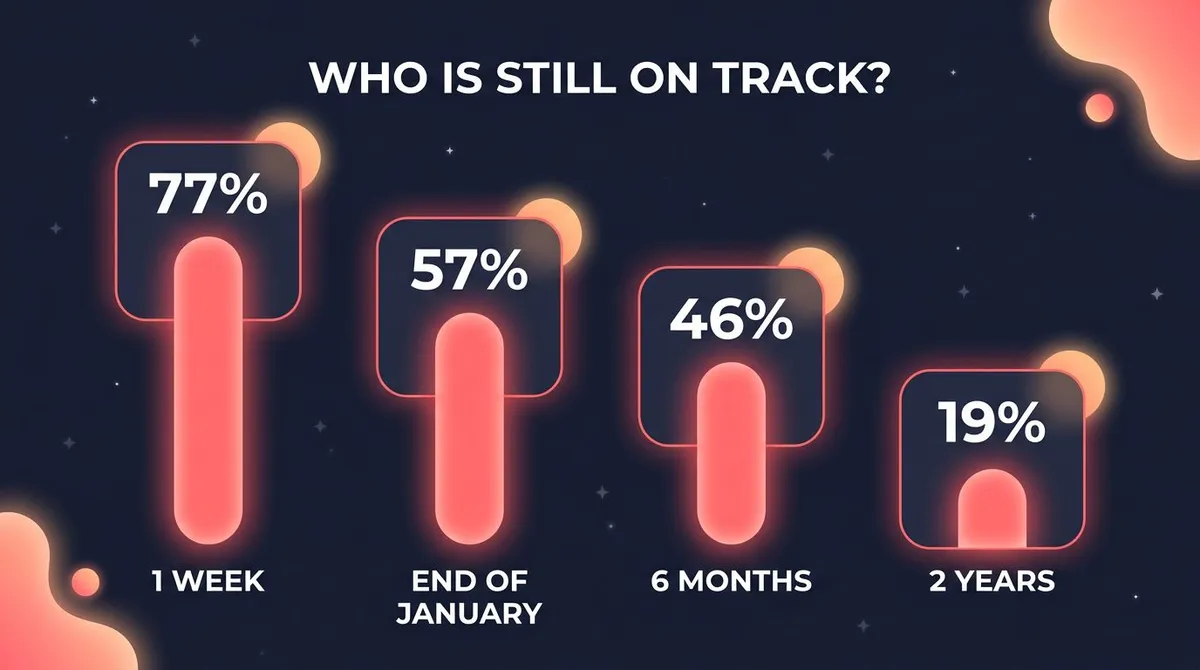
The best news hides in the six-month row. In the 2002 study, people who made a pledge were compared with people who held the same goals but hadn't turned them into one. At six months, 46% of resolvers were still going, versus 4% of the others. Norcross's own summary: you're about 10 times more likely to change by making a New Year's resolution than by wanting the same change without one.
Is it true that only 8% of resolutions succeed?
Probably not — and we couldn't verify it, so we're not using it. The "8% success rate" you'll see across the internet is usually pinned on "University of Scranton research in the Journal of Clinical Psychology." But the number doesn't appear in Norcross's peer-reviewed papers. The trail typically leads back to a now-dead stats aggregator that named the school without citing a traceable study. The verified Scranton figures are the ones above: 46% still going at six months, 19% at two years. The closest real cousin to the 8% claim is Wiseman's 12% one-year rate — grim, but half again higher than the meme. If you're writing about resolutions, cite those instead.
When do people quit? Quitter's Day and the February drop-off
The quitting starts fast. Per Ohio State's Fisher College of Business, 23% of people quit their resolution by the end of the first week. By the end of January, 43% are done. And only 9% of Americans who set one feel they see it through.

Fitness platform Strava gave this cliff a name: Quitter's Day. After crunching the 822 million workouts its users logged in 2019, Strava predicted January 19, 2020 as the day people were most likely to give up on their New Year's fitness goals. Strava now pegs it to the second Tuesday of January each year — for 2025, that was January 14. The company says it has been the most common break point for its users for more than five years.
The pattern shows up in survey data too. In the Forbes Health/OnePoll survey, just 8% of people said their pledge lasts only one month — but 22% said two months, 22% said three, and 13% said four. Hence the sobering average lifespan of 3.74 months. Most resolutions don't die on January 12. They fade quietly in February and March, one skipped day at a time.
The most popular New Year's resolutions
Health goals dominate everywhere researchers look. Here are Americans' top resolutions for 2026, from YouGov's December 2025 poll of 1,104 adults:
| Resolution for 2026 | Share of Americans |
|---|---|
| Exercise more | 25% |
| Be happy | 23% |
| Eat healthier | 22% |
| Save more money | 21% |
| Improve physical health | 21% |
| Lose weight | 17% |
| Improve mental health | 16% |
| Learn something new | 15% |
Other datasets paint the same picture. Pew found that 79% of resolvers set goals about health, exercise, or diet. In the Forbes Health/OnePoll survey, 48% named fitness a top goal, ahead of money (38%), mental health (36%), weight loss (34%), and diet (32%). Even in Sweden, Oscarsson's study found physical health (33%), weight loss (20%), and eating habits (13%) topping the list. If you're still deciding which of these areas to focus on, our free vision board maker sparks ideas by life theme and turns your picks into a printable board.
Why New Year's resolutions fail
The numbers above aren't a verdict on your willpower — they point to a design problem. Behavior science flags a few repeat offenders.
The goal is vague. "Get fit" gives your brain nothing to act on come a random Tuesday. Clear, measurable goals beat fuzzy ones — Wiseman's experiment found men were 22% more likely to succeed when they set concrete sub-goals (a pound a week, not "lose weight"). Our guide to setting goals that stick covers the research-backed framework.
There's no if-then plan. A resolution says what; it rarely says when or where. Deciding "when X happens, I'll do Y" in advance — an implementation intention — sharply boosts follow-through, because you stop arguing with yourself in the moment.
The goal is framed as avoidance. In the PLOS ONE study, people chasing approach goals ("start running") succeeded 58.9% of the time, versus 47.1% for avoidance goals ("stop eating sugar"). An 11.8-point gap from wording alone.
The timeline is wrong. People expect a new habit in 21 days. The real figure, from Lally's University College London study, is a median of 66 days — with a range of 18 to 254. Quitter's Day lands around day 10. Most people quit before the habit had a chance to form.
One miss becomes all-or-nothing. Lally's data showed that missing a single day made little difference to eventual habit formation. But resolvers treat the first miss as proof of failure and drop the whole project — the February fade in one sentence.
How to actually keep a New Year's resolution
The same research that documents the failure rates also points to what works.
Use fresh starts — all of them. The fresh start effect, from Dai, Milkman, and Riis, shows goal-driven behavior spikes after time landmarks: gym visits rise 33.4% at the start of a new week, 14.4% at a new month, and 11.6% at a new year. January 1 isn't magic — it's one of dozens of mental reset points every year. Miss January? Monday works too.
Make one clear, approach-framed goal. Wiseman's top advice: make only one resolution, and define success in concrete terms. If you want a shortcut, our free SMART goals generator turns a vague wish into a clear, measurable plan in about a minute.
Anchor it to something you already do. New habits stick faster when tied to a routine you already have — after coffee, before your commute. That's habit stacking, and the habit stacking builder helps you find the right anchor in your current day.
Plan for 66 days, and track them. Expecting autopilot in three weeks sets you up for the February fade. Most people find that a visible streak carries them through the boring middle. It's why a simple tracker like HabitBox works: one tap per day, and the chain becomes the reason to keep going. And since resolvers are 10 times more likely to change than non-resolvers, the resolution isn't the problem. The system around it is.
Methodology and how to cite this page
The statistics on this page were compiled and verified in July 2026 directly from the named primary sources. Those are: peer-reviewed studies (Journal of Substance Abuse; Journal of Clinical Psychology; Management Science; European Journal of Social Psychology; PLOS ONE), national surveys (Pew Research Center; YouGov; Forbes Health/OnePoll), university publications (Fisher College of Business at Ohio State; University of Hertfordshire), and platform data reported by Strava. Every outbound link points to the original source. We left out the widely shared "8% success rate" figure because it could not be traced to a study that exists.
You're welcome to cite or quote any statistic on this page. Please credit the researcher or survey named next to the number, and link to this page as: HabitBox, "New Year's Resolution Statistics (2026)." If you spot a newer primary source we should include, let us know at hello@habitbox.app.
New Year's resolution statistics FAQ
What percentage of New Year's resolutions fail?
It depends on the horizon. Verified research shows 23% of resolvers quit within the first week and 43% by the end of January (Fisher College of Business, Ohio State). At six months, 46% are still going (Norcross et al., 2002). By two years, only 19% remain on track (Norcross & Vangarelli, 1989).
What is Quitter's Day?
Quitter's Day is the second Tuesday of January — the day people are most likely to give up on their New Year's resolutions. Fitness platform Strava coined the term after analyzing hundreds of millions of user-logged workouts, and it now recurs each year — Strava placed it on January 14 in 2025.
How many people make New Year's resolutions?
About three in ten American adults. Pew Research Center found 30% made at least one resolution for 2024, and YouGov found 31% planned one for 2026. Younger adults lead: 49% of 18-to-29-year-olds made one in Pew's survey.
What is the most common New Year's resolution?
Exercising more, chosen by 25% of Americans for 2026 (YouGov). Health goals dominate overall — Pew found 79% of resolvers say their resolutions concern health, exercise, or diet, and Forbes Health/OnePoll found 48% of people named fitness a top priority.
Do New Year's resolutions actually work?
Better than not making one. In a controlled comparison, 46% of resolvers were still on track at six months versus 4% of non-resolvers with the same goals — roughly a 10x difference (Norcross, Mrykalo & Blagys, 2002). The catch: success depends on clear goals, realistic timelines, and tracking, not willpower.

Mira Hartwell
Editor, HabitBoxEditor at HabitBox. Writes about habit science and productivity, grounding every post in named research (Lally, Wood, Walker, Huberman) instead of recycled advice. Read full bio →